“Keep Your Hand On That Plough, Hold On”

Science has no answers for Multiple Systems Atrophy. Some day it will, but until then, I lean heavily on the humanities for sustenance.

Ian McEwan is on my Mount Rushmore of writers. Presently, I’m reading his most recent novel, What We Can Know. The main character is a former academic caring for her husband who is suffering from Alzheimers. I marvel at McEwan’s ability to evoke that world. A hyper creative, all-world imagination that deeply moves me.

Then, a week ago, I stumbled upon a Robert Plant/Saving Grace Tiny Desk concert. Plant’s voice, at 77, is more bluesy and folksy than rock and roll. Major props to him for continuing to create. And for moving me. Deeply.

Lynn’s hearing is about the only thing M.S.A. has spared. So I shared this song with her. All I know to say to her now is, “Keep your hand on that plough, hold on.”

Matthew, Mark, Luke, and John, all them prophets dead and gone
Keep your hand on that plough, hold on
Never been to Heaven, but I’ve been told the streets up there are lined with gold
Keep your hand on that plough, hold on

Hold on, hold on
Keep your hand on that plough and hold on

Mary wore three links of chain, every link was Jesus’ name
Keep your hand on that plough and hold on
The only chains that we should stand are the chains of hand in hand
Keep your hand on that plough and hold on

Hold on, hold on
Keep your hand on that plough, hold on
Hold on, hold on
Keep your hand on that plough and hold on

Hold on, hold on
Hold on, hold on
Hold on, hold on
Keep your hand on that plough, hold on

Paragraph to Ponder

Via LOliver by way of JByrnes:

“There is so much to tend to, hold, be with, feel. May you find so much gentleness for your own process. May you let your humanity unfurl, over and over again. May the grief and hurt wrapped up in facing the world be held by your own willingness to look. May love soften the hard edges. May light soothe the dark places. May you return to your own heart’s knowing and trust what it whispers to you. May you let yourself do all of this so imperfectly, that imperfection a reminder that you are a human being, figuring it all out for the first time. I’m with you.”

Early evenings, like a lot of the time that I care for Lynn, I’m on the move. Making dinner, getting her fed, eating myself, doing dishes, cleaning the counters, taking out the trash, vacuuming the hardwood floor.

Activity blunts the grief. But I pressed pause Monday evening and it rushed in.

I stopped cleaning to dance. In the reflection of the oven, I saw the real dancer watching me. When I try dancing, she just smiles.

And now, the dancer pushes her wheelchair away from the table so that she can move toward the pretend dancer.

“You want to dance, don’t you?” Bigger smile. I expedite things by wheeling her into the kitchen. Where I help her up and embrace her. We slow dance like first-time junior highers slowly swaying back and forth.

But dammit, it’s The National singing “I Need My Girl”.

The refrain rips through. “I need my girl. I need my girl. I need my girl.”

My girl has no clue I’m crying.

May love soften the hard edges. May light soothe the dark places.

‘You Are Not Alone’

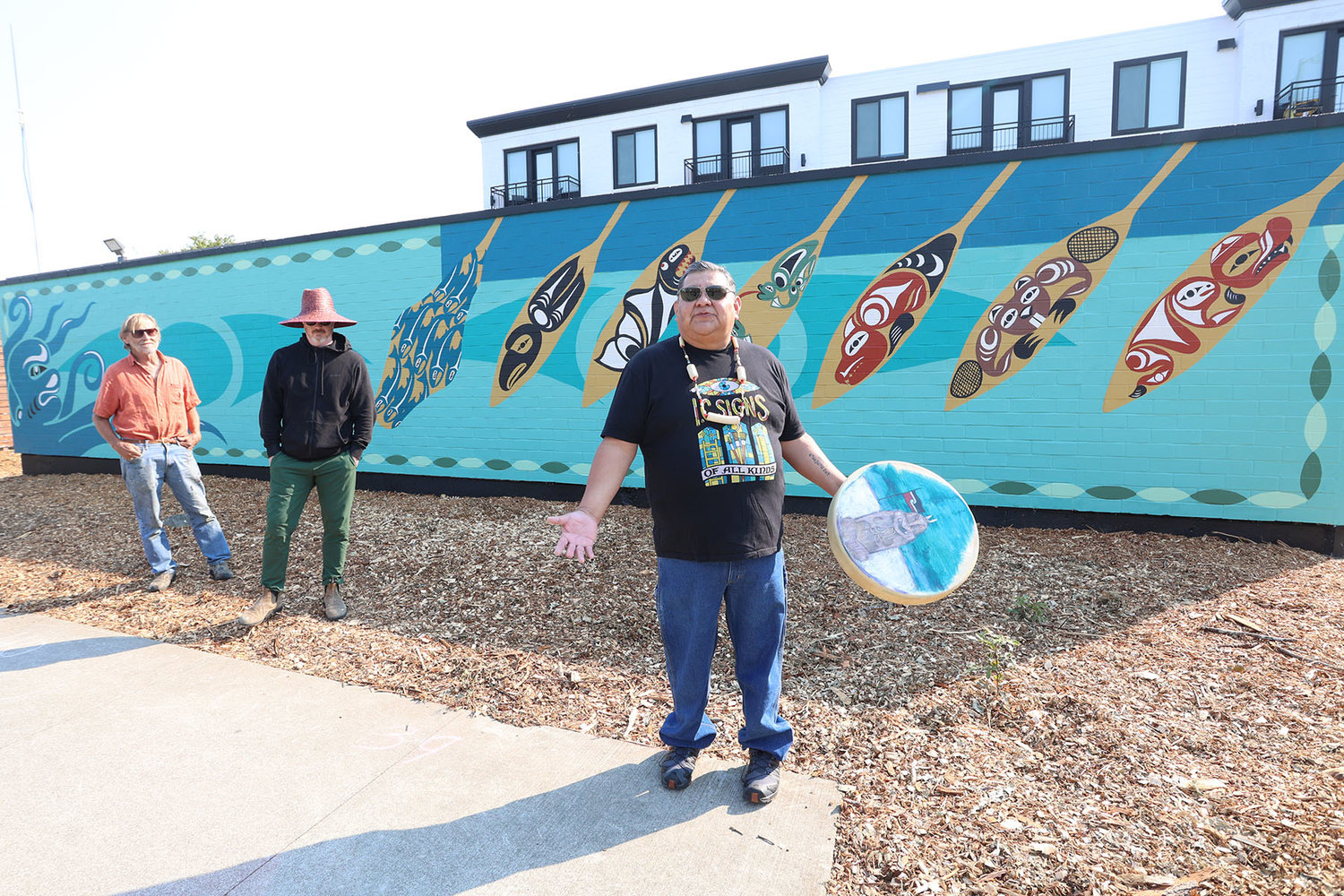
Check out our YMCA’s “You Are Not Alone” mural. Because I’m so outgoing, I chatted up the artist while she was outlining it. Turns out, there’s a movement of “You Are Not Alone” artists who want to use wall murals to instill hope and connection while fostering more discussion of mental health.

I suspect their murals are more likely to accomplish the later than the former. I’m just not clear on how the murals might spark social connection which social science increasingly suggests is as close as there is to a loneliness panacea.

Do not mistake my lack of clarity, or even skepticism, as criticism. These are kind and caring people with the best of intentions.

Don’t Just Follow The Money

Saturday night the Gal Pal and I (and Kris and Brian) went to a concert at Traditions Cafe in downtown Olympia. When we go out, we go all out, which means some grub beforehand. Traditions concert tickets are $15. I counted about 40 peeps tucked into the small cafe. So I started to do the math because I’m always doing the math, can’t help it. Actually, MaggieZ does math, I do arithmetic. $600 divided between three musicians minus one-third to the cafe (guessing) equals $400 divided between three or $133/per. Don’t forget to factor in a few CD sales, but still less than $200/per.

And yet, all three musicians, Larry in particular, performed like it was a stadium concert with 40,000 people. His technical prowess as a guitar player and singer was impressive, but not nearly as much as the profound joy he had for sharing his gifts. The intrinsic genesis of his art was a beautiful, downright spiritual thing to observe.

And it got me thinking about whether I’d share my teaching gifts with the same committed passion if I only had a few students. And how I like to be well compensated for my time. And how I want to be more like Larry when I grow up.

Fast forward a few days to a story our local on-line paper ran on a local citizen who is doing a mindfulness workshop for local educators. Interested in mindfulness, I snooped around her website only to find a “shopping” section with bullshit mindfulness products. And her teacher workshop costs twenty Tradition’s concert tickets. I don’t begrudge her the right to run a profitable business or her desire to build wealth as a young person. Also, people pay decent money for yoga classes, but the overt commercialism and explicit selling of mindfulness, not only makes me want to run the other way, but likely turns off others who could benefit greatly from it.

Granted, it’s easier to take my advice to be like Larry and not just follow the money all the time, when you have some money. But whether you do or don’t have money, nonstop selling becomes habitual, meaning the extrinsic overwhelms the intrinsic until one’s work contributes very little to the greater good.

I’ve referenced two PressingPausers—Kris and MaggieZ—whose loyalty to the humble blog I greatly appreciate, but I’m thinking about a third who shall remain nameless because that’s the way he’d want it. Check out this other article from our same local on-line paper, “Puget Sound Honor Flight Recognizes Veterans One Flight At A Time”. When I first saw it, I immediately skimmed it for my friend’s name, but somehow he didn’t make it into the article. The fact that no one is watching him get up at 4 a.m. to drive to Sea-Tac Airport monthly, or watching him sometimes accompany local veterans on the actual flights, or watching him attend board meetings, makes all those activities much more meaningful.

Larry didn’t need much if any money. All he needed was a small group of people to share with. Same with our esteemed, third PressingPauser. All he needs is an appreciative veteran or two to share with.


My Turn to Crime

It’s not my fault. I’ve fallen in with some bad dudes. It started a few years ago when The Sopranos drew me in. Then The Wire. Then Breaking Bad. Now The House of Cards. I should be eligible for a mail order degree in Abnormal Psychology.

What is it about Tony Soprano, Avon Barksdale, Walt, and F.U. that makes it so hard to look away as they leave ruined lives and dead bodies in their wake?

My theory rests on the assumption that I’m a part of the 99% that has a social conscience, but sometimes still wrestles with doing the right thing. At 2a.m., with the streets deserted, we still wait for the red light to turn, but not before imagining going. We get frustrated with people all the time, even irate at times, but we successfully suppress our violent tendencies. We get used to the tension between our better and worse-r selves. And fortunately for society, our better selves almost always win out.

Tony, Avon, Walt, and Frank are the 1% that effortlessly give in to their worse-r selves. Their lives are not complicated by other people’s feelings. Once off the rails, they have zero regrets. On second thought, scratch Tony from that foursome, his earnest therapy sessions with Melfi disqualify him from the truly pathological.

In large part, I think I find these dramas so compelling because I can’t fathom what it would be like to live completely unencumbered by doing the right thing. To not give a single thought to authority, social convention, and the social contract we enter into as drivers while running the light. To not care whether someone lives or not.

There’s another important variable in the equation. For me the gruesome violence is usually just palatable enough because I know they’re fictional dramas. After watching The Wire, I can reason, “That teen drug runner didn’t really die at the hands of the other teen drug runner, because they’re acting.” LIke when watching a play or reading a novel, it helps to know it’s imaginary. In Breaking Bad the innocent kid on the bike in the New Mexico dessert didn’t really die. He’s probably a popular eighth grader somewhere in SoCal.

Could the time I’ve spent with the Mount Rushmore of television criminals have a deleterious effect on my normal, law-abiding self? That’s doubtful because the Good Wife makes me take a powerful antidote to these intense crime dramas every Sunday night. Downton Abbey.

Postscript—Watch this 60 Minutes segment (13:40) on Wolfgang Beltracchi (13:40). Beltracchi, as evidenced by the final exchange which begins at 13:28, has Mount Rushmore criminal potential.