How To Write

Guest post of sorts. That will appeal primarily to the small subset of PressingPausers who fancy themselves cycling nerds. Ben Farver is the Founder of Argonaut Cycles, a custom/boutique/ultra bougie bicycle manufacturer based in Bend, OR.

As concise and clear a design philosophy as you’re ever going to read. Ben in Bend for the win.

The Wrong Problem

The industry has been racing toward aerodynamics and stiffness for a decade. Neither one is the most important thing about a bicycle.

Ben Farver, Founder of Argonaut Cycles

Every major bike brand is in a race right now to make the most aerodynamic frame on the market.

I think they’re optimizing for the wrong thing.

That’s not a contrarian position for its own sake. Aerodynamics matter. Weight matters. The gains are real. But the conversation the industry is having about what makes a bicycle better has narrowed to a point where it’s almost entirely about numbers that most riders will never meaningfully feel.

And in that narrowing, the thing that actually determines whether a ride is transcendent or just fast has gotten lost.

Aerodynamic gains only matter if you’re racing. Ride quality matters on every single ride.

Here’s how the industry argument goes. Make the frame slipperier, reduce rolling resistance, optimize the tire interface. Get the rider from point A to point B faster with less effort. That’s the whole conversation.

And I understand it. Going fast on a road bike is one of the closest feelings we get to flying. Thirty miles an hour, two and a half feet above the ground. Faster is better. I’m not arguing otherwise.

But those aerodynamic gains only pay real dividends at the elite level. They matter in a race, where the difference between first and fourth is measured in seconds. They matter when you’re in a peloton, and drafting dynamics actually change what a more slippery frame is worth.

For everyone else, the gains are marginal at best. And most riders aren’t racing. Most riders are out for three hours on a Saturday morning, trying to find what makes cycling worth doing.

That thing has a name. I call it dynamic response.

It’s the feeling of the frame working with you, rather than just under you. The load-and-release quality that makes pedaling feel effortless when it should and explosive when you want it to. The vertical compliance absorbs the road without throwing you off your line. The torsional integrity that holds the bike dead stable at fifty miles an hour on a descent.

These aren’t vague experiential claims. They’re engineering outcomes. Specific, measurable, designable. They just require a different set of questions than the industry currently asks.

The bikes that win the aerodynamic argument all ride the same. That’s not a coincidence. It’s the cost of optimizing for one variable.

The irony is that I’m not ignoring the aerodynamic conversation. The RM4 is in development and will be more aerodynamically efficient than the RM3. Slipperier. Faster. That matters.

But the design intention isn’t to make it faster at the cost of everything else. It’s to make riding faster and more satisfying. To push both ends of the spectrum at the same time.

That’s the argument we get to have that nobody else does. Because we’re not starting from the aerodynamic frame and trying to add ride quality back in. We’re starting from ride quality and building outward.

Most of the industry has it backwards.

The RM3 is like the classic Porsche 911. The RM4 will be the one sitting next to it in the garage that makes you realize how much further the idea could go. The difference is that both are built around how they feel to drive. Not just how quickly they get around a track.

There’s a reason people who get on our bikes for the first time tell me they’re stiffer than the bikes they came from. I know for a fact they’re usually not. The frame they got on isn’t as stiff as their previous bike by any objective measure.

But it has better power transfer. It has that load-and-release quality that people associate with stiffness because it’s the closest sensation they have a word for. What they’re actually feeling is the frame doing its job well.

That’s the problem worth solving.

Not how quickly the frame moves through the air. But how well it moves with the person on it.

The industry will keep improving aerodynamics. Tubes will get more optimized. Drag coefficients will keep dropping. And those bikes will keep winning races.

What they won’t do is give you the feeling that made you fall in love with riding in the first place.

That one is ours to build.

Maybe a better title for this post would’ve been, “How To Think”. And hell yes I want one.
With Apologies To My Sissy

Who often reminds me, as only a loving big sissy can, “It’s not all about you, Ron.” But this post might be. 😜

A subset of humble blog readers, who also happen to be personal friends, have reached out to see how I’m doing post bike accident. Which I’ve greatly appreciated. Here’s more than they, and you, prob wanna know. If my sissy has read this far, she’s rolling her eyes.

Five of us were enjoying a truly beautiful spring day, sunny, 50’s, meaning built-in air conditioning. In a pace-line, we were two hours into a two hour and twenty minute ride, baring down on Tumwater High School at 20-22mph thanks to a slight tailwind.

I was fifth of five. The lead rider, who has been relegated to Witness Protection, did not point out a small, but deep divot in the road. Remember sports fans, whenever you’re on the front, your main responsibility is to the be the eyes for the whole train. Rider number four hit the devilish divit head on, and as a result, slowed quite a bit. I was sitting my customary three feet behind him and didn’t have enough time to avoid riding into his back wheel. At the last fraction of a second, I turned my wheel to avoid his, but all that did was create an angle that launched me dead left into and across the center of the road. Picture a rock skimming across a glassy pond.

My skimming across the pavement happened right in front of a kind and caring woman on the way to work. Had she left for work 20-30 seconds earlier she very well could’ve ran over me. She checked on me and called it in while my friends looped back to provide additional/wonderful support. Soon, a bevy of young male firefighters began asking me questions and poking and prodding me. If I was gay, I would’ve immediately started feeling better. They asked me who the President was, and I said, “Oh man, I feel badly enough already.”

My friends studied my helmet and saw that there were no scratches and so everyone knew my compromised cognition was just my normal state of being. While I was sliding across the road, I was sure I’d broken my collar bone or hip or both. When I came to a stop and was able to sit up and eventually get to the side of the road, I was pleasantly surprised to discover that apart from road rash on my right shoulder, elbow, and knee, all the damage was confined to my right rib cage. Which hurt like a motherfecker.

The fire boys recommended I go to the hospital for a more thorough eval, but they have to say that, right? One also stated with a wink what all my cycling friends and I already know from experience, there’s absolutely nothing they can do for broken ribs.

Meanwhile my friends were putting my chain back on and checking out CanRon, the name of my newish whip, which remarkably, was almost entirely unscathed, maybe because it first bounced off me instead of the road.

Then, I somehow rode it home chapperoned by the team until we got to Deschutes Falls Park and then BC rode with me all the way into the garage atop the Fifth Street Bridge. There’s only two explanations for how I made it home under my own power. Stupidity and adrenaline.

The first night was scary. I had help at dinner, but afterwards, when alone, I was unable to move. I could hear my ribs rattling when breathing, which was even painful. My doc cycling friend who fancies himself a comedian, advised, “Just don’t move or breath.” Eventually, I tried to get into bed, but ended up half on the edge of the mattress and half off. Then, I couldn’t get off the edge of the bed. There may have been a lot of moaning and even tears. Masculinity is overrated.

Eventually, I had a good idea, which like the aurora borealis, happens on occasion. The recliner for the win. Somehow, I slept as well in it as in bed. And that continues to be the case.

I read it takes twelve weeks to recover, but my doc cycling comedian friend texted this yesterday, “You can do activities as tolerated. It should start getting better about 2 weeks after the injury. It will be mostly gone by 6 to 8 weeks.”

The good news is I am way, way better already, six days in. Yesterday, I walked 1.25 miles to the gym, cycled for 30 minutes, and walked home. Just don’t ask me what kind of watts I was pushing. It’s amazing to be able to go from sitting to standing without feeling like someone is jamming a huge butcher knife right into my side. Now, it’s more of a butter knife.

So, my goal is to be back running, cycling, and lastly swimming, closer to six weeks than eight. I mean I need to be ready for the start of the Tour de France in early July. And time is wasting.

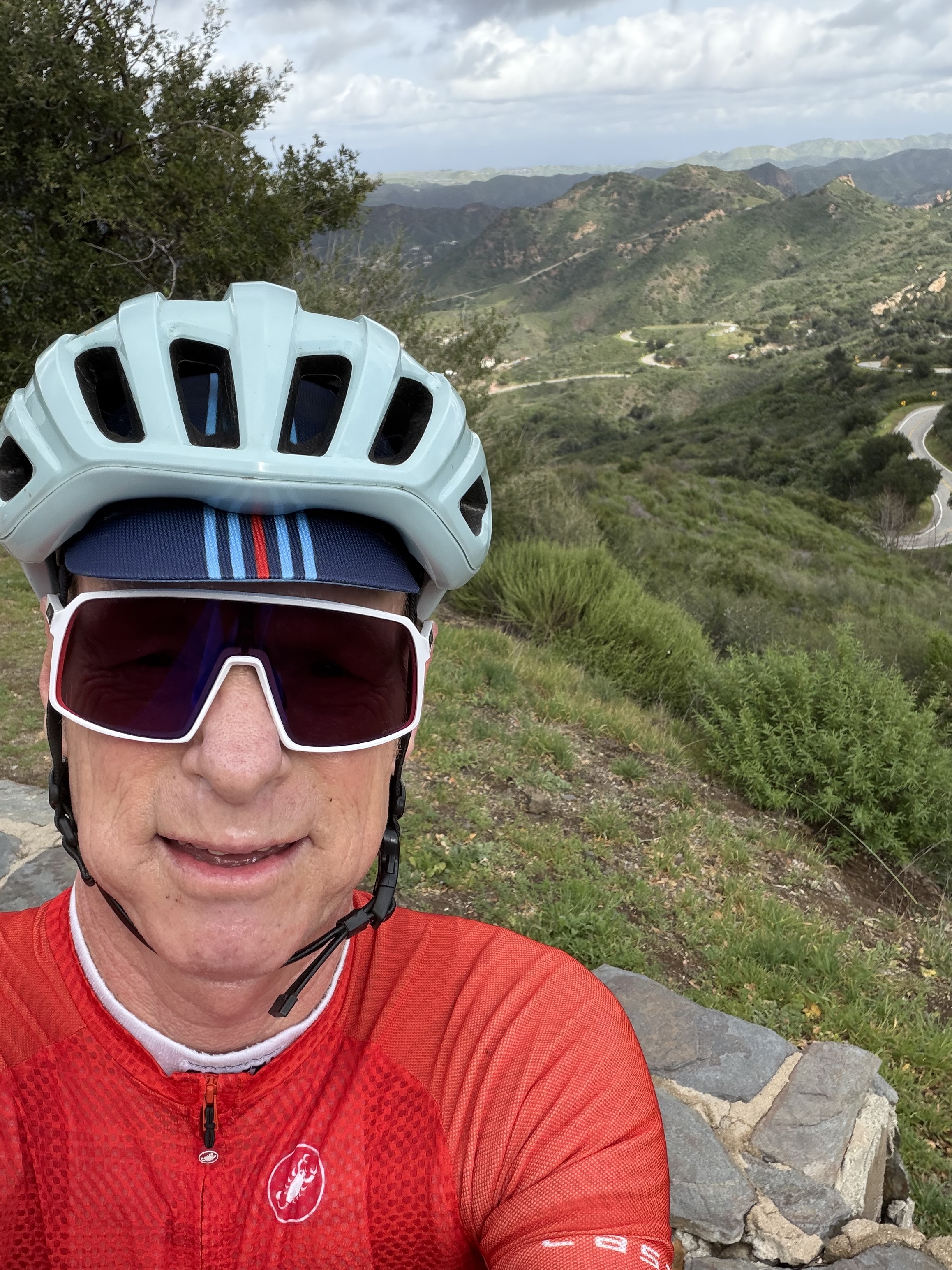
Unlike me, the white Oakley frames did not survive the crash. And for the unusually observant, energy gel in cheek, not chewing tabacco.