I Did It

Somehow.

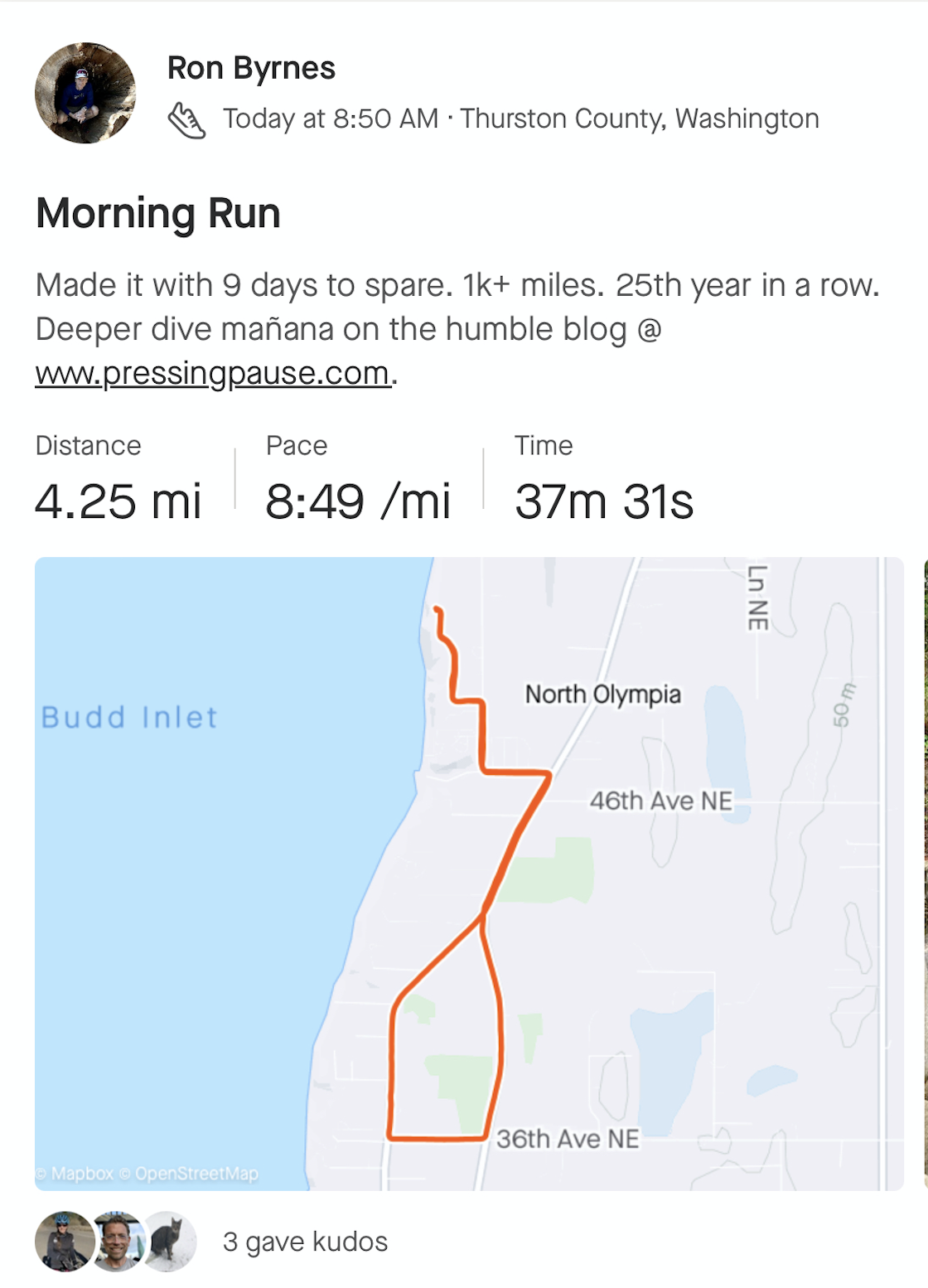
As a result of running 4.2 miles yesterday morn, I maintained my now twenty-five year long streak of running at least 1,000 miles a year. On Gull Harbor Road, at mile 999, I thought to myself, what if that oncoming car just drifts over the fog line and takes me out? Of course, I still have the lateral movement of an elite punt returner.

For the record, the streak continued at the intersection of 47th Ave NE and Boston Harbor Rd as I turned the corner with TSwift, Bon Iver, and Evermore.

This one was was tough, especially after dealing with blood clots in early August and then chronic achilles tendonitis which I haven’t managed smartly.

Bagging a thousand used to be easy, especially when doing half marathons, marathons, and/or triathlons. Hitting four digits was just a routine annual byproduct of being ready to race decently. Now that I’ve retired from competition, the lengthy streak itself is the only motivation. And being fit and enjoying life more as a result of improved physical, mental, and spiritual vitality.

On top of the running, I’ve swam just over 200 kilometers and rode just over 5,000 miles this year, so a decent bit of cross training.

I enjoy swimming and cycling a little more than running these days because they’re less difficult. To continue the streak, I have to sublimate my ego, and let go of pace. I suppose, as I run shorter and slower, I will contribute to the common good that is Strava endurance athletes who can feel better about their relative performance.

I don’t know how long I can or want to keep it going. The key to extending it will be doing a better job of listening to my body in terms of how often, how far, and how “fast” to run. More specifically, I suspect I will need to run shorter, even slower, and more often to extend it.

Thanks to my ace training partners for their continued inspiration and company most Saturdays. MARN, who decided to take up marathoning in his sixth decade. The Byeson, who is a marvel at 5+ years older than me. The Pal, who is somehow getting faster in his fifth decade. And the undefeated University of Washington Husky who effortlessly rows, cycles, and runs right past you.

Thanks especially to the GoodWife for stirring my inner-athlete the most this year. Despite serious health challenges, she is channelling her father’s spirit and is displaying real grit, regularly walking, swimming, and cycling. Watching her pick her way up, down, and around Natches Peak trail in early October was inspiring beyond words.

If I stay healthy and can be half as tough as her next year, the streak will continue.
‘Rona Silver Lining

Americans exercised more in 2020, according to data tracking service, Strava.

“In addition to jumps in running and cycling activity in the U.S., Strava also saw booms in walking, hiking, indoor cross-training activities such as yoga and weight lifting, and water sports like kayaking and stand-up paddleboarding.

‘There was just so much uncertainty surrounding COVID […] it was great to see people deal with that by finding some sort of certainty and an everyday routine,’ Megan Roche, an ultra-runner and epidemiologist, told ESPN.

Women drove the increase in fitness — both in the U.S. and all over the world. Between April and September, women aged 18-29 saw a 45.2% increase in the median number of activities uploaded compared to a 27.3% increase by their male counterparts, the Strava data shows. Women were also biking more, logging a 72% increase in bike trips compared to 2019.”

Case in point, none other than one of my twenty-something daughters. Summer spent lake swimming. Migrated to the pool in the fall. Cycled with friends in the summer. All the while, she turned into a certifiable WALKING machine. 120 miles in November.

I Could Use a Sports Psychologist

It’s been a long time since I’ve written about my athletic self.

2019 has been all about good health and consistent training. Last Friday I ran my 1,000th mile of the calendar year, thus extending my 21 year streak of 1,000 miles+ running annually. As you age and it becomes impossible to set personal speed records, you have to find other ways to motivate yourself. My secret power is not having played contact sports growing up. My knees are golden thanks to golf and water polo. Being slender no doubt helps too.

I’ve swam farther this year than any other because I joined a Masters Team and went from swimming twice a week to three times. Despite that increase in volume, my splits aren’t much better because swimming is an incredibly technical activity and I haven’t improved my technique.

I hope to hit 5,000 miles of cycling by 12/31/19, which thanks to the sabbatical, is about 10% more than normal. A lot of the peeps I cycle with double that.

I ran a very good marathon a few years ago in Seattle. For me. Even somehow won my age group. I’ve ran a few halves since, including one in July, which also went well despite skimping on long training runs.

But despite the good health and all the cross-training, I haven’t competed in a triathlon for 5+ years, which I guess means I’m retired from the sport. I’m even trying to sell my beater triathlon bike.

I often think about returning to competition and this is where I need a sports psychologist. Friends still enjoy it and I know I could be very competitive in large, difficult races, not because I’m a burner, but because I’m slowing down less than my peers because I was never supe-fast to begin with and I have a very deep cardiovascular base from years of consistent cross-training. Also, while I’m not a burner in any of the disciplines, I don’t suck at any of them either. In contrast, almost every triathlete has a weakness*.

For some reason though, I just can’t bring myself to purchase a new bike, register for races, and show up on starting lines. Here’s how I imagine a counseling session with a pricey sports psychologist going down.

SP: So you’re thinking of returning to triathlon. What’s keeping you from committing?

RB: Aren’t we gonna talk about my childhood?

SP: No, frankly that would bore me.

RB: Well, for one thing I’m usually shelled at the end of training rides and I really don’t want to run off the bike anymore.

SP: Have you always been a wuss or is that a recent development?

RB: I think it’s rooted in my childhood.

SP: Never mind then.

SP: What else is holding you back?

RB: To tell you the truth, when I imagine best case scenarios, winning races, it doesn’t do anything for me. I think what if I swim, cycle, and run faster than a declining number of other economically privileged old dudes. And I conclude, so what.

SP: Often, as in life, in athletic competition the joy is in the journey.

RB: Did you learn a lot of cliches during grad school?

SP: Yes, lots of others I’d happily share if we weren’t out of time. Thank you for coming.

* truth be told, my weakness was the fourth discipline, transitions

bike.jpg

How to Age

Emily Oster’s findings in the fitness essay I included in the previous post rest on the following premise—people exercise to lengthen their lives. I run, swim, and cycle quite a bit further and faster than the research says I should because I enjoy pushing myself. And as far as I know the research doesn’t answer this question: Are the costs of more extreme fitness habits lessened when one increases the volume and intensity of their activities over many years? My gut tells me yes. My gut also tells me cross training lessens the costs.

But I’m okay being wrong because I don’t care if I live to 100. The more familiar I get with the 80’s and 90’s, the more inclined I am to trade quality of life for quantity. Which leads to how to age.

There are two approaches, but I don’t know which is better. The first is to remind oneself on a daily basis that you’ll never be younger than you are at this very instance. Meaning carpe diem. Live with urgency. Do the iron-distance triathlon now because it’s going to be even harder in a few years. Travel the world now because it’s going to be harder in a few years. Hike the Wonderland Trail or the Camino de Santiago before hiking to the mailbox is all you can manage.

The alternative is to accept the inevitability of physical decline and embrace life’s limits. Reject “Bucket List” mania. Live more simply. Slow down, travel less, invest more in friendships. Find joy in daily routines. Watch nature. Enjoy coffee, food, and drink. Go gently into the future.

Two paths in the woods diverge. Which to take?