“Having fewer close friends is associated with loneliness, and loneliness is linked to a variety pack of negative health outcomes, from high blood pressure to depression to cognitive decline. Compared to women who lose their husbands, men who lose their spouses experience a much more pronounced and long-lasting spike in loneliness and depression; they’re more likely than women to die by suicide. Researchers attribute these differences to women having more diverse systems of social support.”
“Simckes said they can’t specify exactly what is causing this improvement in youth mental health across the state, but pointed out that social support is improving in the home and at school. Nearly 60% of youth said that they felt they had an adult to turn to when feeling depressed.
‘We don’t know what comes first – are they feeling supported because their mental health is better?’ asked Simckes. ‘Or is their mental health better because they’re feeling supported?'”
And importantly:
Shulman said that although mental health for LGBTQ+ students is improving, this group remains highest for depressive feelings and contemplation of suicide due to the current national political climate.
‘More than 500 legislative bills were introduced last year and the year before in state legislatures around the country, aiming to diminish freedom for LGBTQ people, and especially LGBTQ youth, and the youth are aware of this,’ Shulman said. ‘So at the same time, they’re having more parental support, more stability, more safety in the schools … At the same time, they’re also in the center of a political maelstrom that is not of their own making over which they have little control, but that affects their future.'”
Said one technology analyst this week on the heels of artificial intelligence chip maker Nvidia’s red hot quarterly results. Meaning just like when the internet caught fire in 1995, Nvidia is igniting a whole new technology whose trajectory requires educated guesses.
Let’s press pause and ponder whether we’re better off now than in the early 90s. Inevitably my privilege contributes to my belief that we are a lot better off. Partially because of convenience. Specifically, we take for granted the time we save on almost a daily basis from internet-based personal tech. Case in point. A friend recently posted a picture of himself on Facebook at the Westminster, CA Department of Motor Vehicles where I got my license 46 years ago and I thought, “Why the heck did he go in person?” because I can’t remember the last time I went to the DMV.*
Granted, not a substantive example of human progress, but I suspect it is the cumulative effect of relatively simple and smallish such examples that translate into an improved quality of life.
More meaningfully, here’s a far-out social media adventure I went on last week after an extended family member posted this gem to the ‘Byrnes Family’ group text.
That’s my oldest bro teaching me the sweet science in Muhammad Ali’s hometown. As I looked at it, my attention drifted to the background and my best friend’s house. Jimmy D and I were in separable from ages 3-9. Heartbroken over the end of our friendship, when we moved from Louisville to Ohio I sobbed in the back seat halfway there.
Where the heck is Jimmy fifty-five years later I wondered? A quick google search turned up his dad’s obituary from 2020 including his and his sister’s places of residence. A few seconds later, I was on Jim’s Instagram page looking at his island home just off the Maryland shore that he and his husband were selling.** Then I watched a video from inside his home art studio where he talked about his process. Another quick search turned up his new location. After scouring his instagram and admiring his big white fluffy dogs, I visited his sister’s Facebook page and saw a picture of Jim and his elderly mom. And then back to the obituary and some remembrances including an amazing picture of a very young Jimmy with his parents and sisters on the back brick patio of his Cardiff Rd home. . . the one in the picture.
A miracle of modernity.
I listen a lot to people on the forefront of large language models and my take-away from their predictions is that this technology will greatly accelerate economic productivity and further save people time to pursue more non-work interests and activities.
Not all boats will rise to the same degree, because they never have, but artificial intelligence will in all likelihood induce a much higher tide. White collar people in particular will work less while enjoying simple and smallish and quite possibly complex and more substantive improvements to their quality of life.
BUT will any of us be happier? One way to get at that is to reflect on whether we’re happier now than in the early 90s. Despite internet-fueled economic growth, there’s lots of evidence that we are not. In fact, some would argue that a large part of the internet’s legacy, especially among the young, is steadily worsening mental health. And a coarsening of civic life.
Another way to approach the question of whether we’ll be happier in a post AI world is to consider whether it will foster stronger interpersonal connections. Will it, I wonder, enable us to enjoy the company of more close friends? I also wonder whether it will enable us to slow if not reverse the environmental degradation that threatens our well-being. And will we, I wonder, experience more art that moves us more often, and in the end, makes us feel more alive. Alive in ways that renewing car tabs on-line and skimming friends’ Instagram pages never will.
In the same space of time, 29 years from now, in 2053, I suspect we won’t be much if any happier than we are right now. I would like to be wrong and still around so that you can recall this post and roast me for not being nearly optimistic enough.
*needed to do an eye test to renew his license
**someone in my fam asked if I knew Jimmy was gay, “LOL,” I said. “We were six, I don’t think I knew what ‘gay’ was.”
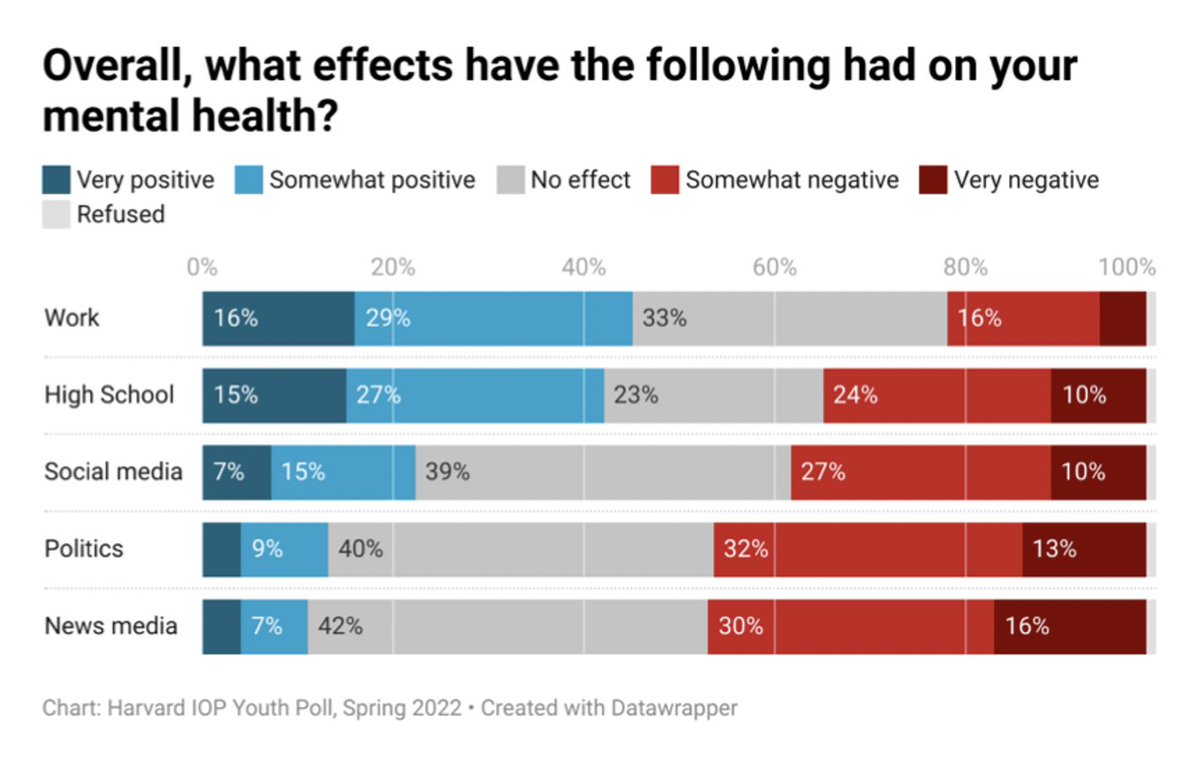
Harvard’s Institute of Politics words. A cornucopia of data including this graphic. My admittedly simplistic take-away. Spend way less time on-line and more at a job that requires your full attention.
Washington joins 11 other states that specifically allow students to take excused mental health days off. From Crosscut:
“Schools can now accept mental health symptoms in the definition of an excused absence, just as they do physical health symptoms. It formalizes allowing students to take days off to care for their mental health, including for counseling and behavioral health appointments.
The law does not allow students to excuse themselves, and each district will come up with its own requirements — for example, if a parent or doctor note will be needed to determine whether an absence is excused.”
One principal acknowledged,
“. . . it’s a change that’s been needed. ‘If a kid breaks their leg, we wouldn’t expect them to take part in PE. But I don’t think there’s an equivalent for a student with debilitating depression.'”
The new rule also enables schools to collect information on its overall mental health, which can inform how they might respond in other ways.
I’m not sure much more information is needed to conclude families, teachers, and administrators are woefully unprepared to adequately help students’ with their mental health challenges.
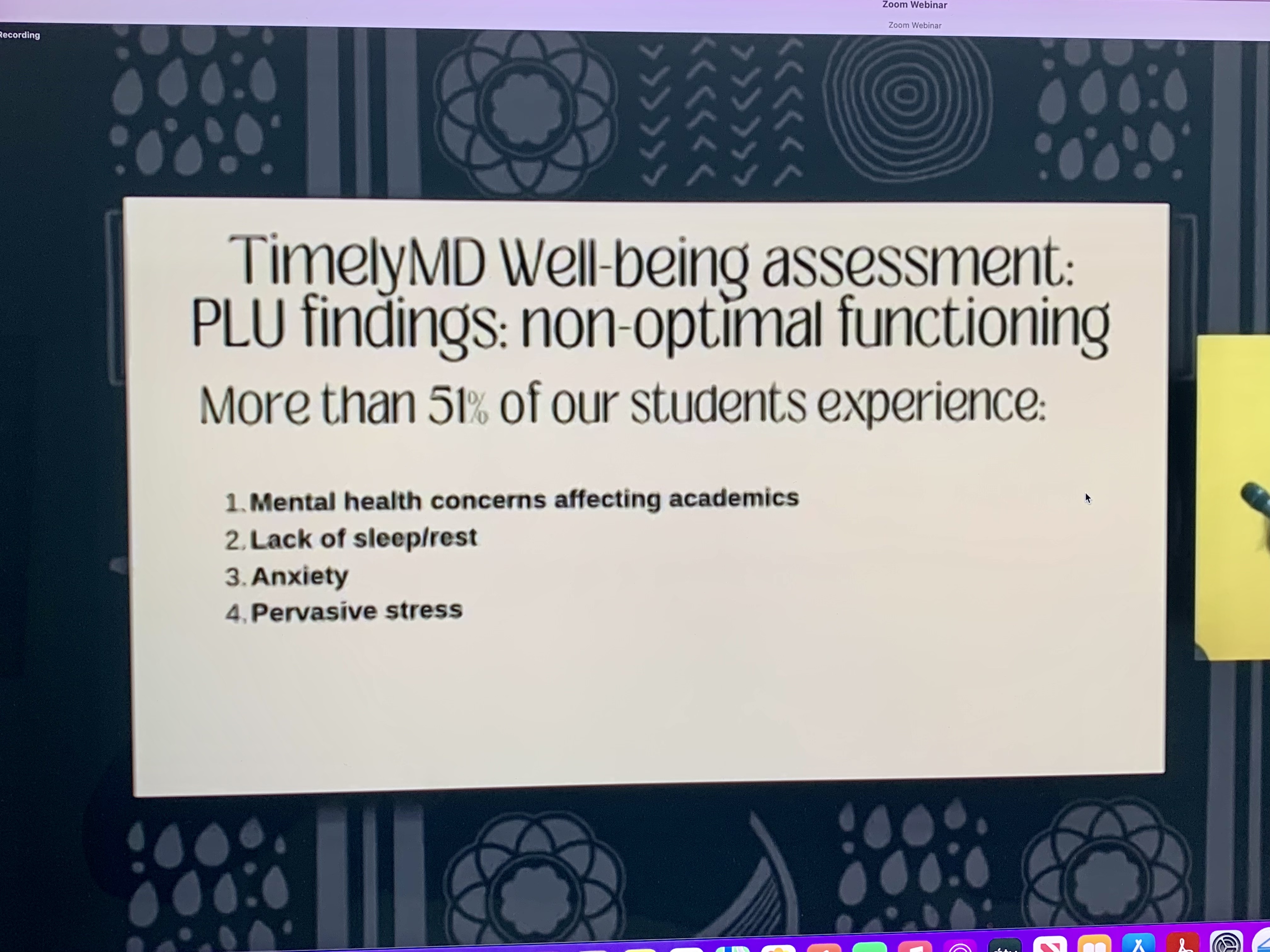
This was a slide from a “Student Mental Health” presentation yesterday.
In light of these findings I’m thinking of reinstituting one of my fave parts of kindergarten—nap time. Sleep pads will not be provided, bring your own. Class is one hour and forty-five minutes long. How much time should I designate for napping?
Also, I am going to begin class by announcing that everyone is going to get an “A”.
Here’s hoping these adaptations and being my normal chill self promote improved student mental health.
In one part, Derek Thompson discusses his “displacement” theory of childhood. Meaning as children and adolescents have spent more and more time on smart phones and other screens, there have been direct and indirect costs to their well-being. One indirect cost has been the “displacement” of play meaning much less outdoor activity with others. In the podcasters’ views, it’s difficult to underestimate the negative consequences of reduced play.
Then, in the afternoon, at mile 34 of my bike ride, I was rolling through the blueberry farms on Gull Harbor Rd. And right before hitting Boston Harbor Rd, there she was.
A 6-7 year old blonde girl who single-handedly is bucking the alone, indoor, screen life. I’ve seen her before in her backyard from Boston Harbor Rd. Her family’s compound is a chaotic mess of animals, hard panned dirt, junk including an abandoned bus, and more animals. Barefoot and dirty, if you only saw her in her backyard, you’d think it was Appalachia.
Yesterday, she was sitting on her driveway where it meets Gull Harbor Rd. Still barefoot, next to a chicken and a “Chicken Crossing” sign, she was sawing a piece of wood with a saw three-quarters her size.
The only thing that would’ve been better is if she was risking injury with a friend or two. I’m sure she has friends, but they were probably indoors on screens.
“Osaka, 23, . . . revealed that she has experienced depression and anxiety since winning her first major at the 2018 US Open and explained that speaking to the media often makes her nervous. She apologized to any media members she had impacted with her decision.
‘I am not a natural public speaker and get huge waves of anxiety before I speak to the world’s media. I get really nervous and find it stressful to always try and engage and give [the media] the best answers I can.'”
This is bigger than the French Open. Osaka is emblematic of a generation that struggles with anxiety disorders and mental health more generally. The question is how are employers going to adapt to their young, often anxious employees? The best course of action will hinge on the type of work. But it starts, in each case, with heightened sensitivity to the issue.
In Osaka’s case, tennis needs her WAY more than she needs tennis. In 2020, she earned $50 million from tournaments and endorsements*. Osaka preferring Instagram to post-match pressers makes perfect sense because she can control the message and her social anxiety. It was painful watching her squirm under intense questioning about a poor performance in a previous tournament. Professional tennis “powers that be” should start thinking about how athletes can leverage their social media to increase their and their sport’s popularity. The post match presser is analog, social media is digital. Osaka isn’t saying she doesn’t want to interact with fans, she’s saying she just doesn’t want to do it live right after matches.
When professional tennis comes to ask me what they should do, I will be brief. Always accommodate.
*I suspect Osaka’s mental health challenges and transparency about them make her an even more popular endorser of products. I also suspect she’d forego many millions for peace of mind.



 Pressing Pause