A Brief History of Fat
Reply

Living in the Upper Lefthand Corner of the United States requires a tradeoff that is difficult at times. You must endure dampness and darkness for eight months of the year in exchange for four months of supernatural light and unparalleled beauty. Right now we’re in the sweet spot of the four months meaning there’s no other place on the planet I’d rather be.
During this morning’s run in Priest Point Park I was intermittently blanketed by the sun’s brilliant radiance as I moved steadily through the forest. Shirtless and sweaty at 7a, I was profoundly appreciative of July. More so than I ever would be if it wasn’t for the damp and dark runs during the eight contrasting months. The contrast is key.
Mid-day, on Mount Rainier with family, the sun ricocheted off the snow surrounding Snow Lake.
Tonight, transfixed by the fading sun on the western horizon, I will sit on the deck eating popcorn and drinking a recovery beer with family. Sunset is at 9:08p.m., but it won’t get dark until 9:45-10p.m. Must store as much Vitamin D as possible.
As a visitor you probably wouldn’t get it, you’d probably say, “Yeah sure, the weather, the trees, the water, they’re all nice, but really, no need to get all worked up about it.” To which I’d say, “I’m selling it short. I can’t do justice to the blessed light that gives me an unspeakable joy and sustains me through the dark.” At which point you’d just slowly back away not knowing what to make of me. Which I would understand and not hold against you. At all.


Addendum: For those keeping score at home, the “find the spelling errors in the initial draft” scorecard currently reads, Cal Lutheran 1, St. Olaf 1, Carleton 0.
Or so says LetsRun.com. I’d revise that to read “Wise Advice for Anyone Trying to Find Their Way in Life”.
Beautiful, powerful essay by Lauren Fleshman, a recently retired professional runner to her high school self. The gist of it, short-term success is a trap, form healthful habits, and decide for yourself what’s most important in life.
Sadly, this month’s most important celebration is crowded out by holiday stalwarts like Cinco De Mayo, Mother’s Day, and Memorial Day; not to mention, lower profile ones like May Day and Teacher Appreciation Week (8th-12th).
Are you ready for World Naked Gardening Day this Sunday? “It’s not about exposing your body to other people,” the founder explains. “It’s about body acceptance and being one with nature on your own.”
With apologies to Elaine, I’m in. Skin cancer be damned.
Early in my dad’s business career he sold appliances for General Electric. Every year we got one new one, including allegedly, the first trash compactor in the country. And for some reason only my mom could probably explain, every last appliance was avocado green. Turns out those early avocado green kitchens did a number on my subconscious because recently I’ve turned into an avocado eating machine, putting them on damn near everything, as if I’m making up for lost time.
So I got a kick out of this, “Your New Avocado: An FAQ“.
Below is a picture of today’s breakfast bowl of oatmeal which lies buried underneath the red and late 1960’s kitchen appliance green fruit goodness. Some mornings I borrow from professional cycling chefs and sub in two fried eggs. And always, I top everything off with a little butter and a lot of Kirkland Saigon Cinnamon (Costco doesn’t pay me for these egregious product placements, but they should).
Today’s philosophical question. At what point does the balance tip towards the add-ins and I can no longer accurately describe my breakfast as a bowl of oatmeal? That’s what philosophers refer to as a “Seinfeld episode worthy” question.
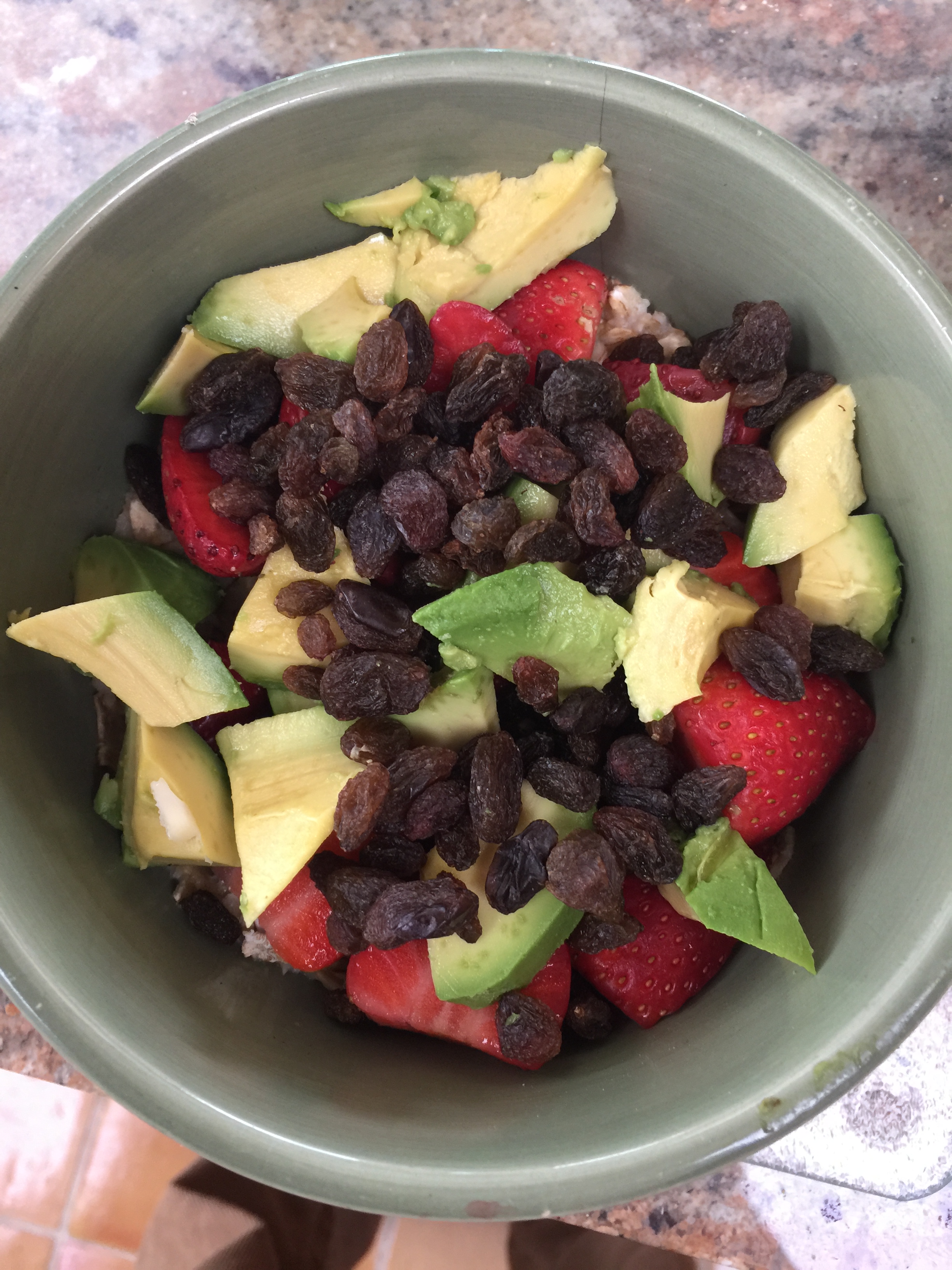
That’s right, even our kitchen bowls are avocado green.
You on it? Ima gonna pass. Why Are So Many People Popping Vitamin D by Gina Kolata.
Related, below is an excerpt from an important new book by Richard Harris whose science reporting you may have heard on National Public Radio, Rigor Mortis: How Sloppy Science Creates Worthless Cures, Crushes Hope, and Wastes Billions.
The Breakdown in Biomedical Research.
Makes one wonder, why do we tend to put scientists and docs on pedestals?
“The new status symbol,” according to a doctor at UC Berkeley, “is the single most effective thing you can do to reset your brain and body.” Can you guess? Need another clue?
“For years, studies upon studies have shown how bad sleep weakens the immune system, impairs learning and memory, contributes to depression and other mood and mental disorders, as well as obesity, diabetes, cancer and an early death.”
The rest of the story is here.
The title of a recent New Yorker essay by Jerome Groopman.
The problem with most diet books, and with popular-science books about diet, is that their impact relies on giving us simple answers, shorn of attendant complexities: it’s all about fat, or carbs, or how many meals you eat (the Warrior diet), or combinations of food groups, or intervalic fasting (the 5:2 diet), or nutritional genomics (sticking to the foods your distant ancestors may have eaten, assuming you even know where your folks were during the Paleolithic era). They hold out the hope that, if you just fix one thing, your whole life will be better.
In laboratories, it’s a different story, and it sometimes seems that the more sophisticated nutritional science becomes the less any single factor predominates, and the less sure we are of anything. Today’s findings regularly overturn yesterday’s promising hypotheses.
On top of that:
. . . research seems to undermine the whole idea of dieting: extreme regimens pose dangers, such as the risk of damaged kidneys from a buildup of excess uric acid during high-protein diets; and population studies have shown that being a tad overweight may actually be fine. Even studying these issues in the first place can be problematic. Although the study of the Mediterranean diet, for example, reflects randomized controlled experiments, most nutritional studies are observational; they rely on so-called food diaries, in which subjects record what they remember about their daily intake. Such diaries are notoriously inexact. No one likes admitting to having indulged in foods that they know—or think they know—are bad for them.
What to do?
Amid the constant back-and-forth of various hypotheses, orthodoxies, and fads, it’s more important to pay attention to the gradual advances, such as our understanding of calories and vitamins or the consensus among studies showing that trans fats exacerbate cardiovascular disease. What this means for most of us is that common sense should prevail. Eat and exercise in moderation; maintain a diet consisting of balanced amounts of protein, fat, and carbohydrates; make sure you get plenty of fruit and vegetables. And enjoy an occasional slice of chocolate cake.
The problem with that, common sense is not common.
Last week, a friend, via Facebook, asked me how I was doing. “Excellent,” I wrote. “My family is healthy and happy.” At this stage in my life, everything beyond my family’s health and happiness is like desert, nice, but unnecessary.
Like individuals, organizations can’t evaluate how they’re doing without first clarifying what’s most important. That’s why so many teachers are frustrated today, schools obsess about students’ test scores instead of whether students are curious, kind, and able to accomplish meaningful things in small groups.
On Sundays, I often wonder how do religious leaders keep score? What’s most important in evaluating how a church, synagogue, or mosque is doing? That the budget is balanced, that attendance is increasing, that a lot of mission work is being done?
Our church is in transition. Sometime in the next four or five months, a new pastor will replace our two departing ones. The reduction is partly due to a 20% decrease in membership and a 13% decrease in giving.
Here’s my imperfect understanding of what’s happened. Four or five years ago we hired two progressive pastors who were left-of-center politically; some key church council leaders were lefties; our synod, the Evangelical Lutheran Church of America decided to ordain gay clergymen and women; our state voted in favor of marriage equality; and we rewrote our “Welcoming Statement” to explicitly reach out to GLBT members of our community.
That pace of change overwhelmed some people. Also, as it turns out, people inside religious organizations have dispiriting personality conflicts just like people on the outside. One of our church members told me the members who won the political debates about gay clergy, marriage equality, and the wording of our Welcoming Statement were not gracious winners.
How do religious bodies negotiate political differences and does that factor into how they are doing? Conventional wisdom is that religious leaders and their congregants should leave politics aside. I disagree. Churches, synagogues, and mosques would be much more vital places if they modeled mutual respect for contrasting political viewpoints. Public dialogue about controversial issues is so anemic right now, lots of people on the outside would take notice.
Granted, that’s easy to assert in the abstract, but when talking about abortion, the death penalty, or even marriage equality, it’s much, much harder to implement. In fact, I wonder, are there examples of political diverse religious communities thoughtfully engaged with contemporary issues? Birds of a political feather prefer to flock together, but is that inevitably true inside churches, synagogues, and mosques as well?
I hope not. And I hope our next pastor considers that challenge among the things that matter most.
“It’s not how many times you get knocked down,” Stuart Smalley, Socrates or some spandex shorts wearing high school football coach once said, “it’s how many you get back up.” I’m not sure who to credit with this well intentioned quote because 2014 has not just knocked me down, it has damn near knocked me out.
To fully appreciate my wretched present, we have to rewind to October when I tore a calf muscle while doing too many hill repeats in prep for the Seattle Half Marathon which I ended up missing. Even writing “half marathon” makes me laugh now. I took four weeks off and then returned slow and easy. On the fourth recovery run the calf again rioted. So now I’m not even half way through an eight week hiatus. The other day I started corralling wayward Christmas tree needles when I had to turn the vacuum off and sit down and rest before continuing. All this, eighteen months removed from long distance triathlon success. We are always the last to know when we’ve peaked.
Add into the mix an enlarged prostate which means sucky sleep, contacts that are shot meaning sucky vision, and an unplanned trip to Dante’s Inferno compliments of an influenza roundhouse that left me too sick at times to watch television. Somewhere along the long downward spiral, I went from thinking “I should probably try to get back up and do Stuart Smalley or Socrates proud,” to “Screw it, I’m just gonna curl up in the fetal position and stay down. If I tuck tight enough it may not matter if 2014 continues kicking me in the gut.”
A part of staying down was going to the dermatologist who always smiles when she sees me. You’re thinking she’s probably turned on by me, but I looked liked I just returned from the lower levels of Hades. She always smiles at me because my tired skin pays for her boat. She has zero interpersonal skills, but she’s damn good with a liquid nitrogen canister. It was as if 2014 asked her to liquid nitrogen me until I begged for mercy. So now, a few days later, red blotches are forming all over my formally handsome self. And I haven’t shaved for ever, I need a hair cut, and if my sinuses weren’t completely blocked I’d probably lay on the floor of the shower for awhile.
Like a paratrooper who perfects her aerodynamic tuck, I thought if I just give in to my cosmic fate, I’ll hit bottom faster and bounce higher when I do. So why not roll the dice with one of the things I most cherish, my marriage.
“You know when I asked if you’d get me some 7-Up or Sprite?” “Yeah.” “Well, the funny thing about that is that’s what my mom always gave me to drink when I was sick as a kid. It’s funny, there’s something about a near-death experience that makes a part of me still want my mom. That’s probably the least masculine thing I’ve ever said, huh?” “A mother’s love is primal.” Say wha?! The first sign yet the calendar may not have it out for me.
And then I visited Australia, well actually an Australian blog after the author visited here. And I read this:
People often ask me what it’s like living with a chronic illness. And by ‘often’, of course I mean never.
So, for the benefit of absolutely no one, allow me to explain. You know that feeling you get when you start to come down with something? Your throat starts to hurt and your glands swell up. Your sinuses block and your nose starts to run. Your head hurts and you can’t think clearly. Your bones ache, your body feels weak and no amount of sleep seems to make a difference.
Well, to the best of my admittedly limited scientific knowledge. . . these are actually the body’s natural defences for fighting off infection. It’s your immune system switching on and kicking in to gear.
And these are the symptoms I’ve had 24/7 for the last seven-and-a-half years. Because, as I’ve explained before, my body has been fighting off an infection it can’t beat and my immune system remains permanently in the ‘on’ position.
The good news is that it means I rarely get whatever bug it is that’s going round. Happy days. The bad news is that I permanently feel like I have the flu. Not so good.
Of course, there are other symptoms, too, like sensitivity to light, noise, cold and heat, significant memory impairment, insomnia, chronic pain and various bodily dysfunctions not appropriate to discuss in this type of public forum. And that’s without the introduction of any number of medical treatments — and believe me, I’ve tried a few — which inevitably make you feel worse than you did to begin with.
So, in short, living with a chronic illness is a real party and that’s your answer.
The first gift of 2014. Perspective.
I am fortunate that the relentless attack on my body is abating and that most of my many ailments are fixable. I will ask the lifeguard to roll my pathetic, coiled bod across the deck and into the pool in a day or two. I will try to ascend the trainer tonight and soft pedal while watching college basketball. The torn fibers in my calf muscle will eventually reattach. I will start running in mid February and should be back to semi-normal in June. Meds make the prostrate manageable. I will make an appointment with the optometrist. My ugly sores will heal. I will shave my face and head. Then I will shower, put on clean clothes, and resume my rightful place among the mostly living. And that is the best I can do.
 Pressing Pause