Paragraphs To Ponder

From YahooFinance.

“Before MacKenzie Scott signed the Giving Pledge and started on her path to give away her $36 billion net worth, she went looking for a paragraph in a book she’d marked up during her college years.

She opened her Giving Pledge letter with a memory of pulling Annie Dillard’s The Writing Life off a shelf of her old college books, where she found a passage that she had ‘underlined and starred.’ Dillard’s advice to writers was to not hoard your best material for some later chapter. 

‘The impulse to save something good for a better place later is the signal to spend it now,’ Dillard wrote, warning that otherwise, ‘you open your safe and find ashes.’ Scott took the writing advice literally and applied it to her massive fortune. 

For the past six years, Scott has remained committed to emptying her safe, so to speak. She’s donated more than $26 billion across more than 2,700 gifts through her philanthropic organization, Yield Giving. Her marquee year was in 2025 when she donated an eye-popping $7.2 billion. (That’s more than Bezos and his wife, Lauren Sánchez Bezos, have given over their entire lifetimes, according to Forbes estimates). The publication also named Scott the third-most generous philanthropist in the world this year, noting she has given away 46% of her net worth. 

True to the Dillard ethos, she gives fast and lets go. Her philanthropic style is stroking unrestricted checks with no applications, no progress reports, and almost no press.” 

Absolutely certain it doesn’t mean anything to MacKenzie Scott to be named the “third-most generous philanthropist in the world” this year. In fact, I’m pretty sure if she had her way, pieces like this one would never appear in print. What a role model.

Don’t hoard. Don’t find ashes. Annie Dillard with one of the most amazing assits of all-time.

The City Of Angels Needs Some

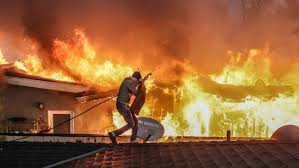
Exactly 40 years ago, fresh from student teaching at Dorsey High School in South-Central Los Angeles, I drove wide-eyed in my VW Bug onto LA’s wealthiest high school campus, Pacific Palisades, to start my second required student teaching stint. Due to my youthful good looks, a ripped security guard stopped me and lit into me for parking in the faculty lot. This week, Palisades Charter High School, with over 3,000 students, burned down.

Seven years later, I temporarily moved into a friend’s palatial Pacific Palisades house to do my doctoral research at the Venice Foreign Language/International Studies Magnet School. We are no longer in touch, and I would be surprised if his family still owns the house all these years later, but based on the photos and video of the devastation, I’m guessing it’s gone too.

The average home in Pacific Palisades is valued at $3.4m. That knowledge will limit some people’s empathy, as if it’s a finite resource that should be parceled out judiciously on a sliding scale. Two things can be true. Many Palisades residents will be financially okay once the dust settles while never fully recovering from extensive personal loss.

I am struck by the tremendous interconnectedness of homeowners. Sparks jumping from house to house like dominoes. Given the density of homes in Malibu and along the Pacific Coast Highway, and in the Palisades, as the locals say, it wouldn’t have mattered if a few homeowners cut back their vegetation and hosed off their roofs before evacuating. The one-two punch of the Santa Ana winds and their next door neighbors’ burning houses, sealed their fate.

Intense individualism is the defining feature of life in the (dis)United States. But not this week in Los Angeles County. To borrow from John Donne, “No house is an island.”

Postscript.

Being A Public Secondary School Principal Is Not For The Weak Of Heart

Or anyone lacking superhuman interpersonal skills.

Jessica Winters’s story in The NewYorker titled ” The Meltdown of a Middle School in a Liberal Town” (April 3, 2024) left me wondering how a school district starts over. It’s a case study of things completely falling apart in an Amherst, Massachusetts public middle school. It features angry parents, school personnel ignoring the separation of church and state, educators wholly unprepared to work with trans students, cultural conflicts of all sorts, and many other layers of public school dysfunction.

Today there’s a similarly harrowing story in The New York Times, titled, “A Principal Confronted a Teenage Girl. Now He’s Facing Prison Time.

The heart of the matter:

“For educators everywhere, the criminal prosecution of Mr. Sanchez for an action that schools typically handle using their own disciplinary codes opens up new levels of potential risk. Fights are part of high school life. If a school official can be not just disciplined but also jailed for intervening to break up or prevent a fight, what are teachers supposed to do?

In an interview, Mr. Sanchez mentioned a fight last year in which a teacher told the students to stop but did not physically separate them. ‘And the parent was just so upset when they saw the video, like, ‘Why isn’t this person stopping it?’’ he said. ‘And to be honest, I was a little upset, too. I didn’t say that to the parent, but I did say, ‘Well, because sometimes people are worried about liability.’”

Recently, I did a writing workshop with fifteen K-12 teachers who are seeking school principal certification. More specifically, they were applying for grants that provide them substitutes for their classrooms so they can get the required hours interning as administrators-to-be.

Impressive group, but after reflecting on these stories, I can’t help but wonder if they know what they’re committing to. The numerous simultaneous challenges they will soon face. The public’s anger and disregard for one another. The tenuousness of the public commons. The toll it will take on them and their families.

My guess is not entirely, because if they did, they’d probably choose professional paths where mere mortals stand much better odds of succeeding.

Pedestrian Safety Versus The Speed Of Traffic

Pedestrian safety is all about the “built environment”. From “Determining who gets blamed when cars hit pedestrians.”

“’But what we’re seeing in this research is that the built environment is a key factor. People make errors in judgment, but no one deserves to die or get injured for such errors. And they would be less likely to make these choices if there were more pedestrian infrastructure,’ said the director of the Center for Urban and Regional Analysis at Ohio State.

One recommendation from the researchers is to redesign the crash forms completed by police to include information on the built environment around the crash site, such as distance to the nearest pedestrian crossing, to give more context on why pedestrians make certain choices.

The built environment for pedestrians isn’t just a problem in Columbus, according to the researchers. Many cities have similar issues. And the situation in Columbus is improving because of Vision Zero Columbus, a government effort focused on reducing crash-related fatalities and injuries in the city.

But this study shows the importance of a Safe System Approach to designing roadways to minimize the effects of human errors and allow pedestrians, as well as cars, to move safely through the city.

“We don’t have to design the streets the way we do. We can make fundamental design choices that could prioritize safety over the speed of traffic,” Miller said.

Put more simply, the relative frequency of cars crashing into pedestrians based upon the presence of cross walks and related pedestrian infrastructure is fairly predictable. No, that’s not surprising. The larger question, I suppose, is how can citizens get their municipalities to prioritize pedestrian safety over traffic speed?