Privacy Is So Yesterday

This is how the story starts:

“NEW YORK (AP) — Columbia University said Monday that it has removed three administrators from their positions and will keep them on leave indefinitely after finding that text messages they exchanged during a campus discussion about Jewish life ‘disturbingly touched on ancient antisemitic tropes.'”

Do not mistake what I’m about to write as exonerating the admins. I am not shedding any tears over their dismissals. Be prejudiced and stupid at your own risk.

That said, there’s a troubling story within the larger troubling story. I’ll leave it to you to decide which is more troubling.

The story is that none of the reporting I’ve seen raises a single question about the method used to bust the admins. Someone sitting behind them used their phone to take pics of one of the dismissed admins’ phone on which a group text was running amok.

You may have seen the recent story of some guy on an airplane wearing a wedding ring who allegedly hit on and hooked up with a fellow passenger. A nearby busy body passenger filmed the whole shady thing and then uploaded it to her socials. It went viral, people found his wife, and I don’t know how it turned out. I don’t even know if the vid was edited with the hope of going viral.

Way more interesting than the actual case study was the difference in how the story was told. Specifically, there was lots of conversation about what might be referred to as “electronic etiquette”. More to the point, whose actions were more egregious, the alleged philander or the budding movie maker? That’s an issue upon which reasonable people can disagree, but the point is her total ignoring of his privacy was a part of how the story was written up.

But not in the case of the Columbia grouptexters.

The larger question is whether we want to live in a world where everything we think and write—whether in public, semi-private, or private even—is subject to public approval or disapproval or not?

I can’t help but conclude, based on the complete non-questioning of the surreptitious phone texting photographer’s methods, that few people are sweating the end of privacy.

Maybe all that’s left of the privacy crowd is a sad sack Boomer with a humble blog.
Sentence To Ponder

From “How Trump Coins Became an Internet Sensation“.

Some context. Watchdogs have warned that Telegram a Facebook and Twitter-like social media platform exercises far less moderation than its rivals.

“In one post, a fake account for Representative Marjorie Taylor Greene, a Georgia Republican closely aligned with Mr. Trump, shared a fake story on a fake Fox News website about a fake tweet by a fake Elon Musk, falsely claiming that Tesla’s chief executive would soon accept Trump coins as payment.”

Heaven help us.

Consciously Turn From The Dark

For me, the Efficiency Evangelists who preach a Life Hack gospel breed serious cynicism. Because their gospel message seemingly follows from a mindless amalgam of capitalism, social status, and materialism.

But since my time is increasingly finite, I’m down with “efficiency lite”; meaning making the most of my time, ideally without the capitalism, social status, and materialism baggage. This means I routinely read book, t.v., and film reviews to improve my odds of choosing content that is especially compelling. This also means being at least somewhat intentional about who I hang with. I seek content and people that either inform, inspire, challenge, lighten, and/or uplift myself and others.

Unlike the Efficiency Evangelists, I don’t want to accomplish more, I just don’t want to waste my time on people and content that breed contempt for this one precious and wild life.

Is it just me, or does it seem like we’re surrounded by people and content that breeds contempt for damn near everything? Increasingly, the glass isn’t half full, it’s bone dry.

This means my task is two-fold, actively seeking the light in terms of uplifting people and content while actively rejecting the dark. Therefore, I have to get better at not reading and watching some content, not engaging with some social media, and not interacting with some people.

When the Good Wife and I sit down to dinner, we sometimes ask, “What did you do today?” What I’m reflecting on here gets at another important question we are not in the habit of asking which is, “What didn’t you do today? Who didn’t you see? What did you choose not to read? What media did you disengage from? What social media did you purposely skip?”

To live more wild, socially redeeming, precious, fulfilling lives, we have to be wiser and more self-disciplined about combatting the cynical, spiteful, mean-spirited non zero-sumness that dominates our media. That cynical, spiteful, mean-spirited non zero sumness has done as much or more damage to our spirits, interpersonal relations, and democracy, as the ‘rona has to our physical health.

With apologies to the non-sports minded, we have to play much, much better defense and consciously turn from the dark.

p.s. Did I ever tell you about the time I did a reverse dunk in a winter bball tournament with gloves on?

I Am Happy To Report That I Got In Trouble

IMG_1592 2

In this day and age of unregulated social media algorithms that inflame our most negative instincts, how cool is it that one online community is making a concerted effort to do a hell of a lot better.

It doesn’t even matter that LinkedIn couldn’t detect the self-deprecating nature of my recent “Liberals Are Hypocrites” post. Their algorithm probably stopped at the offensive title and didn’t proceed to the body of the post that read, “Like me.” Or maybe it did scan those two words, but wasn’t able to detect my intended meaning. 

It’s all good LinkedIn, I wholeheartedly applaud your efforts even if I was wrongly caught up in your decency dragnet.

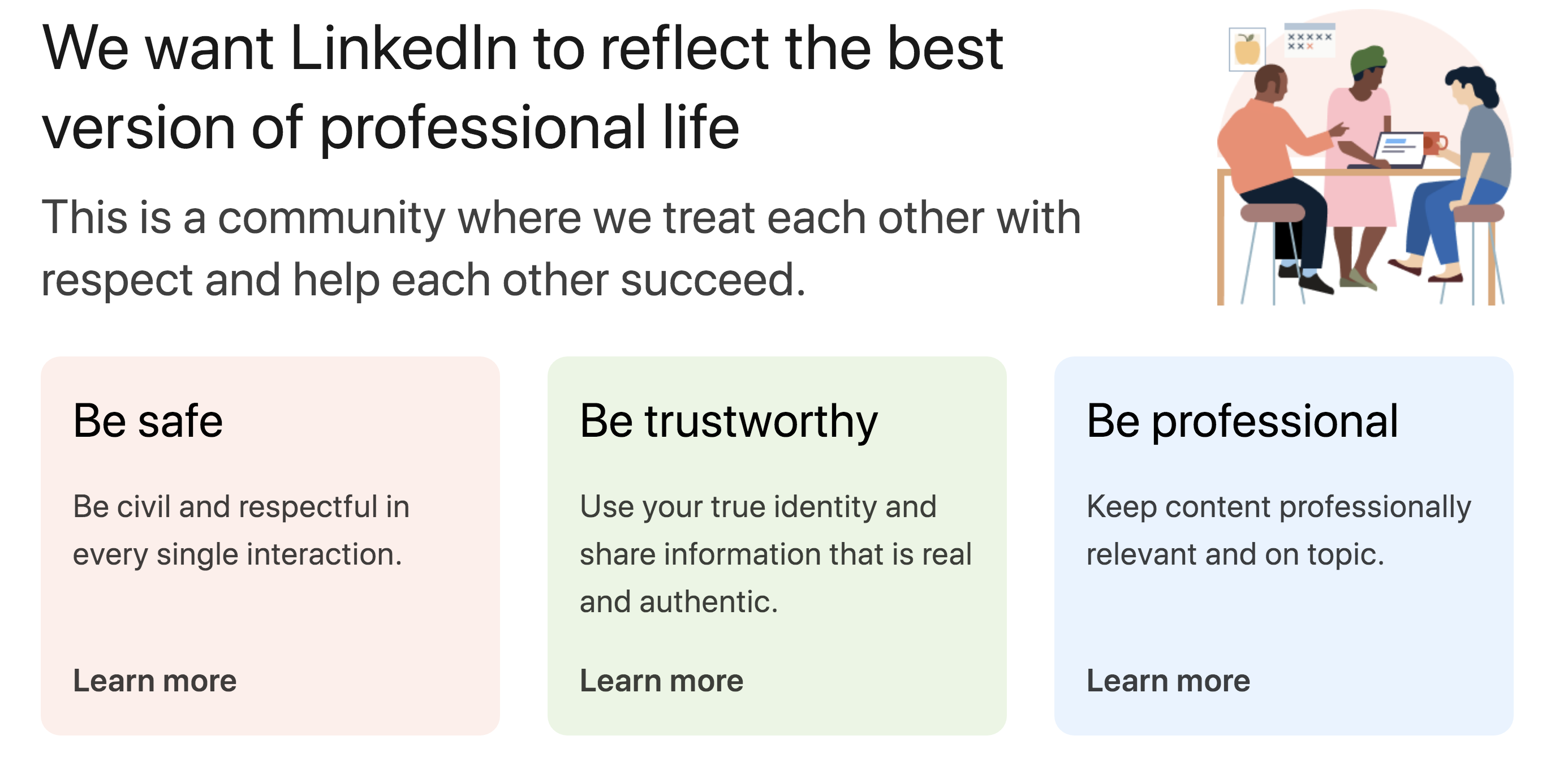
LinkedIn’s Learning Center does a great job explaining their ground rules. Here’s a taste:

Screen Shot 2021-11-12 at 4.53.48 PM

Hey Zuckerberg, Dorsey, et al., here’s a fourth “Be”. Be like LinkedIn.


Help Me Understand

Why do people engage in political debate on Facebook and other social media? Has anyone ever changed their party affiliation or political thinking more generally because someone on social media convinced them to?

It seems utterly ill-suited for meaningful political discussion. Bumper stickers probably are a more effectual means of political persuasion.

I Predict There Will Be More Wild Ass Predictions

‘New York City is done!’

‘Office work is done!’

‘Higher education as we know it is done!’

‘Long distance travel is done!’

Why are so many highly educated people making such dumb, over-the-top predictions? Besides the fact that education and wisdom have never been closely correlated, it’s because the prognosticators are desperate to be heard above the din of the social media cacophony. PLEASE listen to my podcast. PLEASE read my twitter feed, ‘insta’, blog, book.

Scott Galloway is Exhibit A of this modern tendency towards hyperbole. Subtly, nuance, and ambiguity—the stuff of complexity—is passe, and we have the scramble to be relevant on social media to thank for that.

Lo and behold, New York City real estate values are on the rise again. Executives are desperate to have employees return to offices, college life looks and feels very familiar, and have you been in an airport lately? A bit more hybrid learning, telemedicine, and remote work aside; most ‘rona-inspired changes in behavior are proving relatively superficial despite the pandemic’s legs.

I would like you to prove me wrong on this, but neither do I expect many of the heartfelt proclamations of personal transformation to stick. Maybe a vicious virus can inspire a personal ‘reset’ of sorts in the short-term. Maybe people will simplify their lives; strike a healthier work-life balance; and commit more deeply to their family, friends, and neighbors. But as soon as the virus begins to fade, watch for long established habits to return. Human nature endures.

Ultimately though, when it comes to brash, facile predictions, maybe resistance is futile, in which case I predict the UCLA Bruin football team will win the Pac-12*.

*The last time that happened, Blockbuster Video was killin’ it.

Why Do We Social Media?

One of our next-door neighbors doesn’t talk to the GalPal and me. I understand her not talking to me, but the GalPal, come on, she is as friendly as they come.

The couple who sold to us told us that would be the case, which helps not taking it personally. But man, it’s odd. Especially when Ms. NextDoor posts on-line about ordinary, face-to-face stuff. For example, this weekend she broadcasted to the whole neighborhood, plus surrounding ones I think, that her college aged sons were temporarily moving home, as well as other extended family, so she wanted everyone to know more cars will be coming and going. The kind of thing you’d say when bumping into a neighbor on a walk.

But so far, 4.5 years in, I’ve never seen her take a walk. But what do I know, maybe she has a treadmill in her crib and is running 10 miles a day. But I digress.

Alas, I prob have a log in my own eye. I just left a comment on a Facebook Group page called “Saving Guilford College”, the small Quaker liberal arts college in Greensboro, NC where I taught previously. I wrote the following in response to a post from a woman about her deceased husband, my former colleague. She wrote that when he was near death in the hospital he said, “Guilford College killed me.” That got my hackles up. So obviously a delicate sitch. You can decide for yourself how well I balanced respect for her and her family with my frustration at his lack of personal responsibility.

“I was a down-the-hall colleague of Bill’s from 93-98 (Education Studies). He was always super nice and clearly good at what he did. I’m very sorry he didn’t get to enjoy a post-work life with you and the rest of your family. However, respectfully, I don’t understand his contention that Guilford killed him. College professors have lots of autonomy over exactly how hard they work and for how long.”

Was that a wise investment of time? Did I make the world a better place by getting that off my chest? No and no, and yet, I couldn’t help myself. My excuse is I’m supposed to be reading students’ papers today which always gives rise to world class procrastinating. And yes, I’ve already vacuumed. 

Now I’m afraid to open FaceBook to see the probable backlash. What’s keeping me from quitting Facebook? 

The Lonely Majority

How loneliness could be changing your brain and body.

“A  2018 study. . . found that 54% of 20,000 Americans surveyed reported feeling lonely. In the span of a bit more than a year, the number rose to 61%. Generation Z adults 18-22 years old are supposedly the loneliest generation, outpacing Boomers, Gen X and Millennials, despite being more connected than ever.”

Wowza. The silent, underreported epidemic.

“Loneliness might conjure images of being apart from friends and family, but the feeling runs much deeper than not having plans on a Friday night or than going stag to a wedding. Evolutionarily, being part of a group has meant protection, sharing the workload and increased odds of survival. After all, humans take a long time to mature. We need our tribes.

‘It’s very distressing when we are not a part of a group,’ said Julianne Holt-Lundstad, professor of psychology and neuroscience at Brigham Young University. ‘We have to deal with our environment entirely on our own, without the help of others, which puts our brain in a state of alert, but that also signals the rest of our body to be in a state of alert.’

Staying in that state of alert, that high state of stress, means wear and tear on the body. Stress hormones like cortisol and norepinephrine can contribute to sleeplessness, weight gain and anxiety over extended periods of exposure, according to the Mayo Clinic.”

What to do? Doug Nemecek, chief medical officer at Cigna:

“‘We need to reach out to some friends and make sure we maintain those connections and have meaningful conversations. It’s important for all of us to be comfortable asking other people how they feel.”

And for the lonely majority to risk being vulnerable when asked.