Election 2016—Father-Daughter Dialogue 3

Alibaba: My last post was a theoretical exercise. In responding to your question I was not having an actual conversation with a Trump supporter. That – as I said in my answer – would of course include curiosity and listening and learning and new perspective.

But, to answer your question. Yeah, that phrase slipped past me and isn’t good. It didn’t capture a few things that I meant it to. 1. A broad, general sense, of “take a lot of action to make the world a better place, focusing on people who are systemically marginalized.” 2. That “vulnerable” doesn’t mean “people who can’t help themselves,” it means those who are structurally disenfranchised, subjugated, silenced, and that I am also talking about myself, as a woman, when I say “vulnerable people.” I feel like my rights are at risk and want to make sure they are protected. 3. That I think when the issue at hand does not relate to an identity I personally possess, it is important to look for and defer to people who do hold those identities. Cop out it may be, I do not think I have words better than these to describe this: “That is to say if you are able-bodied, if you have money, if you have resources, if you are seen as white, hetero, cis, if you have had the opportunity to develop your politics through theory rather than through forced violations against your body and your people, then take that backseat, offer a share of your resources to help organizers and activists travel and stay sheltered, protect and stand with communities you are not from, but do not take up space. Humbleness is what fuels a courageous fight that does not center you as savior.” -by Jenny Zhang in “Against Extinction”

And why do I think this is important? Because there are voices that have historically been ignored and there is a responsibility to do what we can to correct history and make them as loud as possible now. Because it would be arrogant and ignorant to think I know more about the lived experiences of someone else than they do, or what they want or need.

Now a few for you. What do you think the most important takeaways from the election are? In other words, what should we pay the most attention to going forward? 

Ron: Thoughtful reply, thank you. I’m sorry you think I don’t give you enough credit for being more savvy some/a lot of the time. When you communicate that frustration, I almost always think about my relationship with my dad. I get your frustration because I never felt like your grandfather gave me enough credit for being a capable, contributing, independent adult until I was in my mid-to-late 20’s. Too often, it felt like he was stuck viewing me as my dumbass sixteen year old self. I’m not sharing that for sympathy, or as an excuse not to be more caring, just to say I think some of your frustration is baked into the generation gap. Maybe everything will always be perfectly copacetic with your child(ren) and the pattern will be broken.

One take-away. I’ve written about the problems of the Simple Living movement before. It’s illogical for well-to-do people like me to tell the less well-to do about the limits of material wealth. My multi-layered, multi-facted privilege disqualifies me from commenting on anyone’s economic decision-making and lifestyle, but that doesn’t mean I can’t wax philosophic about larger, related questions. Which is to say, I interpret the election result as a culmination of a larger trend in the US where more and more people are slighting their health and spiritual well-being in the pursuit of material gain. Put more simply, it’s the triump of a self-regarding consumerism. Way more people than Dems expected put their trust in the candidate they perceived to be a superior businessman. The aformentioned Frontline documentary shows he’s a terrible businessman, but perception becomes reality. In essence, Trumpers said, “He’s such a great businessman, I’ll give him a pass on the hateful anti-immigrant, anti-women, anti-everything bullshit.” At the risk of simplifying things, I think Trumpers were saying, “Compared to HC, Trump will improve my job prospects, I’ll make more money, and be able to afford more stuff at my favorite big box store, so who cares about the environment, Muslim-Americans, traditional foreign alliances, or grabbing pussies.” In the battle between self-regarding personal economics and other-regarding American ideals, self-regarding personal economics has won.

The election may have turned on traditional Dems who succumbed to apathy and didn’t vote. Maybe they thought victory was in the bag, and turned off the game midway through the fourth quarter (you have to allow me one sports metaphor per reply) or the Democratic candidate didn’t rally them around the Common Good. HC was like a tennis player sitting well behind the baseline (okay, now I’m borrowing on the future), hitting desperate lobs, defending herself, criticizing her opponent, not rallying enough traditional Dems around the Common Good.

Pay attention to going forward? Short answer, Trump’s ego is such that he thinks the rules don’t apply to him. Look for him to play fast and lose with Constitutional principles related to the Executive and Supreme Court case law. I anticipate him breaking enough laws that he’ll lose the support of the Republican-controlled Congress. Even money he gets impeached before completing his term. One can hope.

More personally, getting out of the pool the other day, I asked a friend, older and faster than me, “Got any (Masters) meets coming up?” Normally, he’s competiting all the time, but he said, “No, I’m just too down. I’m going to give my meet money to the Sierra Club and Planned Parenthood who I know will make the most of it.” Admirable sure, but not my approach. I return to the Stoic notion of “trichotomy of control” in which you focus as much of your time/energy on those things we have some or a lot of control over. Swimming competitions gave my friend joy, so it saddens me he’s letting the Celebrity President rob him of that. I will continue to do the things that bring me joy, watch the sun rise, drink my green tea latte, eat healthily, swim across Ward Lake, run in Priest Point Park, cycle with friends, watch my daughter graduate college, dialogue with you, see independent films at the hippy theatre, and try to be a more attentive and caring educator, husband, father, citizen. I confess, over the last three decades, since I was your age, my strong desire to change the world has ebbed. I’m glad you want to and I do have confidence that your friends and you can, especially if fueled by Zhang’s “humbleness”. I want to change myself, be more kind, listen more patiently. The next election won’t turn on that, but my small sliver of the world—my marriage, my family, my community, will be better for it.

Do You Mind If I’m Totally Frank?

Last week, that’s what one of my students asked me in the middle of a discussion led by a classmate. The topic was what stoicism teaches about getting along with others. At the beginning of the discussion, I skimmed the student leader’s questions. The last one was about stoicism and sex which was addressed within the related reading.

With about ten minutes left in class, I said to the student leader that he should probably pick one of the remaining two questions. Without hesitating he jumped to the last much to his classmates’ delight. Apart from a little antiseptic sex ed talk, I’m guessing this was the first time they’d ever truly discussed sex in a classroom.

It’s ironic that the more interpersonally consequential the subject—take sex as one example and marriage as another—the less likely we are to talk about them with adolescents and young adults in any detail. I guess we think of such topics as too personal, private, and value-laden. As a result, pastors rarely if ever talk about sex and marriage from the pulpit, parents rarely if ever talk about their relationships with their children, and educators routinely sidestep topics like that. That means adolescents and young adults are left to themselves to resolve all of the challenges posed by human intimacy through trial and error.

The sex question immediately piqued everyone’s interest. One especially animated student turned from the student leader to me and asked, “Do you mind if I’m totally frank?” Me, “Sure, of course.” Her, “There’s a big difference between fucking and making love.” As they repeatedly say on the television series Fargo, “Okay, then.”

Couple that ice breaker with the fact that it’s a small class, the students are friends, and they think I’m way cooler than I am, the conversation was more candid than I had anticipated. It’s kind of a blur. At some point, I pointed out that they hadn’t yet dealt with the stoic’s primary insight on sex, that in middle or old age few people reflect on their younger selves and wish they had been more promiscuous. Stoics point out that the opposite is much more common, that sexually active people often regret the damage done by being so promiscuous. To which one student bravely said, “I’m 19 and I regret being as promiscuous as I was in high school.”

From there the discussion turned to the confusing and controversial stoic suggestion that sex, even inside of marriage, should only be for the purpose of procreating, which strikes me as an overreaction to the dangers of promiscuity.

Rewind the tape to earlier in the week when, with two colleagues, I was involved in a protracted discussion with a student teacher who is struggling in her internship. I was asking questions designed to get her to admit a regret or two in the hope we could turn to what could be done to remedy the situation. “What would you have done differently if anything?” “Okay,” she finally said without asking if she could be perfectly frank, “I fucked up.”

After the meeting that utterance was what one of my colleagues wanted to talk about first. He was right, she does have to be smarter about professional contexts, meaning more tactful and diplomatic, but these two incidents point to a huge generation gap when it comes to attitudes towards profanity.

Swearing, using “fuck” more specifically and not just as a verb, but as any part of speech, is so common among adolescents and young adults that some adults’ resistance to it, like my colleagues, hardly makes any sense to them.

Just as it’s unrealistic to expect married people to abstain from sex except when procreating, it’s unrealistic to expect young people to stop swearing altogether. The best hopelessly square people like myself can hope for, is that they learn to use profanity freely around their peers when in informal settings and then “code-switch” and refrain from it when around mixed aged people in other settings.

If you don’t agree, you can go forget yourself.

Climbing Mount Everest

This year my university picked Jon Krakauer’s 1997 best seller Into Thin Air as the common reading for first year students. Despite being an endurance athlete who likes mountains, I’ve never had any interest in mountain climbing. So two weeks ago I half-heartedly began reading about the infamous failed ascent of Everest in May,1996.

I enjoyed thinking about what it would be like to try to climb any 8,000 meter peak more than I expected, but I have no plans to scale Mount Rainier or any other mountain. I’m content scaling Tumwater Hill every now and then.

I dig when people have deep-seated passions which give their lives extra meaning. When they’re compelled to throw pottery, write novels, grow roses, brew beer, race bicycles, tie fly fishing knots, follow the Chicago Cubs, or climb over 29,000′ above sea level.

Krakauer’s fellow climbers caused me to reflect on human nature. One of the guides, an internationally renowned climber who survived only to die a year later atop another mountain once said, “Mountains are not stadiums where I satisfy my ambition to achieve, they are the cathedrals where I practice my religion.”

This quote fascinated me because the feel you get from Into Thin Air is that for most everyone on the mountain it was most certainly about ambition to achieve. Ego, reputation, bragging rights upon returning, and avarice were all more evident than Zen-like notions of self discovery and improvement.

I didn’t understand the willingness of the climbers to attempt the ascent with people they knew next to nothing about. Even if one were to go by themself with the help of a world class guide and small group of Sherpas, it would be a life and death gambit, but add in inexperienced climbers in less than peak fitness, and the risks increased exponentially. Why enter into a co-dependent relationship with other people who left to their own devices would fare much, much worse on the mountain.

Similarly confusing was partnering with some character-challenged people who clearly prioritized their own individual success and survival above anyone else’s.

If you see the film, let me know if I should.

Of Coupon Codes and Meaning in Life

Karl Marx believed history was shaped by an overarching dialectic—an enduring conflict between the bourgeoisie who owned the means of production and the proletariat who were stuck selling their labor to the capitalist class. I have my own overarching dialectic that I believe shapes family life, religious communities, municipalities, and even nation-states—an enduring conflict between our material and spiritual selves.

In the simplest terms, it’s a battle between our preoccupation with consumer goods that make our lives more convenient and comfortable versus prioritizing family, friends, those in need, and the ethical stewardship our finite natural resources.

My material self routinely gets the better of my spiritual self. I spend too much time shopping online and I recently I purchased an iPhone 6+ and a new car. But I suspect I’m different than a lot of consumers because I’m keenly aware of the battle that rages inside me. I also live well below my means and know my phone and car, as nice as they are, can’t hold a candle to the joy and meaning my wife, family, friends, students, and writing provide.

How ironic that this time of year is marked by numerous sacred religious traditions and we’re more susceptible than ever to mindless materialism. Consumerism trumps contemplation. This manifests itself in many ways, stampeding store customers have to be the most jarring (the increased popularity of online shopping appears to be dampening that phenomenon).

This weekend in Seattle, The Gap and a few other stores were having a “50% off everything in the store” sale. Which got me thinking about a grand experiment in which all of downtown Seattle businesses had simultaneous “100% off everything in the store” sales. Their motto might be, “This stuff was really ill-conceived and is poorly made, ugly, and of no real use, so please, please take it off our hands.” Tens of thousands would jump in their cars and speed downtown, park haphazardly, and run towards the stores with eyes ablaze.

Free man, free! Nevermind that they’d have no real need for the stuff falling out of their overfilled shopping carts. Free man! Nevermind that they wouldn’t have enough room in their dresser drawers, closets, or garages for the stuff. Free! Nevermind that the stuff wouldn’t fill those empty spaces in their lives created by superficial or strained relationships with others.

My spiritual self has convinced my material self to sit out the mania this December. Join me. Help me tilt the balance from the material to the spiritual.

Stoic Insights on How to Put Up With Put-Downs

One of my running partners manages a hair care sales team. Last week he began a run by telling Dan, Dan, the Transportation Man that he had a new product for him. Some concoction that would make his hair thicker. “What about me?” I asked. “If anyone needs it, it’s me. What am I chopped liver?” “You’re too far gone!”

From my notes from William Irvine’s A Guide to the Good Life:

Understandably, people are sensitive to insults. Rather than deserving our anger, flawed people who criticize us deserve our pity. As people make progress in Stoicism they will become increasingly indifferent to people’s opinions of them. Because they are indifferent to others’ opinions, they feel hardly any sting when insulted. One of the best ways to respond to an insult is with humor, especially self-deprecating humor. Sometimes the best response is no response at all, to calmly and quietly bear what has happened. That robs the person of the pleasure of insulting us.

Self-deprecating humor is like Bill Wither’s music or sunshine in the Pacific Northwest, you can never have too much of it. The trick is to make so much fun of yourself than no one else can compare. In the past, I’ve singled out Tina Fey as a self-deprecating sensei worthy of study. Now, meet her equal, Emily Yoffe or Slate Magazine’s Dear Prudence. Prudence somehow answers impossibly difficult questions about all sorts of interpersonal, romantic, and sexual dysfunction. One of her most recent Q&A’s made me laugh aloud. Do not ruin it for me by suggesting some college students wrote it late at night as a prank on the electronic magazine. It has to be authentic.

Q. I am having a rather silly problem with my otherwise wonderful wife. She gets up early every morning before work to go to the gym, and then takes a shower when she gets back to our small one-bedroom apartment. After her shower, she says she gets overheated easily while we’re both getting ready for work. I can understand that—I’ve already showered while she’s gone, she’s been exercising, and then she’s showered, plus she needs to use a blow dryer to style her hair. But her way of dealing with this is to walk around almost naked (in just her bra and underwear) until she absolutely has to get dressed to leave for work. She eats breakfast like this, puts on her makeup this way—she basically just goes about her morning routine with barely any clothes on and sometimes she skips the bra entirely. Under other circumstances, I would enjoy this. But when I’m trying to get myself ready for the day, this is kind of distracting. I find myself getting aroused, and since we’re both trying to get out the door for work, it’s a bad time for sex. But then I get to work and I’m frustrated all day long. I’ve tried raising this issue with her (delicately) and she gets offended that I can’t control myself after we’ve been married for eight years, which I find offensive. She’s the one walking around half-naked. How can I try to resolve this with her peacefully?

A: Ah, tempus fugit! At this stage in my life, the way I turn off my husband is to walk around naked. This is a sweet dilemma, so it’s too bad you both get so annoyed with each other over the fact that after eight years the sight of your undressed wife bouncing around the apartment is so arousing. I get letters from women wishing that their husbands weren’t lounging around with the family jewels draped over the upholstery (they do not find it a turn-on). But I think yours is the first from a guy who finds his wife’s toilette so distracting he can’t get out the door. But surely, once you’re at the office, you are able to focus on the marketing data and don’t spend the whole day moaning over your morning testicular vasocongestion. If you’re not able to move on and save it for later, you sound very juvenile. Instead of continuing to fight over this, try taking action (not the kind of action that will make you late for work). Buy a pretty, short, sheer robe for your wife and give it to her as a gift. Explain that she’s so damn attractive that if she were a little more covered in the morning it would help you focus on the day ahead. Tell her she of course doesn’t have to wear it, but you know that color looks great on her, and you hope it’s lightweight enough that she can put it on without getting overheated. Let’s hope that she takes your gesture in good spirit and likes the robe. Of course, if it’s silky and sexy, seeing her in it may have the unintended consequence of overheating you.

Prudence’s line about turning off her husband provided the second best laugh of the week. The best goes to my daughters, one of whom posted this picture to her Facebook page.

The two things I'm most proud of in todo el mundo.

The two things I’m most proud of in todo el mundo.

Sports are Not a Metaphor for Life

First a note to international readers. In the U.S. the first two weeks in April is many sports-minded people’s favorite time of the year because of a confluence of great events highlighted by the college basketball national tournaments and the tradition-rich Masters golf tournament. There’s also the start of the professional baseball season and the beginning of the professional hockey and basketball playoffs. And this year there’s going to be a pretty special footrace in Boston next Monday, the 21st.

Few, if any, expected to see the Universities of Connecticut and Kentucky play for the national basketball championship. Combined, both teams lost nineteen games during the regular season. Similarly, Bubba Watson looked completely lost on Augusta National’s greens during Saturday’s third round. Most people thought it was Louisville’s, Arizona’s, or Florida’s tournament to lose and Matt Kuchar’s turn to break through in a major championship. Few were shocked when Bubba fell behind by two strokes early during Sunday’s final round.

But Bubba, following Connecticut’s and Kentucky’s lead, rallied to play his best golf at the most important time, and won by three strokes. My takeaway is this. Next week in Boston, pay no attention to who is in the lead at the halfway mark. In fact, don’t place too much importance on who is ahead at the 20 mile mark. In keeping with this sports season, someone unexpected will assert their will on the field over the last few miles. Call me crazy, but maybe even someone not from East Africa.

When I first sketched this post in my head, I was playing around with what, if anything, these athletic contests have to do with how you and I should live. But I was forcing it because athletic competition is not a meaningful metaphor for life. Because only one team hoists the national championship trophy and only one golfer puts on the green jacket each April.

In life, the more our family members, close friends, and co-workers flourish, the better our lives. The key to that is cooperation in the form of mutual support. In contrast, family, friendship, and co-worker competition inevitably results in petty jealousies, anger, and dissension.

And yet, sometimes there are sublime moments of cooperation in the heat of athletic competition. For example, at one of last year’s major marathons, the two men leading the race passed one water bottle back and forth. Maybe they were Stoics even more focused on giving their best effort than finishing first. And often the most awe-inspiring moments are compliments of young athletes, like high schooler Megan Vogel, who flat out reject win at all costs thinking.


Thank You

Most bloggers, like most people, are motivated by social status and wealth. I get contacted all the time by bloggers who want to teach me how to monetize my blog in three easy steps.

I write because we are social beings and writing is one especially beautiful way to deepen relationships and create lasting community. Like the wannabe Stoic that I am, I try to write twice a week immune to the humble blog’s statistics. But I’m only partially successful. I like peeking at the changing number of visitors  and where all over the world readers live. Truth be told, even worse, my blogging enthusiasm ebbs and flows in part based on the vagaries of your reading preferences.

Thank you for visiting this calendar year. I wish it didn’t matter, but it does. Thanks to everyone that took time to comment through the year. And thanks to Don for being my editor extraordinaire. And most importantly, thanks to everyone who is able to tell me in person that they have read a recent post. That’s the most positive encouragement I receive. It’s one thing to look at a bar graph with “page views”, it’s a whole different thing to see individuals behind the numbers. I wish my motivation was completely intrinsic, but I imagine that will remain an elusive ideal. Your participation matters, so thank you.

My goal for 2014 is to stay the course, by which I mean share insights about families, schools, and communities that illuminate and inspire. I hope you achieve whatever is most important to you and yours in 2014.

I was going to recreate this vid, but I couldn’t find a tutu that would fit or a white horse. God bless the carnies.

Lighting Candles

Sometimes, when the early morning running conversation turns too negative too long, one member of the posse reminds everyone else it’s “Better to light a candle than curse the darkness.”

People tilt towards pessimism, which spreads upon contact. Pessimism is a special challenge in the Pacific Northwest in late October because daylight, and Vitamin D, dwindles.

Ancient Stoics knew gratitude didn’t come naturally, so they practiced negative visualization and voluntary deprivation. Negative visualization is taking time to imagine worse case scenarios—no longer having enough healthy food, having one’s bicycle or car stolen, losing one’s home to a natural disaster, losing one’s job or savings, or the unexpected death of a loved one—to better appreciate the impermanence of everything and everyone.

Voluntary deprivation is practicing living without those things we tend to take for granted for the purpose of appreciating them more. Examples include fasting, bike commuting for a month, or traveling solo. Absence always makes the Good Wife and me even fonder of one another.

Since others’ attitudes influence our own, another strategy is to purposely seek out hopeful, creative, funny, positive people, while simultaneously steering clear of permanent pessimists.

Staying active throughout the winter helps keep the candle light burning bright. Invest in the necessary clothing and lighting to stay comfortable and safe. Spend more time outdoors than in the gym. Saturday morning’s run was incredible. It didn’t matter that everything was soaking wet because of dense overnight and early morning fog. The streets, sidewalks, and trails were lined with colorful leaves. God’s carpeting.

The photographer I’m currently shacking up with captured one especially beautiful thread of that carpeting.

P1000522

Minimize End-of-Life Regrets

Writing faculty at my university get to choose their own seminar themes. When I chose “The Art of Living” for my first year writing seminar a few years ago, I wasn’t sure how it would go. Was I crazy to think that eighteen and nineteen year olds might find Epicurus, Seneca, and Stoicism almost as interesting as me?

I knew very few of their K-12 teachers had asked them to think about what they most want out of life. And psychologists say they have a sense of immortality. Why bother with how to live if you’re going to live forever?

One month in, I’m happy to report, they’re actively engaging with the reading material (primarily William Irvine’s The Guide to the Good Life and Roman Krznaric’s The Wonderbox) and one another. I love how comfortable they are disagreeing with our authors and one another. My greatest challenge is staying out of their way.

Some have experienced loss—one’s mother died a few years ago from breast cancer, another’s from a heart attack, and still another travelled to Winnipeg last week to attend her aunt’s funeral.

The first unit was on “philosophies of life”. More specifically, I asked the students to agree or disagree with Irvine’s thesis that to avoid major end-of-life regrets, everyone needs to have a grand goal of living and specific strategies to achieve the goal. Irvine argues most people have regrets at the end of their life because their primary pursuits—wealth, social status, and pleasure—are in the end, unfulfilling. His grand goal of living is to maximize tranquility and joy by reviving Stoicism for the modern era. Few people experience much tranquility, Irvine argues, because materialism, social status, and pleasure conspire against it.

The larger question we’ve grappled with is how intentional should we be in our day-to-day lives? What role, if any, should spontaneity and serendipity play? What’s the right balance?

The students fell evenly across the “intentionality/spontaneity” continuum, some quite certain that people need life goals, and associated philosophies with specific strategies for achieving them. Others pushed back saying, “Are you kidding? How can anyone expect people with our limited life experience to put forward grand goals for living let alone specific strategies for achieving them?” They thoughtfully argued that life would present unforeseen struggles and opportunities. For example, one said she never would’ve have fallen in love with French if she had been correctly placed in the middle or high school Spanish class for which she had actually registered.

When some of them argued for intentionality, I couldn’t help but think they’d have to recalibrate their specific goals and strategies (for example, to have a large loving family) if and when they commit to a life a partner with their somewhat different visions of the future.

What about your life? According to Irvine, your life is most likely an argument for spontaneity because our culture offers us an “endless stream of distractions” that keeps us from clearly identifying, and planning how to accomplish, what we most want out of life.

Be less distracted this week, and thanks, as always, for reading.

Stoicism Fail

A wannabe Cicero, I’ve enjoyed thinking about and trying to apply aspects of Stoicism to my life ever since reading William Irvine’s “A Guide to the Good Life” four or five years ago. The ancient philosophy’s anti-materialist emphasis on tranquility and joy resonates with me.

Irvine thoughtfully explains how to apply the ancient concepts to modern times. One stoic insight concerns internal goal setting. Irvine argues that we often succumb to negative emotions—anger, fear, grief, anxiety, and envy—because we focus too much on things outside of our control.

Irvine:

When a Stoic concerns himself with things over which he has some but not complete control, such as winning a tennis match, he will be very careful about the goals he sets for himself. In particular, he will be careful to set internal rather than external goals. Thus is goal in playing tennis will not be to win a match (something external, over which he has only partial control) but to play to the best of his ability in the match (something internal, over which he has complete control). By choosing this goal, he will spare himself frustration or disappointment should he lose the match: Since it was not his goal to win the match, he will not have failed to attain his goal, as long as he played his best. His tranquility will not be disrupted.

This weekend, at my first triathlon competition in 10 plus months, I learned how far I have to go to apply this more Eastern, process-oriented approach to goal setting. I’ve always really enjoyed competing at Hagg Lake, a large clean body of water surrounded by dense woods 30 minutes west of Portland.

There’s another Olympic distance (1500m swim, 40k bike, 10k run) race in Portland every June that draws four times as many participants probably because it’s flat. The 11 mile road that loops Hagg Lake has one 300 meter flat stretch across the dam. Total elevation on the bike is 1,500′. The run is up and down throughout as well. It’s a course that’s perfectly suited to me. The hills are our friends.

Check out my times from my three Hagg Lake races.

Swim T1 Bike T2 Run Overall Time
2004 23:17 2:54 1:17:15 1:24 44:37 2:29:27
2007 23:08 3:37 1:16:16 1:32 45:23 2:29:56
2013 26:21 2:40 1:14:28 1:24 46:29 2:31:22

Note that I forgot to race in 2010. My goals for this year were to beat my 2004, 42 year-old self course record. I thought I could drop enough time in the bike leg to make up for a slight loss of time in the swim and run. Pretty darn Stoic I thought, racing against myself. But then I wavered. I looked up some of the guys who pre-registered and I knew I was faster than them based on previous races. I thought I could win my smallish, oldster age group.

Then I raced to the best of my ability. Which, if I was any kind of student of Stoicism, would be the end of the story. But of course it’s not. I passed a few guys in my age group during the run and thought I was probably second. In the finishing chute a 33 year old, who I had been leap frogging back and forth with throughout the bike and run, sprinted past me to finish 1 second ahead of me. He was pumped. I didn’t remind him that my wave started five minutes after his and that I beat him by 4:59. Hey everybody, gather round. Watch Ron carom off the Stoic rails.

After a dip in the lake with the world’s best wife but worst race photog, I checked out the results. Damn. I got spanked by four fellow geezers and finished fifth out of fifteen in my age group. Forget that “best of my ability” bullshit, I felt like I had failed. Doubly, as an athlete and Stoic. Why dear friends did I let the computer printout alter my mindset so much? I lost touch with the fact that I’m really lucky to both have the resources and be healthy enough to compete in a beautiful natural setting. And I lost touch with just how inconsequential my triathlon performance is in the grander scheme of things that matter even a little bit in life.

In hindsight, fifth out of fifteen isn’t terrible, but after my excellent performance at Canada last year (14th out of 217), I started to get cocky. In Canada I rolled for almost eleven hours, what’s two and a half? It showed in my poor race prep. Pre-race I ran twice off the bike for a total of 7 miles. And this summer I’ve blown off as many swim workouts as I’ve completed. And my cavalier attitude culminated in me forgetting my wetsuit which explains most of the additional time in the swim.

Truthfully though, best case scenario, had I remembered my wetsuit and trained with greater focus and intensity, I could have gone four or five minutes faster, but I still would have finished third or fourth.

See that, still focusing on time and placement. I have even more work to do as a Stoic than I do as a triathlete.

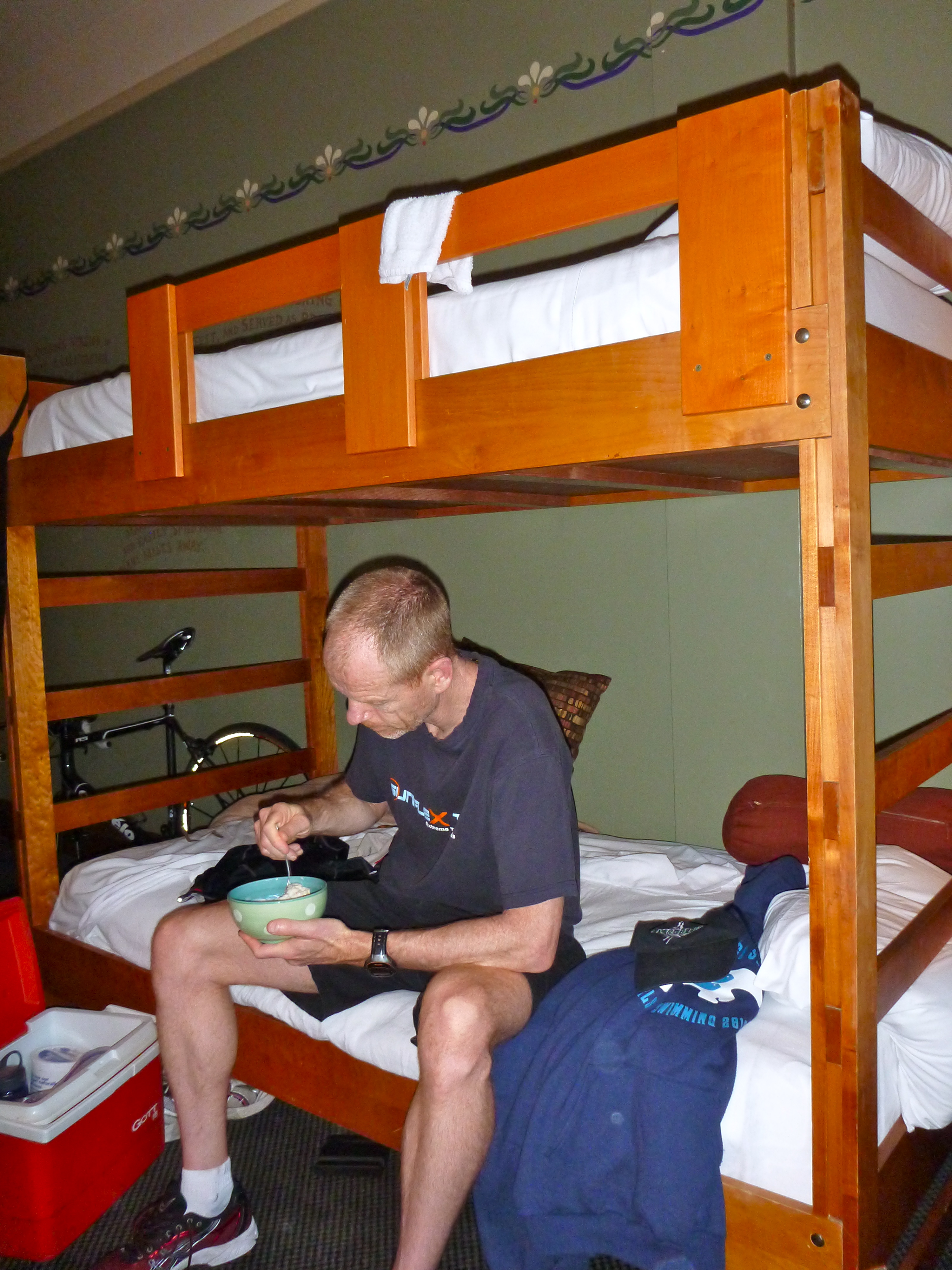
Pre-race breakfast at McMennamin's the Grand Lodge. The GalPal gave me the bottom bunk.

Pre-race breakfast at McMennamin’s the Grand Lodge. The GalPal gave me the bottom bunk.

Perfect weather, calm, 60 degrees, lake was 75

Perfect weather, calm, 60 degrees, lake was 75

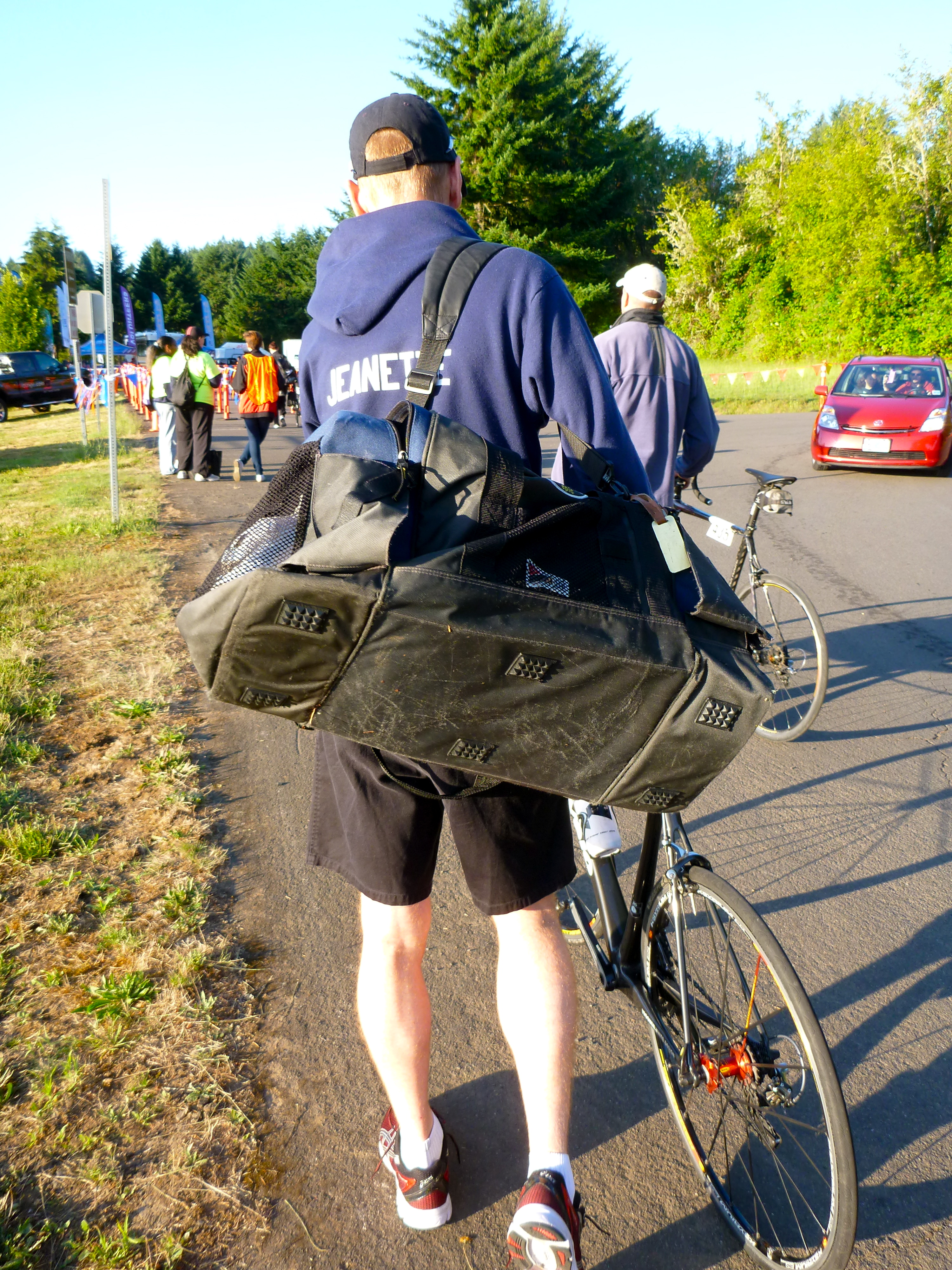
Rockin' the daughter's sweatshirt

Rockin’ the daughter’s sweatshirt

The failed Stoic post-race

The failed Stoic post-race