Knowing Our Physical Selves

I was teaching in Yakima, WA last week.  On the way into Yakima there’s a sign that proclaims, “Yakima, The Palm Springs of Washington.”  While it’s often sunny and hot in Yakima, its self-perception is a bit skewed.  I like Yakima, but it’s working class, has few golf courses and swimming pools, and according to newspaper reports, is a huge international drug hub. 

Imagine if only saying it made it true.  Maybe I should make some signs for my yard.  “Ron Byrnes, Ironman World Champion.”  “Ron Byrnes, British Open Champion.” “Ron Byrnes, Husband and Father of the Year—Again.”  “Obama-Byrnes 08.” 

Clearly I’ve underestimated the power of positive signage for far too long.  For the Mall in D.C., “Energy Independence.”  For the White House lawn, “Inspired, Enlightened Leadership.”  For Wall Street, “We’re Rallying Now.”  For the Seattle Mariners’ Safeco Field, “The Team to Beat.”  For the Chevron station down the street, “Gas is Cheap.”  For the side of McCain’s Straight Talk Express, “More Inspired, Enlightened Leadership.”

I digress.  When I’m in Yakima, I run on a bike trail by a river.  It’s a pretty nice vibe.  Last Monday night I felt good, so I picked it up, passed the normal turnaround, a junk yard/chop shop, and kept going.  The physical toll of the previous day’s drive and the psychic toll of that day’s teaching fell away as I entered into half marathon-zone, a mod-hard sustainable pace.  Mid-run, drenched in sweat, I started to wonder what it would be like to be sedentary and never have the sensation of extending myself physically.  Never cut wood, never do yoga, never lift weights, never run, never walk a long ways.  I assume you lose touch with your physical self.  I think that disconnect or “physical deadness” would be worse than the all of the negative health effects of a sedentary life combined. 

Over the last fifteen years, as I’ve developed an active lifestyle, I’ve grown increasingly in-tune with my body.  In the water, on my bike, running, I have a good feel for the effects of distance and geography on how hard I can push it and how long it will take my body to bounce back. 

After the run, I filled my water bottle and collapsed into a chair in my hotel room.  The air-conditioner revived me in short order.  If pressed, I couldn’t really explain the science of the “runners high” although I know endorphins play an important part.  My explanation is simpler.  My runners’ high is the result of the sudden contrast between extending myself physically to an uncomfortable point and then completely stopping.  Subconsciously (at least it was subconscious before I wrote this sentence), I make a deal with my body, extend yourself for x number of miles or minutes or hours and then I’ll stop, promise.  That night, post run, no sedentary person on the planet could appreciate as much as I did the joy of sitting perfectly still, drinking water, watching the NewsHour.  Similarly, neither could they relate to how amazing it feels to collapse in the grass in front of Enumclaw High School after cycling up, down, and around Mount Rainer. 

When it comes to fitness, as I’ve written previously, people focus too narrowly on weight loss.  For me, there’s a spiritual component to it. I feel more alive as a result of knowing my body.  As in Yakima, I regularly push my body to the point of uncomfortableness; as a result, I’m a happier, more complete person. 
Free Zimbabwe 2

I had some time today so I started the redesign way ahead of schedule.  There’s more to do, but what you see is a start.  New name, same plan, post on Mondays. As always, I value your input whether in person, via email, or a blog comment.

Back to Zimbabwe.  In April, in Norway, I attended a talk by Namibia’s ambassador to Scandinavia (her office is in Stockholm and she travels regularly to Finland and Norway).  There were probably forty of us gathered to listen to the ambassador in the small Namibian non-profit cooperative that sold Namibian goods and raised money for development projects.  The ambassador summarized recent Namibian history, highlighted the progress made since Independence, and then explained Namibia’s ongoing challenges.  Afterwards, she encouraged us to ask anything that was on our minds. 

So after waiting for a few Namibia-specific questions to be posed, I asked, “What, if anything, can your neighboring countries and your government do to pressure Mugabe to respect his citizens’ basic human rights and reverse Zimbabwe’s tragic downward spiral?”  I don’t remember every word of her response, but I vividly recall the analogy she used to explain Southern Africa’s passivity.  She smiled and said, “It’s like my husband and me.  We might not always get along perfectly, but when we argue we want to do so in the privacy of our home.”  Most in the audience viewed that as an imminently reasonable response, but her analogy begs important questions.  Is the right to personal, group, and national privacy unlimited?  Or does one earn the right to privacy by upholding agreed upon international human rights?  The alternative is to say it’s the rule of the jungle within our houses and the survival of the most heavily armed within our political borders and to hell with interventionist neighbors on our streets and just over our borders. 

Just as our first amendment rights to freedom of expression aren’t unlimited, neither are our rights to privacy.  I can’t grow marijuana in my house nor can I excuse physical abuse based upon my “right to privacy.”  Mugabe has been physically abusing his citizens for a decade.  Or maybe, if we extend the ambassador’s analogy, he’s just exercising his right to privacy on a national scale.  Intervention obviously raises a host of challenging questions with probable complications, but we need to urgently raise the questions and confront the probable complications before more people die from starvation and political violence.  How would WWII have turned out if Germany’s neighbors had upheld the German’s right to “national privacy?”  How many more Rwanda’s would there have been and how many more will there be?  

The most important political insight is “Power corrupts and absolute power corrupts absolutely.”  We make a mistake when we think differences in human nature explain why some nations are dysfunctional and we’re so together.  We’re relatively together for one overarching reason: our constitutional system of checks and balances that limits power and minimizes corruption. Recently, a Wall Street Journal writer made a case for military intervention in Sudan, Burma, Tibet, and Zimbabwe.  If I was grading his commentary, I would have assigned an “Incomplete” because he didn’t address the dilemma of what foreign military powers can do, if anything, to create conditions which will give rise to governmental institutions—specifically substantive checks and balances—that will increase the odds of troubled countries creating positive momentum.  Without checks and balances, a new group of oppressors will begin surfacing as soon as the western militaries return home. Five plus years later, I do not believe Iraq has turned the corner in this regard despite a tremendous loss of American and Iraqi lives and the continuous and unsustainable expenditure of military and financial resources.

Free Zimbabwe 1

Post #26, 13.1 miles into the marathon that is “52 Mondays.”  Most marathoners take their split at the midway point, begin self-assessing how everything is going, and often make adjustments to the pre-race plan.

Well, how is everything going?  Mom likes the blog and says dad would be proud.  That’s more than enough motivation to continue running, I mean writing.

Thanks to the detailed and insightful feedback of a much more experienced and knowledgeable blogger, I am going to make several changes to 52 Mondays, the majority of which will take awhile to implement because of my technical limitations.  Hopefully, I’ll launch a “new and improved” site by the end of the year.  One immediate change is not writing more, but in the interest of shortening my posts, posting mid-week on occasion.  

Transition 1.  A few weeks ago I told a friend of mine at work who oversees our First Year Program that I might create a new writing seminar based upon the positive psychology/happiness studies literature.  I think 18-19 year olds are at the perfect age to seriously explore what’s most important to them and how they want to live their adult lives.  My friend’s response was hilarious because I could tell he was trying to mask his gut reaction.  It was as if I had punched him in the gut.  This is what I read into his squeamish smile, “Are you kidding me?  I can’t believe you’re not just lending credence to that fluff, but you’re considering subjecting unsuspecting students to it too?”

His preconceived notions about positive psychology probably parallel many people’s thoughts when they hear the word “wellness.”  In contrast to a phrase like “social justice,” “wellness” conjures up images of people sitting in a circle, sharing their feeeeelings about all sorts of personal issues, and then sharing a group hug before going out to drink white wine together.

Social justice. . . Che Guevara, in your face street protests, dark beer, youthful, U2, cigarettes, piercings, tats, levis, birkenstocks.  Wellness. . . Oprah, group therapy, strawberry lemonade, middle-aged, Enya, vitamins, pleated Dockers, Topsiders.

So given that baggage, why the subtitle, “Wellness writ-large week-by-week?”  Because I don’t think about wellness as a watered-down version or weak alternative to social justice.  In my thinking, it should incorporate political well-being and be edgier and more substantive than people expect.

Transition 2.  Free Zimbabwe.

In the spring of 1990, while teaching in Ethiopia, L and I spent the week of spring break traveling throughout Zimbabwe.  We were amazed by how excellent the roads, hotels, and housing were, especially in the cities.  Quality of life in Kenya was much higher than in Ethiopia and the quality of life in Zimbabwe was much higher than in Kenya.  Among other highlights, it was awe-inspiring to hear the roar of Victoria Falls from a few miles away and then stand near its edge soaked by the mist.  As suggested, we rented bikes and road over to the Zambian side for an even better view of the falls.  We also visited an artists’ cooperative and bought a beautiful soapstone statue from the artist who made it.  Like in most sub-Saharan countries, there were pictures of Mugabe everywhere.  Even during this golden age of Zimbabwe’s development, some of our guides were critical of his leadership.  Also, one day on a Harare sidewalk, we saw a member of the security forces clubbing a person who had allegedly committed a petty crime.  Still, despite that disturbing scene and the criticisms of Mugabe, we had no clue of the tragedy that lied ahead.

Since then, Mugabe, age 84, has single-mindedly focused on maintaining his grip on power at the expense of everything else.  As a result, no citizens in any country on the planet have experienced a more precipitous drop in quality of life over the last ten years.  In fact, I wouldn’t be surprised if the pace and extent of the cataclysm is unprecedented in world history.  In the last few weeks and months, Mugabe has ignored the results of an election he lost and vowed to ignore the results of the “runoff.”  His henchmen have killed at least 86 opposition politicians, illegally detained 2,000, injured and maimed 10,000, and internally displaced 200,000.  Mugabe can match credentials with any dictator on the planet, yet he flies under the radar because the U.S. and other western powers don’t think of Southern Africa as important and Zimbabwe doesn’t export oil.  To make it into George Bush’s “Axis of Evil” you have to be located in a strategically important place and/or have natural resources the West is dependent upon.

Decluttering

How many things do you own?  Think you could live with 100?  Some people are trying in what’s termed the 100 Thing Challenge.

Not sure of the catalyst really, but I’ve been growing increasingly minimalist in orientation for some time and I’m intrigued by the challenge.  Establishing a baseline could be tough and time consuming.  I’m pretty confident I own fewer things than most adults in my socio-economic strata and far more than one hundred things. 

If I do take up the challenge, how should I count?  If I have to count each book, each compact disc, each golf ball, and each golf tee; game over, no point of continuing.  With your approval, I’m going to employ the “collective noun” provision meaning books, compact discs, and golf accessories count as three possessions.  Yes men, of course I’ve considered eating with my fingers exclusively, but then it may be tough to get a good grip on the golf clubs.

Also, with your approval, I’m going to ignore consumable items like food and drink.  Of course that still leaves a boatload of Tupperware, kitchen appliances, Ziploc bags, silverware, etc.  No one said it was going to be easy.

Those last possessions bring to mind the issue of shared possessions.  For example, the double X’s and I watch two televisions, so I’m going to divide four by two and count television as one-half a possession.

I stand no chance of getting anywhere close to 100 without sharing more things with more people.  Would I be violating some unspoken American law of individualism if I suggested to my three neighbors that we sell three of our lawn mowers and share the remaining one so that it will only count as a .25 possession or will they drag me before the Homeowners Association for the insidious crime of Norwegian-like socialist sensibilities?

The trick, it seems to me, is not just getting down to 100 possessions, but staying there for longer than a year.  I’ve seen friends trim their possessions only to replace them, thus spending more money in the end.  Seems to me the question isn’t how much weight can you lose, but can you fundamentally change your lifestyle and keep it off in the medium and long-term?

Also, I wonder what percentage of the 100 possessions should contribute to some semblance of personal and family history?  I’m probably guilty of parting too easily with sentimental stuff. For example, please don’t ask me where my Father’s Day card is.  For a lot of people I suppose, sentimentality is the biggest obstacle to genuine simplifying.

I don’t know if I’ll take up the “100 Thing Challenge” or not because my focus has been on reducing the absolute volume of my material footprint more than reducing the absolute number of possessions owned.  My personal motto might be, “smaller, lighter, better.”  If I do decide to take up the challenge, I’ll create three piles. . . “definitely in,” “definitely out,” and the largest no doubt, “undecided.”

Here are a few “definitely ins” that immediately jump to mind.

1) Mountain Hardware down jacket fondly known as “Puff Daddy.”  Any possession with a name of course makes the cut.  I may look like the Pillsbury Dough Boy in Puff Daddy, but I couldn’t care less.  It’s revolutionized my winter life.  I don’t have a lot of body fat, but with PD, that doesn’t matter.  No more standing at butt-cracking cold soccer games in a light drizzle freezing my ass off.  Enuf said.  Welcome in Puff. 

2) Bose radio, old school, no CD.  When I was five years old, chillin’ in Louisville, Kentucky waiting for the first grade to start, I’d fall asleep listening on the radio to the Kentucky Coronels in the American Basketball Association.  Louie Dampier, Dan Issel, Goose Givens, good times.  Ever since, I’ve loved radio.  I listen to everything, Rush Limbaugh (in small doses granted), Dave Ramsey, sports talk, NPR, the BBC, and even music sometimes.  One day, about fourteen years ago, I was driving down Friendly Boulevard in Greensboro, NC, with my precocious daughter snuggly tucked into her car seat.  In the smallest, squeakiest voice imaginable she asked, “Hey Dad, Is that Car Talk, Money Talk, or Sports Talk?”  I darn near drove off the road.

3) 2006 Honda Civic Hybrid.  Nameless thus far.  Regrettably, I live too far from work to cycle, so this is a practical decision.  Also, I’m so close to my first 50 mile per gallon tank that I’m not going to stop until I achieve it.  I average about 42-45 miles/gallon during the cooler months, but in the summer the mileage improves.  A few times lately I’ve registered 49+ miles per gallon, but I can’t break the coveted 5-0.  Right now, I’m two-thirds empty and sitting at 50.6, the highest I’ve ever been this far into a tank.  So next week I will be the guy sweating profusely, doing 55 in the far right lane on Interstate 5, using cruise control until I’m midway up my driveway, and finally doing a celebratory jig at the Costco pump next to you.

4) Macbook laptop.  Without it I couldn’t blog as conveniently and my legion of faithful readers would suffer in ways I couldn’t stand to bear.  Hey wait a minute, it’s the university’s laptop.  Sweet, still at three.

4) Douglas Matrix road bike.  This enables me to maintain my fitness and some nice friendships since I ride with others.  Of course, for fitness, a pair of running shoes would probably be a better choice since I can run year-round.  And with the bike comes a longer list of accessories . . . helmet, gps computer, pump, spare tubes/tires, etc.  Once again, I’m going to lay claim to the collective noun provision and label those 5) bike accessories. 

6) A pair of running shoes.  These will have to do double, triple, or quadruple duty no doubt, meaning I’ll have to sprinkle baking soda in them to manage the odor (you’re welcome for the tip) and I’m making the unilateral decision that baking soda falls under the heading of “consumable item.”

7) Contact lenses.  The value of clear vision goes without mentioning and achieving it without glasses distracting from my natural good looks is an added bonus.

8-9) Two pairs of pants.  One pair will have to be jeans since they don’t have to be washed as often as most others.  The other I will have to think about very carefully.  I wonder if any of those zipper pants that turn into shorts come in versions where the zipper isn’t that visible so that they might work in professional settings.  

10) A swimsuit, polyester jammers specficially, which will have to do double duty as underwear.  I hereby promise to wash them nightly and they can dry as I sleep.

Related to 10, can I please add a pair of swim goggles to 7?  Be forewarned, if you don’t approve that request, I may have to wear prescription swim goggles both in and out of the water. 

I know, I know, I know, I’m still shirtless, sunscreenless, and sockless, but maybe I can work at home more, and if not, I still have another 90 to go.  Admittedly, the list is a bit fitness-heavy, but I think I’m off to a solid start.

Dear John

A “friend” of mine must have recently made a donation in my name to the Republican Party because I’ve been getting letters from the likes of Dino Rossi and John McCain.  Last Monday’s was “From the Desk of John McCain.” 

Hard to believe, but a reputable institution of higher education pays me to teach writing on occasion.  I last taught a writing seminar in the fall of 2007 and I’m not scheduled to teach another until the spring of 2009.  So, to stay fresh, I’ve decided to grade the letter “From the Desk of John McCain.” 

When I assess my students’ writing, I always start with three or more strengths.  Sometimes that’s easy, sometimes, not so much.  Next, I identify what I term “next steps” which helps create more positive momentum than the more conventional “weaknesses.”  I limit myself to three “next steps” so as not to overwhelm the student or presidential candidate.  Often, as in today’s example, that requires prioritizing.  Finally, I close with a summary sentence and the only thing some students and presidential candidates care about, the almighty letter grade.

Dear John,

I enjoyed reading your letter.  It’s obvious you spent a lot of time on it, which is admirable given the fact that you have been traveling a lot lately.  Among other strengths, the following four stood out.  First, you do an excellent job of masking your age.  For example, when you refer to your “vision for our country,” when you explain your need to “hit the ground running” given the “Democrats’ battle-tested fundraising machine—fueled largely by liberal special interest groups” and when you promise to “listen to the people of our nation,” the subtext is obvious, you can still see, run, and hear.  You subtle dog, all I can say is I’m down with that anti-aging literary trifecta.  Very nicely done.

Second, as I’ve emphasized in class, you do a great job of using details instead of vague generalities.  One of several examples is when you ask for “a generous contribution of $2,300, $1,000, $500, $100, $50, or $25 today.”  That’s much clearer and more engaging than your initial draft references to “heaps of money” and “bucketloads of cash sometime soon.”  

Third, you graciously acknowledge your readers intellectual limitations by zeroing in on three main ideas—keeping taxes low, cutting wasteful government spending, and ensuring our troops come home victorious and with honor—and then repeat each main idea three times.  Nice application of the KISS principle—Keep It Simple Senator. 

Finally, I was touched by the warm “Dear Friend” salutation (that’s the first line in the letter) and could hardly believe the “Monday Morning” date when I received it in my mailbox that same afternoon.  The fact that you hand delivered it shows extraordinary care and commitment.

At the same time, as always, there are a few next steps.  First, your postscript, “Please make a generous contribution of $2,300, $1,000, $500, $100, $50, or $25 to support my campaign to become your next president” is an exact restatement of the second to the last sentence that almost immediately precedes your postscript.  Postscripts should communicate an altogether new point, something you forgot until the very last minute.  For example, “Barack Obama’s middle name is Hussein.”

Second, and more importantly, try to pay closer attention to the internal consistency and logic of your arguments.  For example, on the top of page 2 you write, “I know the voters want more than petty partisan bickering.”  But then only four sentences later you write, “Whether it’s the rising costs of food and gas, the mortgage crisis, out-of-control government spending, the war in Iraq, or soaring health care costs, the Democrats’ proposed solutions to these problems have proven time and again that they are out-of-touch with the beliefs of most Americans.”  Since your letter is in effect a monologue it doesn’t necessarily come across as “petty” or “bickering”, but it’s clearly partisan.

Third, in terms of the substance of your ideas, I want to encourage you to highlight other issues—climate change, domestic and international poverty, the need for a national energy plan—that are of interest to many voters.  Also, when you say you want to “keep taxes low” you should follow through more and explain what governmental programs you intend on cutting and why. 

In short John, this letter shows genuine improvement.  If you continue to work hard, and show this type of progress, there’s a chance you may pass the course.  To borrow from the last African-American presidential hopeful, I’m going to “keep hope alive.”  Please come to office hours if you have any questions and remember you have one week from today to resubmit for a higher grade.

Ron

Final Grade:  C-

“Greatest Country” Lunacy

A month or two ago, in Norway, I was watching Larry King on CNN. It was a free-for-all debate among some know-it-alls about Barack Obama’s relationship with his pastor. One obnoxious woman concluded her convoluted rant with “. . . and that’s why the U.S. is the greatest country in the world.” Similarly, I wish I had a dollar for every right wing talk radio host that ends his/her program by declaring the U.S. is “. . . the greatest country on God’s green earth.”

That self-declaration is ludicrous on so many levels, why do we let CNN guests, radio hosts, and others get away with saying it? Of course the “greatest country on the earth” choir can belt out their chorus whenever they want, but whenever they do, instead of us passively/mindlessly accepting their parochial kneejerk claim, we should pepper them with the following questions: How many countries have you lived in? What did you do in those countries to understand how ordinary people live? How many languages do you speak? How many regions/cultures/countries histories are you intimately familiar with? What’s your methodology for ranking countries? Is arrogance factored in?

Absent those types of questions you and I have to take some responsibility for the “greatest country” idiocy.

Often it seems “greatest country on the earth” thinking is equal parts conservative politics, nationalism, and tortured biblical interpretation. I sometimes envision these folks flashing their US passports at the pearly gates like some self-important bozo cutting in the front of an airport security line, “‘Scuse me, American coming through, ‘scuse me, ‘scuse me!”

I’m not sure I’ll ever understand why so many conservative, literal interpretation-bible believing, “greatest country on the earth” proclaiming Christians refuse to evaluate our nation’s historical actions in the context of the attributes highlighted in the Sermon on the Mount. Go figure, instead they highlight our relative military might.

Don’t insult my intelligence by suggesting I have to either proclaim, “America is the greatest country on the earth” or succumb to anti-Americanism.

I propose a reframing of the question to, “Is America an admirable country?” Foreigners are best positioned to answer that and they will not be swayed by style over substance. Our best hope is to boldly challenge the arrogance of the “greatest country on the earth” contingent while redoubling our efforts to realize our extremely inspiring, yet still unfulfilled ideals spelled out in the preamble to the Declaration of Independence and the Bill of Rights.

Heritage Run

The last time I was privileged to live abroad, I enjoyed writing an essay about my regular run in Chengdu, China that appeared in PLU’s magazine. Maybe I’ll share it sometime this year.  

As you can probably imagine, China and Norway are extremely different places.  For instance, it’s nearly impossible to compare population density in a Chinese city and a Norwegian burb. Even though running in Norway isn’t nearly as chaotic and eventful as running in China, I thought you still might enjoy learning about it.

In China, I did about five pancake flat miles five days a week, four outside the Sichuan University campus and one inside it on a black cinder 400m track. I ran in and out of a stream of cyclists and I could easily see a thousand people during the 38-40 minutes it took to complete my run.

During my hilly 8 mile Norway run I might see a few dozen people if I count those speeding by in BMW and Audi station wagons with rooftop boxes.  It’s not anywhere near as sensory an experience, but I’ve come to enjoy the quiet, the rolling farmland, the beauty, the peacefulness and naturalness of it all.


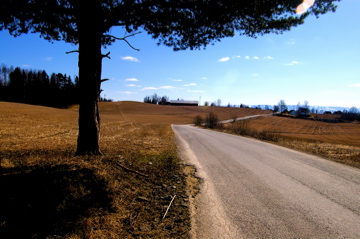
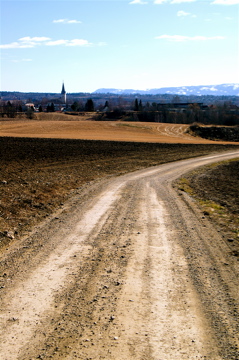
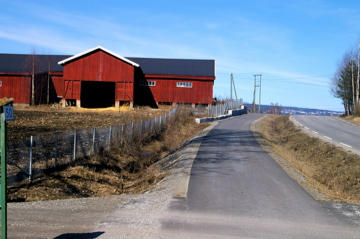
My hometown running crew—PC, Dano, and Double S—will be surprised to learn I have “a route” since I typically make them run a different 10-miler every Saturday.  As my mom says, “Variety is the spice of life.”  I occasionally improvise here, but usually tough out what I’ve labeled the Heritage run. It has a lot to recommend it: no stop lights, not even any stop signs (at my age it’s hard to get started again after stopping); hardly any traffic; as the pics hopefully attest, it’s scenic (even more so when snow covered); and the hills and 650 feet of elevation require an honest effort.

If I led my crew on this run, one of my aforementioned, hill-adverse training partners, would flip me the bird well before the midway point.  I’m only running three times a week because the day after a Heritage run, I like to swim or take the day off.  I’m taking more days off here since no one is waiting outside for me in the morning.  My favorite segment, which I’ve labelled “Grandma’s Stretch,” is about five miles in. I like it because most of the elevation is in the bank and I get to begin cashing it in. Also, it dissects exquisite family farmland.

Through this segment I sometimes picture Grandma Byrnes as a young girl running around the beautiful farms that dot the hills on each side of the road. She emigrated from Norway at age 13. It’s not a stretch to think that Grandma’s Stretch probably looked fairly similar 100 years ago.  

Our Northern Retreat has gone extremely well.  In addition to our new Nordic friends, I’ll miss pounding the bike paths, neighborhood streets, and farm roads that make up the Heritage run.

[Note to runners: between 1:00 and 1:04 depending on the footing, wind, and just how honest an effort.]


Passion

I’m looking at the 4th tallest structure in Europe, the Berlin TV tower, which is 364m high.  The fam and I are at a Fulbright seminar and I spent our first morning trying to get online.  Of course I could have paid the exorbitant fee our hotel wanted, but that would run counter to stipend stretching.  I could post entirely about the last hour, but I think I’ll just hit yesterday’s highlights before retyping the planned post from laptop to internet cafe computer.  And as a sidenote, who gave the German’s permission to move the z and y on the keyboard?

Great Third Reich tour yesterday lead by two youngish American Fulbrighters based in Berlin.  We probably walked five miles in part because a huge half marathon had shut down the bus system.  Damn runners.  The tour was informative and memorable.  The 15 year old was particularly tuned in.  The 12 year old drifted in and out.  The 12 year was enthralled with a sidenote, the hotel where Michael Jackson dangled his baby from a window.  Several pictures were snapped.  Our room is on the 34th floor of a nice hotel with an amazing view in what used to be East Berlin.  Loved the bus rides in from the airport, very gritty sections of former East Berlin.

On to the planned post.  47 minutes of time left, so forgive the rough trans.

Isn’t passion in some form, or to some degree, integral to wellness?

At Lexington Junior High in Cypress, CA, I dreaded my 7th grade Spanish class.  I struggle with languages and the teacher was going through the motions.  The class started at something like 10:20 and ended at 11:10.  I explained to my hombres who were equally bored that our problem was the minute hand (pre digital) had to fight gravity to make its way from the bottom of the hour to the top.  Knowing that didn’t prevent us from endlessly staring at the classroom clock in the hope that someday it might miraculously skip forward.

One of the best barometers of passion is the opposite of my Spanish experience.  When passionately engaged with something, time loses relevance and seemingly stands still.  A few springs ago, A, J, and I stood standing in our family room watching in complete disbelief as L gardened right through dusk and into complete darkness.  Eventually, we gave up on her cooking dinner and turned on the outdoor lights for her.  When she came in dirty, exhausted, and completely contented, she said she hadn’t noticed the sun had set.

What activities give you the most joy?  When does time at least slow, if not stop?  How can we develop passions or maintain existing ones in our work-a-day world?  Do you enjoy camarderie with others who share your passions or are they solitary pursuits?  Are we doing everything we can to help young people develop socially redeeming passions?

These questions bubbled up a couple mornings ago after listening to the head coach of England’s national football team on BBC Radio.

In a tone so serious it’s impossible to exaggerate, he intoned: “Where have our great goal scorers gone?!!!  What are we doing to develop the next generation of great goal scorers?!!!  I had just come to and was semi-conscience so I searched for the transcript online to see if I was imagining things.  While looking for the transcript, I stumbled upon Nick Webster’s blog, which convinced me I had heard correctly.  Here’s an excerpt from one of his recent posts:

“So where are the English strikers and will they ever come back?

With a sick feeling in my stomach, I’m afraid to say that until a major shift in attitudes and social conditions occurs, we’ll not see an Englishman top the scoring charts for at least another decade.  I have three reasons for my pessimism.  Firstly, a lack of street football.  Secondly, a lack of poverty.  Lastly, too much time in front of the TV and video games.  All three reasons are related.

When, I was a kid, we’d play in the streets for hours on end.  In fact, in summer it wasn’t uncommon to have matches that lasted eight hours or more as children came and went.

The score wasn’t that important but scoring always was.  I can still recall great goals from my childhood-from swerving thirty-yarders that Petr Cech would’ve struggled to stop to mazy dribbles that would have Diego Maradona (circa 1986) drooling.

It was in the street that you would try the outrageous finish because it didn’t matter if you missed-you had another seven hours to make amends.

Although I wasn’t from a poor family, there still wasn’t a great deal of money for extra stuff.  The movies were a luxury, malls were non-existent and ice/roller skating was for rich kids.  Football was all I had-and rest assured I’ve played my fair share of games with balls that wouldn’t must FIFA inspection.  The hunger of poverty has often been cited as a major factor in producing the two greatest players in the world, Pele & Maradona-scorers of ridiculous goals.”

Even though I didn’t grow up playing the “beautiful game” and haven’t fully embraced it despite being a soccer dad for the last decade, I want to meet the Nickster because I love his passion.  Forget economic malaise, global warming, the threat of terrorism, poverty, education reform; dammit we need some goal scorers.

Given the Nickster’s logic, maybe Gordon Brown should do everything in his powers to accelerate England’s economic downturn in the hope that a world-class English striker or two might rise from the ashes.  Were that to happen, I’m guessing the Nickster and his football-mad friends might just accept the trade-offs and re-elect Brown. 

L’s life is enriched by gardening, the Nickster’s by football, and yours?

(apologies for the typos, it’s the Germans fault)

First Quarter/Right to Access

A double-entry.  Part one, the blog at the one-quarter mark.  Part two, Norway’s “right to access” law and swimming.

Fifty two weeks, divided by two, equals twenty six, the same number as miles in a marathon.  In that case, we’re just past the 10k mark, a good place to reflect on things.

I’m enjoying blogging and have a fairly lengthy list of topics I look forward to writing about over the next 10k.  And thanks to referrals from regulars I suspect, the number of readers continues to tick upwards.  Life is simpler in Norway, so I’ve had more time than normal to commit to the weekly post; as a result, as you may have noticed, they’ve increased in length.  They’ll probably shrink later in the year when I’m more pressed for time.

A lot of widely read bloggers suggest churning out lots of relatively short, imperfectly edited entries.  In contrast, I typically complete a post 4-6 days ahead of time and then spend 5-15 minutes a day editing it before posting it Sunday night or Monday morning.  Also, as you’ll notice, I don’t list the blogs I most enjoy, some of them written by friends who have recommended my blog to their readers.  I could add them, but I don’t know, it’s an eclectic list and I guess I wonder if just because I like a particular blog, you would too. 

A small proportion of readers choose to post comments, which I understand.  Unsurprisingly I suppose, younger readers account for a disproportionate share of the comments.  Apart from the occasional comments, I have no way of knowing what’s most important to me, the degree to which posts stimulate individual reader’s thinking and spark conversations.

Seems to me there are two distinct ways musicians, actors, writers, or other types of artists—build an audience.  The first is to ignore conventional wisdom, pursue your muse wherever it takes you, develop a truly distinctive sound, voice, perspective, or look, and hope people respond.  A second approach is to continually tweak one’s sound, voice, perspective, or look based upon whatever the artist perceives the majority of people want to hear, read, and see.  In the most extreme form, market analysis or focus group-based art.

In our consumerist society, the first approach is the path less taken.  (Imagine Frost market testing different stanzas within his classic poem!)  The first approach brings Dylan to mind.  When he picked up an electric guitar for the first time, and many of his most faithful followers were livid, he ignored them.  Granted, he already had some commercial success, but ironically, his decision to experiment and pursue his music wherever it took him moved more and more people and his audience continued to grow as he evolved. 

My preference is to split the difference.  I’d like to improve the blog, so I’d appreciate it if you’d shoot me an email or post a comment about which subcategories you are most enjoying reading/thinking about?  Also, what do you think about post length, too short, just right, too long?  Dig the new font?  Thanks in advance for any other feedback you might provide as well.  If you don’t have my email, consider posting a comment at the end of this entry. Also, I could definitely use some business/technical assistance if anyone wants to volunteer their expertise.  For all intents and purposes, I’m clueless on both accounts.  I could use guidance on a host of things including: the best way to copyright my work, website-design improvements or enhancements, and suggestions for building the readership.

Part two.  A few weeks ago I realized one of my deepest held dreams, but before I reveal it, I have to get something of my chest.

Norway has a unique “right of access” law that is explained on the State of Environment Norway website as follows:

[Everyone in Norway has a right of access to and passage through uncultivated land in the countryside, regardless of who owns it. This is of course of fundamental importance for traditional types of outdoor activities. It gives everyone the right to walk in the mountains and forests, go skiing in winter, and cycle, toboggan and ride on paths and tracks.

The right of access to uncultivated land is set out in the Outdoor Recreation Act, and is based on respect for the environment, landowners and other users. The right of free access and passage applies to uncultivated land, but also to cultivated land when it is frozen and snow-covered. It also includes farmyards, plots around houses and cabins, and industrial areas. The right of access does not apply if you are using a motor vehicle.

On uncultivated land, you may go anywhere you like on foot or on skis and picnic wherever you want. You may also put up a tent for the night – or sleep under the stars – but you must keep at least 150 m away from the nearest house or cabin. If you want to stay for more than two nights in the same place, you must ask the landowner’s permission, except in the mountains or very remote areas.

The right of access also involves responsibilities. You must show consideration and care, so that you do not cause any damage or inconvenience to the landowner or other users. You must also respect the countryside: make sure you take everything with you, including your rubbish, and never leave an unsightly campsite behind you.]

How progressive and enlightened right?  Well not if people exercise their “right to access” while you’re TRYING to get in a good swim workout like I just was at the Ankerskogen 50 meter pool.  The fish among my readers know well what it’s like to begin entering into a nice lap-swimming grove only to find Clueless Swimmer heading straight at them.  Why?  Because CS is the only person who starts in the deep end without bothering to ask if they can “split the lane.”  Instead, they’re intent on splitting your head.  Meanwhile, who knows what Clueless Lifeguard is thinking.  This might happen a couple of times a year.  In Norway, multiple those odds by say, 100%, and you begin to approach the likelihood of swimmers exercising their right of access in your lane.  A few weeks ago when I swam at Ankerskogen, it was nearly empty, but that didn’t stop a mom and child from choosing my lane to play in.  You have to be kidding me, there’s an entire OLYMPIC-SIZED pool for you two to practice your somersaults.  I wrote it off as an anomaly, but that was naïve. 

Today was classic.  Norway is the land of the slow breaststroker (insert joke), which I can deal with.  Slow Breaststroker got in MY lane, but I was able to swim around her fairly easily.  That is until SB’s Man Friend joined her and they proceeded to do slow-mo breaststroke side-by-side 5-10 meters in front of me as I was about to begin an interval!  Did they expect me to swim under them?  What did I ever do to them?  I switched lanes and shortly afterwards noticed that the Tandom Breastrokers tired about two-thirds of the way into the lap and decided to recover on the lane lines with their legs straight out in effect shutting down the entire lane.

Just appreciate the cross-cultural differences my arse, that is just wrong.  The only good news in the TB’s universal breach of lap swimming etiquette is that they did the same thing to another lap swimmer a little later.  Until then, I thought they somehow intuited that I was a US citizen, and were taking out their anger over the Iraq War and American imperialism and hegemony more generally on me.

A little later, poof out of nowhere, a few kids appeared right in front of me in MY lane.  I pulled up as if swimming into something in open water only to see the proud parents beaming from the deck.  “Way to exercise your ‘right to access’ kids!” 

Let’s revisit the wording of the law shall we: On uncultivated land, you may go anywhere you like on foot or on skis and picnic wherever you want.  Nowhere does it say, in a public pool, you may do slo-mo tandom breaststroke whenever and wherever you feel like it.  Nor does it say you may play in the one damn lap lane that someone’s working out in.

Okay, I feel better.  Can you tell I’ve entered a new phase of cultural adaptation, one where I’m less likely to romanticize cultural differences and I’m more cognizant of contradictions, imperfections, and complexities?

But fortunately, the news is not entirely downbeat on the swimming front.  As mentioned, one of my long held dreams was surprisingly fulfilled recently . . . if only temporarily.  I’ve always thought it would be way cool to have access to a lap pool that I could swim in whenever I’d like.  No time restrictions, no Biannual Pool Guy swimming next to me every third fifty, no Clueless Swimmer heading straight for me, no Tandem Breaststrokers blocking my path, no lifeguards to tell me I can’t run on the deck or see how far I can spit water in the shower.  Turns out, Hedmark College University, my current base, has a pool that’s occasionally used by students.  Recently, I received an invite to swim with a couple of faculty on Tuesday at 7:45a.m.  They were great, both about 60 years old.  One said, “We are two boys, and we swim, oh about 500-600 meters and then sit in the sauna.”  I was invited to join the boys in the sauna, but opted to swim a bit more than 500-600 meters.  We three boys had the pool and fitness center to ourselves.  And I’m happy to report neither of them breaststroked into my lane.  It’s a decent, five-lane wide pool, but quite short at 16.67 meters.  Lord knows I need work on my flip turns, plus, the price is right.

As I dressed after that first swim, I started to connect the dots.  I have a key card to the building and locker room.  So don’t tell anyone, but I’ve started going solo.  Not as good a workout as normal since everything is broken up with all the pushing off.  I can tell I “recover” a bit with every one to two second push off.  But beggars can’t be choosers, and in my opinion, solitude and swimming are the perfect way to start the day.  When do I want to swim next?  The mind whirls. 

Creating an Active Lifestyle

After reading my fitness story, a sedentary friend wrote (well not really, but it’s a nice literary device), “Okay Ron, I liked your story, but what should I take from it?  I’ve failed at repeated attempts to create an active lifestyle.  For a change, don’t be an egghead academic, just spell out the implications of your story as simply and specifically as possible.”

Here’s my best shot. 

1.  Stop using time constraints as a rationale for a sedentary lifestyle.  Until you start creating positive momentum through a modest routine, be honest with yourself and say, “Being fit isn’t important enough to me yet.”  My sedentary friend might say, “You were a grad student without children.  I work longer hours and have more family responsibilities.  Don’t have the time.”  This line of reasoning perplexes me.  Has everyone else except me completely mastered time management?  Below I suggest exercising one to four hours a week for the first several months.  Are people really so time-efficient that they can’t squeeze out one to four hours a week? 

2.  Focus on improving the quality of your life more generally and let weight loss be a natural by product of developing an active lifestyle.  My initial goal wasn’t to lose weight, get ripped (obviously), or win races, it was to become more disciplined in the hope that it would carry over into my life as a doctoral student researching and writing a lengthy dissertation.  So instead of starting with the normal question, “How much weight should I lose?” forget the scale and think about the other areas of your life (diet, personal finance, family commitment, spiritual devotion, etc.) that might improve if you develop greater self-discipline through a consistent fitness routine.  Positive spill over.

3. Set manageable goals and be patient.  Don’t expect to get fit in a few weeks or months.  When I was sedentary and soft, I wasn’t as overweight as most Resolutions and I was young, so you may want to adjust downwards from my modest starting point, 20 minutes, 4-5 days a week.  First month, one to one and a half hours a week of walking, swimming, rowing, cycling, or light jogging.  Month two, two hours a week.  Month three, three hours a week.  Month four, four hours a week.  Sometimes when I travel and find myself in a hotel fitness center, I marvel at Treadmill Guy doing his annual workout.  He’s recognizable by his spare tire, ALL OUT pace, streams of sweat, and precarious position near the back edge of the treadmill.  I resist telling TG what I’m thinking, “The Olympic Team has already been selected.  Slow down for pete’s sake, so that when you’re done there are positive associations with the activity and you don’t dread your next workout.  It took years of sitting still and eating poorly to get that out of shape, so it’s going to take just as long to become fit.”

4.  For the first year, do all activities at low intensity.  Many triathletes use a training pace frame of reference based upon “perceived rate of exertion”: easy, steady, mod-hard, and hard.  Do all activities during the first few months at an easy pace meaning it’s easy to maintain a conversation.  Feeling frisky after a few months, accelerate a bit to “steady,” which means you can still maintain a conversation or sing “Serpentine Fire” outloud with Earth, Wind, and Fire on your iPod (actually, stay away from “The Elements” because they’ll transport you to mod-hardville faster than you can sing “When I see you’re face like the mornin’ sun you spark me to shine.”).  Save the mod-hard and hard stuff for years two and beyond.  More Norah Jones and less Nelly. 

5.  Avoid comparing yourself to more experienced walkers, runners, swimmers, or cyclists.  I’m competitive, but as I was getting going, I channeled my competitive energy into a training log where I recorded distances and times.  Instead of asking myself, can I keep up with that stud down the street, I wondered whether I could go a bit further than last month, or whether I could run a regular route 15 seconds faster than normal.  When I competed, it was against myself, and truth be told, I continue to do that.  This is where Treadmill Guy’s friend, Biannual Pool Guy, get’s tripped up.  Sometimes when I’m in the middle of a 500 or 1,000 free in the pool, BPG will wait for me and time his push off as I’m completing my flip turn.  He does his best to hang for two laps, rests for a few minutes, then repeats.  I get a kick out of this, but BPG would be much better off working up to a continuous 500 free at his own “just getting into swimming” pace.  One’s ego can conspire against slow, steady, and evolutionary progress.  Also related to pacing, conventional wisdom is to find training partners, preferably people a bit stronger and faster.  That’s definitely helpful for competitive athletes, but I don’t think it applies to someone starting to piece together an active lifestyle.  My advice, start out alone or find someone whose fitness is just as much a work in progress.

6.  Pay attention to and celebrate subtle signs of progress (I didn’t breathe quite as hard on that hill, I wasn’t quite as tired at the end, I had a bit more energy at work today, etc.) in order to create positive momentum.  Once a weekly rhythm is established, positive momentum will kick in.  For example, once I got into a weekly exercise groove, I gradually started to eat more healthily.  My thought process was, “Tomorrow’s run will be less difficult and more enjoyable if I eat x instead of y or 1/2x instead of x.”  Gradually I began to develop a base level of fitness to where I could run 3-4 miles without becoming winded or do a 1,500-1,800 meter swim workout with ease.  As I burned more calories and switched to a lower-fat diet, I lost weight; as a result, my shortish workouts at an easy/steady pace became even easier.  Positive momentum.

7.  Keep your “I should probably be working out right now” wasted time to a bare minimum by exercising first thing in the morning and/or commit to meeting a workout partner at an appointed time.  Also helpful, organize your workout clothes/equipment and the next day’s breakfast/work clothes/lunch the evening before to expedite getting to work and gradually move up your bedtime about the same number of minutes as your intended workout.  Other excellent solutions to the time dilemma, if at all feasible, do some of your commuting or errands on foot or bicycle.  Related suggestion, if you hook up with a training partner, be the type of training partner you want to have.  His conservative politics and predictable routes aside, my ace running partner, MC, also known as PC, is the gold standard of training partners because he’s as consistent and prompt as a German train.  We run three or four days a week at 6:15a.m. in all conditions and if either person is 90 seconds late, we know it’s due to a rare communication breakdown.

8.  Use exercise to develop a deeper, more intimate feel and appreciation for the natural world.  A couple of women who live on our street are committed walkers.  I bet they walk an hour a day every day, but I don’t understand why they loop our neighborhood over and over and over.  They don’t have small children at home so my guess is it’s just a habit.  There is a park with nice wooded trails easily within reach, but to each is own.  I guess it’s better than exercising mostly indoors.  My suggestion is to break out and find a wooded trail to walk or run on, pedal into nature, or find open water to swim or row on when the mercury rises.  As a result of doing those things, I feel a deeper connection to my corner of the world.   

9.  After a few months of consistent exercise, consider signing up for an event, such as a 5k walk or run, or 30 mile bicycle ride, as an added incentive to train.  If you do sign up for an event, reread number five first.  Some people get caught up in comparisons and commit to especially difficult events like a marathon or Ironman distance triathlon that are way beyond their level of fitness.  Sometimes the event is so difficult it’s mostly a negative experience and has a detrimental effect on their medium to long-term effort to build a consistent fitness routine.  One and done-ers.  Do some 5ks before your first 10k, some 10ks before your first half marathon, a 100 kilometer or metric bicycle century before your first 100 miler, some sprint triathlons before your first Olympic, and several Olympics before your first half Ironman.   

10.  After you develop a lifetime commitment to fitness, remember the sedentary chapters in your life and encourage others who are striving to get fit regardless of their starting point.  A few years ago, after returning from a dinner-hour swim workout at the Y, I said to L, “Water aerobics is a joke.”  “What are you talking about?” she asked.  “Every person in the water aerobics class tonight was seriously overweight.”  In hindsight, that was one of the more ignorant and arrogant things I could have said.  I didn’t know what any of the participants weighed a few months or a year earlier.  Maybe they were just starting to make the lifestyle changes that would lead to improved health.  They weren’t sitting at home on the couch eating and watching television; they were working out in sync with what I’ve written here.  They deserved respect and encouragement not disdain.   I forgot that I had been sedentary once.  Besides, as my running, cycling, and swimming training partners like to remind me, there’s always someone more fit.  A great Swahili phrase comes to mind, harambee, which translates, “Let’s all get together and push.”