
Friday Assorted Links

1. When Being a Humble Leader Backfires. I greatly prefer leaders who error on the side of humility, but these findings makes sense.

“Our findings show that you can increase team effectiveness by being humble only if team members expect a leader to display that characteristic. Pay attention to what values the team holds, and adjust your behavior accordingly. If your team demonstrates a desire to share power, your humility can encourage more dense and frequent information exchange and promote creativity. In teams where the unequal distribution of power is accepted, however, members are likely to expect you to take charge and make important decisions. In these circumstances, showing weakness through humility can be counterproductive.”

The challenge then is correctly reading your team’s expectations.

2. Disparities Persist in School Discipline.

“Black students represent 15.5 percent of all public school students, but make up about 39 percent of students suspended from school. . . .”

The report from which this statistic springs will frame the final exam of my “Multicultural Perspectives in Classrooms” course the next time I teach it. Take home exam. 1) Why do those disparities persist in school discipline? 2) What can/should teachers, administrators, and others do to eliminate the disparities? Why?

In question one I’ll be looking for references to educators’ implicit biases, or more specifically, their negative preconceived notions about students of color. I will also be looking for references to “teacher pleasing behaviors”, or more specifically, how white, middle class students tend to catch breaks because their mannerisms are far more familiar to their predominantly white, middle class educators.

3. In historic first, an American Indian will lead Seattle Public Schools.

4. From tests to sports to music recitals, competitive activities can wreak havoc on a kid’s confidence. This piece is sorely disappointing because the journo fails to ask the all-important question: whether kids need to compete as early and often as they do. My answer, no they do not.

Monday Assorted Links

1. Michigan’s sixth man is easy to root for.

2. Some headlines are better than others.

3. American adults just keep getting fatter.

My brother and his partner, as I learned last week, walk 1 mile around their block every night without fail, right after dinner, without even picking up the kitchen.

4. Props to Bill and Melinda for acknowledging that teacher evaluation efforts haven’t shown results.

5. The worst part of Trump’s presidency so far.


We Kid Ourselves

We tend to exaggerate our importance to our workplaces. The longer someone has been at a job, the more inclined they are to think they’re irreplaceable. In actuality, after I leave my job, and you leave yours, things will be just fine.

I realize that because I’ve been thinking about how many times my co-workers mention the three people who have left for other jobs or retired in the last couple of years. The harsh reality of it is hardly ever. The saying “Gone, but not forgotten,” doesn’t jive with my experience.


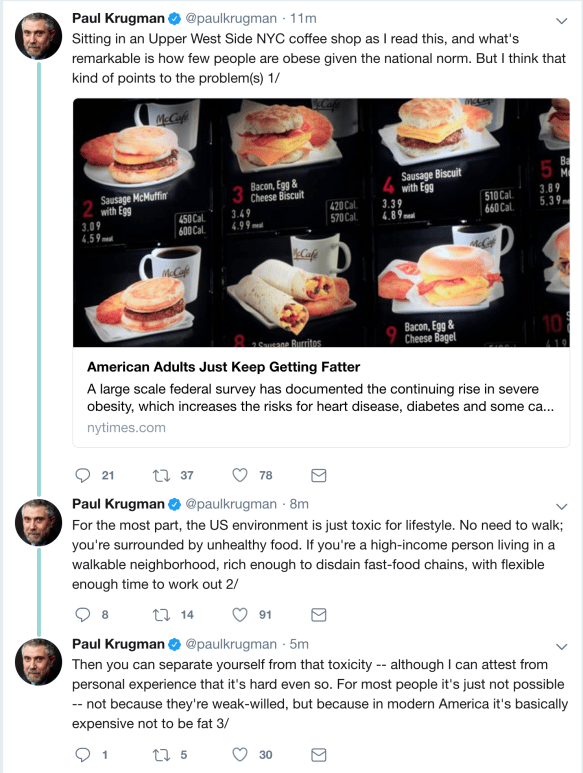
A Nobel Prize Economist Thinks People Are Fat Because They’re Poor

Screen Shot 2018-03-23 at 12.07.15 PM.png

Dear Paul,

Normally, I’m down with your writing, but this particular twitter stream of yours makes liberalism an easy target. People, whatever their economic standing, have some agency. I must be a bad liberal because I do not believe there’s a vast Republican, capitalist conspiracy preventing the poor from walking, riding bicycles, and passing on fast food if they choose. But then again, I’ve never won a Nobel Prize.

Sincerely yours,

Ron

Very Good Sentences

From Rachel Sherman’s, Uneasy Street: The Anxieties of Affluence.

“A more egalitarian distribution of resources across communities (national or otherwise) can be defended as a morally better form of social organization because it benefits more people and, ultimately, society as a whole. But advancing such a perspective is still no easy task. Wealthy people tend to resist giving up their short-term advantages, and their outsize political and media power means that they disproportionately control both the terms and the outcomes of the debates on these issues.”

Next, I think I’ll chip away at The New Yorker mountain that has formed over the last few months. Speaking of which, it’s not every day I get to say that a colleague and friend has a poem in The New Yorker. Such a brilliant writer.

On Tact and Diplomacy

News alert, we live in hyper-partisan times. Because so many people are on edge, tact and diplomacy are at a premium. The Right refers to this as “political correctness”, I think of it as civility.

When it comes to your thoughts though, I’m happy to report that you still have unlimited freedom. It’s perfectly fine for extremist conservative or liberal or anarchist or whatever thought to percolate between your ears. You may even be so bold as to journal about all of your wonderfully extremist thoughts.

We have daily reminders though of the costs of letting those thoughts bubble out without much consideration for how they are going to be received by others. Think of those as “What was he or she thinking?” moments. The answer of course is they were not, at least not enough.

During this morning’s run, I listened to a National Public Radio story titled “Olympia Braces For Change, But Some Homeowners Aren’t Thrilled”.

The story in short:

“Leaders in Olympia are trying to adapt to changing demographics and make room for an influx of new residents, but their plan is rankling some homeowners.

City leaders are considering changes to zoning across roughly two-thirds of the city that would allow for more of what they call “missing middle” housing in single-family neighborhoods.

That ‘middle’ is multi-family housing that falls between a single-family home and an apartment building, such as a duplex, triplex, townhome, cottage, or accessory apartment.

Olympia officials hope is to address a mismatch in the housing stock: 70 percent of the city’s households are just one or two people, yet much of the city’s housing is single-family homes designed for larger families.”

Enter Bob Jorgenson:

“’The potential changes we’re talking about are going to be basically a reverse re-gentrification of a neighborhood,’ said Bob Jorgenson, who has lived in Olympia for 30 years. ‘We’re going to be putting multi-family where multi-family is not appropriate.'”

Bob’s opposition to the policy seems reasonable enough, ultimately, he’s just exercising his First Amendment Rights. But these are not ordinary times and Bob’s problem is he’s woefully out-of-touch with the larger context of growing income inequality in the United States and rising homelessness in Olympia.

Then there’s the “money” sentence in the short, illuminating story:

“Jorgenson, who created a Facebook page to rally residents against the plan, said he’s worried about worsening traffic, declining home values, and changing the aesthetics of single-family neighborhoods.”

Changing the aesthetics. For shitssake. It’s okay to think like Bob, but if you care at all about living peacefully with your neighbors, keep your self-centered, politically regressive thoughts to your self.

Bob cares more about the looks of his neighborhood than he does growing inequality, poverty, and homelessness. I predict Bob is going to get creamed tonight at City Hall at 6:30p.m. It’s dinner date night with the Gal Pal. Maybe we’ll go to Ramblin’ Jacks and hop across the street afterwards to watch Bob get tarred and feathered for being inexcusably out-of-touch.

Maybe I’ll even boost his spirits with a gift, a notebook, in which he can journal all about single-family neighborhood aesthetics.

Wednesday Assorted Link

1. What to do when you inherit old family photos.

Answer, “hire an organizer to help you.” A “new economy” job made for Jeanette Byrnes.

2. Woman in Turkey seeks divorce over husband’s bicycle “obsession”.

Oh oh.

3. Officials in jail after Burundi President is “roughed up” in a football match.

How long until Trump starts jailing golf partners who outplay him?

4. At 15, Juggling Freshman Year and an International Squash Career.

“In juniors, you can go for shots from the backcourt and run to get out of situations. The pros are much more disciplined. They’re stronger and more physical. But in the end, it’s all about competing. And I love to compete.”

5. A dose of Korean Peninsula reality.

6. Why white evangelicals abandoned their principles for Donald Trump.

Early Michael Gerson, “As I worked on the piece and read a lot of these [evangelical] leaders, it really dawned on me that a number of them were happy that Trump was hitting back at people who disdained him. They feel they’ve been bullied, and they want powerful pushback. I find that psychologically understandable, but it has literally nothing to do with Christianity, or the ethical tradition of Christian social engagement”

Later Michael Gerson, “. . . if you’re a leader, an evangelical leader, there’s something more at stake here. You’re discrediting a set of views that are really important. You’re associating your faith with bias and white grievance, and that is a very serious matter.”