Spreading Kindness

Inspired by Ann Braden’s “Flight of the Puffin” fourth and fifth graders are making and sharing kindness cards with people in their school community. 

Fifth grader Hazel Uvenes reflects:

“The person who gets the card knows that they are kind and different and amazing in their own way. I think it’s really great because sometimes the littlest things can bring somebody out of a bad day.”

She added:

“I think maybe it could uplift their spirit a lot, and they feel like they can have fun, they believe in themselves, they can be kind to others. . . “

Soon the students will share their kindness cards with local organizations in order to brighten even more people’s days.

Lincoln-Kindness

Monday Required Reading

You Can Learn to Love Being Alone.

“People who pursue solitude of their own volition ‘tend to report that it feels full — like they’re full of ideas or thoughts or things to do. . . . In this way, it’s distinct from loneliness, a negative state in which you’re disconnected from other people and it feels empty.”

Putin’s Bloody Folly in Ukraine.

“As Putin spills blood across Ukraine and threatens to destabilize Europe, Russians themselves stand to lose immeasurably. The ruble and the Russian stock market have cratered. But Putin does not care. His eyes are fixed on matters far grander than the well-being of his people. He is in full command of the largest army in Europe, and, as he has reminded the world, of an immense arsenal of nuclear weapons. In his mind, this is his moment, his triumphal historical drama, and damn the cost.”

The style and substance of South Carolina basketball’s Dawn Staley.

“‘She loves on them hard,’ associate head coach and longtime confidante Lisa Boyer says. ‘She’s playful with them, she’s hugging them, she’s there for them. I think they sense the fairness. I think they sense the genuineness of her. She speaks to them — it’s not some fairy tale. She’s telling them the deal.'”

“‘I owe basketball,’ Staley says. ‘I’m forever indebted to it. It engulfed my life for the positive. The game has gotten more of my time than my friends and my family. I feel like on a smaller or larger scale, it can impact my players’ lives in some kind of way.'”

A Renowned Community of Quilters is Taking on Copycats—and Winning.

“’We put a lot of work into it, and it’s about our life,’ Charley says of quilting. . . . We used these quilts for warmth. It was about our struggle, and our survival.'”

“Charley might feel differently, she offers, if these makers — who may have, say, studied textiles at art school — sent some of their profits back to the community that inspired them. But that doesn’t happen. “This work is ‘inspired’ in your mind, because you see the quilt pattern,” Charley says. “But you don’t know my story. And you’re going to try and duplicate it — and go to Joann Fabrics to do it?’”

The Age Of ‘Anti-Ambition’

A phrase for our times by The New York Times’ Noreen Malone. Subtitle, “When 25 million people leave their jobs, it’s about more than just burnout.”

Among the insights:

“. . . last month a Business Insider article declared that companies ‘are actively driving their white-collar workers away by presuming that employees are still thinking the way they did before the pandemic: that their jobs are the most important things in their lives. . .'”

“. . . a Gallup poll that showed that last year only a third of American workers said they were engaged in their jobs.”

Malone adds:

“Recently, I stumbled across the latest data on happiness from the General Social Survey, a gold-standard poll that has been tracking Americans’ attitudes since 1972. It’s shocking. Since the pandemic began, Americans’ happiness has cratered. The graph looks like the heart rate has plunged and they’re paging everyone on the floor to revive the patient. For the first time since the survey began, more people say they’re not too happy than say they’re very happy.”

Given the constant updating of statistics, the physical devastation caused by the pandemic is obvious. In contrast, the negative mental health effects lurk below the surface. If like me, you’re firmly on the ‘happy side’ of the ledger, keep in mind that we’re in the minority. Consequently, let’s strive to grant others more grace than normal.

2021 Sportsperson Of The Year

This morning I asked the GalPal if she wanted to say anything on behalf of her candidacy for 2021 Sportsperson of the Year. But instead of touting her 2021 athletic greatest hits, she declined, saying, “I’m not into competition anymore.” 

How ironic because that’s exactly what this year’s winner says in the middle of this short documentary about what I’m deeming 2021’s Athletic Accomplishment of the Year. 

I present to you, the 2021 Sportsperson of the Year, Lachlan Morton and the 2021 Athletic Accomplishment of the Year, The Alt Tour.

What is there not to love about Morton? Among other attributes that tipped the scale his way was his self-awareness, his social conscience, his sense of humor, his commitment to fun, and his utter lack of ego. 

Sportsperson of the Year honorable mention goes to two athletes who, like Lachy, also inspire lots of other people without much media coverage at all (not counting Strava and Insta).   

Jeanette Byrnes for her commitment to open water swimming and monthly open water plunges sans wetsuit. #nails 

Dan, Dan, the Former Transportation Man for sticking like velcro for another year to the Boon Running Team, of which I am a proud member, despite giving up 2-13 years to the youngish, handsome “legends in their own minds” that make up the team. #nails

Sports Accomplishment of the Year honorable mention. M.A.’s inaugural marathon at 62 years young. Way to go rook.

The best of the rest: Tom Brady. 

How To Make A Positive Difference

A fall semester postscript.

When evaluating their progress at the end of the semester, my first year writing students say the same thing over and over. “In high school, all we ever did was literary analysis. Intro. Three body paragraphs with supporting details. A conclusion. I learned the formula, but it was mind numbing.”

Why are secondary teachers stuck in literary analysis mode? Is it as simple as teaching to Advanced Placement tests? If so, maybe we should risk the ire of parents determined to pass their privilege on and ditch Advanced Placement altogether.

Why not ask students to occasionally write about themselves in the context of big questions? To be introspective. To dare to be personal. To be philosophical. It takes some of my students longer than others to pivot to first person “I”, but eventually everyone sees value in it. Some experience an immediate awakening. For example, in one final paper a student wrote, “I don’t think I truly understood myself until this class because I never contemplated my biggest motivators. Why doesn’t my mom love me? Why do I feel so insignificant? Am I enough?”

K-12 teachers might reply that they’re not therapists so why venture into personal rabbit holes. I’m advocating for public, group-based community; not private, individual therapy.

Another student explained the difference especially well:

“Even on the days with the best attendance, our classroom does not exceed twenty people. This has allowed us to know each other on a deeper level than that of just classmates. I feel as though each person in class is now someone I can call my friend. Through group discussions, the sharing of intimate parts of our lives, and just laughing together in general, we have discovered all the similarities each of us share. As a group, we have formed our own sort of community, filled with people of all different majors and parts of the country. I can confidently say that I have learned just as much from talking to my classmates as I have from the assigned class readings.

Despite the different reasons for each student being placed into Writing 101, we are each leaving the class with one commonality. We formed a special little community built on finding our footing in a new place, trust, and compassion. . . . We made connections that could last a lifetime and learned lessons from one another that changed our perspectives.”

Since classmates don’t assign grades, students are socialized to pay attention exclusively to their teachers. Watch for yourself, in the vast majority of classrooms, students completely tune out one another.

Dig this paradox. My teaching is most consequential when I fade into the background and get my students to listen to, and learn from, one another.

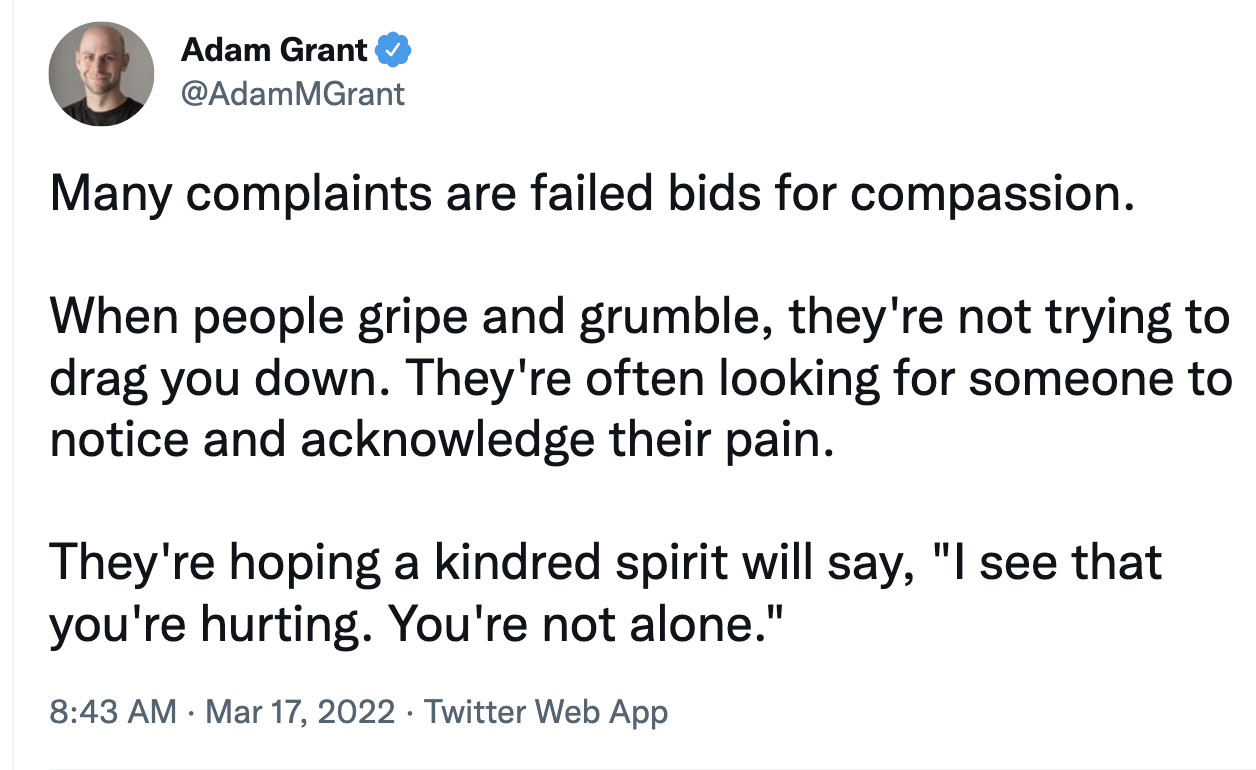
Wednesday Required Reading

The ‘Mighty Mo’ begins her second century as a swimming champion. Thanks DB.

10 New Dating Slang Words To Know In 2021. Ladies, I’m tired of all the breadcrumbing.

Researchers shrink camera to the size of a salt grain. More University of Washington academic prowess.

Why there hasn’t been a mass exodus of teachers.

The latest imitation calls an academic journal’s integrity into question. LOL.

Tell Someone They’re Amazing

In preparation for tomorrow’s writing seminars, I’m rereading old final papers to select a few to share with my current students who are writing their fifth and final ones of the semester. In short, the final paper is a self-assessment of the progress they’ve made throughout the semester.

One former student wrote:

“This course has had a profound impact on the way I think about writing and life. I have become a stronger conversational writer with more confidence in my abilities, and I have been encouraged to continue writing outside of an academic setting. Now I really enjoy informal writing: I am planning on writing an op-ed in the Mooring Mast (the school newspaper) and am even applying to work at the Writing Center at Professor Ron’s suggestion. Without his support, I would not have had the confidence to make that decision.”

Thanks to their elementary, middle, and high school teachers; and parents I presume; about a third of my first year students have really high ceilings as writers. And over the years, I’ve gotten better and better at helping them realize their writing potential. I do it by telling them they’re amazing. While they’ve earned good grades throughout their lives, they’ve received very little or no meaningful and specific praise. The good grades don’t add up to much over time and many of them lack confidence.

I make a boatload of electronic comments on every paper. Some are suggested revisions, but many others are smiley faces, comments like “really excellent paragraph” and “nice insight”. At first their insights are sentence-long, now they come in waves of paragraphs. I always end with a long comment where I highlight their clearest strengths and next steps and often conclude by telling them how much I enjoy reading them. Upon returning papers, I follow up in class with praise for their last writing effort and positive examples of their improving work.

Those are some of my ways of telling them not that they’re “A” students, but that they’re amazing young adults. Pete Carroll, of the 3-8 Seahawks LOL, refers to it as “relentless optimism”.

Like my students, we lack confidence that there’s anything amazing about us. We could change that if we started telling family and friends what we most appreciate about them.

The Good Wife is grieving the loss of her mom and dad. Last night, in an attempt to cheer her up a wee bit, I told her she had been an amazing daughter to them for the last five years. She replied, “I have?”

I couldn’t believe that she was too close to it and too hard on herself not to see how amazing she had been. Flying to see them in Central California repeatedly, moving them to Washington State, and then putting her life on hold for the last year as their needs grew exponentially. Lovingly and completely selflessly caring for them to the end almost by herself.

It wasn’t her fault that she wasn’t sure she had done enough. Because no one had told her she was amazing.

Next Level Philautia

Ancient Greeks had six distinct words for different types of “love”, eros, philia, ludus, pragma, agape, and philautia. Philautia is self-love. The more you like and feel secure in yourself the more philautia you enjoy. 

In this recent New York Times personal essay, “I Just Turned 60, but Feel 22“, Margaret Renkl provides the single best example of philautia of all time.

“The joking birthday cards that start coming at 40 were funny 20 years ago because they were so far from reality. Now they’re funny because they’re so true. One of the cards I got last week featured a vintage photograph of plump women in swimsuits who looked remarkably like me in my swimsuit. “At your age, swimming can be dangerous,” the card read. “Lifeguards don’t try as hard.”

I laughed so hard, my belly jiggled, a feature of being 60 that troubles me only a little. This is just who I am now, a person who looks exactly like her late mother, despite far more exercise and a far healthier diet. Besides, I loved my mother, and I love seeing her again in every store window I pass.