
April Miscellania

• The wife got me with a pretty good April Fools, said the new car “wasn’t starting in the morning” and “we should have someone look at it.” I had to return serve. So a few hours later I told her “Good news, the NYT is reporting that young trendsetters are dying their hair gray.” She laughed heartily until I said “April Fools!” That fact that it wasn’t a joke, is now the joke. That’s just the multi-layered way I roll.

• Got some rare direct blog feedback at dinner last week. One of my sibs said indignantly, “Why should anyone care about the details of your fitness routine?!” I explained those posts are primarily for Lance. Consider them optional, not required reading. Lance NEEDS to know how hard to work to maintain his running and cycling superiority.

• So here’s my indignant sib-adjusted fitness report for March. Battled a micro-tear in one calf and then threw my back out lifting/twisting dumbbells to and from the rack without my legs. Lost about a week. Swam 23,900m; cycled, 340; ran 97. WOM (workout of the month) was a 33 mile ride and 2.25 mile run with my 22 year old uber-niece who is about to kick some serious butt at the College Nationals Triathlon in Texas.

• March Madness update. The WSJ computer and I are currently in sixth or seventh place out of eleven in the office pool. If Duke wins, I will probably end up on the podium, but no one remembers who came in second. The first five participants don’t even follow college bball. I’m actually glad computers apparently can’t quantify something as complex as a 64 team tournament. It won’t be the same when it goes to 96 teams. Classic case of less being more. Of course this year I wish it had been 196 because then UCLA might have qualified.

• This recent David Brooks essay is one of my favorites of his of all time. Brooks got killed by the most recommended commenters. I found some of their comments perceptive, but most of those were of the “Look at me, I caught you being inconsistent” variety. No one is always perfectly consistent. Many of the most recommended comments struck me as weakly argued, mean-spirited, knee-jerk liberalism. I’m a liberal, but not a fan of knee-jerkism of any variety. Very easy to criticize especially so indirectly. I give Brooks credit for courage. He knows he can’t win when it comes to most NYT readers.

• Personal record for blog readership in March 2010; however, no reason to get carried away, you’re still a member of a select group. For reasons I’m not entirely sure of, people never comment on my personal finance posts, so I think I’ll retire that thread. Even though readership is up, commenting is not. Maybe I’m not angry enough? Maybe I need to tap my inner-Glenn Beck. Also, for reasons I’m not entirely sure of, I can’t get many readers to follow the small number of links I sometimes include. Case in point, you didn’t even open the previous Brooks’ link did you? I know everyone is pressed for time and I appreciate the fact that more people are at least logging on and skimming posts.

• Turns out I was exaggerating when I wrote that I’d pay anything for an iPad. I have not ordered one yet not because I wanted to read the reviews that were just published and let the application/software dust settle a bit. I anticipate buying one sometime before the summer equinox, but as a card carrying late adaptor, if so moved, I reserve the right to postpone the purchase indefinitely. Not owning one won’t stop me from adding “Sent from my iPad” on the bottom of my emails. Faux tech cache. Sometimes I amaze myself.

• Speaking of email, publicly admitting that I suck at it in my last post proved cathartic. Oddly, it inspired me to turn over a new email/internet leaf captured in this sticky note. Three days later, I’m stickying to it. Now email is not the boss of me, I’m the boss of email!
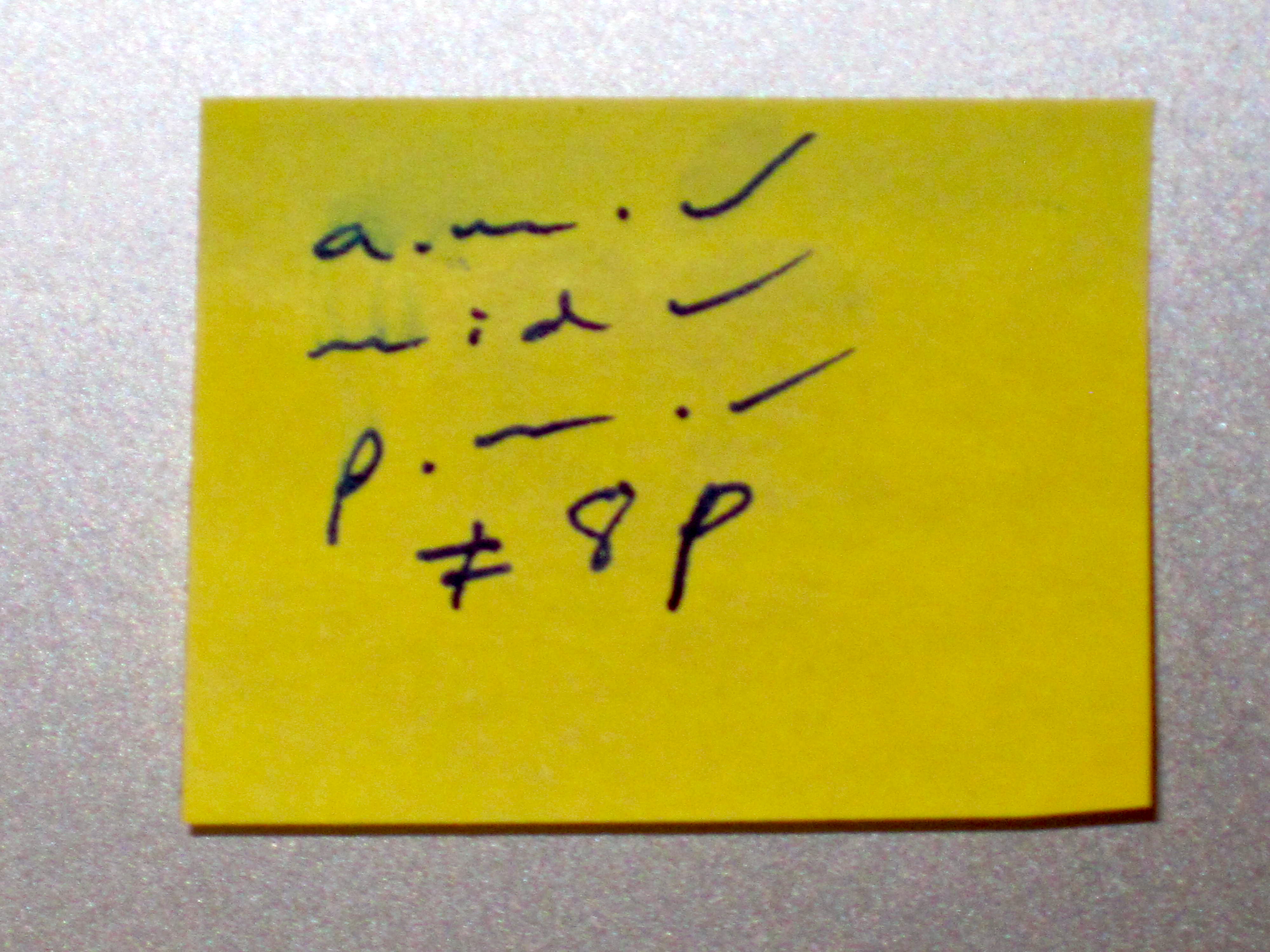
The note doubles as a logo cover, sorry Apple

Not Sure

What’s the optimal timeframe for “To Do” lists, a day, a week, a month, a year, a lifetime? I’m not sure. A day seems far too short, a year and lifetime unhelpfully long, unless the list is filled with BHAGs. For some people it’s all about the week ahead and the Sunday p.m. planning is key.

Maybe the optimal timeframe boils down to the nature of the “to dos” on the list. The vast majority of mine are of the daily/weekly variety and that’s probably why I get stuck in “tyranny of the urgent” mode. Of course it feels good to check off “clear my inbox,” “read papers 2.1-2.4,” and “call X back,” but only on the surface because it’s frustrating not to make progress on weightier, more meaningful medium and/or long-term projects.

If I subdivide my “To Do” list into daily, weekly, and monthly subsections, I predict I’ll still get stuck in the daily thicket. I’ve read some productivity lit and I think I need to breakdown my medium and or long-term project-related “to dos” into numerous small, specific “to dos”. I should also take more time to “plan backwards” by figuring out when I want to complete the medium and long-termers and then determine what intermediary steps and related deadlines make the most sense.

Truth be told, determining the perfect timeframe and wording my “to dos” with greater specificity probably won’t result in a radical increase in productivity. For that I think I need to combine improved “to doing” with greater self discipline to read and immediately act on email once in the a.m. and once in the p.m. Right now, there’s too much email water torture going on.

Alienation of Affection

Try to keep up. North Carolina is one of seven states that allows a married person whose marriage has ended to sue another person for what’s referred to as “destroyed affection”. I learned this when a friend in NC informed me through a newspaper link that a woman I used to work with was recently sued for allegedly breaking up another woman’s marriage. Then I heard the story on the BBC via NPR.

The woman who brought the suit was separated from her attorney husband who apparently had an affair with my acquaintance. He was one of the college’s attorneys and was co-writing a book with my acquaintance who was the Dean of Student Life. Makes me wonder if Tiger has a bunch of books coming out shortly, but I digress. The victim of “destroyed affection” argued she had a “good long marriage” until younger co-author hussy “came along and maliciously destroyed it”.

An interesting twist, in bringing a suit like this, you don’t have to show that anyone had sex with anyone else, just that he or she (joke alert—I’m betting it’s almost always “she” because we know men are much more respectful of the marital covenant, I mean no one was hitting on Elin Woods) destroyed the affection in the marriage.

Apparently, people bring about 200 cases a year of “alienated affection” and the most anyone has won is something like $1.9m. The woman in this case won $9m, thus the media spotlight. I’m guessing my acquaintance, who is now Dean of Student Life at another college in another state, makes $80-90k/a year, so good luck collecting.

A couple of implications of this bizarre legal drama spring to mind. Penelope Cruz, if you’re reading this, you should know my wife isn’t a particularly litigious person, but hey you never know. Just to play it safe, maybe you should stop making movies for awhile. And to the older guy at church, yeah you know who you are buddy, who keeps bugging the gal pal to go on a “bike ride”, don’t think I don’t know what that’s code for. In fact, to the gaggle of guys at the “Y” who constantly tweak their swim schedules to overlap with the person I’ve enjoyed a “good long marriage” with, consider yourself forewarned. Alienate her affection and I WILL go legal shock and awe on all of yous.

Dearest Daughters

Dearest Daughters,

Wondering what all the healthcare hoopla has been about lately? Long story short, Congress just passed a law that will result in significant changes to the ways Americans pay for health insurance, pay for healthcare, and receive healthcare. Many of the changes go into effect in between 2014 and 2018.

Congress has been trying to improve our health care system—which represents one-sixth of our economy—for fifty years. The vast majority of Congressional Democrats voted for the bill and every single Republican voted against it. Democrats are celebrating and Republicans are vowing to repeal the law and win more seats in November’s election and regain majorities in the House and Senate.

Almost every Democrat supported the bill and every Republican did oppose it because they define “fairness” very differently. Their different ways of thinking relates to the “what’s fair” discussion we had a week ago about high school sports. Is it fair for schools to cut kids whose families can’t afford to pay for their children to play club volleyball, soccer, or baseball year-round? Similarly is it fair that people who make little money pay between 0-15% of their income in taxes and people who make large bank pay 28-35% or more?

Most Democrats would say no it’s not fair to cut mostly “non-clubbers” and yes it is fair to have a progressive tax system where the more you make the larger the percentage you pay in taxes. Otherwise, the gap between the “haves” and “have nots,” whether high school athletes or ordinary citizens, will widen so much that the American ideal of equal opportunity will be imperiled, and eventually, our quality of life will be compromised.

Most Republicans would contend that the only fair approach is to cut completely independent of “club status” and institute a “flat tax” so that everyone, regardless of their income, pays 18% for instance. More specifically, Republicans would say it’s patently unfair to penalize kids whose parents have worked hard, saved their money, and want to spend it to help their kids excel at sports? And with respect to taxes, it’s unfair to penalize people who have worked hard in school, excelled in the job market, and earn large bank.

In response many Ds would say people who excel in high school or life do so because of subtle and not so subtle advantages that build from birth, through school, and into adulthood. Put differently, privilege reproduces itself. More simply, well-educated, high earning families tend to raise kids who do well in school and are economically successful afterwards.

In response many Rs would argue that inequities are inevitable, equal opportunity is an unrealistic ideal, and the income gap should motivate poorer people to work harder.

Picture a see-saw with the word “EQUITY” painted in big block letters on the left-side and “EXCELLENCE” on the right. People who most value equity believe people who have not been given equal opportunities in life deserve a little extra help to make the high school team, to balance their family budgets, or to pay for health care. People who most value excellence believe “extra help” makes disadvantaged people dependent upon government assistance, fosters laziness, and results in mediocre high school teams and healthcare systems.

Most Ds in Congress sit squarely on the equity side, most Rs squarely on the excellence side. Many citizens would split the difference either sitting towards “equity” or towards “excellence”. Others who value both equally, would sit right in the middle.

Back to the new law. I have to confess, despite my education, I’ve been perplexed by many of the healthcare debate’s details. The media, like cruddy teachers everywhere, wrongly assumed most everyone was “in the know”. Add in Democrats and Republicans shouting past one another for the cameras and I’m sure I wasn’t alone in my confusion.

I’ve been reading about it since its passage and will try to explain why Ds are rejoicing and Rs are threatening to repeal it. Think about America as a pyramid with 5% of very high earners at the top ($200,000-250,000/year+), 70% in the middle, and 25% of poor people at the bottom (families of four earning $33,000 and less/year). In all likelihood, the law will have the least impact on the middle 70%. In the simplest terms possible, the top 5% will pay more in taxes so that the bulk of the bottom 25% can receive insurance often for the first time and thereby have a tad more economic security.

So back to the see-saw. To R’s the bill focuses far too exclusively on equity at the expense of excellence and fairness for the well-to-do. To D’s the bill focuses on equity in the interest of fairness.

What do you think, help the poorest among us by requiring well-to-do people pay more in taxes? What’s fair? What’s in our best interest?

Peace Out,

Dad

Hitchens

Christopher Hitchens, prolific, ballsy writer, interesting cat. Author of God is Not Great and a top ten most influential columnist. Krugman, #1, had a good line in response, “Why would God allow that?”

A month ago he switched from religion to sports and wrote an anti-Olympics screed. Hitchens plays an important role if for no other reason than by comparison I’m nowhere near as cynical. When it comes to cynicism, Hitchens has the gold wrapped up.

Makes me wonder, given his bleak worldview, what inspires him to get out of bed in the morning? His wikipedia essay provides some possible clues: George Orwell, Thomas Paine, Thomas Jefferson, Lenin, Trotsky, cannabis, and alcohol. Hard to play golf with those guys. Note to self, stay away from the cannabis and limit the alcohol.

Hitchens is busy putting the final touches on his “Summer Vacations are Not Great,” “Motherhood and Babies are Not Great” and “The Natural World is Not Great” essays.

Hitch, keep bringin’ the doom and gloom so I appear downright cheery.

Digital Nation

The title of a provocative PBS frontline documentary that I recommend. Young people spend 50 hours a week plugged in. The film-makers seem in favor of teachers integrating as much personal tech as possible. At the same time, they highlight researchers who are discovering that young adults aren’t nearly as good at multitasking as they think. For example, drivers who text are 23 times more likely to have an accident.

A few tech skeptics in the film argue that tech-happy schools inevitably reach a point of diminishing returns with respect to students’ shrinking attention spans, disinterest in reading books, deteriorating writing skills, and inability to think deeply about anything for a sustained period of time. How can teachers integrate technology—whether cell phones, wireless internet netbooks or laptops, blogs, Twitter, Facebook and related social network sites—without the negative consequences?

Most of the tech zealots in the film would argue the consequences aren’t necessarily negative because the benefits clearly outweigh the costs. Times have changed, no big deal if people don’t read books or don’t write as well as they once did because they’re better prepared for the world of work and they’ve gained new, gratifying, virtual friendships. As one zealot says, “Okay, so people won’t write in as flowery a way.”

The loss of “flowery” writing isn’t my concern, it’s the loss of illuminating, insightful writing. When I read, I want to be enlightened. Help me think about something more deeply or in an entirely new way. Take me somewhere I’ve never been Richard Russo, Jhumpa Lahiri, Ian McEwan, Chinua Achebe. Introduce me to new people, move me, change me.

Another question raised by the film is how is personal technology impacting young people’s writing? M.I.T. students in the film are quick to admit that the sum of their papers’ paragraphs don’t add up to more than the total. Each paragraph is okay, but they don’t build one upon another because they’re writing while instant messaging, checking email, watching YouTube videos, commenting on them, reading blogs, watching t.v., and listening to music. They have “paragraph-long” not “essay-long” attention spans. In ironic parallel structure, the filmmakers suffer from the same malady since the last-third of the film explores drone technology in what feels like a tangent definitely deserving of its own 86 minutes.

How is technology impacting my writing? Like everyone I’m suspect, I struggle with internet-based distractions including a steady stream of email, other people’s blogs, favorite websites, news headlines, sports scores, stock market swings, and on and on.

A month ago I had to cough up my university laptop for a day to get the OS updated. To quote Paul Krugman (Wednesday in response to Obama’s backpedaling on bankers’ pay), “Oh. My. God!” I culled reading material, student papers, class handouts, and other forms of clutter that had been collecting for months. Next, I read some of the reading material that survived the recycling bin. Then with notepad and pen, I made writing-related notes. At the end of the day, I felt like I accomplished more than normal and wondered why don’t I unplug regularly.

Digital fasting.

Maybe the gap between how I felt after a normal “plugged-in” day of near constant interruptions (email, websites, blogs, the phone, colleagues, students, etc.) and how I felt after my forced “unplugged day” explains why I haven’t purchased a cellphone yet. As someone once said about globalization, “You can’t put the toothpaste back in the tube.” I’m not ready yet to spread more toothpaste, in the form of incessant interruptions, onto my brush.

I don’t have a good answer for why I don’t unplug on a regular basis.

Truth be told, this blog may be a form of distraction. Instead of telling a sweeping, substantive story of some sort, one that rests upon numerous ideas carefully woven together, I spend thirty to forty-five minutes a few times a week writing 400 word mini-essays that rest on one or two partially developed ideas.

Telling a sweeping, substantive story would require me to focus for several weeks, months, or years. So far at least, I haven’t been up to that.