Feeding the Spirit. . . Slowly

Most days I’m bullish, in a two-thirds kinda way, on our future. But about a third of accelerating modernization worries me. For example, young people gravitate almost exclusively to high speed, visual media that leaves the future of non-visual slow mo media like National Public Radio extremely vulnerable.

This was painfully apparent the other day while I was listening to NPR while driving through downtown Bend, Oregon. I learned that the “Talk of the Nation” call in program was going off the air after 21 years. Something about a $7m debt. Next, as I drove back to Sunriver, I listened to a riveting, seemingly unbelievable (it was April 1st) story about a Portland State University student who got caught in a gruesome, downward sex trafficking spiral.

And I thought it was an exotic, mostly Southeast Asian story. I needed educating and was schooled by a memorable story that stuck with me the way powerful journalism does. Journalism that educates, pricks your conscience, and tugs at your emotions.

Youtube videos are often funny diversions from day-to-day life, but few rise to the level of powerful journalism.

I had to listen to the same station for twenty minutes and use my imagination to envision the young women’s harrowing story. Devalued attributes in today’s social media landscape.

I’m a frugal fool meaning my money saving strategies are sometimes irrational. So I identify closely with my friend who likes the Washington Post. I sent him a link to a recent article that described the Post’s new pay wall. He quickly fired back, “It will never work, I’ll just read the minimum number of articles and then turn to other news sites.”

But when it comes to the potential of our journalism to challenge our intellect, hold our public officials accountable, and sometimes even nourish our spirit, we get what we pay for.

I can’t help but wonder, no make that worry, about what happens to 21st Century media when young people are unwilling or unable to paint pictures for twenty minutes and their parents refuse to contribute to the salaries of the skilled men and women who excel at telling our stories.

You May Now Unplug the Treadmill

The hedonic treadmill, also known as hedonic adaptation, is the tendency of humans to quickly return to a relatively stable level of happiness despite major positive (or negative) life changes. According to this theory, as a person makes more money, expectations and desires rise in tandem, which results in no permanent gain in happiness. For example, a person excitedly drives a new car home from a lot. They’re marginally happier. But a few weeks later it’s dirty and the driver has adapted to the improved interior, handling, and quietness. The loving feeling dissipates.

Now that you’re an expert on the hedonic treadmill, you’re ready for a March Madness story about our tendency to think the grass is usually greener on the other side. Let’s title the story “Why is contentment so elusive?”

UCLA, my team, got schooled in the opening round. A few days later, the coach got whacked. The backstory to why is an interesting case study in leadership, but that’s peripheral to our story.

Along with many others, Mark Few (Gonzaga) and Brad Stevens (Butler) have been mentioned as possibile replacements. Because of a new Pac-12 conference television deal, UCLA can triple or quadruple their current “small market” salaries. Both coaches, young and very successful, have been sought after by other schools in recent years.

Here’s what an Indiana reporter recently wrote about Stevens and UCLA.

UCLA just spent $138 million renovating Pauley Pavilion. Stevens is going to be able to negotiate, not just a top salary, but also facility upgrades (the Bruins need a practice facility), length on the contract, security on that contract (Howland got a buyout for the remaining four years on his deal), and assurances that this coach can run the program as he sees fit.

You give Stevens all of that, coupled with the lifestyle that living in Beverly Hills (just a long jump shot from the UCLA campus) brings, and all of sudden Butler fans have a very legitimate reason to be nervous.

I don’t question Stevens’ love of Butler in any way. I love my alma mater, as well. But when he visits the UCLA campus and tours a renovated Pauley Pavilion, visits the private school where his children will attend in Beverly Hills, eats lunch and plays golf at Bel-Air Country Club (just across Sunset Blvd. from the campus), takes Tracy and the kids shopping along Rodeo Drive, and has them (second) home-shop in Hermosa or Manhattan Beach, where they’ll spend their weekends, I can’t fathom that Stevens doesn’t give pause before waving it off.

The same reporter acknowledges:

There is no doubt, Stevens’ love of raising his family in Indiana, his love of Hinkle Fieldhouse, his love of his players, coaches and administration, his affection for everything about his position at Butler, is going to be tested if the UCLA Athletic Director calls.

Finally, he writes:

Stevens has always said “No, thanks” to job offers. And perhaps he will again. But an opportunity to coach UCLA is different. I told him he’d be crazy to turn it down.

I fully expect Stevens to say “thanks, but no thanks” again. And while he’d be a great coach, I’m actually rooting for him to stay off the treadmill. The writer is projecting his desire to live large in some place like Los Angeles onto Stevens. I suspect Stevens knows money changes you. Sending your kids to a Beverly Hills private school will definitely change them and probably not for the better. And if Stevens wanted a second house twenty miles from his primary residence, he would have probably jumped on the elite program coaching treadmill already.

Few’s the same way. Prefers Spokane, Washington over West Los Angeles. Some people are like moths, attracted to the bright lights of big, celebrity filled cities, but both Few and Stevens are reported to be “intensely private” and know there’s a cost to lost anonymity. Nearly everyone thinks they’d be a lot happier if they made a lot more money. A preternatural minority knows that’s not the case.

I applaud Few’s and Stevens’ self-understanding, wisdom, and willingness to not just say “no” to a lot more money once, but repeated times. Here’s hoping they keep daring to be different.

Ask yourself "What would Nike do?" and then do the opposite. Just don't do it.

Ask yourself “What would Nike do?” and then do the opposite. Just don’t do it.

The Best Get Rich Scheme You’ll Read About All Day

Huffington Post-like tabloid headline alert. By “best” I mean “only”, by “get rich” I mean have a little more money leftover at the end of the month, and by “scheme” I mean partner with your neighbor-friends to buy in bulk.

The Byrnes family likes them some guacamole. Avocados are usually $1.50 at the local grocery store, but are sometimes on sale for 99 cents. At Costco, six are $4.99. I believe in slow-mo, one 83 cent avocado at a time, financial improvement.

The problem of course is eating them before they go bad. One Costco shopper offered this tip in an on-line forum, “My technique is to put the newly purchased bag in the fridge for a week, and then take out one avocado and put it on the counter and keep a close eye on it. As soon as it feels a bit soft I use it up and take out another avocado. I’m surprised at how well this works for me.”

Overtime, buying avocados and many other consumer goods in bulk can lead to serious savings, but if you’re one or two people, or even a smallish family, avoiding waste is always a challenge. Which makes me wonder, why don’t individuals, couples, and/or families form informal neighborhood-based cooperatives to buy things much more cheaply in bulk? For example, someone buys two gallons of milk, six avocados, and a case of beer at Costco and walks over to their neighbors and gives them one gallon of milk, three avocados, and twelve bottles of beer for a few dollars savings.

Not a life-changing transaction, but it illustrates the concept. The key of course, is scaling the bulk buying up, and thereby, extending the savings.

There are a few imminently surmountable reasons for why this networking isn’t more common. People may not have close friends near by. Or people may have nearby friends, but be hesitant to buck the deep-seated individualism that’s ingrained in American life. Can we come together on which beer? Or maybe people don’t feel it’s worth taking non-working time to coordinate group Costco runs. Or like a solo car commuter whose resistant to join a carpool, maybe people don’t want to give up the freedom to shop on their own schedules.

It’s ironic that people’s wages aren’t keeping up with inflation and we’re living in the midst of a social media revolution and we don’t partner up more often to buy in bulk. Maybe necessity is the mother of invention. Maybe as young, tech savvy people struggle to achieve economic independence, informal bulk-buying neighborhood cooperatives will naturally bubble up.

imgres

Green goodness

The Problem with the Simple Living Movement

The high priests and priestesses of minimalism don’t know it, but they have a problem. They’re seriously disliked by the majority of people who are struggling to get by. Ordinary people deeply resent the “voluntary” nature of most high-profile minimalists who write about the joys of downsizing on their numerous blogs, or for the New York Times, or Sunset Magazine.

Take for example how Graham Hill starts his New York Times essay titled “Living With Less. A Lot Less.” 

I LIVE in a 420-square-foot studio. I sleep in a bed that folds down from the wall. I have six dress shirts. I have 10 shallow bowls that I use for salads and main dishes. When people come over for dinner, I pull out my extendable dining room table. I don’t have a single CD or DVD and I have 10 percent of the books I once did.

I have come a long way from the life I had in the late ’90s, when, flush with cash from an Internet start-up sale, I had a giant house crammed with stuff — electronics and cars and appliances and gadgets.

Somehow this stuff ended up running my life, or a lot of it; the things I consumed ended up consuming me. My circumstances are unusual (not everyone gets an Internet windfall before turning 30), but my relationship with material things isn’t.

Half way into Hill’s story, I started to guess at the vibe of the 329 comments already posted. As David Brooks can confirm, New York Times readers are an unhappy bunch. Hill probably wanted praise, but I’ve seen this car crash enough times to know how it transpires. A lot of readers tore into him. Like Michelle from Chicago:

There is a big difference between choosing minimalism and minimalism being a harsh aspect of daily life. At any moment, Mr. Hill could choose to buy more things. If one of his 6 dress shirts rips, he can simply buy a new one. It’s a far cry from a minimum wage worker who has this lifestyle by default, because there isn’t money to rent a larger apartment or money to replace a torn shirt.

The sad fact of the matter is the gap between the “haves” and “have nots” is so great the “have nots” are unable to give any credit to the “haves” for living below their considerable means. I believe Hill and others like him deserve credit for their thoughtful and principled simplicity, but it’s naive for him, for me, for anyone to expect those trying to live month-to-month to cheer well-to-do minimalists for critiquing conspicuous consumption.

I was mindful of this dynamic when commenting on a blog recently. I was responding to a post about the recent highs in the stock market. I wrote that many people are starting to invest in stocks which means it might be a good time to take some profits. And then consciously added, “for those fortunate enough to have them.” If I hadn’t added that phrase, my comment would’ve prompted other replies of the “who has profits these days” variety.

Where does this leave Hill, myself, and many other minimalists who recommend voluntary simplicity? Can it be done without offending? Probably not. Which makes me think maybe we should stop writing about it altogether. Maybe we should just live it and wait to see if anyone asks, “What gives? Why do you live the way you do? Why such a small apartment? Why so few possessions? Why don’t you ever check bags when flying?”

Someone now leave the obvious comment. Nevermind, I’ll do it myself. “What the hell Ron, why do you assume people can afford to fly?”

Why I’m Not Selling Apple

A friend, who has made it a point to resist Apple’s takeover of the personal tech world, emailed yesterday. The subject heading was “Time to Sell”. There was a link to an “Apple’s in decline” article and a follow up with an ominous excerpt. Full disclosure: this post doesn’t relate closely enough to the blog’s stated purpose, but I have to do something to stem the tide of anti-Apple email gloating.

Apple investors have to expect blowback when the stock slides. It just comes with the territory. Anti-Apples get more and more annoyed with every $100 rise in its share price. There’s probably just a touch of envy involved.

Late summer Apple hit $705, today it closed at $450. So the haters are slapping themselves on their backs in glee.

My email “friend” got his Masters in Business Administration at the University of Washington, not the Anderson School, so some remediation is in order.

Principle 1) Buy low and sell high. Apple’s on sale. Compared to the recent high, $255 off per share. In the next year or two, is it more likely to fall another $250 to $200 or rise $250 to $700? I’m betting on the later.

Principle 2) Never invest more than 5% of your total portfolio in a single stock. Apple’s sell-off hasn’t bothered me as much as UCLA’s inability to rebound the basketball because it’s 1/20th of the pie. Imagine having 20 children, one who goes off the rails. By the time you notice, she’d be halfway back to the straight and narrow (especially if she produced a less expensive iPhone for China).

Principle 3) When it comes to equities, be sure to take a medium or long-term perspective. If, for any reason, you might need to cash in your stock investments in a few months or years, avoid stocks, especially those of individual companies. I’m not selling because I don’t need to. I can wait on that 5% of my portfolio. Indefinitely really. That’s why I rolled a portion of my AAPL investment into a family charitable fund mid-summer. When it comes to our equity investments, VTI is the apple pie, VEU is the scoop of vanilla ice cream, and AAPL is the whip cream.

Principle 4) Have realistic expectations. In other words, don’t be ahistorical. Understand the “law of large numbers” and don’t get overly excited on run-ups. What did a lot of investors do in Las Vegas, California, and Florida when real estate prices exploded in the early 2000’s? They extrapolated. “Oh, I can easily earn 20% next year too.” After yesterday’s sell-off of $63, Apple is up 8.13% over twelve months. That’s only disappointing if you assumed it would return 30% annually. Maybe it’s turning into a single’s hitter. Which is fine for me because I’m a Mariners fan.


Rooting for the Millennials

Car makers are worried.

Today’s teens and twenty-somethings don’t seem all that interested in car ownership. Or driving more generally. Less than half of potential drivers age 19 or younger had a license in 2008, down from nearly two-thirds in 1998. The fraction of 20-to-24-year-olds with a license has also dropped. And adults between the ages of 21 and 34 buy just 27 percent of all new vehicles sold in America, a far cry from the peak of 38 percent in 1985.

Jordan Weissmann in the Atlantic writes, “The billion-dollar question for automakers is whether this shift is truly permanent, the result of a baked-in attitude shift among Millennials that will last well into adulthood, or the product of an economy that’s been particularly brutal on the young.”

I’m guessing both and.

Wiessmann asks why purchase a new car given the five figure cost, insurance, repairs, and $4/gallon gas, especially if there are reasonable, nearby alternatives like a Zip Car membership, bicycle sharing program, or subway?

Also Millennials are more likely than past generations to live in cities, about 32 percent, somewhat higher than the proportion of Generation X’ers or Baby Boomers who did when they were the same age. But as the Wall Street Journal reports, surveys have found that 88 percent want to live in cities. When they’re forced to settle down in a suburb, they prefer communities which feature plenty of walking distance restaurants, retail, and public transportation.

“If the Millennials truly become the peripatetic generation,” Weissmann warns (emphasis added), “walking to the office, the bus stop, or the corner store, it could mean a longterm dent in car sales. It’s doubly problematic (emphasis added) if they choose to raise children in the city. Growing up in the ‘burbs was part of the reason driving was so central to Baby Boomers’ lives. Car keys meant freedom. To city dwellers, they mean struggling to find an empty parking spot.”

Josh Allan Dykstra in Fast Company asks, “What if it’s not an ‘age thing’ at all? What’s really causing this strange new behavior (or rather, lack of behavior)? He likes the thinking of a USA Today writer who blames (emphasis added) the change on the cloud, the heavenly home our entertainment goes to when current media models die. Dykstra writes, “As all forms of media make their journey into a digital, de-corporeal space, research shows that people are beginning to actually prefer this disconnected reality to owning a physical product.”

“Humanity,” he contends, “is experiencing an evolution in consciousness. We are starting to think differently about what it means to ‘own’ something. This is why a similar ambivalence towards ownership is emerging in all sorts of areas, from car-buying to music listening to entertainment consumption. Though technology facilitates this evolution and new generations champion it, the big push behind it all is that our thinking is changing.”

I like Wiessmann’s and Dykstra’s analyses and insights, but not their conclusions. They’re singleminded focus is on twentysomethings’ impact on economic growth as if everything valuable in life hinges on sales receipts. Ultimately, they’re coaching car makers on how to entice Millennials back into the market.

I’m more interested in cheering them on. For resolving to live differently than their parents, meaning within their means. For caring about the quality of the environment for future generations. For contributing to our country’s energy independence and making it less likely we’ll fight foreign wars. And for challenging the status quo of conspicuous consumption.

At the risk of overgeneralizing, an inspiring generation.

young-people-325x294

Of Breakfast Tables and Technological Change

One of my fondest childhood memories involves my older brother who loved making my life miserable. He routinely read the morning sports page and comics while eating toast weighted down by peanut butter and honey. Inevitably, a few drops of the honey would spill over onto the paper, so that when our dad read it, pages would stick together. Prompting dad to snap and drop a “g*d dammit” much to my delight.

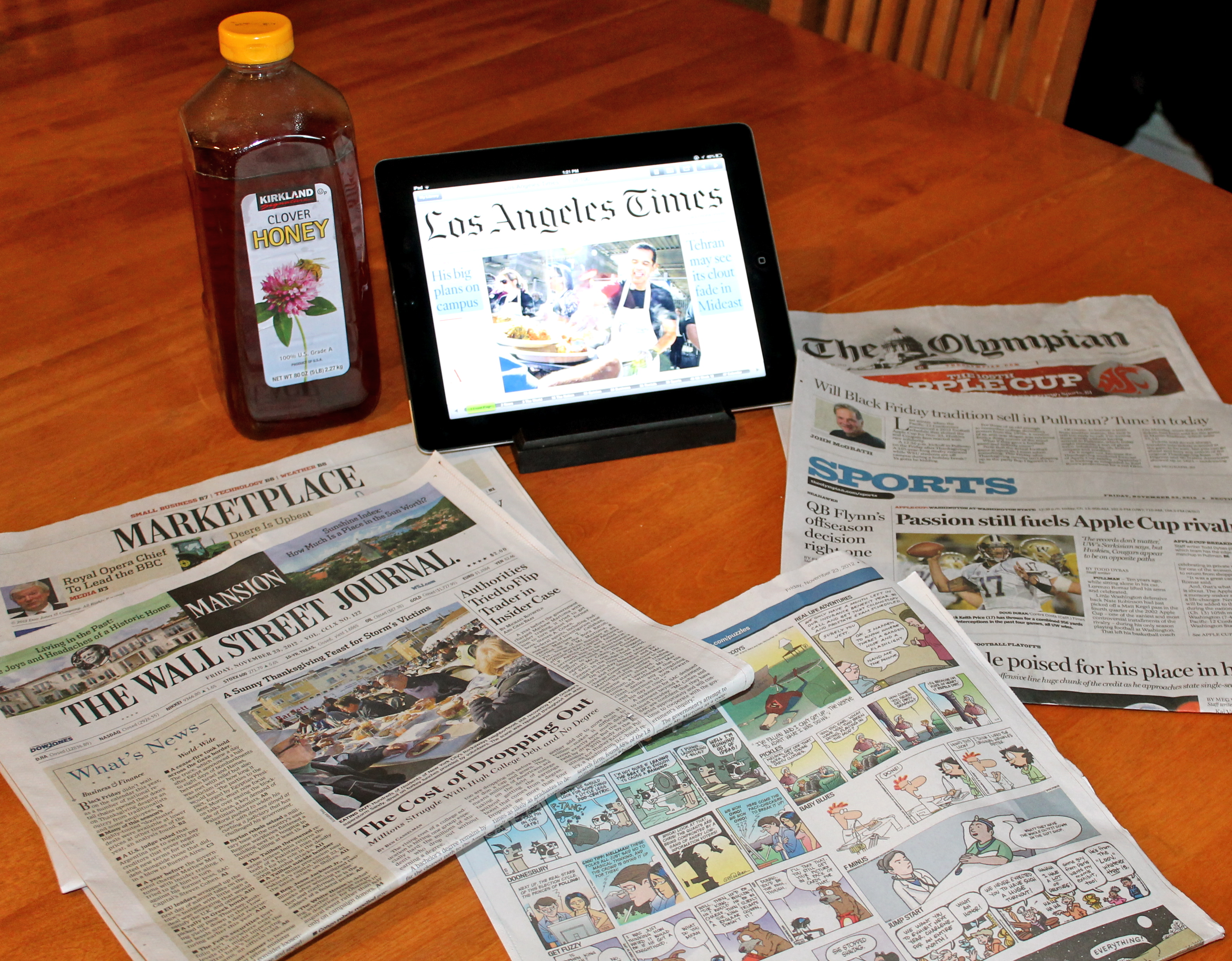
Fast forward forty years to our Olympia, WA breakfast table. The GalPal and I grew up in newspaper reading families so we’re part of the diminishing newspaper reading minority. I read lots of local and national newspapers on my laptop and iPad. But as you know, the heavy hitters—led by the New York Times—have started to charge for more than very minimal access.

We have a local paper weekend subscription which runs $13.33/month or $160/year. 52 weekends times three days equals 156 issues a year at a cost of $1.02/per. That’s a terrible value, but it’s a concession to marital peace. For some reason Betrothed has to hold the paper in her hands on the weekends. I hear divorce costs more than $160.

And we subscribe to the Wall Street Journal which runs $8.33/month or $100/year. That’s the educator’s discount price. The regular price is three times more at $26/month. 52 weeks times six days minus holidays equals about 305 issues/year at a cost of 32.7¢/per for me and 98¢ for the masses. That’s for home delivery and complete digital access on any device.

The WSJ subscription is about to expire and I’m thinking about switching to the New York Times digital/tablet edition. No home delivery. Unlimited access on any computer and tablet. Smart phone access is a little more. Educator’s discount price, $10/month; regular price, $20/month. That’s $120/year for 365 issues meaning about 32.9¢/per for me and 66¢ for the masses.

Another option is PressReader, the best choice for serious news junkies. It’s like a cocaine addict buying a personal cocoa field. For $30/month subscribers gain access to 2,300 newspapers from 95 countries, representing 54 languages. Here’s a 4+ minute video introduction. They’ve provided me with a sample subscription which I’ve been trying out. It’s a promising application, but it may not have your local paper. Also, it takes 10-15 seconds for papers to download and moving around within papers takes some getting used to. If it was my only option, I’d adjust quickly and like it, but I’m going to pass on paying three times more for way more content than it’s possible to process.

As if the newspaper subscription water isn’t muddy enough, two more options include the online news aggregator Zite which I’ve reviewed before (here) and Pulse another news aggregator which I really like and highly recommend (both available at iTunes). Pulse works especially well for skimmers. In fact, I dare you to find a rival.

For the love of all things digital, someone please convince the GalPal the answer is obvious. Read the local paper online, use $120 of that $160 in savings to subscribe to the New York Times, and use the remaining $40 to buy more dried mangos.

Apple Inc. and the Betrayal of the American Dream

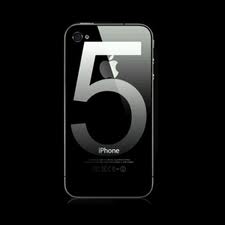
Big week for Apple fanboys and girls. New iPhone. You better keep up with all the cool people and buy one. It will change your life. Well, maybe not, but you’ll be the envy of all those iPhone 4 losers. “Wow dude,” you can say to them, “that’s one short, thick, throwback phone.”

A recent book by two Pulitzer Prize winning investigative reporters titled, “The Betrayal of the American Dream,” criticizes Apple for outsourcing too many of its jobs. Here’s a National Public Radio story on the authors and their book.

Even though I’m an Apple fanboy and investor, I believe the bigger the company and the greater its influence in the world, the more we should hold it accountable for being transparent, honoring workers’ rights, and protecting the environment. Apple’s marketing, products, and momentum can bedazzle at the expense of critical inquiry.

I’ve been swapping emails with my friend—Dan, Dan, the Transportation Man—about driverless cars. The last one I sent him linked to an article that suggested, initially at least, driverless cars will cost around $300k. “Just do what Apple does” he wrote back sarcastically, “and outsource it (the manufacturing of the driverless car) to China.”

In the United States, especially during election season, knee-jerk criticism of outsourcing is legion. Few of the critics take any time to consider how much more they’d have to pay for their toothbrushes, clothes, iPads, bicycles, and cars if they were all completely manufactured in the United States. Heaven for bid if we connected a few dots.

In their critique of Apple, I wonder whether the “Betrayal” authors factor in the daily benefits of its products to users around the world. I made light of the newest iPhone, but you’d have to pry my MacBook Pro from my cold dead fingers.

Also, outsourcing is an abomination only when economic nationalism prevails. It’s possible, theoretically at least, to think more globally without sacrificing love of country, and therefore, to cheer job growth irrespective of political borders. Especially given global economic interconnectedness and the fact that most of Apple’s foreign-based employees buy some U.S. imports.

The authors would chuckle at my naivete. They’d point out we continue to run a tremendous trade deficit with China because international trade is conducted on a grossly uneven playing field. China has far fewer labor and environmental regulations, pays workers far less (even when adjusted for cost of living), and places protective tariffs on our imports. The uneven nature of the international trade playing field is a pressing problem.

But I wonder what the authors would say about the charitable giving the GalPal and I will be doing the next few years as a result of recently selling some Apple shares that had quadrupled over the last four years.

For me, the jury is still out on what kind of corporate citizen Apple is. I value critical analyses, but at present, I will continue to use its products and invest in it. I am not a model to follow. Apple’s fate will be determined by the individual and collective decision-making of technology users around the world.

For cutting edgers like me, there’s just one decision left. A black or white iPhone 5?

10 Ways to Save Money Today

Off to Canada for a little swimming, cycling, and running this weekend. One loyal Pressing Pauser asked if I was going to tweet or blog the event. No plans to blog until returning next week. Tweeting is a good idea. Better start following me on twitter to see if I survive the day. Then again, the social media adverse can just wait to see if any new posts begin appearing here next week.

Now, back to regular programming. Miscellaneous ways we’ve recently reduced our overhead.

1A-1E are biggies because auto insurance is a recurring payment. 1A. Cancelled comprehensive and collision insurance on our 2006 car with 86,000 miles on it. 1B. Took an online driver safety course. 1C. Faxed daughter’s driver training completion certificate to insurance agent. 1D. Faxed academic transcripts for good grade discounts. 1E. Informed auto insurance agency that I’ve gone half time at work and therefore will be commuting only half as much.

2. Charge daughters for portion of cell phone service, Netflix streaming, and car use. Shrewd readers may protest this is less about “savings” and more about “redistribution”.

3. We’ve been eating out less. Maybe once a week at nice, moderately priced restaurants.

4A. Betrothed had to form a small business back in the day when she started teaching Spanish to elementaries in a before-school program. Biz license cost something like 25-30 dollars. Then we got a Costco business American Express card. Meaning a 4% discount on gas. 4B. Use the simple, free, and excellent “GasBuddy” app to find the cheapest gas around. Here’s the web-based version. We have two Costcos within ten miles and I was perplexed at why their prices varied by 14 cents recently until a friend informed me that they are committed to being the cheapest within a five mile radius.

5. Buy movie tickets in advance at Costco. Ocho dollares per. And NEVER buy popcorn, candy, or coke at the theatre. Scratch that. Never say never. Bought some very lightly buttered organic popcorn at the hippie theatre awhile back. Thought my wallet and ticker could handle that. Even went crazy and splurged on a coke for my date. Yes, of course that turned her on (even more than normal).

6. Except for Sunset magazine (promotion price was $10 or 12/year), we’ve let most of our subscriptions expire. Tend to read on-line periodicals and papers.

7. My running shoes cost $130, but I hunt for previous models (all that’s different is the color) on-line and can usually find them for 50% off. I recently bought six pairs for $65/per. No taxes and free shipping. I’m covered for a few years even in the case of economic apocalypse.

8. GalPal has a garden with beans, lettuce, and we have lots of wild strawbs around the yard. Haven’t taken the time to calculate the cost of seeds, soil, etc. Labor is free because she enjoys it.

9. I use a few coupons at the grocery store. Takes almond milk from sup expensive to just plain expensive. Used a Fred Meyer coup. yesterday. Two half gallons of Dreyers ice cream for $5. I had planned to wait til after Iron-person Canada to dive into those babies, but you know what they say about the best plans.

10. Decided not to buy the new Lebron James shoes even though I could probably slam dunk in them, catch the eye of an NBA general manager, and make a little more than I do teaching.

$315. At that price, I should be able to do a 360 degree dunk in them.

When to Retire?

Most people retire as soon as they think they can afford to. Every week personal finance periodicals run stories about people delaying retirement due to the housing correction, health insurance inflation, and in the end, insufficient savings.

Look around and you can’t help but see older workers. Prepare to see more and more. A boatload of sixty, lots of seventy, and even some eighty something half or full-time employees.

While tossing the majority of my mom’s office files last week, I came across a remarkable memo my dad wrote on December 3rd, 1990 to the two owners of the major corporation he was running at the time. Here it is:

The three of us should sit down and have a talk. I’m 65 in 1991, and as we have discussed pensions around the office we’ve used 12/31/91 as my retirement date. We should discuss the future leadership of S&E. I find myself ambivalent about retiring or staying on.

He then listed the “PRO’s for staying” including “we are an organization that works and we have good sales and profit growth.” Then he shifted gears:

The CON’s are: I will have been at the helm for 7 years, and a change in leadership could bring fresh ideas, a different approach and faster sales and profit growth.

Age slows one. It’s something none of us avoid. I find myself like the aging ballplayer—I don’t want to stay on when new leadership could take S&E forward more effectively. Others see the slow down before you do.

I feel too strongly about the company and its future to become an impediment. What are your feelings?

The more I reflect on this memo, the more unique I find it that he’s putting the company’s interests before his own. No one enjoyed his work more than my dad and no one out worked him. Yet, he acknowledges “new leadership could take S&E forward more effectively.” That’s like President Obama saying someone else might have a better working relationship with Congress and accomplish more on behalf of the American people. Or an aging college professor saying students might benefit more from an energetic, 30-something academic.

I don’t begrudge any older, moderate income person their decision to work past their prime, but for older, financially secure people, my dad provides a selfless example worth emulating. The question isn’t just what’s best for me, but what’s best for the company or even the community.

Footnote to the story. The owners did sit down with my dad. Shortly afterwards they extended his contract and also named him Chief Executive Officer of a second corporation they owned.