Self Sabotage

It’s 9:30a.m. Here are some of the decisions I’ve made today, January 2, 2013:

  • I decided to wake up at 5:22 a.m.
  • I decided to put on running pants and two thin, long-sleeve running shirts since Weatherbug was reporting -1 degrees C at the nearby elementary school (0 C and higher=shorts). Plus medium gloves, hat, reflective vest, headlamp.
  • At 5:44 a.m. I decided to walk outside into the pitch black fog.
  • At 5:45 a.m. I decided to run 6+ miles with the Right Wing Nutter and Dan, Dan, the Transportation Man (inexplicably, the PrinciPAL is still in Hawaii). I decided to take the posse around Safeway via North and Eskridge.
  • After some curbside chitchat, at 6:42 a.m., I decided to remove my sweaty running clothes and walked almost naked (still had my socks on) the length of the house to my bedroom where I put on dry running shorts and a dry t-shirt.
  • Upon returning to the kitchen, I decided to eat a banana with peanut butter after which I filled up a water bottle—half orange juice, half water.
  • At 6:58 a.m. I decided to spin 26k (213 watts, 1:01:25) while watching a combination of the Dan Patrick Show, CNN, MSNBC, and ESPN.
  • At 8:05 a.m. I decided to do 60 push ups broken up with some foam roller goodness, planking, and stretching.
  • At 8:30 a.m. I decided to have a large bowl of oatmeal with raisons, brown sugar, butter, and molasses.
  • I decided to skim the Wall Street Journal while eating.
  • For desert, I decided to have one of those new-fangled smallish oranges that darn near unpeel themselves.
  • Shortly before 9 a.m., I decided to shower.
  • Shortly after 9 a.m., I decided to put on long underwear, thus outsmarting Old Man Winter; plus wool socks (important to do that before the long underwear), pants; a t-shirt; and my ace, moth eaten, expedition weight thermal top.
  • Around 9:10 a.m., I decided to go upstairs to my desk where I checked on the stock market rally and chuckled at the Lakers’ boxscore.
  • After aimlessly surfing the internet for fifteen minutes, I decided to reply to a few emails and start Thursday’s blog post, tentatively titled “Self Sabotage”.

A friend of mine has high blood pressure, but that doesn’t stop him from obsessing about things over which he has very little control. A conservative Republican who is sympathetic to the Tea Party, he went darn near silent after the election, depressed by what he sees as a “serious loss of freedom”.

Determining the most appropriate size of the government is an important and legitimate debate, and I understand that 48% or so of U.S. citizens wants to reduce it, but my friend, who has no international frame of reference, lets things like Obamacare, gun control proposals, Bloomberg’s proposed soda regulation, helmet laws, and the unemployment benefits extension get him seriously down. Oddly, he takes each of those proposals and policies personally.

As a result, he completely slights the freedom he does have to make hundreds of decisions every day—ones that directly influence his health and well being—like how much sleep to get, when and how to exercise, and what to eat and drink. That all important trifecta—sleep, exercise, and diet—probably account for at least half of a person’s health and happiness.

But I’m losing the argument. He seems determined to let distant politicians get him down. Ironically, in losing, I’m illustrating another daily freedom he routinely overlooks—the freedom to tune others out.

A New Approach to a New Year

I’m a monogamous reader. When I commit to a book, I commit. No late night flirting with other authors that I might regret in the morning. Another idiosyncrasy, I can be slow to ditch flawed books. I was on a nice reading roll during the first half of 2012, but got totally stalled in a cook book somewhere during the summer. Yes, you read correctly, a cook book! You’re forgiven for wondering what kind of imbecile sets out to read a cookbook cover to cover. The same kind that set out to read the bible from cover to cover in the sixth grade. Wasn’t able to check that one off either. Damn Leviticus.

But, I’m happy to report, my reading self is back. In fact, I may read more in January and February than all of 2012 combined, but more on why in a future post. At present, I’m wedded to Oliver Burkeman’s The Antidote: Happiness for People Who Can’t Stand Positive Thinking. Although it’s clearly written, Burkeman’s ideas are so provocative and contrary to conventional wisdom, The Antidote will probably require a re-reading, making it my last book of 2012 and first of 2013.

If like me, you enjoy holding up common assumptions to the light of day, I especially recommend Chapter Four, “Goal Crazy: When Trying to Control the Future Doesn’t Work”. In short, Burkeman convincingly argues that most everything you and I have been taught about goal setting is flawed. In part, his argument rests on what went wrong on Mount Everest in 1996 when many climbers died because they didn’t turn around in time to survive the descent. In his view, Krakauer’s Into Thin Air analysis is “ultimately dissatisfying” as an explanation.

He finds Chris Kayes’ interpretation more persuasive. Kayes, a former stockbroker turned business professor and expert on organizational behavior, suspects the climbers were “lured into destruction by their passion for goals”. Burkeman writes of Hayes, “His hypothesis was that the more they fixated on the endpoint—a successful summiting of the mountain—the more that goal became not just an external target but a part of their own identities, of their senses of themselves as accomplished guides or high-achieving amateurs.”

“If his hunch about the climbers was right,” Burkeman adds, “it would have become progressively more difficult for them to sacrifice their goal, despite accumulating evidence that it was becoming a suicidal one. Indeed, that accumulating evidence. . . would have hardened the climbers’ determination not to turn back. The climb would have become a struggle not merely to reach the summit, but to preserve their sense of identity.”

One take-away from the chapter is that there are often unintended consequences when people focus intensely on especially lofty goals. Kayes points out that the mountaineers who died climbing Everest in 1996 did successfully reach their goal: they ascended to the summit. The tragic unintended consequence was that they didn’t make it back down.

Burkeman also offers up a  challenge—to become more comfortable with uncertainty, to turn towards it, to exploit the potential hidden within it, both to feel better in the present and to achieve more success in the future. Burkeman sites a person who says the key to this approach is to think more like a frog. “You should sun yourself on a lily-pad until you get bored; then, when the time is right, you should jump to a new lily-pad and hang out there for awhile. Continue this over and over, moving in whatever direction feels right.” The imagery of sunbathing on lily-pads isn’t mean to imply laziness, the emphasis is on enjoying one’s work in the present rather than postponing happiness based upon endless five year plans.

Burkeman’s thinking challenges my default tendencies to plan and set goals. My goal for 2013? Have fewer goals and turn towards uncertainty.

imgres

Columbine, Blacksburg, Tucson, Seal Beach, Aurora, Newtown

The National Rifle Association has gone silent, hoping that we conclude there’s an inevitability to gun violence, call it an unfortunate cost of Second Amendment rights to gun ownership. That’s the exact reason we can’t become desensitized to the steady stream of incomprehensible violence.

We have to spend the next few months insisting that our Congressional representatives take the actions that Michael Bloomberg and Diane Feinstein described on Sunday’s Meet the Press.

We have to learn to think about mental illnesses like physical illnesses and advocate for more accessible and affordable care for the mentally ill.

We have to insist on people’s rights. To go to school, to go shopping, and to go to a movie without fear.

We have to resist the urge to arm more people. On the same Meet the Press, Bill Bennett (pundits should be like yogurt and have expiration dates) said we should probably have an armed security guard in every school. I thought of that when I walked into my YMCA Sunday afternoon to workout. The doors open for anyone and the membership check-in is about 30 to 40 feet inside the building. I passed 20+ people before having to show my membership card. Sometimes when the line is long, I just slide in behind it and head to the locker or weightroom. So unless we’re going to install TSA-like security at every YMCA, mall, and theater, I don’t see armed school guards as a solution. I recommend Jim Fallows position on this and his most recent Atlantic piece on the shootings (and Goldberg’s which he references).

We have to ask why, according to Mother Jones, since 1982, males are responsible for 61 out of 62 mass murders with firearms across the country. What does the fact that some young men more than young women want to physically injure and/or kill others say about our parenting of boys, our schools, and our culture? What changes in our parenting, schools, and culture are needed?

Lastly, an impassioned debate among two female writers—I am Adam Lanza’s Mother and Don’t Compare Your Son to Adam Lanza.

imgres


Continuous Improvement

A bullshit workplace notion. Midway into artistic or athletic activities, jobs, careers, relationships, life, we plateau. Shortly thereafter, energy ebbs, and our performance erodes.

We improve for a bit, we plateau, we decline.

I observed a good second year math teacher today at the independent middle school. Then we conferenced. After listening to him reflect on the pre-algebra lesson, I listed his many strengths. Then I made a few suggestions. Call on Ben as soon as he puts his head on his desk. Give Robin your marker, take her seat, and have her teach everyone her prime factorization method by illustrating it on the board. Have two more students explain and illustrate their methods and then ask, “Which is most efficient and why?” Let the kite string out a bit and “guide from the side” for awhile. Remember, the educative effect is greater when students do something than when something is done to them.

He told me he likes it when I observe because he’s reminded of effective teaching methods that he has let slip. He’s a good second year teacher who has started to plateau because he’s rarely observed, and rarely gets to observe other, more accomplished teachers.

A small number of the very best teachers, artists, athletes, and people continue improving considerably longer than their peers by seeking out expert, critical feedback; by investing progressively more time and energy; and by surrounding themselves by other positive, hardworking people, who are trending upwards.

And the wisest teachers, artists, athletes, and people have a sixth sense for both when they’ve plateaued and when their performance has begun to decline. And then the wisest, most selfless, most financially secure of them, step aside to provide the next generation opportunities to improve, plateau, and decline.

The Scientific Roots of Homosexuality

It’s amazing how many things I get wrong. I was sure UCLA’s new football coach, Jim Mora, was a bad hire. He’s on a short list of national “Coach of the Year” candidates. I was certain a book and movie series about humans, vampires, and wolves would be a bust. And I once mistakenly donated appreciated stock shares that I had held less than a year, thus losing the tax deduction. A “friend” of mine often tells me, in the endearing manner only he can, “You don’t know shit!” Maybe he’s right.

But now, thanks to David P. Barash’s challenging and fascinating short article titled “The Evolutionary Mystery of Homosexuality,” I might be right about something of importance. I’ve long had a hunch that scientists would someday prove that homosexuality has a genetic basis. Who, I wondered, would choose to be such a distinct minority in a still relatively homophobic world? My related prediction is that a few decades from now homophobes will be embarrassed by their anti-gay vitriol. Hope I’m not wrong about that one.

Here are two excerpts from Barash:

1) Nor can we solve the mystery (why hasn’t natural selection operated against homosexuality) by arguing that homosexuality is a “learned” behavior. That ship has sailed, and the consensus among scientists is that same-sex preference is rooted in our biology. Some of the evidence comes from the widespread distribution of homosexuality among animals in the wild. Moreover, witness its high and persistent cross-cultural existence in Homo sapiens.

2) . . . a reasonable summary is that, when it comes to male homosexuality, there is almost certainly a direct influence, although probably not strict control, by one or more alleles (defined as one member of a pair or series of genes that occupy a specific position on a specific chromosome). Ditto for female homosexuality, although the genetic mechanism(s), and almost certainly the relevant genes themselves, differ between the sexes.

Beyond the suggestive but inconclusive search for DNA specific to sexual orientation, other genetic evidence has emerged. A welter of data on siblings and twins show that the role of genes in homosexual orientation is complicated and far from fully understood—but real. Among noteworthy findings: The concordance of homosexuality for adopted (hence genetically unrelated) siblings is lower than that for biological siblings, which in turn is lower than that for fraternal (nonidentical) twins, which is lower than that for identical twins.

Gay-lesbian differences in those outcomes further support the idea that the genetic influence upon homosexuality differs somewhat, somehow, between women and men. Other studies confirm that the tendency to be lesbian or gay has a substantial chance of being inherited.

Consider, too, that across cultures, the proportion of the population that is homosexual is roughly the same.

Given some conservatives rejection of global warming data, this research will not cause a collective epiphany on the right. Many on the right will continue to be wary of science and many homophobes will continue to believe that there would be fewer gay men if more households were headed by strong fathers, that gayness will spread if we extend them more civil rights, and that gays and lesbians can be cured of homosexuality through Christian counseling.

On this one, I’m going to side with the scientists and celebrate the progress my gay and lesbian friends are making.

Three Things I Don’t Understand About the Election

1) Why isn’t anyone describing it as historic? Granted, President Obama’s victory in 08 was more groundbreaking, but it’s as if the historic nature of this accomplishment is lost on the chattering class. President Obama’s election in 2008 made it more likely we’ll see a series of non-white male and female candidates from this point forward. His reelection makes that even more certain.

2) I understand why many on the right despise President Obama’s policies. Reasonable people can disagree about the optimal size of government, the strengths and limits of free markets, and how best to provide healthcare, strengthen the economy, and conduct foreign relations, but why are so many conservative critiques of Obama petty, personal, even pathetic?

Exhibits A and B from consecutive comments attached to an election article in yesterday’s Wall Street Journal. Charlene Larson, who assumed Romney would win (in response to another commenter): You’re right, of course. Obama will go back to doing the only thing he’s a success at: creating a racial divide. He will try to undermine the Romney administration. He will violate the gentleman’s agreement that states no past president will speak ill of his successor. Because he’s no gentleman. He’s a bitter, delusional child. Michael Bukowski in response: I believe Charlene is rightly referring to the fact that not once in his Presidency has Obama ever acted like a grown man (see: leader). He does nothing but complain about what he “inherited.”

I’m not in the habit of accusing anyone of racism, let alone faceless names in a paper, but given the nature of Larson’s and Bukowski’s attacks, the onus is on them to prove they’re not racist. My conservative friends will accuse me of selective perception, correctly pointing out that some liberal ideologues routinely criticized “W” in ways that were also petty, personal, and at times pathetic. For example, making fun of the times he misspoke, jokingly labeling them “Bushisms”, the suggestion being he wasn’t nearly intelligent enough to govern. Certainly, some leftist ideologues demonstrated elitism and arrogance, but racism? A pox on anyone that hasn’t outgrown the grade school playground.

Exasperated with his incessant personal attacks on the President, I asked a close conservative friend whether his criticism was motivated in part by race. He said he’d vote for Walter Williams in a heartbeat. Nice return of serve, but still, the onus is on those whose attacks are especially personal to prove they’re not racist. I won’t hold my breath.

3) When will Republicans come to grips with changing demographics, embrace immigration reform, and seriously contend for nonwhite voters? An illuminating sentence from yesterday Wall Street Journal, “Romney thinks his path to victory is to win 61 percent of white voters as long as white voters comprise 74 percent of the vote—and the Obama camp agrees.” Add age into this mix. People between 18-44 tilted heavily for the President. As long as Republicans slight young Hispanic and African-American voters, sell your Republican stock.

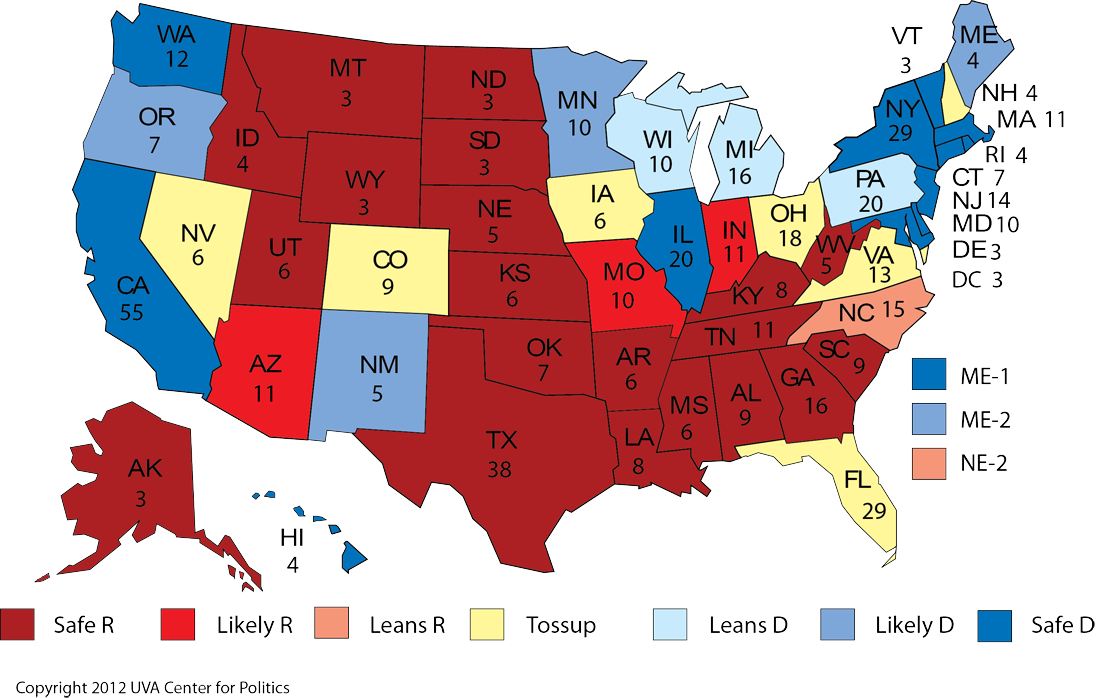
The U.S. Electoral College Map Explained

Take a gander.

Since you always aced your social studies courses you already know the President needs 270 electoral votes out of the 538 up for grabs. The winner can lose darn near forty small states, win the most heavily populated ten plus, and be the first to tag the bible on January 20, 2013.

Show the above map to grade schoolers and ask who is likely to win. They’ll say the Red Team.

Even though you understand how the Electoral College works, you probably don’t know why some states tip blue and others red. That’s what I’m here for.

It all starts with cool ocean breezes in the Pacific, upper Atlantic, and Great Lakes region. Those cool breezes translate into more moderate temperatures especially on the West Coast and in the upper Northeast. In contrast, the great, red, middle swath of the country is mired in hot and humid summers and killer cold winters almost all the time. Ocean and Great Lake breezes and cool temps contribute to blood flow, heightened brain activity, and altogether clearer thinking. Sadly, over time, people living in the great, red, middle swath of the country develop cognitive deficits as a result of oppressive heat and humidity and dramatic temperature swings. The technical term for this is Climatic Induced Cognitive Deficit Disorder or CICDD.

Also, until the last presidential election, very few people knew that on clear days you can actually see Russia from the West Coast of the U.S. That proximity to Russia—coupled with shared suffering during earthquakes, mud slides, and forest fires—explains the more collectivist mindset of Left Coasters.

Then there’s dietary considerations. Reds don’t just like their heat, humidity, and bugs, they like breaded and fried meat casserole-based potlucks more specifically. All washed down with whole milk. Blues prefer roasted vegetables, fresh fruit, and wine. That explains the dramatic physical health divide, which like the climatological differences, translates into a mental health chasm. Eat well, be well, think well.

Then there’s preferred outdoor activities. This time of year Blues hike among trees and meditate silently upon their changing colors all while looking forward to snow shoeing and cross country skiing. Reds hike among trees too, in search of large defenseless animals to shoot and kill. Then they drag them home, bread them, and fry them. All while looking forward to firing up their snowmobiles and making lots of noise and pollution. Blue outdoor activities lead to enlightenment. Red to blight and lunacy.

Then there’s different artistic sensibilities. Blues prefer classical music, independent and foreign films, modern dance, national public radio, and The New Yorker. Reds, country and heavy metal, Arnold Schwarzenegger films, reality television, Fox News, and The Washington Times. Heightened enlightenment and even greater lunacy.

Class dismissed.

The 90% Preparation Principle

Forgive me for I have fibbed. At the end of the last post when I said I didn’t know how to build team chemistry. The post was plenty long and I needed to pull the plug.

One of the secrets to building team chemistry is the 90% prep principle. Any residential painter worth her weight will tell you painting is 90% prep. Come on, there’s some female house painters out there aren’t there? The 90% prep principle is why, when our crib needs painting, I write a check. Inadequate patience. But I digress.

The best elementary teachers apply the 90% prep principle at start of the school year. They figure, “Even if it takes around 10 days to build a sense of community and teach the rules and procedures, we’ll accomplish far more than we otherwise would over the remaining 170 days.” Visit a local elementary school at the beginning of the year and you’ll likely see some expert teachers calmly saying to their students, “Nope. Try again.” And then watch the students return to their seats and line up table-by-table for recess or lunch a second, third, and maybe fourth time. Equal parts firmness and kindness.

In the same spirit, the best leaders take time when their teams are first formed to build community and establish decision-making norms. Community building, of course, can take many forms, but the common thread is team members getting to know one another better. Horizontals embrace community building activities more than Verts. Very early on, agreed upon expectations and decision making processes are made explicit.

Savvy leaders know that maintaining team chemistry requires ongoing community building activities, whether shared meals, celebrations, or retreats. They also know decision-making norms need to be revisited on occasion. They know their team’s success depends upon members genuinely respecting one another.

Families, athletic teams, theater troupes, church councils, school faculty, government agencies, and multinational corporations that consciously build community and spell out decision-making norms enjoy greater espirit de corps, and experience far less in-fighting, complaining, and malaise. Consequently, they’re more productive.

There’s an alternative that lots of teams revert to, ignore community building and decision making norms and hope and pray the common work is engrossing enough that people get along just well enough, just long enough to finish the work. Like running on a balance beam on fire. Run fast enough and you might just get to the end without getting burned or falling off.

And now my friends I bring teamwork week to an end with some self-disclosure. I’m most often a Horizontal; however, not when travel planning with the GalPal. How can I put this so that she keeps taking trips with me? Her travel decision making process is a tad bit drawn out for even me. When having to decide on destinations, dates, modes of transpo, departure-arrival-return times, etc., I transform into a Vertical. When it comes to group decision-making, we’re all probably switch hitters of sorts.

Thanks, as always, for reading.

Why is Team Chemistry So Elusive?

Why do so many married couples divorce? Why are so many homeowners’ associations riddled with conflict? Why do so many parents involved in youth sports organizations butt heads with one another? And why is group decision-making so problematic for school faculty and other workplace teams?

Because everyone of us brings imperfect interpersonal skills to our teams. Multiply my social shortcomings and quirks with yours and the next women’s and the next guy’s and it doesn’t take long to understand why positive team chemistry and enlightened group decision making is so elusive. Every team of two or more are dysfunctional in different ways and to varying degrees.

Also, every team has an uneven mix of what I refer to as “Vertical” and “Horizontal” members. Verticals have little patience for processing others’ feelings, talking through differences of opinion, and consensual decision-making. They’re often quite comfortable with someone above them making unilateral decisions. In contrast, Horizontals prefer consensual decision making and the sometimes extended discussions they require. They’re sensitive to other members feelings and often distrust superiors to make unilateral decisions.

When a couple, community group, or workplace suffers challenges that result in hurt feelings, Verticals emphasize focusing on the present and “just getting back to work”. Before returning to work, Horizontals feel compelled to work through what went wrong and attend to team members’ hurt feelings. Trying to negotiate these different orientations becomes another challenge in and of itself.

So every team member is screwed up in his/her own way. And eventually, crises put extraordinary pressure on the team’s decision-making processes. Then some team members want to talk things through, others don’t, and those different perspectives add fuel to the fire. Is it any wonder that lot’s of couple’s divorce, the CIA and the FBI don’t get along, and some work environments turn toxic?

And there’s more. Many teams—whether couples, community organizations, or workplaces—aren’t nearly thoughtful or intentional enough about fostering understanding of one another’s unique contributions to the team effort and the mutual respect that engenders. Instead, a mutual sense of being misunderstood and under-appreciated spreads.

Add to that the fact that teams rarely, if ever, build in time to talk openly and honestly about decision-making processes. Which the Verticals are cool with, but not the Horizontals. For the Horizontals, when there’s little to no opportunity to reflect on decision making processes and surface the occasional hurt feelings, meeting fatigue sets in.

These multi-faceted challenges often overwhelm teams’ collective interpersonal skills. Which results in more resentment. Team members succumb to passive-aggressive behavior, not talking in meetings but complaining bitterly out of them, and walk around with invisible backpacks on, into which they repeatedly stuff hurtful exchanges from the near and distant past. Eventually, in the interest of self-preservation, they retreat to their own corner, cubicle, classroom, office. Making team chemistry even more elusive.

And now I should probably do what all bloggers are supposed to do if they want to grow their readership—help readers. Instead of bullshitting you though, I’m going to be honest. On this Sunday evening, my insights into team chemistry and decision-making dysfunction greatly exceeds my feel for promising fixes.

But I know for a fact that some of you are team leaders who know more about building and maintaing team chemistry than I do. And some of you are members of healthy teams who can offer helpful suggestions on how to maintain team chemistry—whether a couple, a small organization, or a ginormous company. Your turn.

How to Live?

That’s the question my writing students and I are focusing on this semester. I can’t think of a better age to craft a philosophy of life. Most of them are on their own for the first time in their lives. Having to make many, many more decisions by themselves and find their way.

William Irvine, philosophy professor and modern day Stoic, argues you’re likely to waste your life away without a well thought through philosophy of life. Here’s his argument.

You have three choices in how to live. One is “unenlightened hedonism” in which you thoughtlessly seek short-term gratification. Think Faber College, 1962.

A second is “enlightened hedonism” in which you seek to maximize pleasure in the course of your lifetime. People practicing this philosophy of life will spend time discovering, exploring, and ranking sources of pleasure and investigating any untoward side effects they might have. Then they’ll devise strategies for maximizing pleasure.

Regarding hedonism, Irvine writes, “In my research on desire, I discovered nearly unanimous agreement among thoughtful people that we are unlikely to have a good and meaningful life unless we can overcome our insatiability.” He adds, “There was also agreement that one wonderful way to tame our tendency to always want more is to persuade ourselves to want the things we already have.”

But I digress. The third and final choice in how to live is to carefully think through what you most want out of life and then organize your life accordingly. Not the goals you form as you live day-to-day, but one “grand goal in living”. Of the many goals in life you might pursue, which one do you believe to be most valuable?

Most people have trouble naming their grand goal in living because our culture doesn’t encourage thinking about such things. Instead, it provides an endless stream of distractions so they won’t ever have to. To their credit, some people swim against the stream of distractions by journaling, taking digital sabbaticals, enrolling in my writing seminar, and going on silent retreats.

If determining a grand goal of living isn’t challenging enough already, it’s only half the battle. The other half is developing effective strategies for attaining it. These strategies will specify what you must do, as you go about your daily activities, to maximize your chances of gaining the thing in life you take to be of most value.

This is where Irvine says Christian pastors and the ancient Stoics differ. Most Christian pastors, Irvine argues, focus on what people must do to have a good afterlife. Pastors, he says, have far less to say about what people must do to have a good life. That’s why, he notes, it’s tough to distinguish among the religious and non-religious.

For his own philosophy of life, Irvine chose to update Roman Stoicism for modern times. Stoics claim that many of the things we desire—most notably fame and fortune—are not worth pursuing. Instead they developed strategies for achieving tranquility and inner joy by eliminating negative emotions like anger, grief, anxiety, fear, and envy.

Eight years ago, when I was on sabbatical, I took time to write a guiding paragraph that I can’t find anymore in my computer files. I can remember most of it, but it’s okay I misplaced it, because it’s time to update it. And then reference it way more regularly.

If your curious about my philosophy of life, just eavesdrop on me as I live my day-to-day life. Because actions, of course, speak louder than words.