I Run With Ahmaud

From Slate:

“Even without overt discussion of race over 10 days of testimony, the overwhelming whiteness (and maleness) of the defendants has been on full display. Consider the defense’s main argument: that the defendants acted in self-defense. It hinges on the jury’s understanding of a series of perceived threats, threats that surfaced only after the defendants attempted to arrest Arbery for trespassing. “I knew that he was on me, I knew that I was losing this. I knew that he was overpowering me,” Travis McMichael said. ‘If he would’ve got the shotgun from me, then it was a life-or-death situation. And I’m gonna have to stop him from doing this, so I shot.’

On the surface, his comments seem race-neutral. But his testimony highlights a commonly used defense of perpetrators of violence against unarmed Black people: fear. Never mind that McMichael and his father ran Arbery down with their truck. Never mind they were the only ones armed. Never mind that Arbery was outnumbered three to one. Never mind that he had been running for miles before the altercation. Never mind that the defendants went looking for a confrontation. Never mind all that. It was McMichael who found himself in a life-or-death situation that required him to make a swift, irrevocable action—despite his testifying that he had been trained in deescalation tactics.”

Emphasis mine. I’ve watched a fair amount of the trial. If I was a juror, I wouldn’t need to deliberate. I can’t begin to wrap my head around the possibility that McMichael is acquitted.   
Monday Required Reading

Best selling vehicles in America by state.

How to reduce car collisions.

The share of under 35-year-olds going without sex more than doubled from 2008 to 2021, from around 8% to around 21%.

Preventing teacher burnout.

Who controls native education?

Wednesday Required Reading

  1. Social-emotional learning for school principals.
  2. Depression is complicated.
  3. Newberg school board adopts policy banning Pride, Black Lives Matter symbols in classrooms. There are no moderates in Oregon, just lefties and righties.
  4. How much would your favorite classical composers have earned on Spotify?
  5. The digital death of collecting.
  6. Burned out? Maybe you should care less about your job. 

How The Center For Disease Control And Prevention Failed Us

From Alex Taborrok’s review of Scott Gottlieb’s new book, Uncontrolled Spread: Why Covid-19 Crushed Us and How We Can Defeat the Next Pandemic.

“If there’s one overarching theme of “Uncontrolled Spread,” it’s that the Centers for Disease Control and Prevention failed utterly. It’s now well known that the CDC didn’t follow standard operating procedures in its own labs, resulting in contamination and a complete botch of its original SARS-CoV-2 test. The agency’s failure put us weeks behind and took the South Korea option of suppressing the virus off the table. But the blunder was much deeper and more systematic than a botched test. The CDC never had a plan for widespread testing, which in any scenario could only be achieved by bringing in the big, private labs.

Instead of working with the commercial labs, the CDC went out of its way to impede them from developing and deploying their own tests. The CDC wouldn’t share its virus samples with commercial labs, slowing down test development. ‘The agency didn’t view it as a part of its mission to assist these labs.’ Dr. Gottlieb writes. As a result, ‘It would be weeks before commercial manufacturers could get access to the samples they needed, and they’d mostly have to go around the CDC. One large commercial lab would obtain samples from a subsidiary in South Korea.’

In the early months of the pandemic the CDC impeded private firms from developing their own tests and demanded that all testing be run through its labs even as its own test failed miserably and its own labs had no hope of scaling up to deal with the levels of testing needed. Moreover, the author notes, because its own labs couldn’t scale, the CDC played down the necessity of widespread testing and took ‘deliberate steps to enforce guidelines that would make sure it didn’t receive more samples than its single lab could handle.'”

The solution has to be a more decentralized public health apparatus, doesn’t it?

What Are You Most Afraid Of?

That was the The Good Wife’s question on our Saturday night date to the Westside taco truck.

Because I’m male I replied, “Your questions.”

I gave a wee bit more thoughtful answer after the beans and rice kicked in which maybe I’ll summarize sometime soon. 

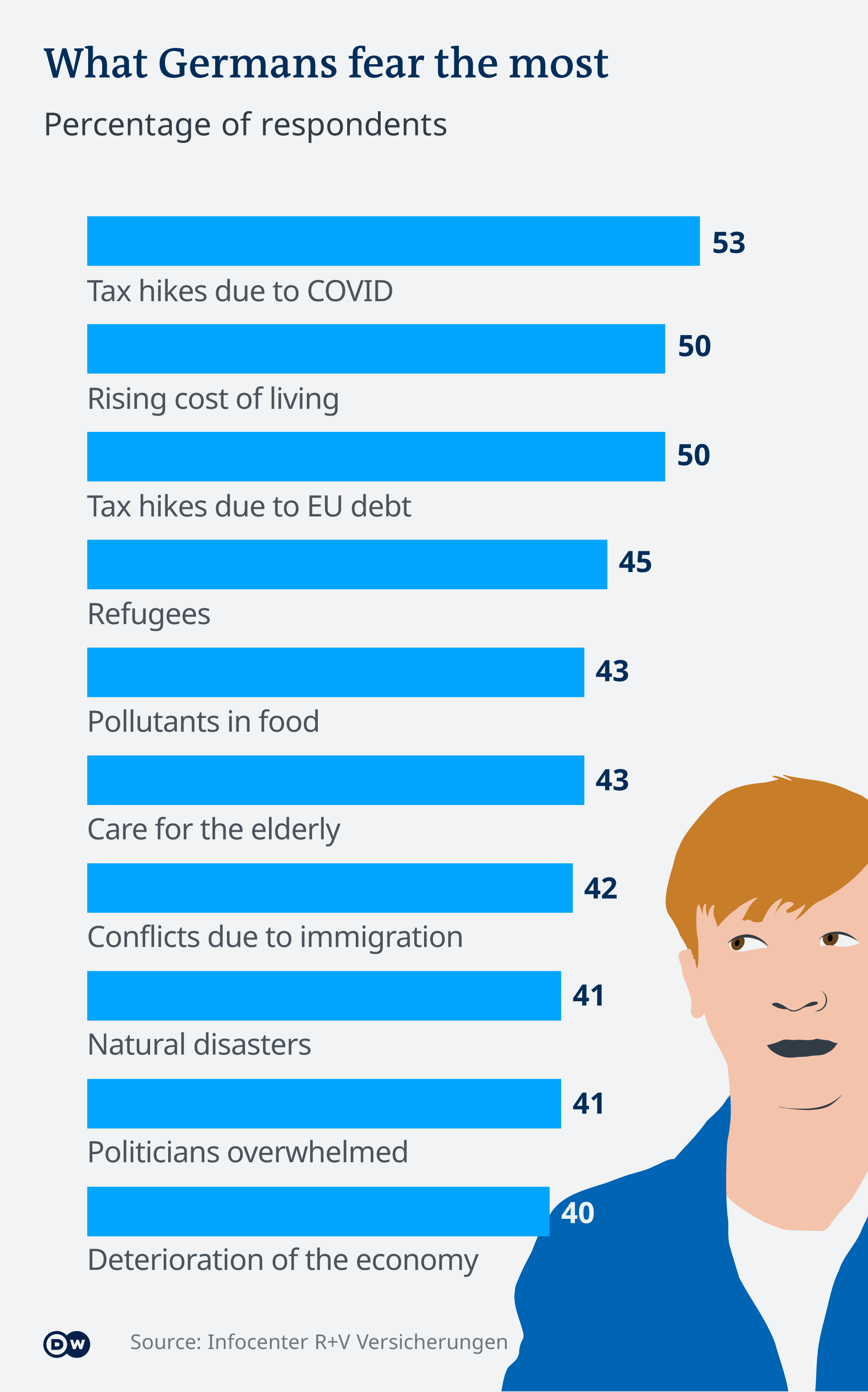
In the meantime, here’s how Germans recently answered the same question.   

59130336_7

There’s zilch overlap between the Germans and me.

I Predict There Will Be More Wild Ass Predictions

‘New York City is done!’

‘Office work is done!’

‘Higher education as we know it is done!’

‘Long distance travel is done!’

Why are so many highly educated people making such dumb, over-the-top predictions? Besides the fact that education and wisdom have never been closely correlated, it’s because the prognosticators are desperate to be heard above the din of the social media cacophony. PLEASE listen to my podcast. PLEASE read my twitter feed, ‘insta’, blog, book.

Scott Galloway is Exhibit A of this modern tendency towards hyperbole. Subtly, nuance, and ambiguity—the stuff of complexity—is passe, and we have the scramble to be relevant on social media to thank for that.

Lo and behold, New York City real estate values are on the rise again. Executives are desperate to have employees return to offices, college life looks and feels very familiar, and have you been in an airport lately? A bit more hybrid learning, telemedicine, and remote work aside; most ‘rona-inspired changes in behavior are proving relatively superficial despite the pandemic’s legs.

I would like you to prove me wrong on this, but neither do I expect many of the heartfelt proclamations of personal transformation to stick. Maybe a vicious virus can inspire a personal ‘reset’ of sorts in the short-term. Maybe people will simplify their lives; strike a healthier work-life balance; and commit more deeply to their family, friends, and neighbors. But as soon as the virus begins to fade, watch for long established habits to return. Human nature endures.

Ultimately though, when it comes to brash, facile predictions, maybe resistance is futile, in which case I predict the UCLA Bruin football team will win the Pac-12*.

*The last time that happened, Blockbuster Video was killin’ it.

Rooting For The Capybaras

From “Capybara population ‘wreaking havoc’ in wealthy community in Argentina.”

“‘It’s not an invasion. That was the capybaras’ land years ago before this rich community built homes on top of the wetland,’ Ariel Fernandez told USA TODAY. ‘So a lot of us in Argentina are rooting for these capybaras to mess with the rich and out of touch. They’re wreaking havoc.'”

I confess, I had never heard of the capybaras.

Thursday’s Required Reading

1. 12 year old grandmaster. 

2. Ultra cycling’s underdog has no patience for haters

3. On infrastructure. Why does it cost so much to build things in America? 

4. The power dynamic between humans and Yosemite National Park.

5. On ‘small travel’. Making discovery, not distance, travel’s point.

A Hard Pass On Psychedelics

Ever pressed pause and asked yourself why LSD and other hallucinogenic drugs are trending?

Here are some explanations from the National Institute on Drug Abuse.

“Hallucinogenic and dissociative drugs have been used for a variety of reasons (Bogenschutz, 2012; Bonson, 2001). Historically, hallucinogenic plants have been used for religious rituals to induce states of detachment from reality and precipitate ‘visions’ thought to provide mystical insight or enable contact with a spirit world or ‘higher power.’ More recently, people report using hallucinogenic drugs for more social or recreational purposes, including to have fun, help them deal with stress, or enable them to enter into what they perceive as a more enlightened sense of thinking or being. Hallucinogens have also been investigated as therapeutic agents to treat diseases associated with perceptual distortions, such as schizophrenia, obsessive-compulsive disorder, bipolar disorder, and dementia. Anecdotal reports and small studies have suggested that ayahuasca may be a potential treatment for substance use disorders and other mental health issues, but no large-scale research has verified its efficacy (Barbosa, 2012).”

Apart from the potential to help with substance abuse disorders and other mental health issues, I don’t find any of the other rationales convincing. Their appeal seems to speak to people’s discontentment with having more of their needs met than any other people at any other time in world history. 

Maybe this is just another case of Okay Boomerism, but I never wake up wishing for more mystical insight. More Sea Salt Caramel gelato in the freezer yes (or dark Raspberry Chocolate), but not a more enlightened sense of thinking or being. I’ll be sitting this one out because I’m content with my current anemic level of insight, thinking, and being.