Intrepid seagulls and cormorants aside, I will not be swimming today.


Intrepid seagulls and cormorants aside, I will not be swimming today.
We’re not getting any younger. How will you be remembered?
Jack Bogle, creator of low cost index mutual funds, died yesterday at 89. In Warren Buffett’s opinion, Bogle did more for the American investor than any person in the country by putting “tens and tens and tens of billions into their pockets.” “And those numbers,” Buffett added, “are going to be hundreds and hundreds of billions over time.”
As a self-taught investor, I’ve learned more from Bogle’s writing than from every other financial author combined.
Bogle’s direct, tangible legacy, low cost passive investing, is something that generations of investors will benefit from in perpetuity.
Just as generations of Pacific Northwest citizens will benefit in perpetuity from a local group’s incredibly effective activism that saved Olympia’s LBA Park from being turned into one more housing development.
A second type of legacy is less direct, tangible, and obvious; but equally meaningful. It entails living so exemplary a life that one’s descendants, and others, seek to emulate the deceased person’s attributes.
In the winter, much to the Good Wife’s dismay, I keep the house cooler than she’d prefer. Recently, when I pressed pause to think about why, it took about five seconds to realize it didn’t have anything to do with Jimmy Carter or our household’s economics. I realized it was one small way of honoring my dad’s frugality that stemmed from his Eastern Montana upbringing. A tribute of sorts. My dad never had to tell me to live below my means because he modeled it so persuasively. I want to be humble like him, just as I want to be one-tenth as generous as my mom.
Yesterday I listened to Dan Patrick interview Ian O’Connor author of Belichick: The Making of the Greatest Coach of All Time (so much for humble titles). My interest in football is waning, but Patrick is a great interviewer and O’Connor was insightful. One thing O’Connor said is that both Belichick and Brady are intensely conscious of their respective legacies.
Which got me thinking. I bet Jack Bogle was not intensely conscious of his legacy. I know for sure that Don and Carol Byrnes were not. My plan is to try to do good work, and even more importantly, be a good person, and let my legacy take care of itself. If I’m lucky, someone, sometime, will seek to emulate an attribute or two of mine.
After spending Saturday morning exercising, I rallied when the family proposed a hike in Olympia’s Watershed Park, a beautiful 1.4 mile trail in the heart of a dense, fern-filled Pacific Northwest forest.
By the time we began, daylight was fading into dusk. In a steady rainfall we began our clockwise loop. A few minutes later, a young athletic woman materialized in front of us, maybe 18 to 20 years young, hair wet, holding her phone, listening to music. Her warm smile suggested this was a better than average run. Fifteen minutes later, she reappeared. Impressed, I said, “Man, you are really getting after it.” “Yeah,” she acknowledged, smiling even more exuberantly.
The Good Wife, Eldest, Youngest, her, and I all got to our parked cars at the same time. She split before I could thank her.
I would’ve liked to thank her for daring to be different. Or more simply for being daring. A lot of people, scratch that, nearly everyone, would say she was crazy to be running alone, near dusk, in the rain, in a park where a person or two have been accosted previously. By focusing on the one or two tragic episodes over the last 10-20 years, people would forget that in between, thousands of runners have joyously run the 1.4 mile loop unscathed.
Our semi-dark, rain drenched hike was great fun, but based on her radiant smile, I bet her run was even more exhilarating. One she’ll remember fondly.
Close in age to my daughters, I thought to myself, what would I think if I was her dad or if my daughters chose to run alone in Watershed at dusk in a steady rain. I would’ve felt better if she had a friend or dog with her and told me her plan, but I’d much rather her (and them) error on the side of running alone in the elements, than not.
Why? Because when we try eliminating risk from our lives, we’re not really living. We’re most safe when sitting on our sofas, but if we spend too much time on our sofas out of fear of what could go wrong if we venture outside, we forego adventures, new friendships, and positive memories of having successfully taken calculated risks alone or with others.
Calculated risks like running in Watershed in a steady rain, in the almost dark. Negotiating the rolling hills, the wet footing. Celebrating being of healthy mind and spirit. Of overcoming fear. Of being alive.
Thank you for reading some of what I wrote this year. My hope for 2019 is that we live a little (or a lot) less cautiously. Happy New Year or is it New Years?
Steve Wright is one of my best friends en todo el mundo. At Southern California’s Cypress High School, we were always the last two shivering on the deck at our 6:30a.m. water polo practices. Eventually, Coach Drent’s threats of additional yardage got us airborne over our fog-shrouded pool.
Today, Steve is a pastor in Huntington Beach, CA, a driver and fairway metal from where we spent our summers surfing and honing our frisbee genius. I invite you to eavesdrop on my Thanksgiving letter to him.
Dear Steve,
Thanks for the excellent resource you posted to Facebook recently. That essay, coupled with several recent “healing” sessions at our church, has me thinking about our church’s recent challenges with conflict and the future of the church more generally. I thought I’d update you on the goings on at Olympia’s Lutheran Church of the Good Shepherd in the hope that what I’ve been thinking about has broader relevance to yours and other churches.
As I listen to people process what happened, I keep returning to four ideas. To understand the first, you have to understand who is attending our healing sessions. The vast majority are the “committed core”, about 15% of the congregation, whose average age is about 70. These stalwarts regularly remind people they’ve been members for 30-50+ years. They spend a lot of time at church and passionately refer to it as their “family”. Some of them are still upset that the Church Council I serve on asked our previous pastor to resign, others that it took us too long to reach that decision, but I digress.
They’re inspiring people whose experience, commitment, and gifts we honor. We also have to understand and be sensitive to their desire to “do church” in the manner they’re most familiar.
My first idea. The more I listen to the committed core talk to one another, the more convinced I am that they don’t have any feel for why younger people and families with school aged children don’t attend or don’t get more involved. We have to make sure the committed core know they’re valued, while listening to and learning from much younger former members, visitors, and others who are just dipping their toes in the LGCS water. Like ethnographers, we need to ask questions of those people and encourage them to talk openly and honestly about what their church experience is like and how they might change it. Absent that type of applied anthropology, I am not optimistic about our future.
My second idea begins with a tangent, but bear with me, it relates. Three-fourths of the way through A’s and J’s schooling, it dawned on me that despite being a former teacher and now a teacher educator, I hadn’t been very involved in their schooling. Kinda ironic. Yes, I attended conferences, but I never filled out a single form or did anything extra. I wondered why and concluded it was The Gal Pal’s fault because she had it totally under control. I didn’t have to do anything because she took charge and immediately swatted any and all forms or related responsibilities back over the net. We shoulda been playing doubles, but I ceded the court to her and neither of us really realized it until after the match was over.
Similarly, think of all the uber-responsible people in their 40’s, 50’s, and 60’s who have taken the lead in the care of their aging parent(s). In some cases, allowing their siblings to coast.
I suspect younger, more casual members of our church watch the committed core in action and conclude “They have it totally under control.” Idea two. I am convinced that the committed core has to let go a bit and learn to do less to create the space for the next generation of members to develop deeper commitments to the community. This is hella tough though because their identities are so closely tied to their church roles and activities.
I’ve observed a similar dynamic in higher education. Almost always, the most senior faculty are the most vociferous when a new curriculum is being developed despite the fact that they won’t be around to implement it. It’s exasperating to say the least. They simply can’t let go.
How do we nudge the committed core to choose not to serve on Council so that other newer members can? How do we get them to speak less often in meetings so that other newer members can? And maybe even, how do we get them to volunteer a little less, so that newer members need to?
Idea three. When it comes to church conflict, we talk about the importance of forgiveness, but absent regular opportunities to work through contending viewpoints about how things are or aren’t going, resentments build. Too often, we rush to “just be done” with a conflict before people truly reconcile. Then, when the next conflict arises, people’s resentments inevitably resurface, making the resolution of the conflict much more complex and challenging. It’s like we’re on a bench press and between reps someone keeps adding 10 lb. weights on each end of the bar.
Also, I doubt that casual church goers are very understanding of church conflict. Idea four. Everyone has a finite capacity for dealing with conflict. And everyone has a little or a lot in their extended families and at their workplaces. It may be naive, but it’s also totally understandable for people to want their church to be somewhat of a conflict-free oasis. Wherever and whenever a couple of hundred people form community, there will be conflict, but given our finite capacity for dealing with it, how do we proactively reduce the number and intensity of conflicts in our church communities?
I left you with a question, which I guess means you have to write back. Or give me an extra 500 yards.
I’m thankful for our friendship.
Happy Thanksgiving to you and yours,
Ron
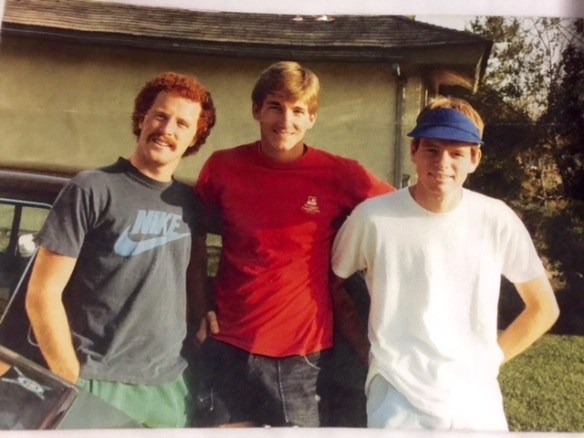
Absent the 1980 Summer Olympic boycott, Steve, Kevin, and I woulda brought home water polo gold. I’m sure of it.
A few friends and I heeded John Muir’s advice this weekend.
Saturday we wondered for a wee bit on the Wonderland Trail where it intersects with the White River. Sunday we went long, looping the Burroughs Mountain Trail from Sunrise. If you’ve never done it, add it to your list. I felt very fortunate to live where we do. And to be alive.
Bonus picture from the niece’s July wedding in Colorado. Taken by Jeanette Byrnes of Jeanette Byrnes photography fame. If you’re looking for a photog, better hire her before she gets too expensive.

West facing valley

Peak-a-boo 1

Peak-a-boo 2

Peak-a-boo 3

Meandering meadow which may be snow covered by now

Purple haze

Best Wife, Dutiful Blogger, Eldest
1. I wouldn’t normally be drawn to an essay titled The Gift of Menopause, but the Times’s preamble drew me in. So glad. Brilliant. Exquisitely written.
2. The Difference Between Being Broke and Being Poor.
3. The Fight for Iowa’s White Working-Class Soul. Is that DJ Byrnes’s future?
4. The Highest Court in the Land. For Richie. Who would dominate.
5A. The specious claims of the “wellness industrial complex” continued. Worshipping the False Idols of Wellness. 5B. Wellness Brands Like Gwyneth Paltrow’s GOOP Wage War on Science.
6. Flat Cokes, Relay Running, and 500 Pages of Notes: A Professor Prepares to Break a Guinness World Record for Longest Lesson. I will not be attending.
If you’re an unrepentant megachurch “superstar” pastor, who has been living a double life, the last thing you want is to see your story told. Shortly before you plan to retire. By the New York Times. On a Sunday. But that’s the bed Bill Hybels made for himself.
The Times tells Hybel’s personal secretary’s story:
“That first back rub in 1986 led to multiple occasions over nearly two years in which he fondled her breasts and rubbed against her. The incidents later escalated to one occasion of oral sex.
She said she was mortified and determined to stay silent. “I really did not want to hurt the church,” said Ms. Baranowski, who is now 65, speaking publicly for the first time. ‘I felt like if this was exposed, this fantastic place would blow up, and I loved the church. I loved the people there. I loved the family. I didn’t want to hurt anybody. And I was ashamed.'”
These #MeToo stories are starting to read like 1980s Madlibs. “The first [type of sexual encounter] led to multiple occasions over nearly two years in which he [verb, past tense] her [a body part] and rubbed against [a different body part].
And saddest of all, the “and I was ashamed” phrase, is an oft repeated, concluding refrain.
The New York Times story alludes to how Hybels’s spell on the church members left them so enthralled with him they couldn’t believe Baranowski and the other women who told similar stories. How dare the women even make the allegations many thought. To this day, that’s the view of the church elders who are proving better at group think than leadership. Initially, the #2 and #3 church leaders, Heather Larson and Steve Carter, both a generation younger than Hybels, rallied around Hybels who they felt was being unfairly criticized.
After reading the Times story, I poked around a bit at Larson’s and Carter’s social media. I learned that almost immediately after the allegations fell on deaf ears at their church, they started to feel remorse for not siding with the aggrieved women.
Larson’s mea culpa to the congregation can be viewed here.
Carter did one better by resigning yesterday upon reading the New York Times article.
He explained:
“I am writing to announce my resignation from Willow Creek Community Church, effective immediately. The new facts and allegations that came to light this morning are horrifying, and my heart goes out to Ms. Baranowski and her family for the pain they have lived with. These most recent revelations have also compelled me to make public my decision to leave, as much as it grieves me to go. Since the first women came forward with their stories, I have been gravely concerned about our church’s official response, and it’s ongoing approach to these painful issues. After many frank conversations with our elders, it became clear that there is a fundamental difference in judgment between what I believe is necessary for Willow Creek to move in a positive direction, and what they think is best. . . . I offered my resignation many weeks ago, but I was requested to delay an announcement and continue with my duties until the leadership determined how to make the decision public. At this point, however, I cannot, in good conscience, appear before you as your Lead Teaching Pastor when my soul is so at odds with the institution.”
Two lengthy, extremely well written profiles worth your time if you’re the least bit interested in (1) North Korea and/or (2) marketing.
1. The Untold Story of Otto Warmbier, American Hostage. Unfunny throughout.
2. How Goop’s Haters Made Gwyneth Paltrow’s Company Worth $250 Million. Very funny in places.
Good sermon pastor, thank you. You’re right, the church does need to involve itself more directly with the “affairs of the city and state”. Apolitical churches do lack vitality.
But I wish you had concluded with “To Be Continued” because there is so much more to consider, isn’t there? It seemed like at least a three-parter.
As members of Good Shepherd Lutheran Church, it would be nice if our mutual effort to be more Christ-like was sufficient for us to quickly and simply come to common agreements about candidates, policy resolutions, and Supreme Court nominees.
But that’s fantastical, “pie in the sky” thinking. Why do I think that? Because there’s one other congregant in our church who I sometimes struggle to discuss politics with. Even though we have similar values and political philosophies, sometimes when we think and feel differently about a specific “affair of the city or state”, we get defensive, even offended to the point where one of us ends up with hurt feelings.
Given our congregation of 250-300 people, multiply the political pitfalls the two of us sometimes succumb to by 125 or 150. Reaching any kind of consensus on the “affairs of the city and state” is so difficult, most churches don’t even try.
I contend it’s impossible to reach any kind of consensus on candidates running for office and on policy issues, even those that directly overlap with Jesus’ example like what to do about homelessness, low-income housing, and taxes.
But that shouldn’t be the goal.* The goal should be to delve ever more deeply into “the affairs of the city and state” knowing that people will come to different conclusions. The goal should be to listen to one another more patiently, to extend more grace to those who think differently, and to maintain caring relations despite differing political philosophies and affiliations. For visitors to conclude, “There’s something different about them. Something compelling.”
The question you left me with is whether we can be an oasis for people who are completely burned out by political partisanship, rancor, and hatred. Can we learn to “do politics” differently, by listening to, empathizing with, and genuinely respecting one another despite our contrasting political philosophies and affiliations? So that we can be an outward looking, positive presence in our community.
I don’t know that answer to that, but I suspect our future depends upon it.
*especially if we want to maintain our tax exempt status
Maybe not the worst advice ever, just the least practical.
That’s what a former engineer recommended we do at last Sunday’s annual congregational meeting when discussing the uncertain status of the After School Tutoring Program (ASTP).
It’s been a tough year for Good Shepherd Lutheran Church. Maybe historians will point to my being elected to the Church Council as the catalyst for the downturn.
Recently, my fellow Council members and I asked the pastor to resign. Inevitably, that upset some members, some so much so they left. Others stopped attending probably because they had enough conflict in their lives already. Consequently, we have challenging budget decisions to make.
Despite the fact that the After School Tutoring Program represents somewhere between 2-2.5% of the total budget, the congregation spent 90% of last Sunday’s budget discussion debating whether we should continue it or not. This wasn’t a one-off, the church is preoccupied by it. I am totally flummoxed and exasperated by the congregation’s seeming fixation with the ASTP. The attention is receives is totally out of proportion to that of other programs, ministries, and issues.
Which begs the question why. My only conclusion is that my engineering friend has it completely backwards. It’s impossible to take the emotion out of it because it’s exclusively based upon competing emotions that have formed over its long history.
I am resigned to the fact that the ASTP is our Ford Mustang. Of Ford’s decision to eliminate every sedan except the Mustang:
“. . . the Mustang’s survival isn’t really about numbers. ‘Five years from now, whether Ford decided to keep the Mustang or not isn’t going to be a material factor,’ Mr. Jonas said. ‘It’s more of an emotional thing. They’re trying to preserve the sexuality of motoring the way it used to be known.'”
Apparently, Ford suits gets what my engineering friend does not. You can’t take emotions out of things. At least not completely. And in the case of the ASTP, hardly at all. Resistance, I’m finding, is futile.

 Pressing Pause