“To be loving is to be open to grief, to be touched by sorrow, even sorrow that is unending.”
“Love is an action, never simply a feeling.”
“To be loving is to be open to grief, to be touched by sorrow, even sorrow that is unending.”
“Love is an action, never simply a feeling.”
When his friends rip him for what they perceive to be an unusually lax job, an egghead professor friend of mine likes to joke that “The life of the mind is 24/7.”
A very successful writing friend of mine once told me that “if you don’t think about your current writing project when you first wake up, something’s wrong.” I’m fascinated by the subconscious which I think of as the nearly continuous internal dialogue I have with myself.
Sometimes I can write a medium-long, (hopefully) substantive blog post in 20 minutes only because subconsciously, I’ve been sporadically working on it for days in my mind. Sometimes even, while asleep.
In one first year writing conference a student of mine described her pre-writing process on one paper this way, “I talked about the prompt a lot while driving around with my friends and then my dad and I really got into it.” For which she received historic levels of extra credit.
Of what does your internal dialogue consist? Are there patterns or themes? What shapes your subconscious? For me, it’s a combination of things I read, watch, and listen to; reflections on interactions with people past and present; and then staring at the Cooper Point coastline of the Salish Sea while nursing my morning latte.
If your subconscious has atrophied as a result of not exercising it enough, maybe you should give this a go.

Source: @AwesomeLibrarians
In preparation for tomorrow’s writing seminars, I’m rereading old final papers to select a few to share with my current students who are writing their fifth and final ones of the semester. In short, the final paper is a self-assessment of the progress they’ve made throughout the semester.
One former student wrote:
“This course has had a profound impact on the way I think about writing and life. I have become a stronger conversational writer with more confidence in my abilities, and I have been encouraged to continue writing outside of an academic setting. Now I really enjoy informal writing: I am planning on writing an op-ed in the Mooring Mast (the school newspaper) and am even applying to work at the Writing Center at Professor Ron’s suggestion. Without his support, I would not have had the confidence to make that decision.”
Thanks to their elementary, middle, and high school teachers; and parents I presume; about a third of my first year students have really high ceilings as writers. And over the years, I’ve gotten better and better at helping them realize their writing potential. I do it by telling them they’re amazing. While they’ve earned good grades throughout their lives, they’ve received very little or no meaningful and specific praise. The good grades don’t add up to much over time and many of them lack confidence.
I make a boatload of electronic comments on every paper. Some are suggested revisions, but many others are smiley faces, comments like “really excellent paragraph” and “nice insight”. At first their insights are sentence-long, now they come in waves of paragraphs. I always end with a long comment where I highlight their clearest strengths and next steps and often conclude by telling them how much I enjoy reading them. Upon returning papers, I follow up in class with praise for their last writing effort and positive examples of their improving work.
Those are some of my ways of telling them not that they’re “A” students, but that they’re amazing young adults. Pete Carroll, of the 3-8 Seahawks LOL, refers to it as “relentless optimism”.
Like my students, we lack confidence that there’s anything amazing about us. We could change that if we started telling family and friends what we most appreciate about them.
The Good Wife is grieving the loss of her mom and dad. Last night, in an attempt to cheer her up a wee bit, I told her she had been an amazing daughter to them for the last five years. She replied, “I have?”
I couldn’t believe that she was too close to it and too hard on herself not to see how amazing she had been. Flying to see them in Central California repeatedly, moving them to Washington State, and then putting her life on hold for the last year as their needs grew exponentially. Lovingly and completely selflessly caring for them to the end almost by herself.
It wasn’t her fault that she wasn’t sure she had done enough. Because no one had told her she was amazing.
Ancient Greeks had six distinct words for different types of “love”, eros, philia, ludus, pragma, agape, and philautia. Philautia is self-love. The more you like and feel secure in yourself the more philautia you enjoy.
In this recent New York Times personal essay, “I Just Turned 60, but Feel 22“, Margaret Renkl provides the single best example of philautia of all time.
“The joking birthday cards that start coming at 40 were funny 20 years ago because they were so far from reality. Now they’re funny because they’re so true. One of the cards I got last week featured a vintage photograph of plump women in swimsuits who looked remarkably like me in my swimsuit. “At your age, swimming can be dangerous,” the card read. “Lifeguards don’t try as hard.”
I laughed so hard, my belly jiggled, a feature of being 60 that troubles me only a little. This is just who I am now, a person who looks exactly like her late mother, despite far more exercise and a far healthier diet. Besides, I loved my mother, and I love seeing her again in every store window I pass.“
My 89 year-old father-in-law died Monday. My 90 year-old mother-in-law died today, less than 60 hours later. It wasn’t heartbreak as much as an inexplicable cosmic coincidence that they damn near crossed the finish line side-by-side.
How do you fill the void?
They were from Two Harbors, Minnesota, a ‘Grandma’s Marathon’ north of Duluth on the edge of Lake Superior. They spent most of their lives in Southern and Central California before moving to Washington State five years ago. They were married for 67 years.
I never saw them get angry at each other. It was a 1st Corinthians love. Somehow, they mastered the whole marriage thing, remaining extremely close until the end.
I couldn’t have asked for a better father-in-law. “It’s about time,” he said when I told him I was going to marry his daughter in a Marie Calendar’s bathroom in Long Beach, California.
Ron took me to a lot of good golf courses and always paid for my green fees. He would brag about my golf game even when it was nothing to brag about. He trusted me with his BMW which Lynn and I would take to the San Luis Obispo swimming pool. He loved that car and pushed it a little harder than I sometimes liked. He took great pride in his citrus trees and he was an oenophile. A rare, down-to-earth oenophile. Despite his professional and economic successes in California, he was always small town Minnesota. There wasn’t a pretentious bone in his body. Just. Like. My. Dad.
Peg never took me golfing. And if I’m being honest, I wasn’t as close to Peg as I was Ron, but we grew fond of each other in the last decade. And for that I’m grateful. I’m especially grateful for the childhood she provided Lynn. With Ron, she chose her in a Los Angeles hospital and sowed many of her clothes among innumerable other acts of love. Unlike me, she was quite formal and proper. So much so, Lynn’s brother absolutely lost it the first time I swore at their dinner table (must have been the red wine).
Less obvious was her physical and emotional toughness. I suppose it’s hard not to be tough growing up on the edge of Lake Superior. In that regard, she was Just. Like. My. Mom.
I am forever indebted to both Ron and Peg for picking Lynn and providing her an unconditional love that so obviously lives on in her. And I am forever indebted to them for the profound love they had for Alison and Jeanette. That lives on through them too.
Maybe that’s how we fill the void. By loving others as we have been loved.
Blessed be their memory.
Of course you do. My new fave essayist, Tish Harrison Warren, has some advice.
“If you survey the advice of the saints from the past two millenniums, a consistent piece of advice emerges: Shut up. Be still.”
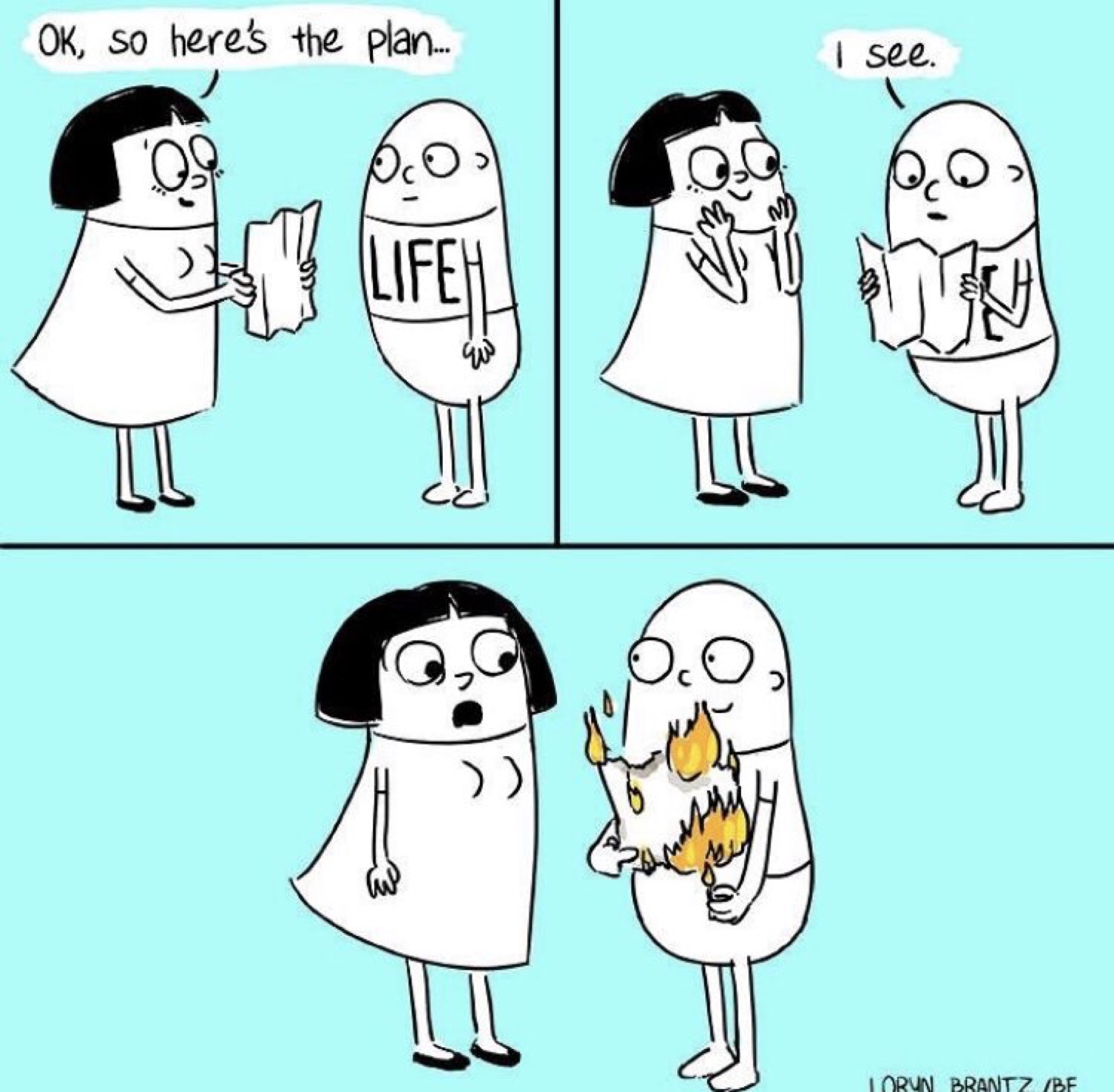
William Irvine’s The Guide To The Good Life is an attempt to reinvent Stoicism for the 21st Century. Irvine argues that everyone should have a philosophy of life that includes specific strategies for achieving their primary objective(s) in life. Absent an intentional plan, at the end of life, people will regret that they have “mislived”.
Put differently, one should live intentionally, not spontaneously. He acknowledges few people do so mostly because of the “endless stream of distractions” that keeps them from clarifying what’s most important. And he made that point before social media and streaming television both exploded.
If pressed though, I’m guessing Irvine would acknowledge rewarding times in his life when he acted spontaneously, when he said yes to an unexpected invitation or adventure.
I wonder if the answer to the dilemma of just how intentional to be in planning one’s life lies in the tides, meaning there should be some sort of natural ebb and flow between intentionality and spontaneity.
The older other people and I get, the more set we become in our daily routines. Losing some of our youthful spontaneity, we should carefully consider the improvisors’ dictum of always saying YES. Okay, “always” is unrealistic, but what about “more often”?
A LOT of my acquaintances and friends have died lately, almost all of them from cancer, a scourge we may be sleeping on amidst the endemic. Being my age, their deaths have got me thinking about my own.
Despite not having an explicit philosophy of life, if I die sometime soon, and have time to reflect on my six decades*, I wouldn’t at all think I had mislived. Quite the opposite. I would be grateful for all the meaningful friendships; all the socially redeeming work; and all the fond memories of things including athletics, traveling, and especially family.
Lately, I’ve felt a deep and profound sense of contentment for most everything including my new and improved health, our home, and the natural environment in which it sits.
That very spiritual sense of contentment doesn’t have to conspire against saying YES to new invitations and adventures does it? To continual growth?
Presently, I’m most interested in personal growth. Professionally there’s nothing I feel a need to accomplish. My plan is to spend my remaining days learning to listen more patiently and empathetically to others—whether the Good Wife, my daughters, you, my students, everyone. That could easily take several more decades. Guess I should keep exercising and eating healthily.
*meaning not on my bike :)
Since school is back in session, let’s ease in with an especially good Tish Harrison Warren essay, “How Silence Became a Luxury Product.” Find a quiet place to read it.
Thanks to my mountain biking neighbor for this find.