A student of mine, in his final paper:
“Being social and vulnerable were two things that I didn’t have much experience in until I got my job at a car dealership and spending a generous amount of time in Professor Byrnes’ class.”

A student of mine, in his final paper:
“Being social and vulnerable were two things that I didn’t have much experience in until I got my job at a car dealership and spending a generous amount of time in Professor Byrnes’ class.”
The semester is a wrap. My parting words to my students.
“The very end of my first class as a brand new professor at Guilford College in Greensboro, NC ended in a humorous manner. I spoke for about ten minutes, doing my best to tie together all the course’s loose ends. I was pulling out my egghead professor vocab and thought everyone was listening closely. After I finished, Josh raised his hand. ‘Oh great,’ I thought, ‘Josh is going to thank me for the brilliant summary and the course more generally.’ Instead, he said, ‘Dude, you have a pierced ear!’ Then the discussion devolved into why I had never came to class with an earring. Lesson learned, keep the end-of-semester spiel very, very brief.
Price writes that ‘the more we train ourselves to notice delights—the everyday beauties and kindnesses and amusing absurdities, the things that make us laugh or that we feel grateful for—we will feel more positive.’ She goes on to suggest we say ‘delight’ out loud whenever we experience anything that sparks joy. I’m trying to adapt this practice. This morning, on my drive in through the Nisqually Delta, I saw a huge flock of birds flying in ‘V’ formation. I said ‘delight’ to myself. Then I immediately thought of this class and what I wanted to say to you now that we’re at the finishing line.
And here it is. Delight.
It’s been a complete and total delight to get to know each of you individually and collectively. I hope the rest of Year 1 goes well and that we cross paths again sometime in the future.”
Ron
Wednesday, 11:30a.m., National Pearl Harbor Remembrance Day. More specifically, the week before I’m buried under final papers. Ensconced in my home office, alternating between reading, writing, and watching the Salish Sea flow northward thanks to a southern wind.
All while grooving to a folk/acoustic/electronic vibe compliments of Sylvan Esso, Becky and the Birds (Wondering), the Cowboy Junkies (Sweet Jane), and Helado Negro (Lotta Love).
On the interweb I see a Stephen Marche prediction that artificial intelligence is going to “Kill the Student Essay“. That hits close to home.
“Essay generation is neither theoretical nor futuristic at this point. In May, a student in New Zealand confessed to using AI to write their papers, justifying it as a tool like Grammarly or spell-check: “I have the knowledge, I have the lived experience, I’m a good student, I go to all the tutorials and I go to all the lectures and I read everything we have to read but I kind of felt I was being penalised because I don’t write eloquently and I didn’t feel that was right,” they told a student paper in Christchurch. They don’t feel like they’re cheating, because the student guidelines at their university state only that you’re not allowed to get somebody else to do your work for you. GPT-3 isn’t “somebody else”—it’s a program.”
Marche adds, “It still takes a little initiative for a kid to find a text generator, but not for long.”
Please tell me there’s no way for ChatGPT to replicate my charming personality.
“Kevin Bryan, an associate professor at the University of Toronto, tweeted in astonishment about OpenAI’s new chatbot last week: ‘You can no longer give take-home exams/homework … Even on specific questions that involve combining knowledge across domains, the OpenAI chat is frankly better than the average MBA at this point. It is frankly amazing.’ Neither the engineers building the linguistic tech nor the educators who will encounter the resulting language are prepared for the fallout.”
I resemble that! I’ve been wrongly assuming that my Multicultural Education take-home final exam was text generator proof.
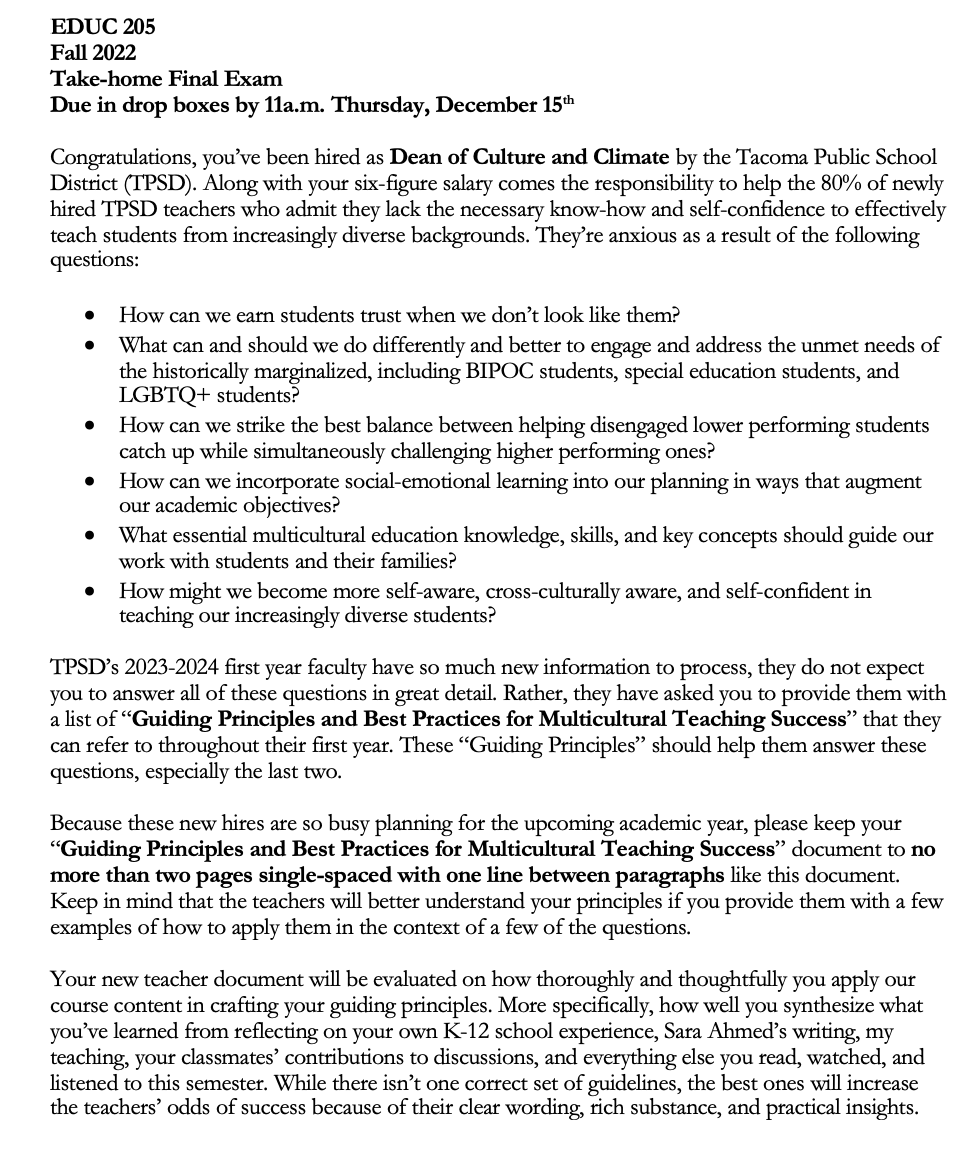
Going forward, I guess I’ll have to require students to pass through a metal detector and write it in-person.
We need more Bill Waltons, the former college and professional basketball legend whose playing days were cut short by numerous injuries and related surgeries.
“My injuries piled up,” Walton explains. “Bad back, broken bones, ankle and foot problems, broken hands and wrists, knee injuries, and broken noses.” By his count, Walton had 38 orthopedic surgeries to mend his various injuries.
Currently, Walton is a wonderfully idiosyncratic basketball analyst whose “glass of life” is constantly overflowing. The list of things he appreciates is exceedingly long. His positivity is contagious. His commentary is 45% basketball and 45% philosophical, interdisciplinary ramblings. The remaining 10% of the time he’s busting his partner’s chops. Their faux exasperation with each other can’t hide their chemistry and mutual affection. It just works.
Midway through yesterday’s UCLA-Oregon game (Bruins off the Duck schneid), Walton said something that instantly clarified my thinking about my teaching this fall. He said, “You can’t learn what you don’t want to know.” Turns out, after a little sleuthing, he was quoting Jerry Garcia of the Grateful Dead, who in one of their songs wrote, “You ain’t gonna learn what you don’t wanna to know.” Shame on Walton, one of the greatest passing bigs of all time, for not crediting Garcia.
Much is being written about the growing academic achievement gender gap. Here is my Reader’s Digest point of view on it based upon my “on the ground” experience. A third of my students are male. At least half of them are excellent, by which I mean they think deeply about what they read, participate actively in class discussions, and write better and better over the course of the semester as a result of working at it. They’re sensitive, caring, and socially conscious. A privilege to work with.
The other subset doesn’t read, participates sporadically in ways that do not deepen our discussions, and pay little to no attention to their peers. They’re way more interested in their phones than what we’re reading and thinking through.
“Well Ron,” the K-12 teachers are probably saying, “your job is to get them interested.” I don’t want to ever become some of my colleagues whose answer to this dilemma is for the Admissions Office to just admit “better” students. My K-12 friends are right, but so is Walton, I mean Garcia, no matter how much magic my engaged students and I can muster, “You ain’t gonna learn what you don’t wanna to know.”
Compared to my female students, a disproportionate number of my male students don’t like to read and lack curiosity about themselves and others. While still a minority of males, this disengaged subset seems most interested in two things. A diploma and a job. Rightly or wrongly convinced of the need for a diploma for improved job prospects, they are resigned to playing the game of school for four years. At a large cost.
These students would benefit immensely from a gap year or two. Especially if we had a respected National Service program that they could opt into.
Absent that, some of the apathetic will do just enough to graduate relatively unchanged. And for many others, their apathy will get the best of them, and all they will have to show for their limited effort is years of debt.
You would think inciting a violent insurrection designed to overturn a fair and free election would disqualify one from running for office again.
And if not that, then calling for a shorter, more election conspiracy-friendly Constitution.
And if not that, the Former Guy’s capitalization and quotation errors seal the deal. In fact, they are enough by themselves to lock him up and throw away the keyboards.

“DeSantis would launch any charm offensive unarmed.”
That’s how an excellent colleague of mine describes her teaching philosophy. It perfectly encapsulates what I strive to do with my students as well.
The phrase “thinking slow together” echoed in my mind while reading David Sims’s review of Dave Chappelle’s SNL appearance.
When watching Chappelle, I vacillated from unconsciously laughing at many of his punch lines to consciously questioning how he set up a few others. A singular talent, I thought he was very funny, but I also experienced some uneasiness and couldn’t give completely in to him.
I didn’t understand why until thinking slowly about it with Sims’s help. And there is the power of the printed word. In a world where faster is always seen as better, writing and reading force us to take time to ponder things, to consider others’ viewpoints, to formulate tentative ideas, and to clearly communicate them.
And as in the case of Sims’s review, that slowing down results in more profound, longer lasting insights than live audio or television generate by themselves.
Clint Smith explains in “What a Racist Slur Does to the Body“.
“As we were walking through the stanchions ushering us past the terminal’s gate, the white woman turned to the Black woman, red with anger, and called her the N-word.”
“. . . it is not that I was unfamiliar with hearing that word out loud; it is that it had been many years since I had heard it used in public, by a white person, in a way that was laced with such unvarnished venom and disgust. It was as if my skin was struck by a match and fire spread through my entire body. My heart’s once metronomic tempo accelerated into a gallop, my blood pumping as if it was trying to tell me to run away. Cortisol was coursing through me.”
One of my college besties is a psychotherapist in the city of Angels. I sent him this George Saunders essay, “Could I understand the people who rushed into the Capital?” and then asked him whether we need more therapy or fiction. Of course, the answer is both.
TL/DR. . . yes, Saunders could. And so can anyone who dares follow his lead.
 Pressing Pause