How We Should Respond to the New Terrorism

5:30p Wednesday night. That’s enough planning of the new class for school principals that begins in February. My night to make dinner. The Good Wife will be home in an hour. I can make an amazing salad in 30 minutes easy peasy.

How to burn the spare thirty? Obs, college basketball, but the games aren’t that compelling and you can only watch the Property Brothers so much. Surfing, surfing, how ’bout some pre-dinner self flagellation. Fox News.

And then it happens. . . today’s brilliant idea hits me with just 4+ hours to spare. There are two steps the U.S. and the West more generally should take in response to the new terrorism.

1st—Spend one night carefully watching Sean Hannity and other Fox “News” show segments that directly address recent events in Paris.

2nd—Do the exact opposite of what they advocate.

Railing about how the Obama administration and the US always coddles Muslims, the angry men on Sean Hannity’s panel were equal parts fearful and hateful. They demonstrated no knowledge of young French Muslims’ life experiences nor did they have any interest in the larger context of radicalism.

Consequently, they didn’t spend any time discussing prevention. Given the chance, they’d probably banish me to a Caribbean Island max security prison for even suggesting historical context matters. Because that’s probably a form of coddling. Now, as I write, Bill O’Reilly is lionizing the Moroccan-born mayor of Rotterdam who said Muslim immigrants who do not appreciate the way of life in Western civilisations can ‘f*** off’.

Instead of watching Fox News, we should listen to the French secondary school teachers in the suburbs of Paris. For a decade plus they have been trying to tell the French public that the alienated youth they teach are especially susceptible to radicalism. Despite being born in France, they don’t feel French. Many of their frustrations are born of institutional racism and religious persecution. The French government is so committed to secularism that it’s unwilling to accommodate hardly any of their religious practices.

Alienation is no justification for the horrific violence of last week. Worth repeating. Alienation is no justification for the horrific violence of last week, but a Rotterdam Mayor/Fox News mix of fear and hate will only make matters worse. To mitigate the problem governments have to think and act counterintuitively. Instead of succumbing to paralyzing fear and hate and the revenge it breeds, we have to be way smarter than anyone on Fox News about the underlying causes of radicalism. The more we think of this as a century long battle for the hearts and minds of young Muslims worldwide, than a ten or twenty year contest of military might, the better.

We need courage to reject the simple, fearful, hateful diatribes of the Rotterdam Mayor and Fox News. “An eye for an eye,” Ghandi said, “makes the whole world blind.”

Most Educational Technology Does Nothing to Improve Teaching and Learning

Two friends of mine develop apps for children with autism spectrum issues. Their work is just one of many examples of how educational technology is an unmitigated positive for students with special needs.

You would never know it given the tendency of the Information Technology Zealots (ITZs) to exaggerate the impact of their toys, but ed tech is not an unmitigated positive for elementary, secondary, and university students more generally.

In fact, 80-90% of educational technology does nothing to improve the quality of K-12 and higher education teaching and learning. The problem is, the ITZs nonstop, unfounded assertions about the benefits of ed tech has rendered our critical thinking abilities completely ineffectual. The Ed Tech Emperor often has no clothes on, but odds are you’re skeptical of that because ed tech groupthink is at epidemic proportions.

The problem is there’s no consensus about how to evaluate whether educational technologies improve teaching and learning; as a result, our default is a vacuous falsehood. More is better.

My starting point is Decker Walker’s assertion that “The educative effect is greater when students do something than when something is done to them.” What is it, ideally, that students should do? Students should read and think about challenging topics and abstract concepts, ask open-ended questions, look at and listen to one another, respect classmates who think differently than them, learn to be empathetic, and write and speak clearly and persuasively. That’s my liberal arts oriented litmus test for whether educational technologies are additive or not.

What happens if we apply my test to a case study that my esteemed university recently added to its website? I’m calling it Professor Technology.

Here are the highlights, or lowlights, depending on your perspective:

Intro. Professor Technology is a self-proclaimed computer geek. Employment in the financial sector and government opened his eyes to the importance of technology in the workplace. His first experience with technology-based education occurred when the IRS asked him to develop national training courses to be delivered both live and virtually. He realized the challenges involved in developing engaging content and obtaining learning feedback. This opened the door to his exploration of many types of learning tools, including online polling.

What is one instructional technique or project that is particularly effective, innovative, or engaging? “I encourage my students to bring their laptops, tablets, cell phones or anything else. I keep them technologically engaged in a way that they will not have the time or desire to do anything else on their machines during class.[i] Students have cell phones and they will bring them to class. That is the reality of 2014. Why not put them to use? The students are intrigued by the idea of ‘texting for learning.’ [ii] Technology allows us to collect information about behavior. Information is just as precious to a company wishing to market a product as it is to an educator wishing to improve specific areas of performance at the class level or at the individual student level.”

What related tool or strategy do you use that other PLU faculty might like to try in their courses? “Although I have many untested ideas, this semester I relied heavily on a neat PowerPoint plugin called Poll Everywhere. PollEv allows me to embed polls in my PowerPoint presentations. I can create multiple choice questions, T/F questions, or open ended questions and embed them by surprise in my presentation. The students can answer polls though their phones, computers, or tablets. For open ended questions, they can type in their answers. The system tells me how many students are attending the poll and how many have cast their vote. The poll results are updated instantly on the class screen.”[iii]

What are the benefits, for you and your students, of utilizing this tool or strategy? “My experience has been that quality decisions are made through quality information. Plenty of quality information is available to most of us if we only know how to reach it and use it. Businesses are well aware of this competitive advantage and employ technology to the fullest extent they can to maximize profits. . . . PollEv allows me to obtain immediate feedback about my class without having to put the spotlight on one specific student. I noticed that students sometimes feel pressure to participate or not participate or to give a right or wrong answer. PollEv allows everyone to participate without fear and gives me the opportunity to reiterate a certain topic while the content is still fresh. I generally embed 1 poll every 5-6 slides.”[iv]

What advice would you have for someone interested in trying this tool or strategy? “PollEv is very easy to use. You may simply visit their website, form an account, and give it a try immediately. While I enjoy embedding my polls into PowerPoint, that is not necessary. You could simply use their online portal to cast your poll.”[v]

The remarkable thing about this case study is just how unremarkable it is. Stories like this—about the benefit of things like wireless laptops, tablets, smart pens, or smart boards—are so commonplace, we passively accept them.

When will we muster the courage to question the ITZs hyperbolic claims? Instead of being bedazzled, even hypnotized by ed tech bells and whistles, we need to challenge Professor Technology to show us how PowerPoint and PollEv are helping students read and think about challenging topics and abstract concepts, ask open-ended questions, look at and listen to one another. Or how they’re helping them respect classmates who think differently than them, be more empathetic, and write and speak more clearly and persuasively.

These aren’t the only questions, or even the best ones, but I probably deserve some sort of medal for asking them. I won’t hold my breath. I’ll consider myself lucky if I avoid a public tarring and feathering by the ITZ hordes.

[i] How can I put this nicely? Professor Technology is hopelessly naïve. No one is that engaging. Mercy, this is an accounting class. Students are likely texting; emailing; and alternating between Twitter, Tinder, PressingPause, Facebook, Instagram, PressingPause, and ESPN.

[ii] The central assertion that I do not accept.

[iii] A giant leap forward from asking students to raise their hands and/or speak to accomplish the same things?

[iv] If ed tech is a work-around for students too afraid to raise their hands or state an opinion in front of their peers, we have more pressing problems than how to better engage students.

[v] I will respectfully pass on not just PollEv, but PowerPoint. Why did Steve Jobs, every time someone used PowerPoint to pitch him a product idea, stop them before the second or third slide?

Sentence That Restores My Faith In “The Public”

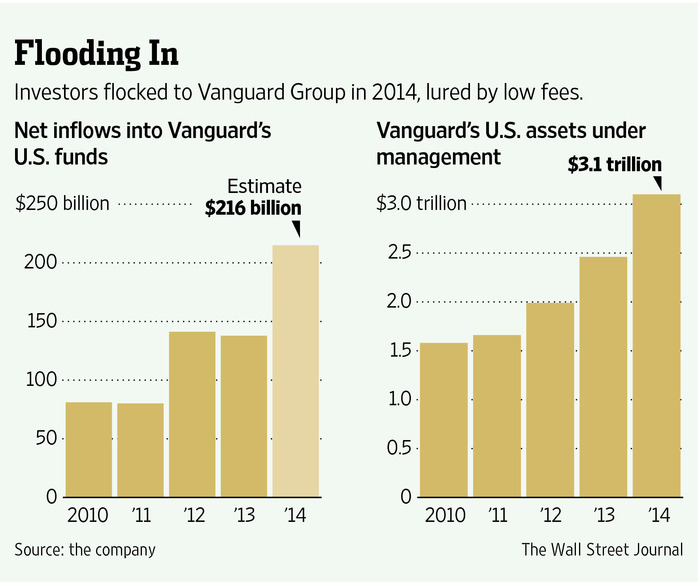
From today’s Wall Street Journal.

Investors pulled $12.7 billion from actively managed U.S. stock funds in 2014 through November, and put $244 billion into passive index funds from Vanguard and others, according to Morningstar.

Related factoid:

Vanguard is undercutting many rivals on fees. Investors pay 18 cents for every hundred dollars they invest with Vanguard, compared with $1.24 for the average actively managed mutual fund, Morningstar said. The company also is beating its passive rivals, which charge an average of 77 cents for every hundred dollars.

MI-CH113A_VANGU_9U_20150104185406

The Problem With Direct Democracy

Let’s start the new year off with some heresy.

Education, medicine, policing, journalism, fill in the cross-section of the work world, every work collective is attempting to reinvent themselves; to save money; to work smarter, not harder; and ultimately, to meet people’s needs more effectively. Thoughtful reformers across the gamut repeatedly cite the importance of public participation in reform efforts.

A friend of mine, a transportation engineer, shared a story with me recently about an award his office received for a particularly successful redesign of a small downtown in Central Washington state. What stood out in the write-up was how thoroughly his team sought citizen’s input on what improvements they most valued before ever picking up a shovel.

Another friend is in the State Highway Patrol. Last week I shared a lengthy article with him about changes afoot in the Seattle Police Department. Here’s his insightful reply:

I’m all for a new approach to policing and public safety, but it needs to be driven by citizen initiatives and new laws not local prosecutors deciding what to file based on what they think is important. I don’t agree with a lot of the prostitution laws, but it is still illegal. Just like I didn’t agree with the marijuana laws, but it was still illegal. The citizens determine what laws we live by not selective prosecutors and politicians.

That makes imminent sense. The education parallel is we need new approaches to K-12 schooling and teacher education, but it needs to be driven by citizen initiatives not middle managers at the Office of Public Instruction.

But I have to believe, given the notion of connoisseurship, or specialized expertise, that there are limits to direct democracy. When it comes to reforming our medical system, I trust Atul Gawande way more than I trust myself. Why? Because from reading him I know he has patients’ best interests in mind. Plus, he has highly specialized expertise.

Like everyone, I have some thoughts on how to improve medicine–I’d like my doctors to work more closely together, I’d love to see a dermatologist sometime before I die, and it would be nice if rising costs were in line with the Consumer Price Index–but I have no idea how to get from here to there. I don’t need a seat at the table, I trust the Atul Gawande’s of the world to reinvent medicine. I’m content, if in the end, I get to vote for what he and his doc friends propose.

For the last three decades education reform has been largely ineffectual because nearly every change has been imposed on teachers from well-intentioned people outside of schools—whether Presidents, Secretaries of Education, Governors, Superintendents of Public Instruction, CEO’s, wealthy philanthropists, and academics. When it comes to revitalizing K-12 schooling, I trust teacher leaders in those schools way more than I trust President Obama, Arne Duncan, Tom Friedman, Bill Gates, Randy Dorn, or myself.

Here’s the most bold education proposal imaginable—let’s empower teacher leaders to reinvent their profession. Let them decide themselves what to teach; how to teach; and how to evaluate, promote, and reward one another. I’ll be content if, in the end, I get to vote up or down for what the teacher leaders propose for the schools in my community.

When it comes to redesigning a small town’s downtown, I trust my transportation engineer friend. When it comes to reinventing policing, I trust my State Trooper friend. Because they have citizens’ best interests in mind and they are far more expert than me in their respective fields. That’s why I’m more a fan of representative democracy than direct.

Bet You Can’t Read This and Still Believe There’s “Justice For All”

From the LA Times. Knives, Death, a Famous Name.

Odd isn’t it that in the U.S. we require schoolchildren to say a Pledge of Allegiance, but we don’t help them think through its contents to decide if in fact they believe some or all of what they mindlessly word. If we’re going to continue that practice, maybe we should update it so that it ends “and justice for well-to-do families with lots of social capital”.

Some day I hope to live in a country where Fred, Kathy, and Brigida Santos are equal to Fabian Nunez, Arnold Schwarzenegger, and Antonio Villaraigosa.

Eschew the South

According to conservative pundits, liberals like President Obama and myself don’t really like the United States. “Love it or leave it!” they ignorantly insist. They want everyone to believe they’re the true Americans because they mindlessly subscribe to American Exceptionalism. Nevermind that our independence resulted from intense dissent born of the freedom of speech the Constitution enshrines.

One of the things I like most about the U.S. is distinct regional differences compliments of its great expanse.

As viewed from the upper atmosphere, I live in the very uppermost left hand corner of the country. And sadly, moms lives in the very bottommost right hand corner. I’m writing this at 36,000′, halfway home on my most recent cross-country voyage. I’ve made this trans-continental trip probably 30+ times since my parents’ long ago move to the Peninsula (known to some as Florida). As a result, I’m declaring myself a Southeastern U.S. expert. Meaning I’m qualified to make extreme generalizations about it even if Southerners take offense.

For example, the conventional wisdom that Southerners are more hospitable is something they like to tell themselves probably to feel better about how inhospitable life can be “down South”. Take the Southerner in the Enterprise car rental office today on Kennedy Boulevard right next to the University of Tampa. “You KNOW you guys need some fuckin’ better help in here don’t you?!”

That warm Southern hospitality is also extended whenever you dare cross a busy street. As I stood at intersection after intersection this past week, speeding drivers shot me angry looks, upset that eventually I’d step foot onto their road. Sunday afternoon, at one intersection, loose wires peered out of the street light so there was no way to trigger the cross walk. After five minutes I moved to the middle of the block to eliminate turning cars from the total amount of sheet metal I had to dodge. Then I did my Usain Bolt impersonation, and now, the humble blog readers rejoice that I (barely) lived to write another day.

Have you heard the joke about the Southeastern city planner? That’s the joke. An oxymoron if there ever was one. Most egregious, there are more Cuba-loving liberal Democrats in Florida than there are bike lane miles. My advice, if you sometimes enjoy walking outdoors or riding a bike, eschew the South. In fact, I hereby announce an Eschew the South movement until pedestrians and cyclists are acknowledged to be fully human. Bumper stickers and t-shirts are now available.

Then there’s the stuff I can’t pin on Neolithic Age city planning–hellish heat and humidity. One of the best things about the upper lefthand corner is our built in air conditioning. Our politics are liberal, but our temps wonderfully moderate. Even on the rare warm summer day, temps plummet at dusk. We also get to run and cycle up and down hilly, even mountainous trails and roads.

I’m going to skip the planned paragraph about the preponderance of fatty and fried Southern food at the risk of being mistaken for a self-absorbed foodie.

This began innocently enough as an appreciation of regional differences, but somehow morphed into an unprovoked regional rant. Fair enough if Southerners hold it against the PNW.

Long story short, I could easily live without the SE, but not Mother Dear. So the diagonal pilgrimages will continue despite their deleterious effect on my life expectancy.

On Cuba and North Korea

The last bastions of communism are dominating the news. I’m reading another book about North Korea, Without You, There is No Us, by Suki Kim.

Rich and powerful voices dominate the airwaves, heads of state, Sony executives, and Hollywood stars. Ordinary Cubans and North Koreans, who have suffered endlessly at the hands of the Castros and Kims remain completely voiceless.

Their stories are the ones that need telling. I’m hopeful we’ll begin to hear ordinary Cuban voices in 2015, lifting the veil on life on the island. I have no such hope for North Korea. The plight of North Koreans is seemingly hopeless. And that should be our focus.

Improve Your Health—Go Outside

As the video below makes clear, research suggests spending time outside is good for one’s health. Physical health, mental health, or spiritual well-being? My hunch, all of the above. No one has to tell children or labradoodles how invigorating it is to be outside. Sometimes, as we age, we forget. Remember the Norwegian saying, “There’s no such thing as bad weather, only bad clothes.” Now if you’ll excuse me, it’s time to walk to church.

p.s. A and J, James is what’s known as “SILM”, Son In-Law Material. Doc. Sense of humor. Wears suits. And he looks like he’s your age (even though he’s 31). Just sayin’, what’s not to like?