The Move

Dear Reader,

Apologies for denying you your need to Press Pause for so long. Please know, this time the extended Pause was not the result of lethargy or a lack of profundity deserving of your consideration.

It was due to a 5.8 mile move which, I am very happy to report, is largely in the rearview mirror.

TL/DR. . . I got my ass kicked every which way by The Move. Which begs an obvy question, why did I voluntarily sign on for unprecedented levels of stress?

Because one can only take so much of . . .

The Salish Sea. The Olympic Mountains. Eagle fly-bys. Water-slapping seals. Even directionally-challenged whales. Enough nature already.

In the end, all the nature just got to be too much for the GalPal to bear. And so, a few months ago, she sayeth, “Let’s live among the people. In town.”

To which I said, “Okay, let’s.”

Tonight, our first Saturday in the new hood, we ate among the people. After dropping the Good Wife off at the restaurant, and then parking, I returned to the restaurant via this alley.

Slow your roll. One setting is not inherently “better” than the other. Just different. The old hood was completely bereft of street art, any real weirdness to speak of, and rabbits outnumbered people.

Time to lean into the back alleys, the street art, the urban mess, the grit. This is my life with The Good Wife. Among the people.

Symbolism Over Substance?

I am fortunate to live in Olympia, Washington in the upper lefthand corner of the (dis)United States. This morning I did one of my fave runs. To Priest Point Park, a loop of the heavily wooded east-side trail, and back, 7.5 miles for those keeping score at home. Now I’m sitting at my desk looking alternatively at my computer monitor and Budd Inlet, the southernmost part of the Puget Sound, a series of saltwater inlets that are, in essence, a bucolic part of the Pacific Ocean.

But did I really run to Priest Point Park and am I really sitting above Budd Inlet? Indigenous groups are succeeding in renaming places based upon their history. Now, Budd Inlet is more appropriately called the Salish Sea and the Olympia City Council is in the process of renaming Priest Point Park, Squaxin Park, after the Squaxin island tribe, who lived here first.

I am down with the updating, but I wonder about a potentially subtle, unconscious even, unintended consequence. What if we think land acknowledgement in the form of updated place names is sufficient and stop short of more substantive changes that would both honor Indigenous people’s history and improve their life prospects?

Of course it doesn’t have to be either/or, it can and should be both/and, but we seem prone to superficial, fleeting acts that are often “virtue signaling“. We change our blog header to Ukraine’s flag, we put “Black Lives Matter” stickers on our cars, and otherwise advertise our politics in myriad ways, but we don’t always persevere. With others. Over time. To create meaningful change.

What is the state of the Black Lives Matter movement? How much attention will the media and public be paying to authoritarianism in Eastern Europe a year or five from now?

Admittedly, that’s a cynical perspective, but I prefer skeptical. I’m skeptical that substituting the Salish Sea for Budd Inlet and Squaxin Park for Priest Point Park will do anything to protect salmon, extend educational opportunities for Indigenous young people, educate people about our Indigenous roots, or improve Indigenous people’s lives in the Pacific Northwest more generally.

In fact, I wonder if it may, in an unfortunate paradoxical way confound those things. I hope not.

Imagine If

The doctor says it’s terminal and you only get one more walk or run. Where and when? I’d be torn between these beauts.

The Arb, Carleton College, Northfield, Minnesota. Miles of incredible, meandering trails. Some by a river, some surrounded by head high grasses, often accompanied by deer. I always get lost and never sweat it. More miles, more better. Great anytime, but especially primo in the fall.

Bodega Head Trail, Bodega Bay, California. What it lacks in distance, it more than makes up in natural beauty. 1.9 miles of exquisite Bodega Bay and greater Pacific Ocean views. Stop anywhere, lay down, and soak up the Vitamin D. The ice plant makes great cushioning for a mid-day nap. An all-time great spring run.

Oak Bay Loop, Victoria, British Columbia. From the Hotel Grand Pacific to Dallas Road around Ross Cemetery and back. ANY sunny morning, but especially nice in the summer. If those coastal views don’t lift your spirit, you really are terminal.

Sunriver, Oregon, Benham Falls Deschutes River Trail. Another summer gem. Beautiful green grasses, a calm river mixed in other places with beautiful water falls, all framed by high desert pines. Full disclosure, since it’s my last run, I’ll be shirtless on this one.

Lastly, if the diagnosis comes in winter, really anyplace with two inches of fresh snow will suffice, but it’s tough to beat Hamar, Norway and Olympia, Washington.

What am I missing?

What People Get Wrong About Financial Literacy

Every spring a friend in North Carolina and I have a NCAA college basketball tournament bet. He takes the teams representing the Atlantic Coast Conference and I get those representing the Pacific-12. If his teams win more games, I send him a t-shirt, if mine win more, I anxiously await my cotton trophy. This year, neither conference did well, but I barely won a stylish long sleeve Guilford College tee*.

We met teaching and playing noon basketball at Guilford College in Greensboro, North Carolina, in the 90s. This year, along with the shirt(s—one for the Good Wife too, and a coffee mug, Christmas in April), he included four copies of recent Guilfordians, the liberal, liberal arts school’s student paper.

Reading them made it seem like time had stood still. Faculty salaries were still the lowest among a large comparison group of peers. Enrollment was down. Faculty morale was flagging. Some well-liked faculty were leaving to the disappointment of students. Students were protesting the administration’s salaries, which had increased markedly, and were at least average among the same comparison group. Tucked in one of the articles was a devastating detail that will make the new president’s job especially difficult. The small Quaker school has $16m in deferred maintenance. They budget $1.8m a year for continuing maintenance, meaning they’re eight years behind. Some students complained about mold in the dorms.

Colleges on the financial edge routinely defer maintenance. “Let’s delay the roof on the science lab another year.” Eventually, the quality of life for students and faculty suffers, and as with mounting credit card debt, the financial challenges multiply and trustees fret they’ll never catch up. Public schools, churches, and city council’s everywhere face the exact same challenge. Can we manage our finite revenue—whether bonds or levees, charitable contributions, or taxes—well enough to maintain our existing buildings, roadways, and parks? If you want to assess the health of a school district, church, or city, find out how much maintenance they have deferred.

We’re fortunate that our Washington State home backs up to beautiful woods that we’ve enjoyed for sixteen years. In the woods there are hiking and running trails, deer, owls, and a path to a nice city park. Now the woods are for sale and three different developers are interested. Many in our community who have organized to save the woods from being turned into another housing development attended the City Council meeting last week to implore the Council to follow through on their own five-year plan for creating more park space.

The organizing committee has done great work thinking creatively about grants and related funding that makes the purchase seem feasible. imgres But the city has been deferring maintenance on our existing parks. One includes a nice boardwalk along the Puget Sound, a walkway so neglected, parts of it will be closed to the public this summer. While sympathetic to our arguments, the city manager and council both regretted that the city can’t afford to purchase and preserve the woods because they’ve deferred far too much maintenance.

It’s human nature to put off saving for future expenses. Just like colleges, school districts, and churches, I do it all the time too. I replace my nicked up bicycle tires after flatting a few times. I get my lawn mower tuned up when it won’t start. I go to the doctor when I’m near death.

I talked to the college senior recently about car ownership. Most twenty-one year olds think exclusively about the purchase price, “If I can just save $5k for that $5k car.” I impressed on her the need for a “cushion” for additional costs like insurance, gas, and regular maintenance including oil changes, the battery, and tires. In an ideal world, she’d also factor in replacement costs, but that’s pie in the sky. Once I broadened her thinking about car ownership, she realized it’s not financially feasible yet.**

Most financial literacy talk is seriously flawed. Everyone overemphasizes technical knowledge. Do you know the “rule of 72”? Do you understand the power of compounding interest? Do you understand asset allocation, mutual funds, investing costs, dollar cost averaging, and taxes impact on your returns?

People think if schools just taught that knowledge all would be well, but it’s not that people don’t know enough about personal finance, it’s that they lack the self-discipline to spend less than they earn. Including legions of college educated people who would pass a personal finance multiple-choice test.

Schools can’t teach young people to defer purchases, to set aside money to adequately maintain and eventually replace possessions, to live within one’s means. The only way to teach anyone the limits of consumerism, to delay gratification, the importance of savings, and how to live within one’s means, is to model it for them over time.

Fortunately, my parents, especially my dad, taught me those habits without ever sitting me down for any sort of money talk. For colleges, churches, cities, and families, “deferred maintenance” means “We’re in the habit of spending more than we have.” Like mounting interest charges, it ties the hands of college administrators, church councils, city councils, and families.

We are extremely fortunate to be able to meet our family’s basic needs each month with some money left over. We can do one of three things with our surplus. 1) Succumb to status anxiety and buy unnecessary luxury items; 2) Keep existential questions about life’s larger purposes at bay through mindless consumerism; or 3) Set some of the surplus aside for anticipated future expenses.

* During graduate school, my friend was a UC Santa Cruz hippie. The UC Santa Cruz mascot is the banana slug. Second Born and I had lunch in downtown Santa Cruz in late January. After lunch we found a must have t-shirt that featured a large banana slug with the caption “SLUG LIFE”. The perfect gift for my next loss. So good in fact we decided I had to send it this year win or lose. He was very grateful and assured us he’ll get a lot of grief for it from his Geezer basketball pals. That, of course, was our hope.

** Odd to me that she’s not more motivated to make it financially feasible. At eighteen, I couldn’t wait to own my own car. So I parked golf carts and picked up range balls for a few years and bought a VW Bug for $1,500. Most gratifying purchase of all time. For the time being at least, in keeping with her peers, she’s perfectly content to bicycle, use public transportation, or, and maybe this is the problem, use her parents spare car.
How to Reign in Health Costs—Build Sidewalks and Bike Lanes

If I promised to give you two dollars five years from today, for one dollar right now, would you give me the dollar? What if I promised to give you twice as much of a much larger sum right now? Could you scrape together the funds and muster up the self-discipline to wait for your return? What about your family and friends?

Great article by Mike Maciag in “Governing the State’s and Localities”. Thanks to “Dan Dan the Transpo Man” for forwarding the link.

In short, cities with more walkers and cyclists are less obese. Key excerpts:

• An estimated 35 percent of U.S. adults are obese, and another third still maintain weights exceeding those deemed healthy. This doesn’t bode well for governments and individuals paying insurance premiums, especially with the country’s aging population.

• Historically, studies have linked trails, sidewalks and bike lanes with an increase in walking or cycling. As medical costs continue to rise and evidence mounts that such infrastructure also improves well-being, more officials might look to give health consideration greater standing in transportation planning.

• While only a fraction of workers in an area may opt to bike or walk to work, having the necessary infrastructure in place compels others to use it more regularly.

• . . . the correlation between commuting and residents not considered obese nor overweight was strong–16 percent greater than the relationship with median household income.

• When cutting expenses, health costs are an easy target. A recent study by two Lehigh University researchers reported obesity-related costs accounted for $190 billion annually in U.S. health expenditures, nearly 21 percent of the country’s total bill.

• Those looking to move can use the popular walkscore.com website to measure how accessible an apartment or home’s various neighborhood amenities are on foot.

The problem is we’re not financially savvy enough to tax ourselves—say in terms of raising the federal gas tax by a $1/gallon—in the short-term to fund the necessary walking and cycling infrastructure in the medium-term that would lead to health cost savings in the long-term. Collectively, we’re unwilling to pay a little more for a hybrid when the “buy back” is somewhere down the road.

In our Southeast Olympia corner of the world, the Byrnes family’s walkabililty score is a pathetic 18 out of 100. On the other hand, we’re blessed with wonderful sidewalks and bike lanes almost everywhere. Maybe I should start using them. Maybe I should walk more. Or run. Or cycle.

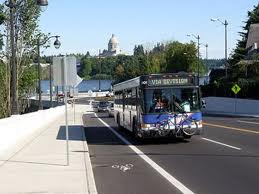
Just one of many nice bike lanes in the State capitol.

Despite the blue, cars still pass cyclists then turn right. Too often, out of sight, out of mind. Ride defensively my friends (said the most interesting man in the world).

When It Comes to the Media, New is Not Better—The Huffington Post as Case Study

“Come here dad,” Sixteen said a few days ago, “you have to see this.” A vid made by some of her high school classmates.

What’s the capital of Washington? Some students say Seattle, others tentatively guess Olympia. Especially funny because they’re Olympia High School students standing two miles from the Capital Campus. Goes downhill from there. What foreign countries border the U.S.? Some guess South America. One girl says “Canada,” and then adds, “no, that’s a state.”

The students’ struggles make sense given 1) social studies content, disconnected from our country’s economic performance, is not seen as worthwhile today and 2) too many social studies courses are taught poorly. The students’ ignorance isn’t the story. The story is what passes for journalism today.

Thursday afternoon, skimming the Huffington Post, I was shocked to stumble upon the vid and this story. Three things to note.

1) Don’t expect anyone at the Huffington Post to take the time to scratch below the surface and show that things aren’t always as they appear. Over 1,200 students attend OHS and about twelve are highlighted in the vid. Olympia High students have been accepted to Yale each of the last three years. Two years ago, two young women went to M.I.T. This year, two young men got perfect 2,400 scores on their SATs. Another student will play golf at Stanford next year. Those stories don’t get highlighted because they don’t serve the purposes of those who want to convince others that U.S. schools are failing, teachers are lazy, and teacher unions are the root of all evil.

2) New journalism is not better journalism. The story and the vid have next to nothing to do with one another; as a result, the story doesn’t make sense, doesn’t hang together, and therefore, never should have ran.

Comedy aside, the United State’s poor international rankings in subject proficiencies such as math is a problem that could cost the country around $75 trillion over 80 years, according to a study called “Globally Challenged: Are U.S. Students Ready to Compete?” Based on the research, U.S. students place behind 31 other countries in math proficiency, and behind 16 other countries in reading.

What the hell kind of segue is that? One minute 1% of students are unsure of some basic knowledge, the next, the country is $75 trillion dollars poorer. If this is new journalism, I’ll stick with the old.

3. Young people aren’t thinking about their privacy nearly enough. One minute a few students are having some chuckles practicing their videography skills, the next, their work has a word-wide audience. When I stumbled upon the story the vid had 37,500 hits. By now it’s probably six figures. The second comment, about a friend of Sixteen’s reads, “Dammn would nail the girl in gray by herself.” The “girl in gray” had no idea what might happen to the footage once her classmates uploaded it to Vimeo. I’m not buying this “end of privacy” bullshit. I’m guessing she regrets having participated. Lots of lessons for all of the young people involved. The primary one, having a vid go viral may not be all it’s cracked up to be.

Postscript—one of the comments from someone at the school:

This article is incredibly misleading and should be taken down immediatel­y. It doesn’t contextual­ize the video properly and makes it sound as if the answers given in it are representa­tive of… well, something. The following descriptio­n is from the High School Student newspaper “The Olympus” which produced the video:

“Students found Jay Leno’s “Jay Walking” videos funny and decided to make one of their own. As is natural for a comic bit, the creators edited in the funniest responses, with the students’ consent. Though there were many correct answers to these pop questions, the comments in national forums concentrat­e on the negative, and, as usual, do not take into considerat­ion the amount of editing it took to get these funny, incorrect answers. So, we are taking down our video. Thanks for thinking about this. It is an interestin­g lesson for all.”

Post Postscript—On Thursday, after the video was taken down from Vimeo, someone, an OHS student I believe, uploaded the whole thing to YouTube. As of Friday afternoon, the video is embedded in the Huffington Post article under a different person’s YouTube account. My guess is the administration required student one to take it down only to have another upload it. Point four. Given the proliferation of social media, school administrators stand no chance of censoring students.