Scheffler For The Win

Not the fleeting kind that ends in hoisting a trophy. The real “meaningful life” kind.

Scottie Scheffler, the world’s #1 rated golfer, is winning more tournaments than anyone else and just asked at one of the most honest and provocative sports pressers in recent memory, “What’s the point?” You don’t have to be a golf junkie to watch/appreciate it.

Maybe his perspective is even more impressive than his game. He somehow knows fame is fleeting. And ultimately, unfulfilling. Especially compared to family.

I quit competing in triathlons after conducting a mental exercise. I thought to myself that if I truly committed to consistent training, age group wins at decent races were possible. And qualifying for the Kona World Championships. And these best case scenarios didn’t move the needle nearly enough for me to continue racing. I concluded, “What’s the point?”

There is one convincing reason for aging weekend warriors to keep entering races. Races provide many the needed motivation to train.

Back in my earliest triathlon racing days, I integrated swimming, cycling, and running into my life to the point that I regularly do some combo of all three each week*. Thus, that rationale doesn’t hold for me. I get “out the door” without signing up for anything. But, I suspect I’m an outlier in that respect.

*Haven’t swam in July yet. Father/Mother, forgive me, for I have sinned. My excuse is I’m allergic to something in the lake. And it seems like a crime to swim indoors in July.
Sorry

Owe the Slo-mo Turtle* an apology. Of sorts. One day last week I was running around baby Cap Lake when I had an inconvenient epiphany. Of sorts.

After pulling the plug on the run, I did what I almost never do. I pressed pause and sat on a bench by the lake to gather enough energy to scale the 4th Street bridges. And I reflected on all the things I do every day to extend my life, like run, lift weights, and eat vegetables. I don’t do those to consciously extend my life as much as I do to improve the quality of however much time is left.

But still, it’s hypocritical for me to be critical of the SmT for doing everything in her power to beat back MSA’s progression. Yes, it does make it harder to care for her, but I’d have the same inclinations if I was in her shell.

Because there’s no way to control for all the variables, and there’s no counterfactual, I don’t know whether her efforts are having any real effect. I see them more as grasping at some semblance of normality.

Today the SmT fell asleep while eating lunch. Afterwards, Hospice Audrey, a very nice PLU grad, came for a visit. We talked about sleep among other things. The SmT is bothered by sleeping way more than normal. Audrey encouraged her to listen to her body. As I repeatedly do.

She’s not good at that. She’s choosing to crawl into the ring with twenty-something Mike Tyson.

All of us are trying to delay the finale. Aren’t we? All of us fight inevitable decline in some combo of small subtle ways and larger more dramatic ones. Don’t we?

Sorry SmT, upon further thought, we are more alike than different.

*Another nickname for the GalPal inspired by her morning routine.

An Entirely Different Kind Of Marathon

A year ago or so, when my wife’s Multiple System Atrophy (MSA) really started to take a toll on her and us, one of her close friends pulled me aside and said, “You’ve run a lot of marathons. This is going to be another one.”

It’s an apt metaphor until it isn’t. Apt in the sense that caring for my wife is daunting and it requires real endurance. And ultimately, it’s exhausting.

But when running marathons, there are markers every kilometer or mile that help you carve the total distance up into more manageable parts. “Okay, now I’m half done.” Or “Okay, now I just have to gut out a measly 10k.”

With MSA there are no markers unless you count steadily worsening mobility, steadily losing one’s voice, or steadily losing. . . pick the system. Despite my wife’s steady decline, I don’t know how to pace my caregiving, so cliché alert, it’s literally one day at a time.

Two aspects of it are especially hard.

The first is the utter selflessness required. A traditional marathon is almost entirely physical. It mostly boils down to whether you’ve put in the miles or not. In contrast, this caregiving marathon is entirely spiritual. Very simply put, the question is whether I can let go of all of my personal hopes and dreams to meet my wife’s immediate needs. All day. Every day. Over and over. And over.

I want to waste some time watching bad television, go away for the weekend, and sleep through the night uninterrupted, but I can’t do any of those things. Or much at all because there isn’t time.

We’re fortunate in that we’ve hired some help, which means I can squeeze in runs, rides, and swims, and thereby flush some of the stress. But some inevitably accumulates.

Recently, I approached a crosswalk in our nearby traffic circle at the start of a run. Not seeing me and thinking she would just roll into the circle, a driver approached the crosswalk way, way too fast and nearly clipped me. I straight-armed her bonnet and lost my shit. So much so she looked scared and immediately turned apologetic. For those scorekeeping at home, my anger was worser than her speeding. “Who have I become?” I wondered.

Which leads to the second challenge. Instead of mustering some semblance of self-compassion, which I’ve become convinced is probably the key to a good life, I continually beat myself up, concluding I’m not nearly up to the spiritual demands of providing the patient, selfless, and kind care my wife would undoubtedly provide me if the situation was reversed.

So, instead of saying to myself, “Ron, you’re doing the best you can to be as selfless as possible in very difficult circumstances.” I find myself thinking. “Because I lack the requisite spiritual depth, I’m doing a shit job caring for my wife.” Those are not constructive thoughts. But, they are mine.

Jenny Breuer For The Win

Breuer teaches entrepreneurship at a Texas high school and coaches sophomore Elizabeth Leachman, the most talented female high school runner in the country. And it’s not particularly close.

The whole Leachman story is so countercultural, meaning tremendously upbeat. Leachman seems unusually grounded for her age in part because her parents know Breuer has their daughter’s long-term interest at heart.

Meaning Breuer is not overdoing Leachman’s training like too many other coaches would.

From Runner’s World:

“The coach and the runner sometimes challenge each other. Leachman wants to do more. Breuer wants her to stay healthy and develop over time. ‘I’m always pulling her back,’ Breuer said. ‘Err on the side of caution.'”

Also of note in this day and age, you won’t find Leachman on Instagram.

“’I think if it was fully up to me, I probably would have it,’ Leachman said. ‘But my parents don’t want me to, and I’m okay with it. I haven’t really fought it.'”

Breuer again:

“’We talk a lot about external expectations, and just because you’re good at running doesn’t mean that it’s everything that defines you,’ Breuer said. ‘That’s what’s really hard, I think, for a 16-year-old to remember sometimes when the spotlight is on. I try to remove that pressure as much as possible and remind her that this is supposed to be fun.'”

This story makes me think maybe the world is not going to hell in a handbasket after all. Just outside of view, there’s excellent parenting going on coupled with thoughtful/caring coaching; resulting in a happy, healthy, and scary quick young athlete.

As in a 9:44 two mile. . . 5:03, 4:41. And a 15:25 5k.

The Coach of the Year one more time:

“’She has a really good perspective. Her parents have done a super job.’ And also, I say, ‘I want you to be an amazing college runner, I want you to be an amazing professional runner, if that’s what you want to do. We don’t want you to peak in high school. That’s not the goal.’”

Postscript—hard not to root for this dude.

The Future Is Here

Everything exists on a continuum. For example, while running down San Vicente Blvd in Santa Monica last week I marveled at the amount of money a fair number of West Los Angelenos spend on cars. Why do they do that I wondered? I concluded, rightly or wrongly, it was because they’re vain. Porsche, Mercedes, and Range Rover make bank on people’s vanity.

Just as I was starting to feel really superior I caught myself. Glancing at my watch, I saw my average pace for the run was 9 minutes and some seconds. Prompting me to pick up the pace in order to avoid uploading a 9 minute per mile run to Strava.* Why you’re asking yourself. See above paragraph. Granted, more subtle and nuanced, but same concept. The only difference, the degree of vanity.

What does this have to do with Apple’s new Vision Pro you’re wondering. Well, I’m here to connect those seemingly disparate dots.

Maybe the mostly likely reaction to the Vision Pro is to fear for a future where tech laden introversion obliterates interpersonal relations even further. But when I walk into the Plum Street Y weight room almost everyone is already listening to their own music and/or podcasts making spontaneous meetings and convo highly unlikely. Including me.** Same on subways and lots of other public spaces. People are already using smart phones, head phones, and related personal tech to tune out the outside world, including the people they are damn near rubbing elbows with.

Steve likes to talk to me whenever he sees me at the pool or in the weight room. In the weight room, when I see him approaching, I pop out one of my AirPods. Easy-peasy. This is what came to mind when watching this Casey Neistat’s review of the Vision Pro.

Just watch from the 7+ minute mark. The first seven minutes are ridiculous, dystopian, depressing, pick your most negative adjective. But let’s do what Casey does at the end of his review and fast forward to a future where Vision Pro-like products are way way lighter, less obtrusive, and less dorky.

Something like eye glasses that morph into sun glasses in the sun seems likely. It would be easy to sit alone on a bench in New York City and switch seamlessly from being alone in your own multimedia world and then either resting the glasses on top of your head or letting them dangle around your neck whenever someone sits down next to you.

There’s no putting this personal tech toothpaste back in the tube, but my tribe, the introverts, will not roam the world alone, figuratively or literally. There will still be a normal distribution of extroverts. And we will still talk to one another even after the Vision Pro becomes semi-affordable and reaches critical mass.

Vain people will even continue expanding their circle of friends, and sometimes even fall in love, and sometimes even have children.

*Fail.

**Love me my AirPods. You can pry them from cold, dead hands.

I Did It

Somehow.

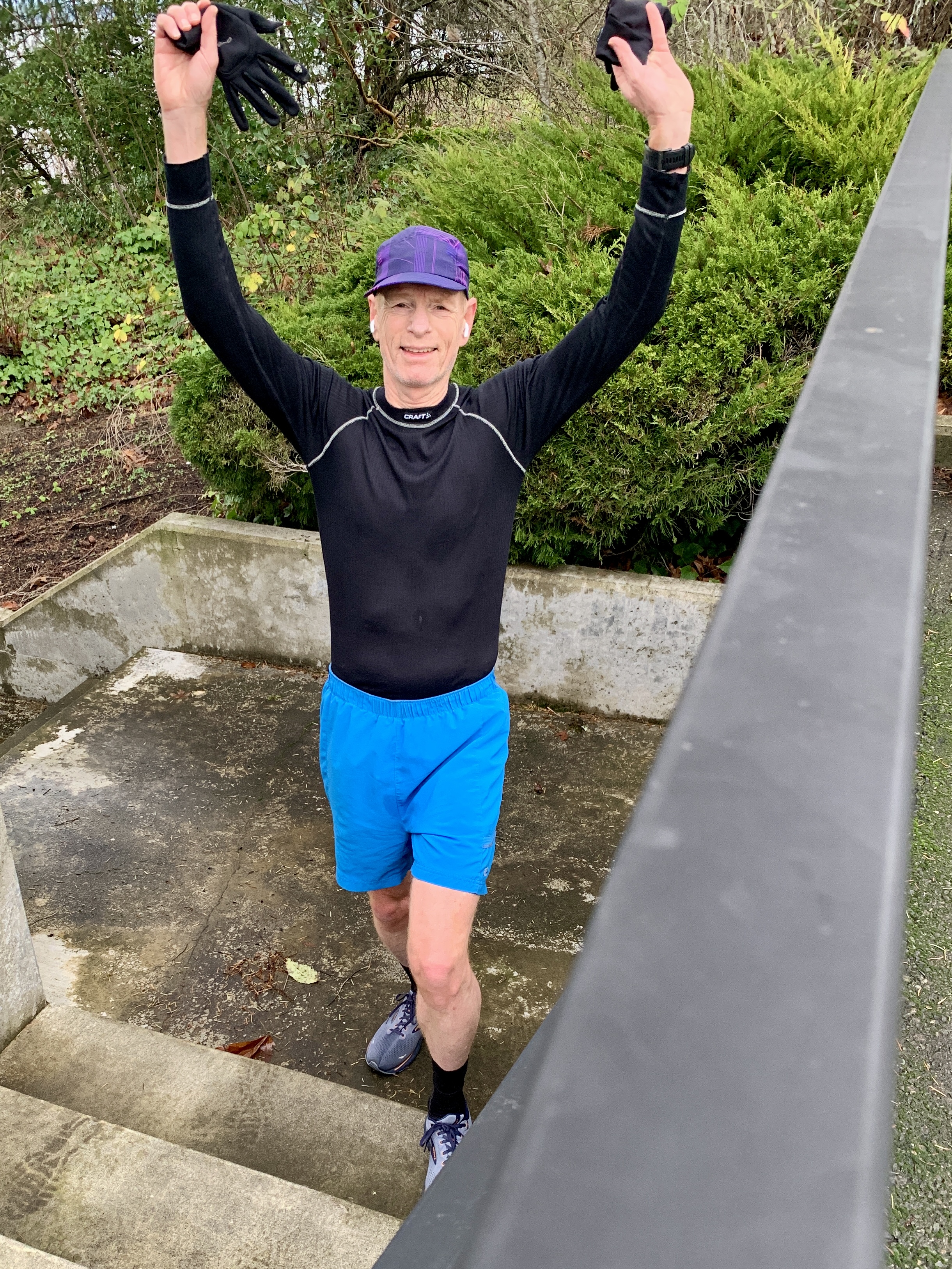
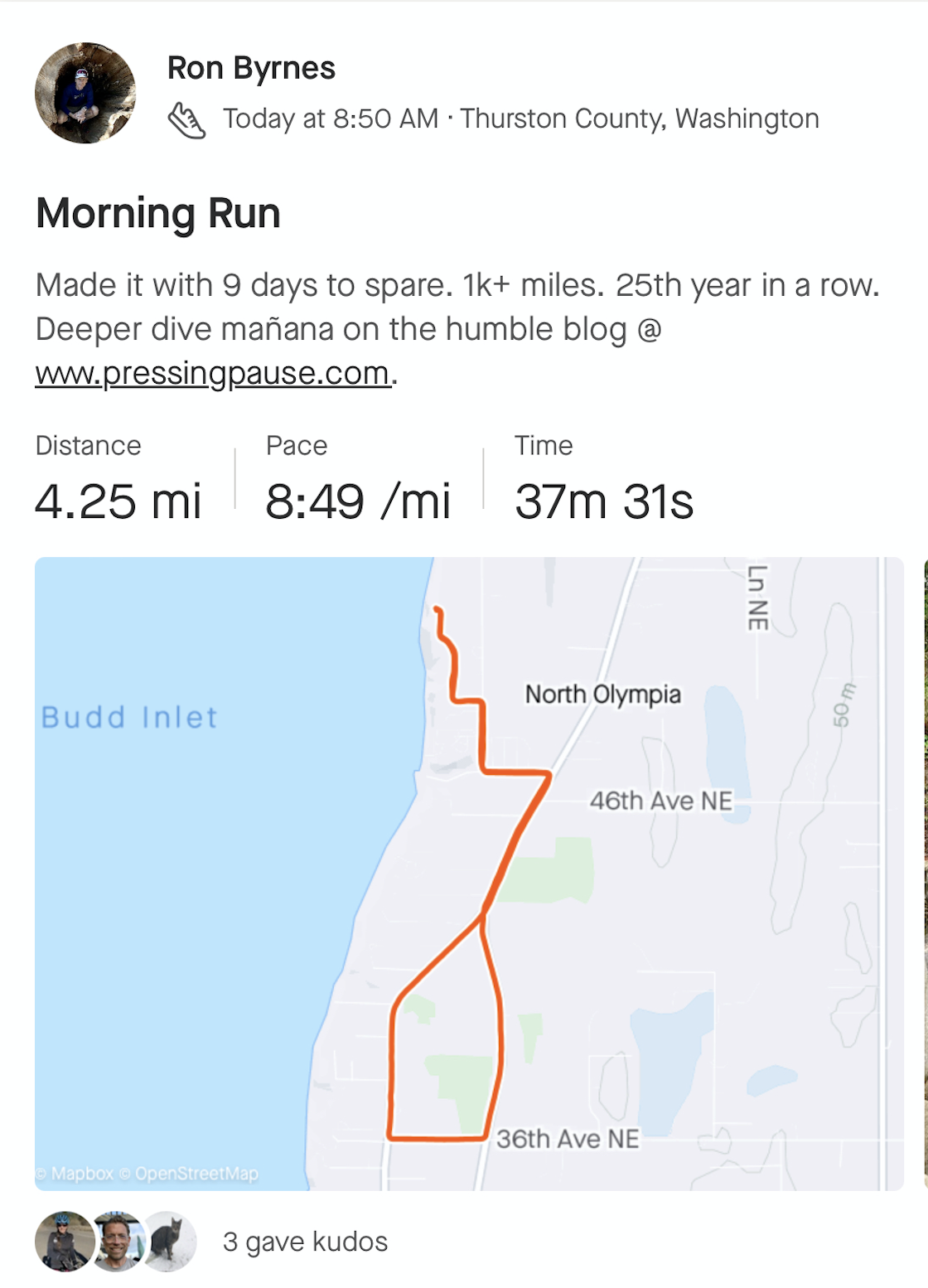
As a result of running 4.2 miles yesterday morn, I maintained my now twenty-five year long streak of running at least 1,000 miles a year. On Gull Harbor Road, at mile 999, I thought to myself, what if that oncoming car just drifts over the fog line and takes me out? Of course, I still have the lateral movement of an elite punt returner.

For the record, the streak continued at the intersection of 47th Ave NE and Boston Harbor Rd as I turned the corner with TSwift, Bon Iver, and Evermore.

This one was was tough, especially after dealing with blood clots in early August and then chronic achilles tendonitis which I haven’t managed smartly.

Bagging a thousand used to be easy, especially when doing half marathons, marathons, and/or triathlons. Hitting four digits was just a routine annual byproduct of being ready to race decently. Now that I’ve retired from competition, the lengthy streak itself is the only motivation. And being fit and enjoying life more as a result of improved physical, mental, and spiritual vitality.

On top of the running, I’ve swam just over 200 kilometers and rode just over 5,000 miles this year, so a decent bit of cross training.

I enjoy swimming and cycling a little more than running these days because they’re less difficult. To continue the streak, I have to sublimate my ego, and let go of pace. I suppose, as I run shorter and slower, I will contribute to the common good that is Strava endurance athletes who can feel better about their relative performance.

I don’t know how long I can or want to keep it going. The key to extending it will be doing a better job of listening to my body in terms of how often, how far, and how “fast” to run. More specifically, I suspect I will need to run shorter, even slower, and more often to extend it.

Thanks to my ace training partners for their continued inspiration and company most Saturdays. MARN, who decided to take up marathoning in his sixth decade. The Byeson, who is a marvel at 5+ years older than me. The Pal, who is somehow getting faster in his fifth decade. And the undefeated University of Washington Husky who effortlessly rows, cycles, and runs right past you.

Thanks especially to the GoodWife for stirring my inner-athlete the most this year. Despite serious health challenges, she is channelling her father’s spirit and is displaying real grit, regularly walking, swimming, and cycling. Watching her pick her way up, down, and around Natches Peak trail in early October was inspiring beyond words.

If I stay healthy and can be half as tough as her next year, the streak will continue.

On The Tone Of One’s Voice

Late last week, armed only with a headlamp while on an early morning run, I approached the col de Merc (antile Store) in pitch blackness. I vaguely saw something coming right at me in the middle of the lux bike lane, but couldn’t make it out until it got closer. It was a speeding bro dressed in very dark clothes on a very dark bike. He had just descended the col de Merc and was flying when I yelled “GET A LIGHT!” at him. He didn’t u-turn to (try to) kick my ass because he had headphones in.

Maybe he took the Mariners-Astros series too hard and wanted to end it.

Fast forward to yesterday’s early morning pitch black run. I could feel a car behind me as I turned into our hood so I made sure to hug the left shoulder so they had ample room for their left-hand turn. A middle aged man driving a beater Nissan Sentra pulled up right next to me and rolled down his window. “Okay,” I said to myself, “it’s on like Donkey Kong.” Ask Dan, Dan, the Transpo Man, when my heart rate is elevated, I sometimes morph from chillaxed pacifist to too easily triggered numbskull.

He had a kind look on his face and his soft voice was that of a Zen Buddhist. “Hey, I just wanted to let you know, you’re really hard to see from behind.” It wasn’t so much what he said, but HOW he said it. His tone conveyed genuine concern for my well-being.

When I yelled at my dark, speeding, headphoned “friend”, my tone was way, way more self-regarding. “Don’t be an arse,” my shout conveyed, “you easily coulda ran me over.”

Think about how you say things, and be the Zen Buddhist driver, not me.

You’re Vacationing All Wrong

Opines Richard A. Friedman, a professor of clinical psychiatry at Weill Cornell Medical College.

“The truth is, when it comes to vacation, rest and relaxation aren’t just overrated. They might even work against the very things a trip is meant to cultivate: a mental reset, a sense of relaxation, happiness. A better vacation is one in which vigorous exercise features prominently. That way, you can take a break not just from work and routine life but also from the tyranny of self-absorption.”

Okay doc, what do you suggest then?

“Recently, a close friend and his wife invited my husband and me to join them on a cycling vacation. I was a bit nervous; I’m a serious swimmer but not an experienced cyclist. Riding 30 to 40 miles a day through Vancouver’s impressive hills for five days sounded like hard work, not pleasure. But by the end of our first day of riding, I was overtaken by euphoric calm.

The work of managing hills by bike has a special way of commanding your attention. I was so busy thinking about whether I could hold my pace for the next rise and how fast I could go downhill without wiping out that I had no time to think about myself. I started looking forward to getting up early and hitting the road. I took in the mountains and forests, dense with cedar and fir, but my focus was really on the bike and the road.”

But this entire Humble Blog is based on the need for more introspection. If everyone is just hammering up hills on two wheels, are we really better off?

“In fairness to the rest-and-relaxation lobby, some introspection is indeed good for you, and being able to tolerate idleness and boredom is a sign of psychological strength. I’m a clinical psychiatrist, and I know well that self-understanding is a cherished goal of therapy. But too much self-examination doesn’t make you happier or more enlightened. Besides, vacation is not the time to work on that skill. You can incorporate moments of idleness into your daily life if you want to get better at sitting with yourself, but vacation is a time for feeling good and escaping responsibilities, including the ones to yourself. Accordingly, you should do what makes you feel good, and that’s activity, not idleness.”

Got it.

As an endurance athlete, I’m keenly aware of how my brain waves fluctuate markedly during most workouts. If I’m going uphill and/or into the wind, my focus narrows a lot on the task at hand. If I’m descending and/or with the wind, my mind drifts to numerous other non-athletic things. I might even begin writing the next blog post.

All movement is good, but add some intensity in on occasion. Even on vacay.