Newsflash—Missy Franklin Forgoes $6m to Swim in College

Seventeen year-old amateur swimming phenom Missy Franklin’s countercultural decision isn’t getting nearly as much ink as it deserves. I’ve lauded her parents’, coach, and her before. I’ll have to plead guilty if accused of putting a 17 year-old athlete on a pedestal.

If Franklin turned pro sports marketing experts agree she’d earn about $2m a year through product endorsements. Instead, she’s decided to swim at the University of California for a few years and then turn pro in 2015, one year before the Rio Summer Olympics.

Here’s the conventional wisdom on her decision:

While the opportunity to earn money from endorsement deals will not completely evaporate should Franklin delay becoming a pro-swimmer by competing at the NCAA-level, it will drastically impact the amount of money she will earn from endorsements. Not only will she miss out on a lot of money in some prime earning years for what are normally short Olympic careers, but she will likely also miss out on the chance to build her brand on a larger stage by way of the promotion and visibility that would come from advertisers using her in campaigns.

Another sports marketer adds, “I think it’s hard not to justify waving her amateurism.  If I was an objective advisor to her and her family, I would advise this way:  Her window to reap the rewards of her life’s work is relatively limited when you consider it over a traditional working career.  As such, her potential earnings in the next four years will be five-times greater than what she’ll be able to make in the subsequent 30 years.”

My brother, who I may have been a tad too hard on the last several months, weighed in more creatively, “Missy-stake! Shoulda took the money.”

She’s rolling the dice on avoiding injury, finishing third in 2016 Olympic Trial races, and having Michael Phelps pressure her into a bong hit.

All you have to do for an alternative perspective, is turn to Franklin herself:

“Someday, I would love more than anything to be a professional swimmer, but right now I just want to do it because I love it. Being part of a college team is something that’s so special. I went on my recruiting trip, and the team was so amazing. Just being with those girls, I really felt like I belonged there. The campus itself is gorgeous. Everything about it was just perfect.”

Borrowing from the linked article above, Franklin said the opportunity to compete with close friends to earn points toward a team total, rather than simply attending school with them, was an allure stronger than the potential millions of dollars she could earn in endorsements. She actually wanted to commit to a full four seasons of swimming for Cal, but her parents told her “that would probably be the biggest financial mistake” she “could ever make.” Franklin acknowledged, “This can pay for your future family. This can pay for your kids’ school, things that I really have to think about. So that’s been the hard part.”

The materially minded majority will lament, “She’s paying about $6m for the opportunity to ride on busses and stand in security lines in airports with her college teammates in order to score points in college meets.” The assumption being she’d be two and half times happier with $10m in 2016 than $4m. What’s lost in that calculus is the fact that her parents are professionals and she’s grown up economically secure. She’s comfortable, she’s a good student, and with her family’s resources and a Cal degree, odds are she’ll continue to be comfortable.

And if comfort was her primary goal, she’d cash in now. She’s saying you can’t put a price tag on some things like memories of close friendships strengthened through athletic competition. She’s wise beyond her years. She probably knows that multimillionaires tend to get caught on an ever speedier treadmill, and as a result, never pause long enough to ask, how much is enough? Franklin, who I suspect is extremely confident she can swim as fast or faster in Rio, is saying $4m is enough.

And what if somewhere in the world right now there’s a 12 year old girl who out touches Franklin in Rio?

I have no doubt she’ll handle it with grace and dignity. “Honestly anything can happen,” she recently reflected. “You can’t predict the future, so whatever God has in store for me I’ll just go along with it.”

Stop Trying to Control Things Outside of Your Control

William Irvine, in A Guide to the Good Life, explains we’re susceptible to negative emotions like anger, fear, grief, anxiety, and envy because of our evolutionary programming. Each of those negative emotions increased our earliest ancestors’ odds of survival, so overtime, they became engrained in us. For example, early humans who weren’t afraid of lions were less likely to survive long enough to pass on their genes. Similarly, those that didn’t worry incessantly about having enough to eat were less likely to survive long enough to pass on their genes.

Irvine explains the good news. Since we can reason, we can understand our evolutionary predicament and take conscious steps to at least partially escape it. For example, the pain associated with a loss of social status isn’t just useless, it’s counterproductive. We need to learn to “misuse” our intellect to override the evolutionary programming that makes us susceptible to negative emotions.

In short, Stoics pursue tranquility. The major impediment to tranquility is our evolutionary programming. Tranquility and inner joy is achieved by “misusing our reasoning ability” via repeated practice at using specific Stoic psychological techniques.

For example, we must overcome our evolutionary tendency to worry by determining which things we can’t control. Irvine labels this the “trichotomy of control.” Once we identify those things we have no control over, we can use our reasoning ability to eradicate our anxieties related to those things. Doing that improves one’s chances of gaining tranquility. To better understand the trichotomy of control, take a piece of paper, and using a ruler or folding it, make three columns. Label the first “absolutely no control”, the second, “total control”, and the third “some control”. It’s easy to quibble with “absolutely” and “total”, but work with me.

Here are some possible items for each column just to get your wheels turning. No control—the weather, the eventual death of loved ones, our own gradual physical decline, and how fast a competitor might show up at your next race. Total control—to eat nutritious food, to exercise daily, to get adequate sleep, to marry or not, to have children or not, to vote or not, to wear boxers or briefs. Some control—to shape your children’s values, to reduce your commute, to make your work environment more pleasant, to protect the environment.

It doesn’t take long into this exercise to realize the lines between the columns should probably be dotted since there’s often blurring. Not as fancy sounding, but a continuum of control would be better than Irvine’s “trichotomy”. The whole point is to learn to let go of everything that makes up the “no control” anxiety-producing end of the chart or continuum. Accept the fact that if you live in the Pacific Northwest it’s going to be overcast for seven or eight months of the year. And there’s going to be an incessant light rain for those seven or eight months. I originally wrote, “incessant, annoying light rain,” but that’s the exact point. Only things we have some or a lot of control over should have the potential to annoy us.

One last example of learning to let go of those things beyond one’s control. One night last week I asked Seventeen what she was swimming in the meet the next day. “The 50 and 100 free I think.” Internal dialogue. “What?! That’s what the beginners swim. That’s embarrassing for a fourth-year co-captain.” Actual response, “Really?!”

Parenting fail. She could feel my disappointment. In a bathtub (too much information too late alert) partially filled with very warm water, I replayed our brief exchange in my mind. I realized I could give in to negative emotions and be frustrated that she doesn’t approach high school athletics they way I did or the way I think others should or I could recognize that she’s an independent young adult who can choose not to train until the season and who thinks of athletics first and foremost as another way of having fun with friends.

It doesn’t matter whether she swims a slow 50 or a fast 500. Positive parenting rests upon unconditional love. Post bath I attempted a recovery. “I’m really looking forward to watching you swim the 50 and 100 tomorrow afternoon.” “Good!” she said in a way that communicated forgiveness. All was well with Seventeen. And the world.

IronCanada 2012—Blood, Sweat, and Cheers

The Truthiness of Things

Swim 1:03:03 (6th out of 217 in 50-54 age group). T1 6:34. Bike 5:40:46 (33rd out of 217). T2 6:20. Run 3:50:30 (7th out of 217). Total, 10:47:12 (14th out of 217).

The Training

Twenty years ago I adopted an active lifestyle where I either swim, cycle, or run five or six days a week nearly every week of the year. I’ve done several Olympic distance triathlons and two half irons. I’ve long watched and puzzled over the 140.6 mile long distance scene. Eleven months ago, when intrigue trumped ambivalence and I registered for IronCanada, I had no interest in “just finishing”. Instead, I established one overarching goal, to complete the run in less than 3:59:59. I knew if I saw a “3” at the start of my run time, in all likelihood there would be a “10” at the start of my total time.

Once I started to train in earnest, I got more specific and thought if everything came together just right the following was possible—1:03, :06, 5:36, :05, 3:50, 10:40. To avoid unnecessary pressure, I kept that equation to myself. I also skimmed the results from the last few years to see how fast the burners in my 50-54 year age group were likely to go. Then, a month ago, when a serious heat wave settled over central British Columbia I decided it made more sense to shoot for a tenth place finish, whatever the conditions, whatever the time.

A healthy fear of racing the distances really helped narrow my training focus. There was little “I should probably work out today” dithering. Even if I was consistent I knew I was going to suffer mightily on race day. If I started cutting corners, I’d not only suffer terribly, but have the added disappointment of underachieving. Once in awhile I chose rest over a planned workout, but that was to avoid injury.

A typical training week was three swims for a total of 7-12 kilometers. No stroke work, no kicking, no drills, half with paddles and pull buoys. Two hundred miles of cycling. Typically two 60ish club rides (meaning intervals) and a solo 80 miler on my time trial bike on Saturdays. Four runs for a total of 30-48 miles. I almost always ran 8-10 miles off the Saturday long ride in increasingly warm afternoon temps. Two key workouts. I ran 15 rolling miles off a hot 70 miler and 4 miles off a 125 mile solo effort (ride time 6:32).

Early on I was dismayed by my average cycling speed, low to mid 18’s. In the last six weeks, without seeming to lean on the pedals any harder, I started to see improvements, regularly averaging low to mid 19’s and 20. And to my surprise, from the beginning of my five-month build, I always ran solidly off the bike. Maybe it was getting professionally fitted and my improved bike position, maybe it was the salt tablets that finally kept the cramping at bay, maybe it was my above average weekly run mileage, or a combination of each. I always ran between 7:45s and 8:15s off the bike, even on the hot and hilly 15-miler, even after 125 miles. I told the running posse that it was starting to feel easier to run 8 minute miles off the bike than fresh out of bed at 5:45a.

Running solidly off the bike built confidence. Confidence to post a “3” and a “10” given decent conditions. I also devised some unique mental strategies. One came to me at the top of a climb in the Eastern Sierras in May. As I sat by a beautiful mountain stream, I meditated on the water’s natural, effortless flow. What if I ran like that? Lightly, naturally, steadily. And then my most bizarre race prep idea of all time. The Canada run course borders Lake Skaha between miles 4 and 22. I started visualizing the lakeshore lined with Canadian Navy Seals (camouflaged and mostly submerged under water) who had “shoot to kill anyone walking” orders. The only way to survive would be to keep running, no matter how slowly. That of course introduced a real dilemma. How could I manage to adequately warn all of my fellow competitors who were slowing to a walk that their lives were in imminent danger?

Pre-race

I planned on traveling to the race solo, but I’m glad we turned it into a family vacay. We dig Penticton. Broke the bank on a house rental two blocks from the beach and start/finish. Sunday morn I left the house shortly before dawn with my wetsuit draped over my shoulders. Blue skies, next to no wind, a wonderfully flat lake. Athletes started appearing out of the glooming. It’s strange to train almost completely alone and then be surrounded by 2,700 other athletes. And to have lots of people watching what I’ve been doing in complete anonymity. I got somewhat veklempt walking down a semi-dark Main Street. Five months of anticipation finally giving way to racing.

Then, standing in the lake minutes before the start, the singing of the Canadian national anthem. A soul stirring rendition. From far and wide. O Canada.

Thankful to be healthy, to be in such a beautiful spot, for my family’s presence, and for all the friends and extended family monitoring and pulling for me from afar.

Act 1—The Swim

In the Torah it says, “We see things not as they are, but as we are.” This is how I remember the race. Which doesn’t necessarily mean it’s the way it went down.

Lined up just right of center in the second row. Anxious as hell. Anticipating an alley fight. Then, somehow, I cruised to the first buoy nearly unscathed. Piece of cake. Why does everyone exaggerate how physical the start is? Just when I started to relax and get a little cocky, I got seriously squeezed by 20 people on my left and 10 on my right. The 130 meters between buoy one and two were the longest two minutes of my life. I panicked, breaststroked a few times, and thought to myself, “Straight lines and the race clock be damned, I just want open water.”

I wanted to get ten people to my right, completely on the inside, but it was like trying to walk across a 30 lane freeway moving at 60mph. I slowed my already slow breaststroking to regroup and turned backwards to see if I could slip back and to the right, but it was a constant stream of rubberized humanity. I now understand how even strong swimmers who are comfortable in the water can get in trouble.

I don’t know how, but I pressed forward. Gradually, it loosened up just enough for me to calm down and get back into a rhythm of sorts. I spent a quarter of the rest of the swim on other people’s feet and three quarters swimming into small open pockets of water. I knew drafting off other people would be faster, but I didn’t care. I just wanted to pretend I was at home in tranquil Ward Lake. By the end, I took three shots to the head, but nothing debilitating.

I always loose my balance and end up semi-dizzy after open water swimming. After throwing in a few dolphin dives for the crowd and staggering for thirty seconds well right of the ramp, I made my way into transition one.

As per tradition, my transitions were disasters. When you exclude them, I raced faster than the 10th through 13th place guys in my age group. Wish I hadn’t crunched those numbers. I have a bevy of excuses, but there’s lots of human error mixed in too. Excuse. I had to hit the sunscreen hard given my fair skin and history of skin cancer. Human error. I wore my swimsuit instead of cycling shorts for the first time ever in a race. It was also hard getting my arm coolers all the way on with wet skin. And I ran to the wrong side of my bike rack and had to crawl under to get it unracked. Comedy of errors. But I hadn’t drowned and I was ready to ride.

Act 2—The Bike

Realized early on I didn’t have my gel flask in my jersey pocket. Another transition fail. I did take salt supplements every 30 minutes, 13 in total. And two powerbars. Felt good and settled in through downtown and up McClean and into Okanagan Falls. High cadence, low effort. Riding like a mountain stream. Reminding myself that the ride begins at the Husky Station at mile 40, at the base of the 11 kilometer long Richter Climb. Between OK Falls and Osoyoos three different groups of riders passed me in blatant violation of the no drafting rules. Hardest part was spending five minutes watching them slowly pull away. I’m guessing there were some 50-54 year olds mixed in there.

I was gradually improving my position on Richter which wasn’t as tough a climb as I had remembered from five years ago when I did it on a training ride. Just past the top I pulled over at an aid station for a bottle. Another cyclist rode into me, I braked too hard, and went over my handle bars at about 4-5mph. Probably my fault for not signaling clearly enough. He was fine, but I had a short, very deep cut on my right shin and was bleeding badly. I’m guessing it took five total minutes to find three bandaids that would stick. I probably could have used a stitch or two, but to borrow from Frost, there were still miles to go. The blood ran all the way down my lower leg onto my white sock which turned light red. Total badass. Look out now mothers!!!

The most amazing aspect of the second half of the ride was the utter absence of wind. I thought there was always a serious headwind throughout most of the second half, but the anticipated press against the chest never came. Which was wonderful. Like the IRS saying, “We’ve decided not to audit you after all.” Loved the smooth pavement on the out and back, up to Yellow Lake, and back into town. Stood a lot on the short climbs and broke up the long ones by standing at times too, but was careful to keep it under control. I rode like I trained, at about 80% effort. Max speed descending from Yellow Lake, 48.3.

Act 3—The First 18 Miles of the Run

Ran like I trained. Went through the half in 1:48:25 and continued to run low 8’s through mile 18. Passed a fair number of peeps. Took salt supplements every three miles and sports drink and flat cola every mile. Drank approximately 120 ounces. Blood was flowing from underneath the bandaids, but there were still miles to go.

Act 4—The Last 8.2 Miles of the “Run”

The ex-7x TDF winner likes to say, “Sometimes you’re the hammer, sometimes you’re the nail.” The last 8.2 miles was ALL nail. The internal dialogue. “F$*# the mountain stream metaphor. And I don’t give a sh&t if the Canadian Navy Seals have me directly in their sights. Go ahead and fire. Put me out of my misery. That’s it, I can’t take it anymore. I’m walkin’.”

I walk 16 minutes a mile so if I’m running almost 8 minutes a mile, it’s an 8 minute penalty per mile spent walking. I think I lost a good 12-15 minutes over the last 8.2 miles which means I almost walked two of the last 8.2 miles. Put differently, I ran 24 miles, which I’ll take. Especially given the second half headwind and temps in the high 70’s, low 80’s.

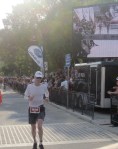
The finish. Pardon the sexism, but when a female athlete passes you in the last 100 meters of a triathlon, it’s referred to as “getting chicked”.  With 100 meters to go I was “geezered”. A ripped guy with the number “60” on his calf passed me at the 140.5 mile mark. I was relieved to hear the announcer say he won his age group (by 45 minutes it turns out), but still, to spot the guy ten years?!

My personal fan club was at the finish cheering wildly in their iRONman gear. Just like before and after the swim, just like before and after the bike. And best of all, somewhere on the Southern California coast, WonderYears Wayne slammed his laptop shut, ruing the fact that his run as the fastest Iron athlete in the fam was finally over, forever and ever, amen.

Act 5—Post Race

I told the race volunteers who “caught” me that I needed to have a cut cleaned, looked at, and taped up. They immediately labeled me “Walking Wounded” and ushered me into the medical tent. The World Triathlon Corporation is a much maligned organization these days, and in many cases for good reason, but the Penticton volunteers were unbelievable. Maybe the WTC deserves some credit for that. One doc said I had a piece of gravel in my cut. How badass is that?! All that extra weight I carried over the last 90 miles!

After getting my cut cleaned and taped up I felt nauseous, tingly, and altogether terrible. Probably borderline heatstroke. They moved me to the second level of the medical tent where I sat for a half an hour drinking soup with ice on my head while being attended to by a nice nurse. Gradually I felt good enough to make the three block walk home. The GalPal and 17 picked up the bike and gear bags and 20 warmed up an assortment of leftovers. I woke up at 3:45a.m. and made myself a peanut butter and jelly sandwich.

I had wanted to wade into the lake right after finishing to speed recovery, but didn’t because I was in such miserable shape. Nor did I eat nearly quickly enough. As a result, I’m still quite sore four days later.

Thanks to everyone who helped me train, offered advice, and/or cheered me on from afar. And thanks to my family for putting up with the extra training and fatigue.

And thanks dear reader for making it through the world’s longest race report. Congratulations, you’re an IronReader!

Canada Seven Weeks Out

[Note to newer readers. I’m competing in a long distance triathlon on August 26th in Penticton, Canada—2.4 mile swim, 112 mile bike, and 26.2 mile “run”.]

June was productive. I’m fit although I’m swimming, cycling, and running slower than I’d like. Rightly or wrongly I’m chalking that up to the higher than normal volume. When I shut things down for a day or two, I bounce back well. I’m looking forward to the August taper and to returning to more normal, sane levels of activity post-race.

Too soon for a definitive judgement, but right now, I’m even more convinced that repeat Iron-distance competitors have several screws lose. One problem is never feeling as if you’re doing enough. I’m training more than normal, but still often feel it’s not enough. Right now I feel especially badly since today is my second rest day of the week. Of course I nearly killed myself on my mountain bike yesterday, but still.

My suggestion, if you ever suffer the same kind of mental lapse I did and sign up for a similar “race”, is to design a standard week that is realistically repeatable. For the love of alliteration I repeat, realistically repeatable. I’ve had to adjust my original weekly swimming, cycling, and running goals down. I’ve also had to build in a weekly rest day (or two). Getting ready is more about consistency and positive momentum than uber-long workouts that often result in missed workouts.

Rereading that last pgraph makes me chuckle. I sound like I know what I’m doing, but I don’t. These are unchartered waters. I wish I could hit it hard this week, taper for the next three, and race, but most participants probably wish they could just be done with it as this point.

Last week, thanks to some of the more generous friends a guy could have, I once again trained at altitude, even if only 4,000′ plus, in and around Sunriver, Oregon. The week consisted of a mix of Benham Falls trail runs, Mount Bachelor cycling, North pool swimming, and a memorable Sunriver to Bend and back mountain bike ride. Even had great, built-in training partners for most workouts.

That was especially nice when I went over my mountain bike handlebars on the penultimate day. I rode smack dab into an 18″ vertical rock on the side of an easy trail. Total lapse of concentration that I paid dearly for. Quite possibly the world’s worst mountain biker. I thought I had broken my nose and lost a tooth and needed lots of stitches. Fortunately, I was cut up and badly bruised, but avoided the emergency room. Very sore, but I’ll be fine in short order. That sigh of relief is the worldwide triathlon media which is already downbeat with Lance on the sidelines.

Another training tip from the rookie know-it-all—be sure to throw your back out and face plant on your mountain bike at least eight weeks before the start.

In related news, I’m sorry to report elder brother, a 2002 Iron-distance Canada finisher, also known as Wonder Years Wayne, has already launched his psychological attack. I HAVE to beat his time of 11 hours, 44 minutes, and 58 seconds otherwise I may have to re-up and the idea of that isn’t very pleasant right now. He takes great pride in accurately predicting my finishing times. Last week he emailed ludicrous numbers in what was an obvious attempt to get me to swim fast, cycle faster, and then blow up somewhere along Shaka Lake during the run. In a shameless flourish even by his standards, he threw in a Hawaii World Championship reference. Not taking the bait. Wouldn’t be prudent.

Here’s to one more month of going long. One more update pre-race.

Postscript—If you’re interested in either writing and/or the importance of positive thinking in athletic performance dig this recent story.

Triathlon Training Update—April 2012

[Newer readers—I had a mental lapse last year and registered for a late August Iron-distance triathlon—3.8km swim, 112 mile bike, and 26.2 mile run—in Penticton, Canada. Once a month the sports world anxiously awaits my training updates.]

Solid month of base building, but swim and bike times are slow. Three flats later, I found a very small piece of metal in my back tire which may help explain the pedestrian bike numbers. The swim times are probably off because I’m training solo, and therefore, not working as hard as when pushed by other fishies. Running has been steady, not speedy, but very solid. I have to get used to longer and even slower than normal distance-based training. The key is finding a rhythm—in each activity—that’s sustainable for hours on end.

In April I knocked out a few mid-distance bike-runs that went well. The mental toughness those require is as valuable as the physiological adaptations. Related to that, I have to learn to run slower in the first 30-60 minutes off the bike. My muscles are so warmed up, I routinely get out of an even semi-realistic “sustainable rhythm for hours” zone. I also have to learn to adjust for warm temps—something that’s tougher than it sounds. That will be the focus of my early August Tampa, FL running.

Like most athletes I have a time goal. Older bro and Lance both went 11:44ish so it would be nice to be south of that. But a friend’s experience at Iron-distance St. George, Utah last week makes me wonder if I should take an alternative approach to goal setting. Long story short, at St. George a 40mph wind kicked up shortly after the swim start. Two to three foot swells kept many from finishing the swim. Had the wind started fifteen minutes earlier, they would have shortened or cancelled the swim. The same 40mph winds played havoc with the bike leg. Times were 40-90 minutes slower than normal.

Stoicism encourages people to set goals that are in their control—such as the quality of the effort they expend in contrast to finishing in first place.

Who knows what race day will hold—a few years ago nearby wildfires meant competing through smoke and haze. High winds, rain; even hail; and most likely of all, serious heat; could sabotage my day if I stick to a hard and fast time goal. The alternative? Age-group placing since everyone has to endure the same conditions. So what place in the 50-54 year old geezer division am I shooting for? Not telling.

The first serious setback to my training took place a week ago when my back seized up for the first time in about 18 months. Painful. My hips were completely out of alignment. Chiro said it was the worst he’d ever seen me. So May started off with long awaited idyllic weather and unplanned, forced rest. Everyone is getting in better shape except me. Poor, pitiful me. Meanwhile, I’m laying on the floor with a heating pad watching the NBA playoffs. The good news is I’m slowly improving and right now I’m about 75-80% of normal.

Next week I depart for the first of two bike intensive training trips—this one to the Eastern Sierras in the state where my cycling fame first took route—California. It’s going to be sunny and hella hot which should be good for my back. Starting next Friday, I will be taking you along, so buy some sunscreen, pump your tires, and lube your chain.

And there’s this from a pre-departure email: On the way down Wednesday, we might stop and do a short ride on Mt. Shasta, and then stay in a motel in Burney, CA. On Thursday, the highlight will be lobster tacos at the Mobil Station at Mono Lake.


Can Grit Be Taught?

Angela Lee Duckworth, a University of Pennsylvania psychology prof, studies “grit” which she defines as  “perseverance and passion for long-term goals“. In this 18 minute-long TED talk titled, “True Grit: Can perseverance be taught?” she summarizes her research without really answering the question.

Her premise, I assume, jives with most everyone’s life experience—achievement involves far more than natural intelligence. An impassioned, focused, single-minded person who perseveres in the face of obstacles almost always accomplishes more than the really smart person who switches from project to project and quits when things don’t go smoothly.

From wikipedia: Individuals high in grit are able to maintain their determination and motivation over long periods of time despite experiences with failure and adversity. Their passion and commitment towards the long-term objective is the overriding factor that provides the stamina required to “stay the course” amid challenges and set-backs. Essentially, the grittier person is focused on winning the marathon, not the sprint.

I think “resilience” is synonymous with “grit”. So can resilience or grit be taught? If not, why not? If so, how?

A lot of especially resilient or gritty people seem to have tough childhoods in common. Yet, there are a lot of people who had tough childhoods who aren’t particularly resilient or gritty. So does genetics or “nature” play a part? Probably, but that doesn’t mean one’s environment is irrelevant. I suspect one’s environment is more influential than one’s DNA.

So what kind of environments cultivate resilience or grit? This recent essay titled “Even Happiness Has a Downside” provides insight into family settings that are unlikely to cultivate resilience or grit—most contemporary ones where the parenting default is to remove obstacles from children’s lives. An excerpt: “. . . being happy, being satisfied, saps the will to strive, to create. It’s why we don’t usually expect trust-fund babies to be cracker-jack entrepreneurs. For all our happiness talk, we actually cultivate dissatisfaction. We don’t want to hog-wallow in the useless sort of contentment that H.L. Mencken derided as “the dull, idiotic happiness of the barnyard.” 

Of the cuff, in her TED talk, Duckworth uses a  related phrase that may be the ultimate target for those interested in cultivating resilience or grit—”intestinal fortitude”. Related question. If a young person is to learn “intestinal fortitude” are they more likely to learn it in school, through a curriculum designed to cultivate it or at home or in their community by observing adults who model it? I would enjoy the opportunity to design a resilience, grit, or intestinal fortitude curriculum, but when it comes to cultivating those things in young people, outside of school modeling probably holds far more promise.

Young people are unlikely to develop resilience, grit, or intestinal fortitude given the extreme child-centeredness that characterizes contemporary parenting. That doesn’t mean families should intentionally accentuate dysfunction, but they shouldn’t shield their children from the inevitable headwinds every family faces either.

I’ve enjoyed coaching girls high school swimming from time-to-time the last few years. The swimmers are wonderful young people, but few of them show much resilience or grittiness. When practice is most difficult they suddenly have to go to the bathroom or stretch their shoulders. They’re unaccustomed to being truly fatigued and they’re mentally unable to push through temporary physical pain. They have a lot of great personal attributes, but for most of them, intestinal fortitude is not among them.

At dinner tonight (Sunday the 15th), the Good Wife suggested we watch Mad Men tonight after it airs (to avoid commercials) instead of Monday or Tuesday night as has been our recent habit. Why? So that Sixteen can watch her show uninterrupted Monday night. Some context. Sixteen is a great kid, works exceptionally hard at school, and looks forward to chilling in front of the t.v. for an hour at the end of several hours of homework (with some Facebook mixed in for good measure). The Good Wife’s intentions are understandable, it’s a well deserved dessert, but I ask you Dear Reader, how gritty is our next generation likely to be if they’re not even expected to share a television from time to time?

[Postscript—Thanks Kris for the Duckworth link.]

Battling Self-Doubt—Who to Believe?

When I was eighteen, nineteen, twenty, I remember being frustrated when home from college. I have three older siblings. One older brother is mechanically inclined, so whenever something needed fixing, it got fixed before I ever got the chance to swing the bat. And no one ever taught me how to work with my hands. Through teasing, I got put in a “mostly incompetent” box which hurt my confidence and zapped my initiative. Better not to try than to fail. A downward spiral of self-doubt. Alex Smith in need of a Jim Harbaugh.

Built like a pool cue, I was also labelled soft and spoiled. Truth be told, I shied away from physical contact, and by the time I came along, my parents were better off, the task master was often traveling, and Mother Dear had let her hair down. I did live a charmed life. I coasted through high school so much, my dad, who also thought of me as sheltered, discouraged me from going to college.

Proving him wrong was motivating. As a first year college student living on my own in a culturally diverse, challenging, and stimulating setting, I was transformed. Afraid of failing, I applied myself, studying intensely. I quickly improved as a thinker, writer, student. I gained confidence in communicating original ideas. I met lots of interesting people who had no preconceived notions about me. I spent a summer working at an inner-city Boston park and food bank with a dozen other college students from around the country.

Whenever I returned home though, time seemingly stood still. In the eyes of my family, I was still the mostly incompetent, soft, sheltered, spoiled seventeen year-old. The result was equal parts alienation and frustration.

So who to believe, others from the past or myself? Incompetent, soft, spoiled, sheltered, or increasingly capable, resilient, socially conscious, and experienced?

This “who to believe” dilemma is universal. Everyone has to contend with negative messages that go way back to parents, teachers, coaches, other authority figures, siblings. Why do some people succumb to long-running negativity and others rise above detrimental preconceived notions?

The single most important variable is whether you surround yourself with positive or negative people. A negative past can be blunted. Case in point, I love how my Better Half always goes into “compensation” mode and encourages me whenever I attempt to install or repair something.

Most of the time though, we have to confront our self-doubt alone. The way to do that is to build enough countervailing evidence to eventually tilt the balance from self-doubt to self-confidence. A marathon without shortcuts.

To illustrate, consider my preparation for IronPerson Canada in late August, a mere seven months away. Something about swimming 3.8 kilometers, riding 112 miles, and then running 26.2 sparks serious self-doubt. Athough I’m not building up for it yet, I can’t help but think about it from time to time. My mental prep is hampered by the fact that I’ve internalized the “soft” messages of my youth. I not only internalized them, I embellished them. Like a taller, skinnier Woody Allen, I even thought at times that I had a particularly weak constitution, and that I’d probably contract some chronic illness, and pass from the stage prematurely.

The self-doubt is playing havoc with my sub-conscious; consequently, I’ve had a series of disconcerting IronPerson dreams. In last night’s version, the brakes on my bike unravelled right before the start leading to the dreaded “DNF”—did not finish. I’ve had others where I swim completely off course and the race goes on without me. I probably haven’t dreamed about the most challenging leg yet because I haven’t worn out all the swimming and cycling nightmares.

Here’s the odd thing though, in the last two decades I’ve become an experienced open water swimmer, long distance cyclist, and marathoner. And while this is hard to admit publicly, I’ve gotten pretty good as an endurance athlete. Riding especially strongly at the end of RAMROD last July and my last half iron distance triathlon last September were major confidence boosters. Yet, I struggle to even write “pretty good” because deep down in my gut the cassette recorder quietly repeats “I’m soft, an impostor, a wannabe.”

I’m wrestling with who I am as an athlete. Ultimately of course, I’m an insignificant weekend warrior, but I have to get more specific to set goals and then devise and successfully implement a race strategy.

Am I still the third-grader who climbed down from the 10 meter platform too afraid to jump off, the scrawny junior higher who routinely got whupped in the 660 yard dash, the junior high cornerback who whiffed an easy tackle, the batter who was too chicken shit to hit a curve, or the long distance runner who was mentally tough and gutted out the last 10k of the 2010 Seattle marathon, or the cyclist who last summer got stronger the longer and tougher the mountain climb? If I’m more of the former, my goal should be the traditional “just to finish,” if more of the later, it should be to throw down with the fastest dudes in my age group.

Forget me and my inconsequential, irrational race. What negative messages limit your potential? Have you succumbed to the negativity of critical peeps from your past or are have you created a positive present?

[extra credit—What city is in the February header?]

If I Was President

Put your hands in the air like you just don’t cair if you think I need some hair extensions, a guitar, single speed bike, and vid like this one. Why should Wyclef Jean be the only one to imagine being president?

My betrothed was thrilled to score a Thanksgiving dinner invite. Didn’t have to cook a turkey or interact too terribly much with the normal one. Early on one of the seven adults at the very nice dinner lamented that getting to the pool in the morning to swim was just “too complicated”. About every 45 minutes, no matter where we were in the conversation, we’d return to that theme usually in the form of my betrothed suggesting alternative activities to our unmotivated friend. For each suggested alternative she presented separate complexities. She was a reminder that it’s a lot easier not to exercise regularly.

It’s been almost four years since I shared ten suggestions on how to create an active lifestyle. Since you didn’t click on that link you won’t notice the overlap in what follows.

If I were president, I’d charm Congress into passing a law requiring every physically able adult to engage in an hour of cardiovascular activity before 8 a.m. Employers would have to push back early starts. Based on personal experience and a constant stream of research, one hour of exercise makes the remaining 15 lots better. Benefits include lower health costs, increased productivity, improved community, and increased well-being. Brisk uncomplicated walking, running, swimming, cycling, water aerobics, elliptical exercises, rowing, or any combination of those for sixty minutes.

I joked with our “too complicated” friend that Betrothed sleeps in her bathing suit to simplify her morning routine. The night before swim mornings I pack my backpack and toss my jammers where I get dressed in the morning. By wearing them under my pants, I save a good 45 seconds in the Y locker room. Too much info I know, but the larger point being . . .

1.) An efficient, successful morning exercise routine begins the night before. Organize your gear so you can almost sleep walk out the door in predawn darkness.

Other suggestions:

2) Gradually pull the plug earlier at night, turn off the tube, forget the foreplay, close the book, and go to bed early enough to compensate for the earlier start.

3) If going somewhere with lockers, consider renting one to simplify what you have to cart back and forth.

4) Start right outside your front door or make sure you can get to your gym within five minutes. I believe a lot of indoor exercisers would be surprised by how much more fun it is to be outside if they invested in some technical fitness duds and were forced to do it by say. . . El Presidente. Of course we’re spoiled in Olympia with excellent sidewalks, street lighting, and bike lanes.

5) Most important of all, find anyone similar in ability to exercise with. Mutual accountability + evolving friendships = much higher success rates.

This challenge is similar to decluttering—logical suggestions aren’t enough to tip the sedentary scale (pun intended). Unless our “too complicated” friend finds a training partner who she enjoys spending time with, suggestions 1-4 won’t make much difference. The conundrum is until a person is able to compare and contrast what it’s like to be out of shape and in shape, they’re unlikely to muster up the self-discipline to change their daily habits.

Try it. Pick something at least semi-enjoyable, invite a friend to enjoy you, and gradually build to one hour, six days a week, before the day starts in earnest. You won’t regret it.

For the serial sedentary among us, I’m going to hire the cast from a very good, but brutal movie Betrothed and I recently watched, Sin Nombre, to enforce the law. Better start now in case I’m elected on 11/6/12. Trust me, you don’t want those hombres knocking on your door asking what you’re still doing in your pajamas.

Tight-Knit Extended Families Require Vision

There are only three types of families: 1) physically distant ones; 2) physically close, but emotionally distant ones; and 3) physically and emotionally close ones.

I realized this while sitting next to a man my age from Egan, Minnesota at a college swim meet recently. He was watching his son—along with his wife, brother, daughter, parents, and in-laws—a good freestyler at the University of Wisconsin LaCrosse. We talked swimming, college decision making, and Gopher football. The state cross-country meet was taking place on campus at the same time, so the GalPal and I had to take a shuttle bus to the pool from an overflow parking lot on the periphery of campus. The bus was filled with three generations of family cheerleaders too.

Physically distant families have to drive or fly for several hours to see one another. According to one writer I’ve recently read, in the U.S. at least, this family type predominates in urban centers on both the East and West coasts. My family is this type—mother and in-laws in two different states, aunt and uncle in a third, siblings in a fourth and fifth, cousins and nephews in a couple of others. Physically distant families may enjoy one another’s company, but they don’t see one another with enough regularity to truly know one another which compromises closeness.

Physically close, but emotionally distant families live within a few minutes or hours of each other, but they don’t get together with any regularity due to unresolved conflicts and/or prioritizing work and material pursuits. Despite their proximity, everyone mostly prioritizes their own nuclear families in the same manner as physically distant ones.

Physically and emotionally close families not only live within a few minutes or hours of each other, but they prioritize getting together weekly or monthly. Minnesota may have a disproportionate number of tight-knit extended families.

Modern Family, the outstanding sitcom about a physically and emotionally close family is atypical because most families today are spread out over long distances. Which probably explains the show’s appeal. Viewers enjoy inserting themselves into that physically and emotionally close family not just because the writers make them funnier than our own family members, but because they’re an affectionate and loving community of mutual amusement and support.

My dad, like most post WWII execs, always took the promotions he received even when they required him to criss-cross the country. I wouldn’t have traded for anyone’s dad, but by choosing successively better jobs that paid more money, he sacrificed a physically and therefore emotionally close family because my siblings and I followed suit, deciding where to live based upon work opportunities, personal preferences, and other things besides physically proximity to one another.

Another variable in some physically distant families is eighteen year olds going away to college. Second Born, next in line in our fam, wants to go “out of state”. When asked why recently, she initially Rick Perryed (couldn’t answer), and then finally said, “The weather.” What are the odds of me having the first teen in the history of the world to base a life decision on weather patterns? Our family, like every other one, is a subculture. She’s simply following the lead of her parents, her cousins, and her older sissy. What would be surprising is if she wanted to stay close to home.

I plan on being more intentional than my dad about prioritizing family closeness. I can’t control where my daughters go to college, take jobs, or end up living, and I can’t control the fact that twenty percent of Americans move every year, but I’m hoping that living in one community for a record-length of time increases the odds of them settling down somewhere close. This is the only home they know. We are Pacific Northwesterners.

If all goes well, ten or twenty years from now, I’ll be just one of an extended family of crazies cheering wildly for a grandchild at a pool or piano recital somewhere nearby.

I Am the 1%

Not based on my five figure salary, my Kirkland Signature wardrobe, my penchant for water at restaurants, or my municipal golf courses of choice.

I am the “one percent” based upon health, meaningful work, beautiful surroundings, good friends, and a loving family.

Turning fiddy in a few months. My peers are showing varying degrees of wear and tear. Their setbacks help me appreciate how fortunate I am to be able to afford healthy food, to have time to exercise daily, to have access to quality medical care, and to feel younger than I am.

My work matters. How fortunate to get paid to help young people write, teach, and think through what they believe and how they want to live their adult lives. And remarkably, every seven years I get the ultimate gift, time to press pause and read, think, write, rest, renew.

Half the year I get to cycle in unbelievably beautiful mountain settings, swim in an idyllic next-door lake, and run on wooded trails and sleepy residential streets. In the summer it’s almost never hot or humid and there are no bugs that would prevent one from eating outside. There are no hurricanes and hardly any lightening, but I reserve the right to amend this post if I someday survive the overdue Shake.

I often climb the mountains, swim the lake, and run the trails with excellent friends. Fitness fellowship.

My extended family is a blessing. My wife and daughters especially so. Apart from one very bad leg, they’re healthy and happy. My Better Half and I just returned from visiting First Born at Leafy Midwest Liberal Arts College. Most nineteen year-old college students would be semi-embarrassed by visiting parents, but for some reasons ours was off-the-charts warm, inviting, and appreciative the whole time. Even invited her Spanish teaching mom to her Spanish class and took us to great student a cappella and modern dance concerts.

When we first arrived on campus, Spanish teaching mom went to meet her at the Language Building. I read in the “Libe”. At the appointed time I headed across campus to meet up with them. Turned a corner and there she was walking by herself to a piano lesson. Cue the killer off-the-ground hug.

We stayed in a room in this house which a woman left to the college with an unusual condition—that it always be available as a student hang out with the necessary ingredients to bake cookies.

Home Base

The suggested donation for staying there was $30/night. We had twin beds in a smallish room. The first hints of winter crept in through the window next to my bed. I could whizz while simultaneously brushing my teeth in the tiny bathroom.

But looks can be deceiving. No one would suspect that inside this humble house, in one of the modest rooms, a One Percenter slept contentedly.