
Why Ukraine Has Captured The Global Imagination

From Kara Swisher’s conversation with Clint Watts on her podcast, Sway.

Swisher asks Watts why Ukrainians have captured the global imagination so much more than most other victims of war.

Watts:

“Several factors have changed over the last decade that are important. One, cell phones in everyone’s hands worldwide. Two, social-media platforms of all stripes connecting everybody at the same time. But the bigger ones, just to be honest, are, this is a predominantly white, predominantly Orthodox Christian population in Europe. And so the West cares. Having worked on Iraq, Afghanistan, Somalia, Syria over the last 15 years, which is how I got into this, I’ve never seen so many people care about what’s going on.

People see that fight, and they see themselves. It’s implicit bias in social media. You like information from people that look like you and talk like you. And you’re seeing that kick into full gear with this battle. And people can identify with themselves, particularly in Europe. Poland — very worried about what’s going on. Germany, all of the sudden, has kicked up its military commitments. We begged them to do this since World War II with NATO, and they didn’t do it. So I think that is the biggest driver of it.”

Swisher points out that there has been horrific imagery from other conflict zones to which Watts responds:

“Absolutely. And I think if you went to the Middle East today and listen to discussions, they’re like, oh, everybody cares now. What about last decade when all of these invasions and battles, and Assad is barrel-bombing? Oh, you don’t know what’s going to happen in Kyiv? Maybe you should have watched Aleppo, or maybe you should have seen in Grozny. That’s their perspective on it.

And I think there’s an importantness, which is the power of translate today compared to 10 years ago. You can engage with Russian content on Twitter or Google when you do a search on a website. You can read it now. It almost magically switches, right? So that’s allowing the West to engage in languages and platforms that they otherwise would have to — they wouldn’t even know existed. They wouldn’t be able to compute it.”

Later in the conversation Watts asserts:

“We could find several Ukraines around the world right now.”

He references the Rohingya genocide in Myanmar specifically.

Our compassion, activism, and charitable giving doesn’t have to be a finite, zero-sum game. We should extend just as much compassion, activism, and charitable giving to all victims of war regardless of their skin color or religion.

my emphasis added
Paragraph To Ponder

From Tom Friedman in the New York Times.

“If Putin goes ahead and levels Ukraine’s biggest cities and its capital, Kyiv, he and all of his cronies will never again see the London and New York apartments they bought with all their stolen riches. There will be no more Davos and no more St. Moritz. Instead, they will all be locked in a big prison called Russia — with the freedom to travel only to Syria, Crimea, Belarus, North Korea and China, maybe. Their kids will be thrown out of private boarding schools from Switzerland to Oxford.”

Monday Required Reading

You Can Learn to Love Being Alone.

“People who pursue solitude of their own volition ‘tend to report that it feels full — like they’re full of ideas or thoughts or things to do. . . . In this way, it’s distinct from loneliness, a negative state in which you’re disconnected from other people and it feels empty.”

Putin’s Bloody Folly in Ukraine.

“As Putin spills blood across Ukraine and threatens to destabilize Europe, Russians themselves stand to lose immeasurably. The ruble and the Russian stock market have cratered. But Putin does not care. His eyes are fixed on matters far grander than the well-being of his people. He is in full command of the largest army in Europe, and, as he has reminded the world, of an immense arsenal of nuclear weapons. In his mind, this is his moment, his triumphal historical drama, and damn the cost.”

The style and substance of South Carolina basketball’s Dawn Staley.

“‘She loves on them hard,’ associate head coach and longtime confidante Lisa Boyer says. ‘She’s playful with them, she’s hugging them, she’s there for them. I think they sense the fairness. I think they sense the genuineness of her. She speaks to them — it’s not some fairy tale. She’s telling them the deal.'”

“‘I owe basketball,’ Staley says. ‘I’m forever indebted to it. It engulfed my life for the positive. The game has gotten more of my time than my friends and my family. I feel like on a smaller or larger scale, it can impact my players’ lives in some kind of way.'”

A Renowned Community of Quilters is Taking on Copycats—and Winning.

“’We put a lot of work into it, and it’s about our life,’ Charley says of quilting. . . . We used these quilts for warmth. It was about our struggle, and our survival.'”

“Charley might feel differently, she offers, if these makers — who may have, say, studied textiles at art school — sent some of their profits back to the community that inspired them. But that doesn’t happen. “This work is ‘inspired’ in your mind, because you see the quilt pattern,” Charley says. “But you don’t know my story. And you’re going to try and duplicate it — and go to Joann Fabrics to do it?’”

You Can’t Handle The Truth About Wealth Building

Social scientists say we can’t multitask, but they haven’t met me. I’m doing pushups and watching a business news channel. A stock market expert/analyst just said there are several market “headwinds” including the invasion of KUWAIT. Then, a few sentences later, he said it a second time. That’s an amazing two-fer. . . an embarrassing history and geography fail.

So why would anyone listen to him bloviate on what the market is going to do?!

Instead, MSNBC should’ve invited me and my crystal ball. Here’s what I woulda said.

The most credible analysts expect VERY modest annual returns over the next decade. Meaning low single digit. Even less than anticipated annual inflation, meaning negative nominal returns, especially after taxes.

So what’s a person who has gotten used to hardly any inflation combined with double digit market and housing price returns to do? To not lose ground. To continue building wealth.

There’s only one answer. Save more. How to save more? Earn more and/or spend less. Now, you probably know why MSNBC didn’t call me.

Trump May Save My Marriage

Yesterday, as you may have noticed, the gravity of the Ukrainian/whistleblower situation compelled Trump to hold his first formal presser since forever.

Odd that the figurehead of “the most transparent administration ever” only took four questions. And LOL, he told the army of journos the type of questions he wanted.

Specifically, near the very end, he said, “An economic question. I want a question about the economy.”

Watching that I had an epiphany. The next time The Good Wife asks “if we can talk,” I’m going to say “Yes, of course.” Then I’m going full on 45.

“A popular culture question. I want a question about current movies.” Or maybe, “A sports question. I want a question about UCLA’s miraculous comeback against Wazzu.” Or “A weather question. I want a question about the forecast for this weekend.”

And then, when she tries to pivot to feelings, “Thank you, that’s all the time we have.”

“Perfect Call”

I can’t believe the President released the memo. What’s next, his taxes?

After reading the memo, as bad as things are in the (dis)United States, I feel even worse for the people of Ukraine given their comedian President whose ass kissing is more sickening than funny.

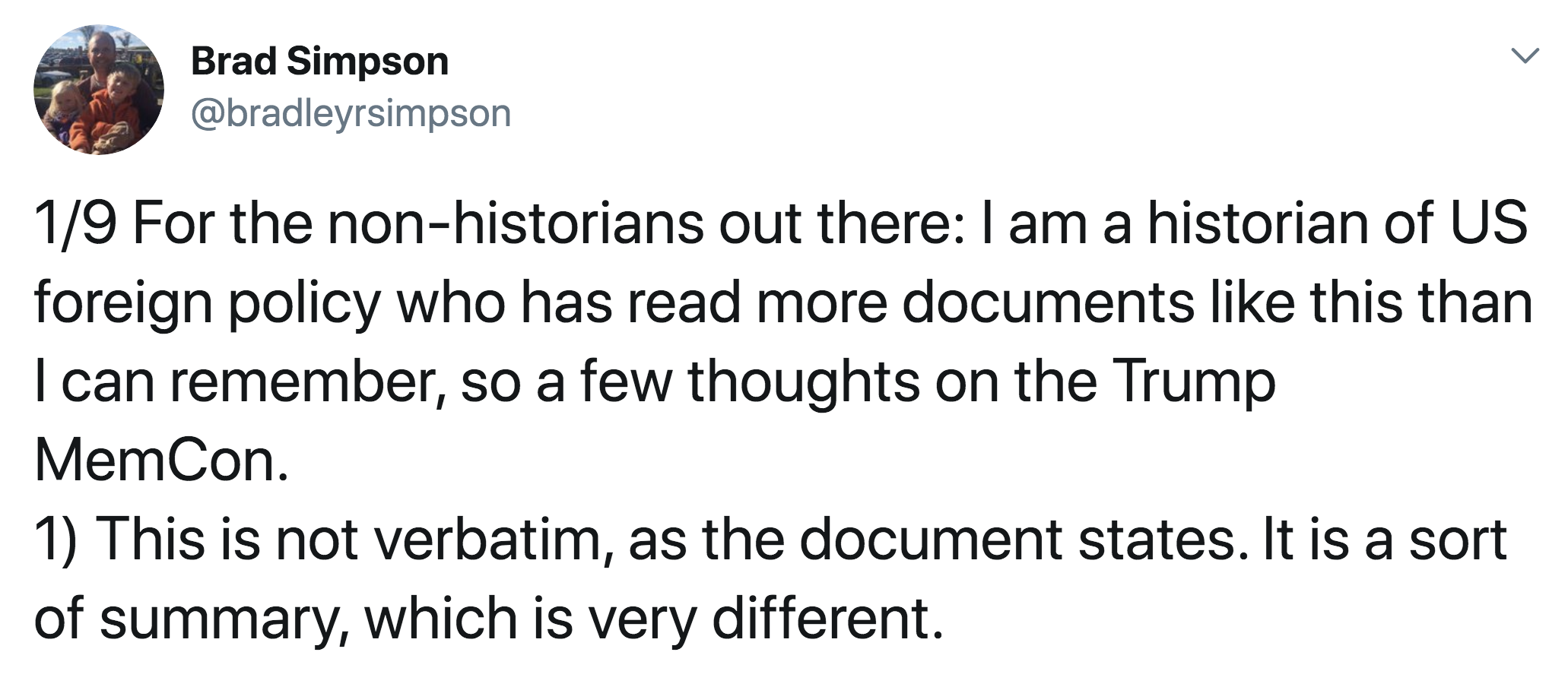
Informative twitter thread on the memo by Brad Simpson, University of Connecticut historian. Starts here.

Screen Shot 2019-09-25 at 12.19.24 PM.png

In Praise of Literary Tussles

The week that was. Ukraine v Russia. Israel v Palestine. Syria v the Islamic State group. Too many lives cut short, too many families torn asunder.

If only we could substitute bloodless literary tussles for the violent ones that dominate the headlines.

For that to happen, we need provocative essay writers willing to ruffle readers’ feathers. Enter Tom Junod of Esquire. I’m guessing he was caught off-guard by just how many feathers his essay “In Praise of 42 Year-Old Women” ruffled.

I really, really, really liked Julie Checkoway’s clever and perceptive response to Junod. Checkoway convincingly hypothesizes that Junod is struggling with his mortality.

She writes:

Men have a lot more trouble, I think, admitting their fear of aging and death than women do. In my experience, women are more openly verbal, at least, about our terror. Typically, men either joke about it or have affairs or splurge on a sports car (these are stereotypes, so fill in your own experience of men here). But they rarely write about the terror of aging honestly. . .

But men are just as terrified as women of aging and dying. . . . How could they not be? They’re human. It’s just that they talk about it in a different way than women do. They talk about it by talking about women’s . . . fading attractiveness. And most men’s magazines—-unlike most women’s magazines—-aren’t filled with articles that expressly address aging graciously, painfully, or at all.

Men’s magazines, like Esquire, are filled with articles like Junod’s, articles in which men talk about how it’s okay with them for women to age. Just a little. And then a little more. And then a little more. Men are writing about death and aging, but they’re just writing about it by writing about us.

Checkoway’s response to Junod is direct, caring, specific, and philosophically rich. And her analysis rings true.