Rich Beyond Measure

That’s a wrap. The semester is over. Grades are (mostly) in. Back at it January 7th for one month-long course. Then my academic year will be a wrap since I’m a half-timer. Don’t hate me because you ain’t me.

It felt kinda weird returning to work in early September after such a long sabbatical. Pre-sabbatical, I handed off my administrative duties, so I was teaching full-time for the first time in a long time. And while I was gone, even more colleagues who I enjoyed had moved on. By “kinda weird” I guess I mean somewhat disconnected.

After all these years, I sometimes feel as if I should’ve assumed more administrative responsibilities somewhere along the line. I mean what kind of sad sack is back exactly where he started 22 years earlier?

And yet, as I read final papers, and email messages, and hand written notes of appreciation, I feel like finally, I might be getting this teaching thing down. Of course, putting that in writing means my “J-term” course will probably be a disaster, you know, pride coming before the fall and all.

Every educator is different, but for me at least, the “secret” to teaching well is the same as living well, the more selfless, the better. Maybe it was having no administrative responsibilities that enabled me to see and hear my students more clearly this fall. More specifically, maybe it was not being in a hurry, maybe it was taking the time to listen to them and to read their words even more closely. And then to respond to those words.

The more authentic and present I am in the classroom, the more my students appreciate my teaching. They also appreciate the thought put into our more accessible, shorter, more thought provoking than average reading list.

My students’ end-of-semester gestures of appreciation make me think I’m still doing the right thing, in the right place, at the right time. Consider one student among many, a physically imposing, politically conservative, first year footballer whose domineering dad tolerated no negative emotions.

“When I found out I had to be in a mandatory writing seminar as part of the ‘First Year Experience Program’ (FYEP) titled ‘The Art of Living’, I dreaded it. I despised writing, especially that of a personal nature. All of the essays and discussions I would have to participate in would be about my life, inner thoughts, and feelings. I figured it was just another stroke of bad luck. My goal for the semester was just to survive, and hopefully improve on my personal writing ability after a few failed attempts. However, I found out very quickly that this was just the class I needed. It turns out that my destiny was not to have an unfortunate event take advantage of me, but was to have an unbelievable stroke of luck being placed in the Art of Living writing seminar.”

Further in:

“This unexpected change of heart provided me with energy and enthusiasm. Writing my fourth essay became something I enjoyed, not something I dreaded. I wrote about my stance on modern love and the concept of soulmates, which was the strongest stance in any essay I had written. I wrote about my own experiences with love, and how in my eyes the person I want to marry will be able to fill my heart with love. I wrote about how that love would allow me to experience the six varieties described in Krznaric’s writing: eros, pragma, ludus, agape, philuatia, and philia. . . . I had ended up doing the exact opposite of what I had initially thought I would: I wrote about my definition of love, my love life, and I loved doing it. By writing from the heart and being vulnerable with my audience, I was able to capture their attention and provide details that I otherwise might have excluded. My paper connected better with my readers, and it was relatable. Over the course of this semester I had not only grown as a writer, but I opened my mind and grew as a person.”

Watching this young man blossom into a superb, sensitive discussant was a joy:

“One of the most influential changes to my (writing) process was in-class discussions. They allowed me to deepen my understanding of the prompts while listening to others’ thoughts and feelings. I could formulate my own stances in response. It allowed me to consider outside opinions and beliefs and flush out my ideas. They made my essays even more thorough because I gained not only different pieces of textual evidence but I learned about different experiences my peers could connect to the readings. Being able to have personal, open conversations in class also made the texts more applicable to daily life. The discussions helped shape not only my essays, but the way I looked at the world as a whole. I could consider expanding my varieties of love as Kznaric wrote, or I could consider the lifestyle of Stoicism written in William Irvine’s A Guide to the Good Life. These discussions opened my heart and mind to the different ideas we discussed in class, and allowed me to incorporate those into my essays. This class broadened my life views and expanded my horizons.”

Because I’m half-time and I get paid over 12 months, and I max my retirement contributions, and I add family dental insurance and a Health Saving Account in for good measure, my take home pay for November was $34.37. But I feel rich beyond measure.

Wednesday Assorted Links

1. What swimming in my underwear taught me about Donald Trump and getting away with it. Funny, but rest assured Briggs YMCA patrons, I do not condone swimming in one’s underwear. That’s the reason the swimming backpack has a second just in case suit and pair of underwear. More spontaneous peeps should adhere to a strict “forget your suit, forget the workout” life philosophy. (Thanks DB.)

2. Why shade is a mark of privilege in Los Angeles.  My conservative friends will say this is ridiculous. As someone far too experienced with skin cancer, I respectfully beg to differ.

“As the world warms, the issue of shade has drawn more attention from urban planners. The writer Sam Bloch, in an article in Places Journal this year that focused on Los Angeles, called shade ‘an index of inequality, a requirement for public health, and a mandate for urban planners and designers.'”

3. I learned to play the piano without a piano. Passion personified.

“I was 11 years old when I asked my mum for piano lessons, in 2010. We were in the fallout of the recession and she’d recently been made redundant. She said a polite ‘no’.

That didn’t deter me. I Googled the dimensions of a keyboard, drew the keys on to a piece of paper and stuck it on my desk. I would click notes on an online keyboard and “play” them back on my paper one – keeping the sound they made on the computer in my head. After a while I could hear the notes in my head while pressing the keys on the paper. I spent six months playing scales and chord sequences without touching a real piano. Once my mum saw it wasn’t a fad, she borrowed some money from family and friends, and bought me 10 lessons.”

4. On writing about divorce when you’re still married.

“There’s my husband in the corner, who’s married to someone always wondering just how solid the ground beneath her feet is, and who always reassures her that it’s good. There’s my ring on my finger. There are all my friends, rising up from the ashes of their old marriages and seeking out new bodies to bond to. What is more romantic—more optimistic and life-affirming—than the fact that we know how all of this might end and still we continue to try?”

5. It’s that time of the year when you start wondering what to get your favorite blogger for Christmas.


I’m Thankful

  • For people, near and far, who make time for the humble blog.
  • For late November sunlight.
  • For my family’s and my health.
  • For friends near and far.
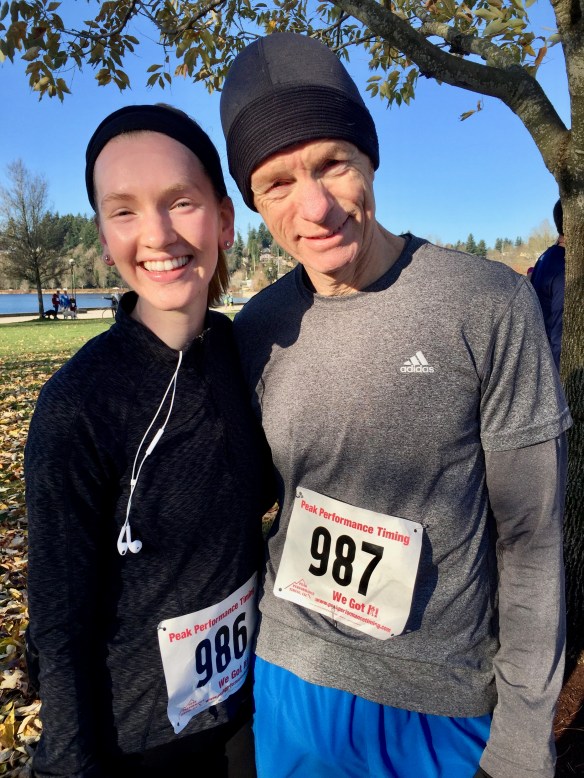
  • For my daughter inviting me to run the Oly Trot with her. Her first “organized” run. We ran conservatively for the first 3.5 and then did our best East African impersonations for the last .5.

IMG_0774.jpg

Another of Alberto Salazar’s Runners Says He Ridiculed Her Body for Years

Someone should write a book. Something like “The MeToo Perps’ Painfully Predictable Non-Apologies”. Possible subtitle, “Their Inability to Understand the Harm They’ve Caused”.

Chapter 53, Alberto Salazar.

“My foremost goal as a coach was to promote athletic performance in a manner that supported the good health and well-being of all my athletes. On occasion, I may have made comments that were callous or insensitive over the course of years of helping my athletes through hard training. If any athlete was hurt by any comments that I have made, such an effect was entirely unintended, and I am sorry.”

“On occasion, I may have. . .”

For shit’s sake, you either did or didn’t Alberto, so either don’t apologize or drop the tentative “may have” bullshit.

“. . . callous or insensitive. . . “

That doesn’t sound so bad. The most timid of adjectives given the allegations.  Why does the (alleged) perp get to label his behavior instead of the victims of the abuse?

IF any athlete was hurt by any comments that I have made. . . “

Thus creating the suggestion that the problem is in their heads. In the initial draft his lawyers probably rewrote, I wouldn’t be surprised if he asked, “Why are they so damn sensitive?”

“. . . hurt by any comments I made”

The classically vague, non-apology apology. Salazar can’t bring himself to acknowledge anything specific that did cause significant pain. Again then, why say anything at all?

He wraps up his non-apology this way:

“I do dispute, however, the notion that any athlete suffered any abuse or gender discrimination while running for the Oregon Project.”

The ultimate power play, the abuser defining what constitutes abuse.

After a close reading of his words, it’s obvious that Salazar is more defiant than remorseful. Sadly, he has lots of company.

Such A Happy Ending

Even better than your fave romantic comedy.

The coolest things about being a famous blogger are annoying your friends with tongue-in-check hyperbole, having readers from lots of other countries, and having people tell you they enjoyed a particular post.

But the coolest may be what happened after I posted “Looking for Love—Introducing The Romantic Love Score” four years ago.

I ended that post this way.

“My friend’s RL score? Currently hovering in the high teens, but she’s committed to changing that. Hope I get invited to the wedding.”

The friend, actually a former student, the one who inspired the post, really took it to heart.* She made lots of changes to her life, some I assisted her with, like what used car to buy, and she committed to updating me on the results every six months. I awaited each update with great anticipation.

Then she went silent. For a year. Last I had heard she was dating someone she liked a lot, but I did not know what to make of the delay. Turns out, she was busy falling deeply in love. And planning her wedding.

Here’s part of what she just wrote:

“The wedding was held in my hometown Lutheran church. We kept the wedding invite list very short. To be honest, we felt uncomfortable asking people to travel to PA knowing that it was a significant cost (in more ways than one) with limited time with the person(s) you are celebrating. We had about 50 people in attendance and it was perfect for us.”

Typically considerate of her, but I sure would’ve loved being there, but maybe it was best I wasn’t since the two pics she included in her recent message nearly brought me to tears.

Her crediting my post and subsequent encouragement with helping her make more friends and meeting her husband moved me.

If you know someone like my friend pictured below, full of life, but wanting to share it with someone special, consider forwarding the aforementioned link to them. The more weddings, the better my daughter’s photog business.

294_CP.jpg

*Ironically, I never had my “former student” in a single class. We met while making S’mores one night at a First Year student retreat. We hit it off and she ditched her small group for mine. Following the retreat, we talked off and on during her remaining three and half undergraduate years. She gets the credit for staying in sporadic touch since then via email.


Kind Of A Waste

Sometimes I come across really talented writers who write about things of limited significance. I can’t help but imagine what they might accomplish if they traded up subject matter.

Case in point. Zach Lowe, ESPN Senior basketball writer. Dig his description of Denver Nugget Center Nikola Jokic‘s early season play.

“He is pouting more even by his mopey standards: waving his arms in frustration at inaccurate passes, and slapping opponents to stop play after what he considers bad calls.

We haven’t even addressed defense. Jokic has never exactly been agile, but he makes up for it to some degree with canny positioning, quick meat-hook hands, and voracious rebounding. Awkward appearances aside, the Nuggets have always been stingier with Jokic on the floor.

They still are, per NBA.com. But Jokic is barely moving. He paws at bodies as they fly around him, like a toddler reaching for bubbles.”

. . . even by his mopey standards–funny stuff

. . . like a toddler reaching for bubbles–even more funny

Imagine if Lowe wrote about national politics. He could probably do the seemingly impossible, find some humor in our downward spiral. And thereby earn the nation’s gratitude.

“I Could Probably Go On”

The first year writing seminar is just past mid-semester. And somehow, despite the professor they were assigned, my first year writers have GOT IT. In place of the typical first year writer’s repeated use of the word “things” and other vague words and phrases, their third papers were peppered with specific details. That switch is almost universally positive. The exception? When they’re detailing their inner lives, like this student of mine, who gave me permission to share this with you.

“I can give a list of the things that are currently making me anxious in this moment: the anatomy test that I should be studying for (I got a 60% on it), if I’m going to pass my classes this semester, what classes I’m going to take next semester, if my friends really like me or just put up with me, the weight that I’m going to gain from the binge that I just had, if this essay is going to be any good, if I even want to go into nursing, what am I going to do with my life once I get out of college. I could probably go on but that was a long sentence as it is.”

My students seem fine on the surface, but as they get honest with themselves and me, I’m learning many are suffering in silence. Their willingness to share their stories with me is humbling.

All that I know to do is to assure them their feelings matter, a lot of their peers feel similarly, and I’m glad they’re in my seminar. Also, I encourage them to take advantage of the counseling available to them.

I don’t know if that’s enough.

Paragraph To Ponder

“Today the teacher who digresses is frowned upon; everything in a lesson is supposed to move toward a specific measurable goal. Teachers are supposed to announce the objective at the start of the lesson, remind students of the objective throughout the lesson, and demonstrate attainment of the objective at the end. Such a utilitarian view of education has a long history, but in recent years it has overtaken education discourse. It can be attributed to the introduction of business language and models into education, and the resultant streamlining of language. Schools and industries have become less concerned with the possible meanings of words, their allusions and nuances, than with buzzwords that proclaim to funders and inspectors that the approved things are being done—goal setting, ‘targeted’ professional development, identification of ‘best practices,’ and so forth. Thus we lose the means to question and criticize the narrow conceptions of success that have so much power in our lives.”

Diana Senechal, Republic of Noise: The Loss of Solitude in Schools and Culture, 2012.

Passion Till The Very End

The word of the day, harangue, a lengthy and aggressive speech. One could add “see Bernie Sanders”. I’m not a fan of Bernie’s oratorical style, but I’m in total awe of his passion especially given the fact that he’s 78 years old.

By 78, a lot of men are dead, hell, Bernie peered over the abyss last week. Elderly men and women in their eighth, ninth, tenth decades often struggle with more than just declining health. There’s the huge psychological challenge of having a purpose to continue living. Something beyond watching television and marking time.

That’s not a problem for Bernie, nor was it for Harold Bloom who died earlier this week. The New York Times described Bloom as the “most notorious literary critic in America” explaining:

“Chiefly he argued for the literary superiority of the Western giants like Shakespeare, Chaucer and Kafka — all of them white and male, his own critics pointed out — over writers favored by what he called “the School of Resentment,” by which he meant multiculturalists, feminists, Marxists, neoconservatives and others whom he saw as betraying literature’s essential purpose.”

I find his unabiding passion even more fascinating than his contrarian intellect for which he’s best known.

Dig this:

“Professor Bloom called himself ‘a monster’ of reading; he said he could read, and absorb, a 400-page book in an hour. His friend Richard Bernstein, a professor of philosophy at the New School, told a reporter that watching Professor Bloom read was ‘scary.’

Armed with a photographic memory, Professor Bloom could recite acres of poetry by heart — by his account, the whole of Shakespeare, Milton’s ‘Paradise Lost,’ all of William Blake, the Hebraic Bible and Edmund Spenser’s monumental ‘The Fairie Queen.'”

In junior high school I memorized some bible verses in Confirmation classes, I just can’t remember which ones.

The Times adds:

“. . . his output was vast: more than 40 books of his own authorship and hundreds of volumes he edited. And he remained prolific to the end, publishing two books in 2017, two in 2018 and two this year: ‘Macbeth: A Dagger of the Mind’ and ‘Possessed by Memory: The Inward Light of Criticism.’ His final book is to be released on an unspecified date by Yale University Press, his wife said.”

Further evidence of his all consuming passion, he taught his last class at Yale last Thursday.*

I texted an academic friend who followed Bloom’s work this humorous excerpt from the Times. Years ago Bloom predicted:

“’What are now called ‘Departments of English’ will be renamed departments of ‘Cultural Studies, where Batman comics, Mormon theme parks, television, movies and rock will replace Chaucer, Shakespeare, Milton, Wordsworth and Wallace Stevens.”

“He nailed that!” my friend texted back.

May you live long, similarly passionate lives.

*Bloom looks really spent in the 2011 picture. For shit’s sake, can we please revisit mandatory retirement provisions? How about you have to hang em’ up at 88 years young?


What Can We Do To Improve Young Adult Mental Health?

My first year writing students are 18-19 years-old. Here’s the prompt for their first paper:

     Irvine argues that people often lack a “grand goal of living” and a coherent philosophy of life because our culture doesn’t encourage thinking about specific reasons for living; instead it provides them with an endless stream of distractions. He contends you’ll most likely squander your life without a guiding philosophy. He adds that even if you have a “grand goal in living” and can explain its importance, it’s unlikely you will attain those things in life you take to be of greatest value if you lack an effective strategy that specifies what you must do as you go about your daily activities. Explain why you agree or disagree with Irvine’s assertions. Also, explain a few things you want out of life and why.

Irvine proposes an updated version of Stoicism as a guiding philosophy. Most of my writers find meaning in some stoic concepts, like the trichotomy of control, but generally aren’t down with Irvine’s thesis that they need a “grand goal of living”. Most argue they’re too young to have formulated very specific life goals, let alone one “grand” one. Often, they thoughtfully point out that a highly detailed roadmap doesn’t make sense given life’s unpredictability.

When it comes to what they want out of life, an increasing number want improved mental health. It’s difficult to overstate the extent of young adults’ anxiety today. When I listen to them describe their anxiety and depression in class and read about it in their papers I have two reactions. Overwhelming empathy and curiosity as to what the hell is going on.

The third episode of the Happiness Lab podcast with Laurie Santos, “The Silver Lining”, might provide a clue. It’s about our tendency to compare ourselves to others who we perceive to be the most well liked, the most social, the most wealthy, the most together, the seemingly most happy. The episode’s title comes from research into Olympic athletes that suggests bronze medal winners are much happier with their medals than silver medal winners because silver medal winners are focused on not having won gold while bronze medal winners are focused on everyone that didn’t medal at all. This concept, “point of reference”, partially explains why happiness can be so illusive.

A Cornell psychologist in the episode contends social media compounds this problem because everyone carefully curates their online image to appear artificially happy. Among other remedies, Stoics advocate for internal goals to counter our self-sabotaging “point of reference” tendencies.

The gravity of the situation has me convinced that there’s no one explanation to “what’s going on”. Another factor could be the pressure my (admittedly selective) students feel to have their adult lives figured out just as they’re beginning them—whether to go to college, how selective a one, how to pay for it, what to study, what internships and other resume building activities to pursue, whether to go to graduate school, which career path, which grand goal for shits sake.

Parents, intensely worried about the vagaries of the economy, and desperate for a return on their considerable college investment, think that if their young adult children just pick the right thing to study—nursing, engineering, and other pre-professional fields—and develop a detailed plan, their college graduate sons and daughters won’t end up living in their basements.

This was what I was thinking about when struck by a related idea during a recent run. This time of the year, in North Olympia, Washington, it’s pitch black when running before work. Most of the streets are not lit, sometimes there’s fog. My uber-headlamp provides about 20-25 yards of visibility.

North Oly roads roll with a constantly changing mix of gentle ups and downs. Picture ocean swells, the Palouse in Eastern Washington, or the Norwegian countryside. Normally, I realized during the run, seeing roads ahead tilt upwards plays with my mind. At least a little. “Here it comes,” I think, “this is gonna take a little more effort.” And then, “Okay, almost topping out, hang in.”

But on this pitch black, foggy, autumn run, there was no such internal dialogue because I COULDN’T SEE AHEAD. The only way I knew I was starting a climb was my breathing became more labored. “Oh, okay, climbing now.” Because I couldn’t see the road tilting upwards ahead of time, my mind was free of that small, subtle nagging dread of having to work harder. As someone whose prone to look too far down the road of life, I was digging running in the moment. Don’t tell me what’s ahead, let me just be present.

Freed of anticipatory dread, my mind turned to my students. They lament how their teachers, beginning in middle school, ask about their life plans. And how it continues through high school. And how their parents too often pressure them to have a plan.

Some of them end up crafting faux-plans just to stop the insanity. As a placeholder of sorts. Some, like a previous writing student, declare nursing upon entering college only to realize in the middle of our first semester seminar that they didn’t really like science.

Maybe we should give our high school graduates headlamps and encourage them to focus at most on the year ahead especially since life is fragile and no one is guaranteed a long life.

What if our message was this.

In the next year, while working, traveling, or going to college; focus on improving your health; nourishing your spirit; investing in new friendships; finding one way to make others’ lives better. Don’t worry unnecessarily about the mountains and valleys that lie ahead in the distant future. You’ll be okay. And if not, let me know how I can help.

Young adults’ mental health might improve.