
The answer to this question is yes, without a doubt.

The answer to this question is yes, without a doubt.
1A. These are the best (and most surprising) places to get a draft in a bike race. Important research to know before your next race.
1B. How to keep the bike boom from fizzling out. In Pete Buttigieg we trust.
“The need for the bike boom to roll on beyond the pandemic is about more than the love of cycling. . . . You’ll literally breathe easier when you start replacing more car trips with bicycles. We’re talking less carbon emissions, less traffic congestion, and a healthier population — the essential ingredients that make people happier and less stressed out. In the World Happiness Report 2020, countries with high bicycle use tend to be among the happiest overall, like the Netherlands (ranked sixth; daily bike use: 43 percent), Denmark (ranked second; daily bike use: 30 percent), and Finland (ranked first; daily bike use: 28 percent).”
2. What to wear to Christmas parties this year.
3. Perhaps he has written more hit songs than anyone else.
4. New data shows residents fleeing California in near record numbers. Substantive reporting from the Sac Bee. Good to know some local papers are still alive and kicking.
5A. COVID-19 and the Failure of Swedish Exceptionalism.
“Whereas American exceptionalism is about America’s unique place in the world, Swedish exceptionalism is about being immune to any disasters that may happen in the rest of the world.”
5B. Younger People Get Vaccines First in Indonesia’s Unusual Rollout.
“There are no good choices, there is only the least-bad choice.”
My amazing playwriting aside, the Jeff Bezos/MacKenzie Scott divorce is an illuminating tale for people committing to one another for the long haul.
The conventional wisdom is that a lack of money and related money fights explain why so many relationships fail. That’s certainly true, but not the whole story. Even people with money can have devastating money disagreements because everyone has a unique money history and no two people will ever think about it the same way.
The bottom line. Couples don’t explore their “money compatibility” nearly carefully enough in the early stages of their relationships. The key is to figure out whether you and your partner are more similar in your thinking about saving, spending, gifting, and investing than not. No, that’s not particularly sexy, but do you want to measure your relationship by decades or not?
One little complication, by which I mean, huge complication. People change over time. Maybe MacKenzie didn’t know Jeff wanted to be the richest person in the world because he may not have wanted to be until his first or one hundredth billion.
What to do about the unknown? Anticipate that your thinking about money will change over time, not radically, but moderately. Similarly, anticipate that your partner’s thinking will change too. Meaning “money compatibility” is always a work-in-progress. Talk about saving, spending, gifting, and investing with some regularity or run the risk of serious differences creating dangerous cracks in the foundation of your relationship.
“While we know that the single dose can protect against disease, we don’t yet know how long this immune protection will last, and at what level. However, there is no rule that says that vaccines must be boosted within weeks of each other. For measles, the booster dose is given years after the first dose. If the booster dose could be given six months or a year after the first dose, while maintaining high efficacy before the second dose, that would allow twice as many people to get vaccinated between now and later next year, accelerating herd immunity — greatly helping end the crisis phase of the pandemic in the United States.”
The setting: Jeff Bezos’s and MacKenzie Scott’s Medina, WA kitchen. After working together to make Kraft macaroni and cheese with hot dogs, they serve themselves, grab two cans of Mountain Dew, and sit down at their formica dinner table. It’s one of their last dinners together as a married couple. A few days following this meal, they decide to pull the plug on their marriage.
Jeff: Mac and cheese with dogs never gets old. [laughs uncontrollably]
MacKenzie: No, it doesn’t. [inner voice. . . but your laugh has sure started to]
Jeff: What did you do today?
MacKenzie: I spent most of it journaling. Which helped me realize I don’t want to help you turn Amazon into the world’s retail store anymore. I think $182 billion is enough money. I want to make the world a better place through writing and giving my share of our money away.
[All the while, Jeff texts Lauren Sanchez under the table.]
MacKenzie: [Softly, sadly, and with a deep sense of resignation.] Did you hear me?
Jeff: Yes, you said you want to help me make Amazon into the world’s retail store.
[MacKenzie stares at Jeff in silence]
Jeff: [Head in his lap.] Can you pass the applesauce?
A New York Times primer for anyone who doesn’t know MacKenzie Scott, the eighteenth wealthiest person in the world.
“Ms. Scott, who was formerly married to the Amazon founder Jeff Bezos, the world’s richest person, has pledged to give away most of her wealth. Her shares in Amazon were valued at about $38 billion last year but would have gained value during the coronavirus pandemic.”
Scott isn’t letting the pandemic stop her from making true on her pledge. Quite the opposite. Last week she revealed she was “the one behind the donations to dozens of colleges and universities, part of nearly $4.2 billion she had given to 384 organizations in the last four months.”
As impressive as the amount Scott’s given away is is how her team did it.
“The money came after weeks or months of hush-hush conversations in which Ms. Scott’s representatives reached out to college presidents to interview them about their missions, several of the presidents said on Wednesday. When they learned who was behind the effort, it was a surprise to them, too. But it could not have come at a better time — when the pandemic was hitting their student bodies hard, they said.
‘I was stunned,’ Ruth Simmons, president of Prairie View A&M University, a historically Black college in Prairie View, Texas, said of learning that Ms. Scott was giving $50 million, the biggest gift the university had ever received. She thought she had misheard and the caller had to repeat the number: ‘five-zero.'”
Scott is the antithesis of most ultra wealthy philanthropists who almost always give to their alma maters, most of which are already flush with nine or ten figure endowments.
“Ms. Scott’s latest gifts bring her charity to almost $6 billion this year, an extraordinary amount. In another unorthodox touch, she announced them in a Medium post on Tuesday. ‘This pandemic has been a wrecking ball in the lives of Americans already struggling,’ she wrote. ‘Economic losses and health outcomes alike have been worse for women, for people of color, and for people living in poverty.'”
Experts on philanthropy were surprised to see Scott associate herself with institutions that were “much more humble and, indeed, needy.”
“To these institutions, a $20 million donation was the equivalent of several times that to a Harvard or Yale, and could have a disproportionate impact.
‘One of the things that’s so incredible about this massive grouping of gifts is that she does not have a personal connection to most, if any, of these universities,’ said Kestrel Linder, chief executive of GiveCampus, a fund-raising platform that works with colleges and universities.
Ms. Scott made gifts to more than a dozen historically Black colleges and universities, as well as community and technical colleges and schools serving Native Americans, women, urban and rural students.”
Dare to be different. And hella generous.

Moderate Democrats are splitting with more radical leftists on Seattle’s plans to give misdemeanor suspects a pass for crimes committed to meet a basic need.
Jason Rantz, right wing radio host tells a precautionary story. Seattle CM called police she defunded to report crime she is effectively legalizing.
I guess I’m a moderate Democrat since I find the proposed legislation problematic for the reasons Rantz explains. However, since we already imprison a larger proportion of citizens than any other country, we know Rantz’s solution of locking up more people will do nothing to reduce crime or improve Seattleites’ quality of life. Because criminals aren’t rational. They don’t plan on being caught, and therefore, don’t ponder the odds of going to prison.
We also now know we can’t afford our prison population if we want balanced state budgets. I wish I could direct a larger proportion of my city, county, and state sales taxes to mental health and substance abuse treatment.
That still leaves the question of what to do with all the criminals of sound mind who commit property crimes and other misdemeanors. On that, I’ll defer to experts to propose smarter, more viable alternatives to prison.
1. What if the Great American Novelist Doesn’t Write Novels? I need to see a lot more of Wiseman’s work, but the little bit I have seen makes me think that question is not at all hyperbolic.
“The fact that Wiseman’s half-century-long project is a series of cinéma-vérité documentaries about American institutions, their titles often reading like generic brand labels — ‘High School,’ ‘Hospital,’ ‘The Store,’ ‘Public Housing,’ ‘State Legislature’ — makes its achievement all the more remarkable but also easier to overlook. Beginning with ‘Titicut Follies’ (1967), a portrait of a Massachusetts asylum for the criminally insane that remains shocking to this day, Wiseman has directed nearly a picture a year, spending weeks, sometimes months, embedded in a strictly demarcated space — a welfare office in Lower Manhattan, a sleepy fishing village in Maine, the Yerkes Primate Research Center at Emory University, the flagship Neiman Marcus department store in Dallas, the New York Public Library, a shelter for victims of domestic violence in Tampa, Fla., a Miami zoo — then editing the upward of a hundred hours of footage he brings home into an idiosyncratic record of what he witnessed. Taken as a whole, the films present an unrivaled survey of how systems operate in our country, with care paid to every line of the organizational chart. They also represent the work of an artist of extraordinary vision. The films are long, strange and uncompromising. They can be darkly comic, uncomfortably voyeuristic, as surreal as any David Lynch dream sequence. There are no voice-overs, explanatory intertitles or interviews with talking heads, and depending on the sequence and our own sensibility, we may picture the ever-silent Wiseman as a deeply empathetic listener or an icy Martian anthropologist.”
2. Why Are Great Athletes More Likely To Be Younger Siblings?
“The roots of the little sibling effect may lie in the way younger siblings strive to match their older siblings on the field. This was the case with Michael Jordan, the youngest of the three Jordan boys and the fourth of the five Jordan children. When the siblings were growing up, Larry — who was born 11 months before Michael — was considered a better basketball player and regularly bested Michael in one-on-one games.
‘I don’t think, from a competitive standpoint, I would be here without the confrontations with my brother,’ Michael recalled in the ESPN documentary’ The Last Dance.’ ‘When you come to blows with someone you absolutely love, that’s igniting every fire within you. And I always felt like I was fighting Larry for my father’s attention. …
‘I want that approval. I want that type of confidence. So my determination got even greater to be as good, if not better than, my brother.'”
Alas, did not apply in my family. Oldest Brother routinely whipped my ass on golf courses and tennis courts alike. And Older Brother was a much better swimmer and water polo player.*
3. Amanda Seyfried Finally Stakes Her Claim. How to be wonderfully grounded, against the odds. Buy a farm.
4. Why Andy Mukherjee is losing hope in India. Given it’s impact on the planet, anyone who is not East-Indian owes to themselves to learn a lot more about India. This is an excellent start.
*that’s why this athletic accomplishment was so gratifying
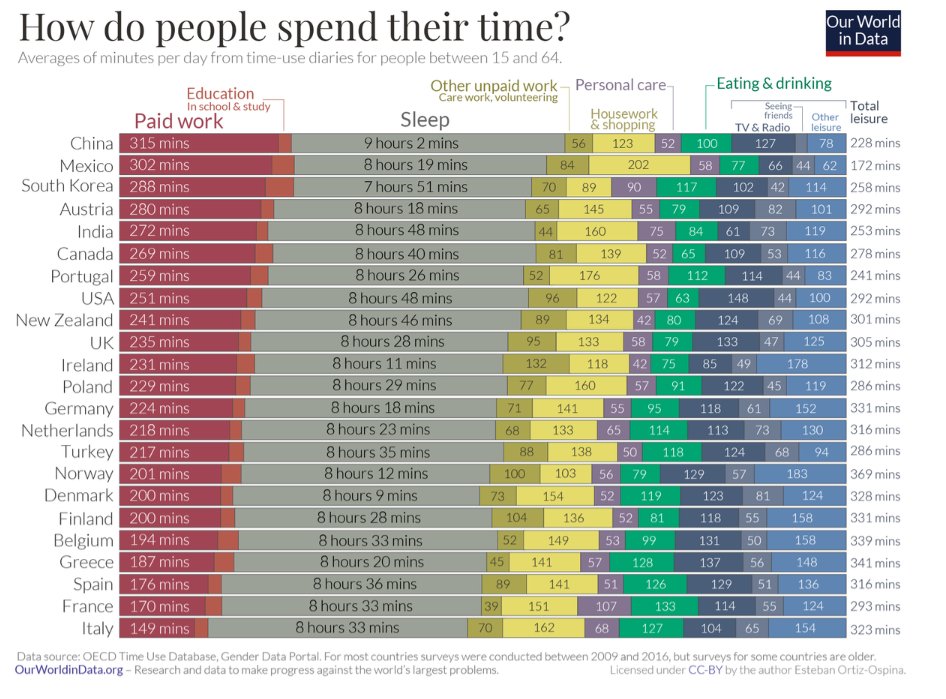
Don’t look at the far left “country” column, study the rest of the graphic, and pick your favorite time-use equation.
Mine was NORWAY.
Despite all the distancing, I’ve had many more meaningful interactions with my students this semester than I anticipated. Interactions that have left me feeling sublimely aligned with my life purpose.
I regularly challenge students to focus more on learning processes than outcomes. More specifically, I advise them not to focus on grades too intensely. I’m not naive as to why so many of them do exactly that—scholarship requirements, good driving discounts, graduate school applications, and parents’ expectations for starters.
And yet, deep down they know their intense focus on grades often compromises their learning. Many still can’t help themselves.
“Why, do you place so much importance on your grades?” I gently probed with one of my first year writers last week during a one-on-one conference. I don’t remember what she said, but I’ll never forget her follow up e-mail.
“You asked me when we last met why I focus so much on my grades. I gave you the first answer to come to mind. I have put a lot of thought into it. I often look down on myself. I have a hard time telling myself, that I’m smart or interesting or pretty. I have a hard time accepting it when others say it’s true. Grades are the way, I can look at myself and say, ‘here in front of you is proof that you are smart, or at least smart enough, and that you can succeed.’ That’s all. Thank you for everything professor.”
I’m the one who should be thanking her for the single most honest, heartfelt explanation for grade anxiety I’ve ever heard.
 Pressing Pause