Personal Life

I hear someone super smart on a podcast. I read about an unsuspecting athlete inspiring lots of other people to vote. I watch Savannah Guthrie give Fox News hosts a tutorial on how to interview the President. I read an absolutely beautiful essay about the arrival of fall in Twisp, WA.

And I want to know more about these people. So I google them and in a few seconds I’m skimming their wikipedia pages (or in the case of the essay writer, their personal website).

And when I skim someone’s wikipedia page, I always start with “Personal Life”. Is that because I’m a nosy bastard or because it’s human nature? What, dig this, they live in Ojai, CA; they’ve been married a few times; they have three children; and they raise llamas.

I wonder whether this phenomenon, which I think is human nature, partially explains higher education’s irrelevance in most people’s day-to-day lives. Higher education is always looking itself in the mirror and saying “This is the year I’ll become a public intellectual. This is the year I’ll make my work accessible. This is the year I’ll engage with the Deplorables.”

But why don’t the changes ever take? I propose it’s because academics, intellectuals, scholars, pick your preferred term, never ever talk about their Personal Lives. The unspoken agreement is that it detracts from the seriousness of your scholarship. The thinking being that one’s ideas, if they’re persuasive and original enough, should be sufficient to garner attention.

And how’s that working out?

Maybe higher education needs to look in the mirror and say “This is the year I become human. This year I’ll reveal something, hell anything, about my life off campus. This is the year I’ll crack the curtains on my Personal Life.”

Journalism Heavyweight

Congress has been asleep at the anti-trust wheel for a long time. Meaning you and I are largely responsible for the fact that every sector of our economy is dominated by fewer, ever larger entities. Small promising companies are inevitably gobbled up by larger ones. Economic theory suggests a lack of competitiveness is bad for consumers.

Similarly, if an ever shrinking number of newsrooms translates into less competition for readership, ever larger newspapers should be bad for citizens and our democracy. Right now, The New York Times is serving as a powerful counterfactual to this phenomenon. I’m not sure what to make of the fact that the largest newspaper is doing a lot of the best work.

Two examples.

‘Straight to Gunshots’: How a U.S. Task Force Killed an Antifa Activist. From the article,

“President Trump praised the killing of Michael Reinoehl, suspected of fatally shooting a far-right protester, as ‘retribution.’ Our investigation found that officers may have shot without warning or seeing a gun.”

More and more it’s looking like Reinoehl was murdered by the U.S. government inside the U.S. Four officers fired their weapons around 30 times. Eight bullets hit civilian properties. Some bullets flew right by an eight year old on his bike. Others blew out windows of neighboring cars. Our incredible passivity about this murder will embolden our President. 

As the virus spread, private briefings from the Trump administration fueled a stock sell-off. While we’re making jokes about a fly, the owners of production fuck the proletariat. By calling it “draining the swamp”, their thoughts about us are obvious, they think we’re stupid. Remember what the President said in the run-up to the last election, “I love the uneducated.”

“The president’s aides appeared to be giving wealthy party donors an early warning of a potentially impactful contagion at a time when Mr. Trump was publicly insisting that the threat was nonexistent.

Interviews with eight people who either received copies of the memo or were briefed on aspects of it as it spread among investors in New York and elsewhere provide a glimpse of how elite traders had access to information from the administration that helped them gain financial advantage during a chaotic three days when global markets were teetering.”

Imagine if the President’s base got half as upset about white collar criminality as they do about the occasional criminality that accompanies urban protests.


Don’t Write This Way

Positive writing models are the most helpful, but sometimes negative examples of what not to do are so glaring they just can’t be ignored.

From a lefty on Twitter, “I don’t want to be alarmist, but a GOP source just told me this: “Trump’s condition is serious. He can go either way. . . . ”

Writing at its worst. What’s more alarmist than “He can go either way”?

Own your ideas. One could write, “At the risk of being alarmist, . . . “, but if you truly don’t want to be alarmist, delete it all. Silence is often a great option.

Weekend Required Reading

1. Nice. At 5’4″ Canadian Leylah Annie Fernandez is about to prove me wrong about women’s professional tennis.

2. A young, supe-smart data scientist on why he’s moving on from the ‘rona and the best models to follow.

3. What Blair Braverman’s sled dogs taught her about planning for the unknown. Dig the blingy booties.

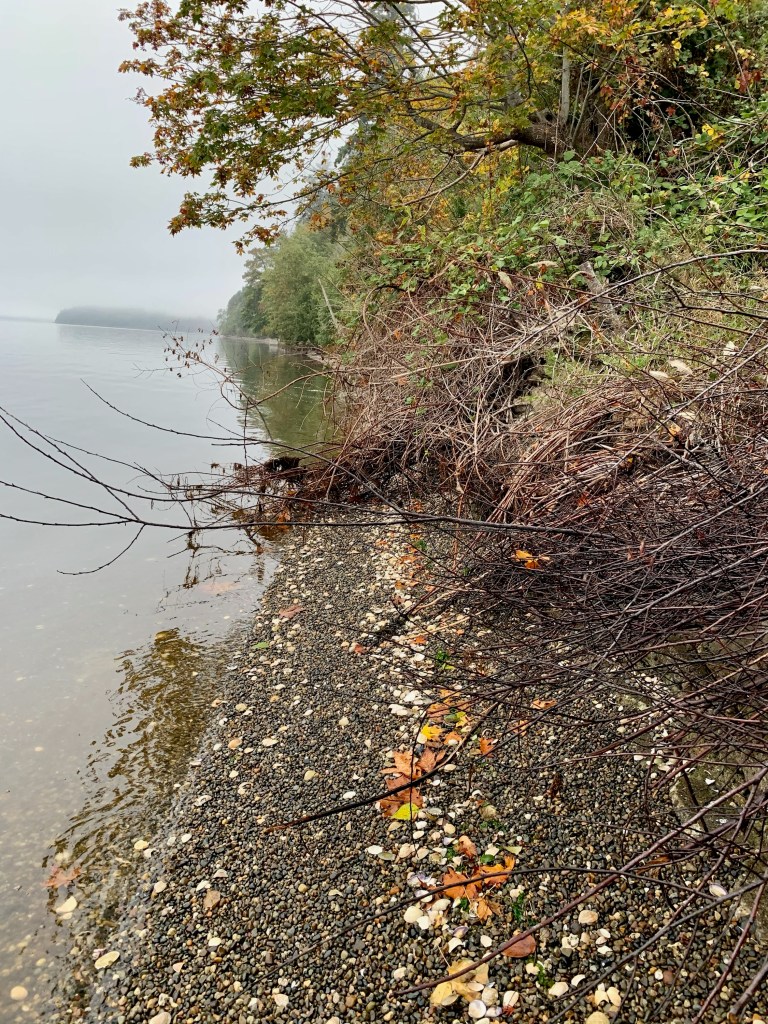
A sore Achilles tendon means I’ve temporarily traded running in for walking. I enjoyed a particularly nice one this morning. Until getting here. Nothing prepared me for high tide. Well, except for the “Tides Near Me” app on my pocket computer. 

Wednesday’s Ride

Blanca is back from the hospital. Travis invited me to loop Mount Rainier. My schedule opened up. In the fourth and final hour of our ride, leg muscles I didn’t even know I had took turns cramping like dominos. But thanks to Travis shepherding me up Skate Creek like George Hincappie used to do for What’s His Name with all the faux TdF titles, somehow I made it.

IMG_1129