
2011 Resolution

Resist manic materialism.

I have no one really to blame because I chose to watch MSNBC while preparing for the 2011 cycling season one morning last week.  It was the morning after 20 inches of snow fell throughout the Northeastern U.S. Business analysts worried “How will the conditions affect retailers since post Christmas shoppers will stay home?”

Does everything always have to be interpreted through the lens of economics?

I should have switched to the Zen Cable Network, a mythical creation of mine where a slow, beautiful, non-narrated slideshow with acoustic guitar accompaniment was looping. Slow moving shots of young people up and down the seaboard sledding and having snowball fights while parents sipped coffee and talked against the backdrop of translucent, oddly beautiful cities.

Manic materialism is the increasingly common practice of defining as many life activities and events as possible in economic terms. How does this—a winter snow storm, schooling, an art form, food, healthcare—make people more or less wealthy? It’s the result of our collective idolatry, and as a result, it’s our unofficial national religion. No activity is immune from its influence. Every life activity and event is reduced to whether it generates wealth.

And make no mistake about it, wealth is defined one way—materially. How much money do you have, how big is your house, how nice is it on the inside, how luxurious is your car, where do you vacation?

Schooling provides a poignant example. Why are U.S. opinion and business leaders over involved in reform efforts today? For one reason—our international economic competitiveness is slipping. As a result, our relative wealth is declining. That’s why math and science content is routinely privileged at the expense of humanities and social studies education. The business leaders at the education reform table are in essence asking, “How in the hell is an affinity for literature or history going to translate into more money for more people?”

Maybe I errored in using the phrase “our collective idolatry” a few paragraphs ago. Maybe all of us are exceptions, a fringe minority that believes we’re more social, emotional, dare I even say spiritual beings, than economic ones.

In prioritizing close interpersonal relationships, maintaining work-life balance, and consciously living below our means, we provide a viable alternative to manic materialism and threaten the status quo.

What else can and should we do in 2011 to provide a social-emotional-spiritual alternative to manic materialism?

Brotherly Love

Thanksgiving is a time to take account of one’s blessings. I am fortunate to have two older brothers. In high school my oldest bro was an excellent junior golfer who I looked up to and followed out onto the golf course at the ripe age of 5 or 6. So I have him to “thank” for my four decade-long journey to find my game. Oldest bro left for college when I was 6 or 7 so I have a few more memories of my other brother who is only three years older than me. Here’s some of what I remember.

He was an original X-game dude decades before the X games. I’m positive he has that crazy adrenaline chromosome that makes people repeatedly do irrational things. Jumped off the 10 meter tower in early elementary school, routinely jumped off our SoCal house into our smallish pool, loves big waves, and prefers skiing in the trees. Any day now I suspect he’ll take his kite board over the Seal or Huntington Beach piers.

Sadly though, despite growing up with long blonde hair, muscles, and dare-devil bad boy persona, he really struggled with the ladies. As a result, whenever he headed out, he’d ask me if I could tag along. Occasionally I’d throw him a bone, but I grew impatient when he proved to be a slow learner. Eventually he compensated by buying homes on the SoCal coast.

As you can plainly see from the “gift” he just sent me, he’s never really forgiven me for not spending more time with him during his formative years.

How Autobiographical?

Awhile back, I started out a fitness update with a passing reference to an encouraging sibling of mine who once told me “no one cares” about my swimming, cycling, and running.

That begs a larger question. What type of writing do readers, blog readers more specifically, find most interesting?

I’m not entirely sure, but I have some hypotheses. Think of the blogosphere in terms of a continuum with writers either off the stage altogether, on the stage’s edge, or center stage. Put differently, there are blogs focused almost exclusively on impersonal specialized content of some sort; other blogs that focus on the sometimes personal application of relatively impersonal specialized content, and blogs whose content is in essence the personal details of the author’s life.

I don’t read a lot of blogs, but here are a few that I do that represent fairly well the different points on the continuum. Each is wildly successfully at least measured by readership. Also interesting, Cowen and Trunk self identify as having Aspergers.

Example one, Marginal Revolution by Tyler Cowen, an economist. Written primarily for other economists, the content is sometimes a reach for me, which is nice. Cowen is scarily prolific posting several times a day. The main thing to note about his blog is he’s mostly off-stage. Sure he’ll ask for restaurant suggestions for where ever he’s traveling next, and he’ll summarize what he’s reading every few weeks (also scary, seemingly a book a day), but don’t look for him to write about whether he’s getting along with his wife or daughter or his non-academic interests.

Example two, DC Rainmaker by Ray Maker, a triathlete. I highlighted Ray’s blog recently. Written primarily for other triathletes, the content tends towards the science of triathlon training. His reviews of triathlon related electronics are the clearest, most detailed, and intelligently written up on the internet. He’s also an outstanding photog who sprinkles twenty or so pics in his three or four posts a week. Ray is my “stage’s edge” example. Two-thirds of the time he focuses in on all things triathlon. The other third, you learn about his worldwide travels (I’m guessing he does IT for the State Department), his fascination with sharks, his love of cooking and food, and “The Girl” who he was recently engaged to.

Example three, Penelope Trunk’s Brazen Careerist. Penelope is the undisputed “center stage” champion. She’s successful I suspect for the same reasons the authors my writing students and I are reading—Esme Cadell, Sherman Alexie, and Frank McCourt—are: 1) She understands that not every moment in every day and not every day in every week is equally interesting. She’s skilled at teasing out from the details of her life “critical incidents” that encapsulate the most interesting elements of her life that also resonate with other people. 2) When describing and exploring the meaning of the critical incidents of her life she grabs readers by the collar by providing intimate details even when they are not flattering. Scratch that, especially when they’re not flattering. And there-in lies the third reason. 3) She doesn’t self-censure herself, instead she opts for authenticity, transparency, the unvarnished truth, pick your phrase(s). In the same literary vein, Tina Fey’s or Liz Lemon’s self-deprecation on “30 Rock” is pure genius.

So in essence, my sib didn’t go far enough. If I self-censure myself and churn out safe, vague, self-conscious descriptions of the personal aspects of my life no one will care for any parts of my personal life story let alone the swimming, cycling, and running chapters of it.

And in all honesty, three years in and I still haven’t figured out yet how to follow Trunk’s, Cadell’s, Alexie’s, and McCourt’s examples in this format. For example, I’ve consciously chosen not to write about the most personally significant thing that has happened to me this year. I’m not quitting though and I suppose this post is another step in the process of figuring where I want to sit on the continuum and exactly what type of blogger I want to be.

Problem Solving

In response to last week’s social science/wealth inequality posts, a comment averse reader sent me the exact kind of response I had hoped to generate when I started blogging. Let’s call her Private.

Private wrote:

Duh? Were you surprised by ANY of those stats? I was not. For me, the far, far, far bigger question concerns my personal responsibility, your responsibility and our corporate responsibility to address those numbers.

She continued:

My Tuesday Lunch Club is superb at identifying social trends and issues therein. It’s solution we struggle with. My Friday dinner friends frequently discuss the week’s news. Again, no useful, doable answers. Based on your variety of sources quoted, you, too, spend a fair amount of time gleaning news stories. It’s my hope that thinking people, such as yourself, spend equal time pondering and yes, even working on and discussing with others, solutions to the problems you identify so clearly. Let’s see some posts about that!!!

Three exclamation points demand a response.

I’m an educator; consequently, I believe consciousness raising is important in and of itself. Ideas matter because they shape our behaviors. But Private would most likely reply what good is awareness of social problems absent concrete actions to solve them? Put differently, quit intellectualizing, roll up your sleeves, and do something to create more equal opportunity.

I don’t have any special insights on problem solving probably because I’m too content with the ambiguity engendered by good questions.

Nonetheless, here is an overarching belief: social problem solving takes many forms all of which should be encouraged equally. Among the forms, 1) practicing selfless, socially conscious, caring forms of parenting; 2) modeling socially redeeming principles such as humility, kindness, and empathy in one’s day-to-day interactions; 3) practicing socially redeeming principles in one’s purchases and lifestyle choices; 4) choosing work that explicitly improves others’ qualities of life; and 5) giving money and time to causes and groups that have proven track records of helping people locally, nationally, and/or internationally.

What would you add?

The GalPal is way more inspiring on this topic than I’ll ever be. While I’m reading, thinking, questioning, debating, and writing, she’s often organizing a team of friends to make dinner for a hundred homeless men and women at the Salvation Army.

Where’s the Romance?

LOVE this guy’s blog; however, I shouldn’t profess my fondness for his blog that way because “You can’t love something,” moms says, “that can’t love you back.”

But as brilliant as Ray’s blog is, there’s something lacking. The same “something” lacking from online triathlon forums like this one—romance.

Not the candlelight hot under the collar type for which the word is normally associated, but the unbridled joy that sometimes accompanies moving outdoors in nature.

Ray, sports science companies, and other triathletes are turning triathlon into a science in which every workout is endlessly sliced, diced, and analyzed.

As a middle adaptor of the personal technology the tri-scientists obsess over, I’m not immune from their privileging fitness science over the aesthetics, art, and romance of swimming, running, and cycling. Consequently, when I run there’s a gadget in my running shorts pocket that bounces signals off satellites so I know precisely how far and fast I’ve run. When I cycle, I lean on my bicycle computer to determine what kind of ride it was based upon whether I achieved a higher than normal average speed.

But there’s no computer that can capture the beauty of a late summer lake swim when the water is glassy and the perfect temperature. No reason to try to measure the rhythm of a long, smooth stroke. No counting of strokes and no measuring of heart rate required.

Nor is there any gadget on the market that can capture what it’s like to run at dawn on golden leaf carpeted Northwest trails in October in a foggy/low light mix. Why even try to quantify how alive I felt last Thursday on my pre-dawn solo eight-miler around Capital Lake. The Capital Dome was lit up and the lake surface was bespeckled with reflections of the Deschutes streetlights. Spectacular.

How do you measure what it’s like to run under the lighting of a full moon or cycle with a friend along the Sound on an unusually warm October afternoon? It’s these experiences with nature and good friends that make me feel alive, not my average watts. And it’s these experiences that clear my mind and strengthen me for day-to-day life.

I’m fortunate to have a great running posse, but lately, since I’m in marathon-mode, I’ve been getting in a few solo runs each week too which has been nice. During one last week, I spent a few of the miles replaying an argument the Galpal and I had stumbled into the previous evening. Reluctantly, I had to admit that the video replay in my head provided inconvertible evidence that I was mostly responsible for the dustup. So when I walked in the house, I apologized. The GalPal was so taken by my (rare) selfless gesture, she violated her strict “no sweaty” hug policy. All of which set me up for a candlelight hot under the collar type of evening. And that my friends is what’s known as the “running romance multiplier effect”.

Credit me when you use it.

The Relationship Conundrum

A few months ago I wrote that everyone in a committed intimate relationship annoys their partner in differing ways to differing degrees. Annoyance is a natural, common thread. Forget the “committed intimate” adjectives, people in relationships eventually end up annoying one another.

There are two contrasting approaches to this reality. 1) Change the person’s behaviors. Continually remind them to turn off the lights, teach them to listen more patiently, insist that they drive just like you. Or 2) Accept their differences. Come to grips with the fact that they’re most likely never going to change and that some of their behaviors are probably always going to be annoying.

I’m an educator so I’m predisposed to believe in the power of reason and the potential for change. But my experience muddies the water. For example, I’ve nagged Fifteen about turning off the lights in our house for years to zero effect. I finally threw in the towel a year or so ago, so now I just turn them off myself. A person complains that her partner doesn’t fully appreciate her Herculean efforts to work, take care of the house, and co-raise the children. Similarly, he feels she doesn’t fully appreciate his contributions to the family’s well-being. They’re playing the most dangerous of relationship games, the no-win “I’m out appreciating you” competition.

I vacillate between one and two depending on the conflict and the day, but if I had to choose, I believe “accepting their differences” mode holds more promise for minimizing interpersonal conflict.

Running on the Edge

Missed my fitness-related posts? My sister says nobody cares, but she thought the Cubs were winning a pennant this year. My sister aside, I’m proceeding as if everyone cares. :)

This is the first summer in a decade I didn’t race in a single triathlon. I was supposed to race (on two wheels) up Mount Baker a few weeks ago, but passed after receiving an early race morning email about extreme conditions and a course change. And I was thinking about doing the Hood River Gran Fondo (100 mile bike race) today, but pulled the plug on the cycling season earlier in the month so bagged that too. I should quit calling myself a triathlete. Is it ethical to continue wearing my Timex Ironman watch?

A running friend extraordinaire annually comps me admission to the Seattle Half or Full marathon the Sunday after Thanksgiving. His website advertises it and so they give him a bunch of pre-paid entries. Most years I run the half, which I really enjoy, but this year I signed up for the full since I haven’t gone long for two years. Everyone should do a marathon every other year, don’t you think?

Enter Dan, Dan, the long distance Man. Dan lives down the street and we train together. He’s of Midwestern stock and a stud, but he gets a little loopy when talking about supplements. We ran the Portland Marathon together two years ago. I was having GI issues at mile 21 and told him I was heading into a PortaPit. “Want me to wait?” “No, go ahead, I don’t want to slow you down.” Sixty to ninety seconds later, with my new and improved plumbing, I started chasing after him. SO frustrating, I could see him, but couldn’t close the gap since he was chasing a woman in a yellow bikini. He finished exactly one PortaPit stop ahead of me and I continue to give him grief for refusing to wait for me.

I don’t think Dan wants to race Seattle with me, but he does want to keep me company on my Saturday long runs. We ran 16 miles Saturday. He didn’t know I was marathon training. I explained I had just decided and that the Seattle race peeps allow you to switch from one race to the other up until race morning.

I’m getting a late start, so I’m kicking up my mileage faster than you’re supposed to. The general rule is no more than a 10% increase in mileage per week. I’ve increased it 20% the last two.

Dano, or the Supplement, or the Malamute, is convinced I’m going to injure myself. He thinks I should be running no more than four days a week, five at the most. I’m running six. Two years ago in Portland I ran well for 20 miles and then faded over the last 10k. Just looked at my late summer/early fall 08′ training log and my mileage was surprisingly modest, 35-45/week. This time I’m going all in with increased mileage with the goal of maintaining my pace through the last 10k. One problem. Miles 20-23 in Seattle are damn hilly. So not only am I increasing my mileage too quickly, I’m getting after it, doing one track and one hill workout weekly too. I almost felt a micro-tear in my calf as I typed that.

I told Dano that if he’s right and gets to say “I told you so” I’ll take 10 days off and run the half. No big deal. Saturday’s run started and ended at the “Y” because I had a massage scheduled for right afterwards. Sunday was a true Sabbath. Today, nine weeks from blast off, I feel (almost) as good as new.

In my next life, I hope to be married to a masseuse.

Beautifully Sad

College drop off one is in the books. How was it? Beautifully sad. After the final hugs, we finally boarded the airport shuttle bus. Eighteen made it especially tough because she wouldn’t walk away. She just waited and watched, never budging. I guess I should have known that was coming, but Fifteen had to inform me that Eighteen’s always stood frozen in time watching whatever conveyances take her loved ones away. Points off for not knowing that.

I was surprised by the GalPal’s relative calmness. Later she informed me she’d been crying quite a bit in private over the last few weeks. Her spirituality made all the difference. Her epiphany? Ultimately, Eighteen belongs to God. We’ve just been taking care of her the last eighteen years. She’s also convinced the distance will prove instrumental in Eighteen assuming adult responsibilities.

Lots of thoughts were swirling around in my head on the shuttle bus ride to the airport. The overarching one was how beautifully sad the separation was. I suppose some parents are glad when their young adult children finally leave the nest. That, in my mind, would be sad sad.

It was a reminder that in life whenever we choose intimacy (by partnering with someone for long stretches of life or by choosing to reproduce), we inevitably increase the risk of painful separation brought about by human fallibility and/or the natural passage of time.

Another thought was how nice it was that I didn’t have to give the final pep talk I had tentatively planned titled, “Work Even Harder, Honor your Grandparents, Don’t Eat Too Many Chocolate Cocoa Puffs, and Be Sure to Get Enough Sleep” because we spent four days together, days marked by dinners out where I told a few college and life parables that communicated everything I had wanted to. I know her well, she listened carefully, I felt no need to elaborate.

The weirdest thing about the four days was how comfortable Eighteen was in her own skin, even when surrounded by her sometimes annoying sister, mother, (and always) annoying father. Day four, after moving in to her dorm room, I suggested she go to the dorm’s dining hall for lunch and “meet us back here” by the student store cafe. “No, I’d rather eat with you guys.” It wasn’t the decision of a shy, anxious, introverted first year, but that of a young woman who appreciates her family and wanted to enjoy our visit to the very end. Despite the antics of her perpetually silly family, there was never a hint of embarrassment, just a mix of fondness and gratitude.

A silver lining of the trip was the thoughtful way Fifteen seemed to process a visit to a neighboring college, her dad’s dinnertime parables, and her sister’s first day of college orientation. She’s always done well in school, but now I think she’s even more motivated to do her best.

The first five-six days at home have been different, but nice. Last week I bought a smaller piece of halibut, only half a gallon of chocolate milk, and the GalPal and I have had enjoyed more time alone.

And the inevitable, natural passing of time marches on.

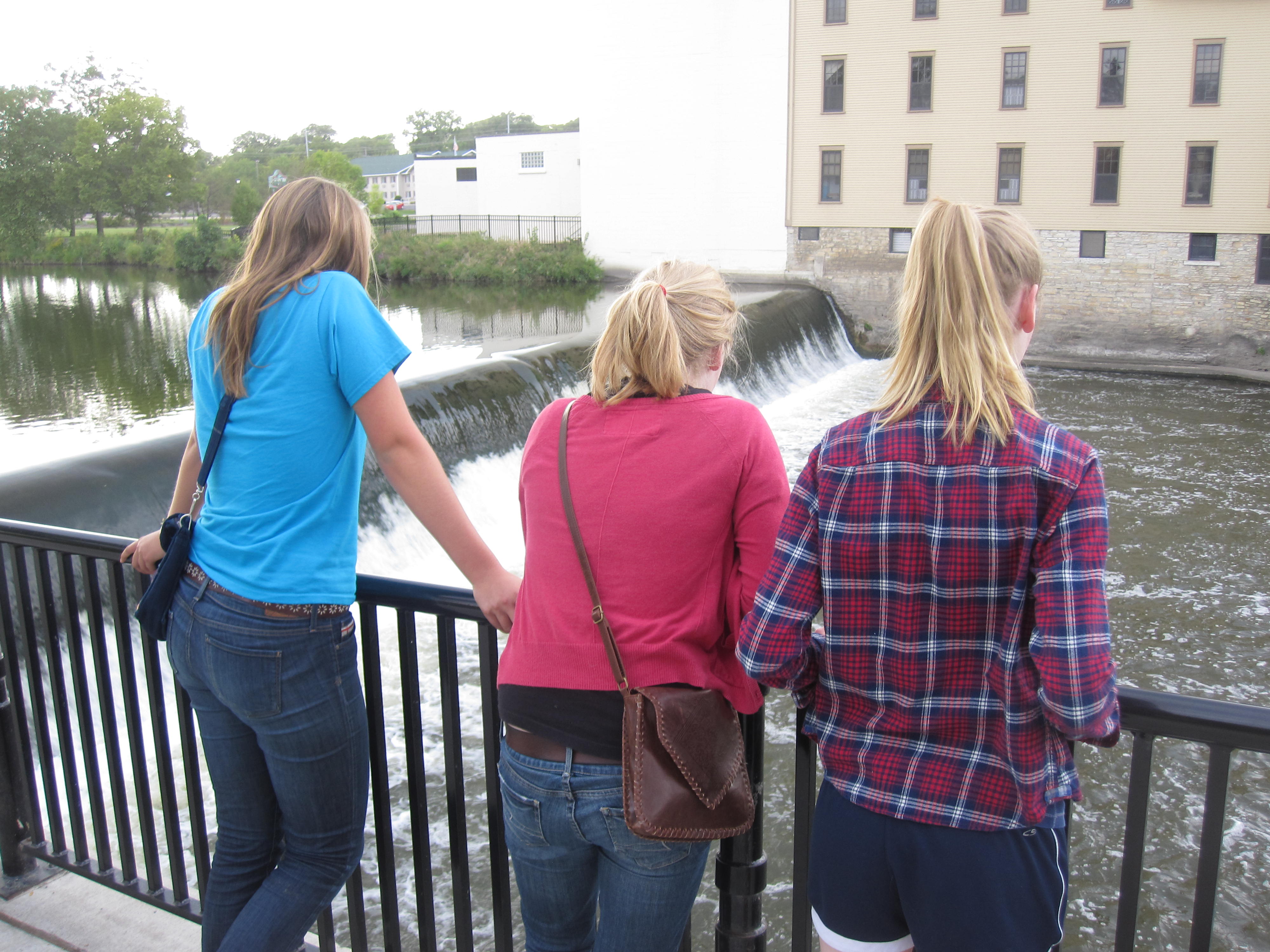
Left to Right. . . Two College Women and a High Schooler Ponder Their Future

Jonathan Franzen, Freedom

Best (and lengthiest) sentence I’ve read in a long time.

When Seth, at a dinner party, mentioned Patty for the third or fourth time, Merrie went noveau red in the face and declared that there was no larger consciousness, no solidarity, no political substance, no fungible structure, no true communitarianism in Patty Berglund’s supposed neighborliness, it was all just regressive housewifely bullshit, and, in Merrie’s opinion, if you were to scratch below the nicey-nice surface you might be surprised to find something rather selfish and hard and competitive and Reaganite in Patty; it was obvious that the only things that mattered to her were her children and her house—not her neighbors, not the poor, not her country, not her parents, not even her own husband.

I did not read The Corrections, but may have to now. Franzen is pure genius at capturing interpersonal conflicts based upon class differences and contrasting world views.

I highly recommend Freedom.

Libertarian Cubism

Ever seen a plexiglass smoke cubicle in an international airport? Tiny with a few stools around a high table. Need a smoke? No need to leave the airport, just pop into a smoke cube and spark up. Sparking up is not really necessary though because you can easily get your nicotine fix just by breathing in the Cheech and Chong second hand cloud. Visibility is about a foot so you have to look very closely to see anyone. I can’t fathom sitting next to a smoke cuber in coach on an international flight.

Smoke cubes are an interesting libertarian solution to individual differences. In essence, airport officials are saying, “Go crazy smokers with .01% of the airport.” Apart from higher group health care costs, why should government limit people’s freedom to fill their lungs with carcinogens, suffer more health problems, and probably die prematurely?

Maybe we should embrace libertarian cubism and extend their use. For example, in the Pacific Northwest we could use some “the weather is depressing” cubes for people like Y-guy who I heard complaining vociferously this morning, the first cloudy/rainy day in recent memory. Pacific Northwest summers are idyllic, sunny and in the 70’s, but some people like Y-guy never get enough vitamin D and consequently suffer from perpetual Seasonal Affective Disorder. The chronically SAD. This morning Y-guy tried to put a damper on my life-giving swim workout by proclaiming, “Hell, it will probably rain for the next 11 months!”

Just as Y-guy should be free to smoke, he should be free to be a walking, talking, downward spiral of negativity and pessimism. I just don’t want to be subjected to his depressing monologue. What if we had a “weather is depressing” cube in the Y locker room for Y-guy and his equally depressing friends?

What other examples of libertarian cubism would you like to see introduced in your neighborhoods, workplaces, and surrounding environs?