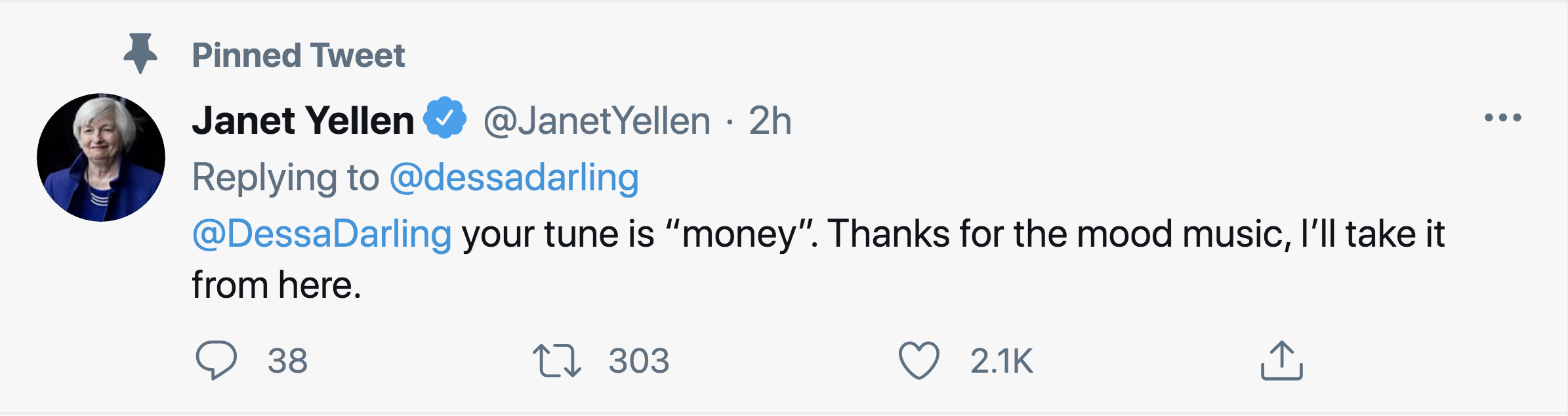
Suck It, Wall Street

The title of the best GameStop crowd-squeeze story I’ve read thus far. By Matt Taibbi. Taibbi skewers the monied class for their blatant hypocrisy, describing the week’s events as. . .

“. . . an updated and superior version of Occupy Wall Street.”

On the hypocrisy:

“The only thing ‘dangerous’ about a gang of Reddit investors blowing up hedge funds is that some of us reading about it might die of laughter. That bit about investigating this as a ‘pump and dump scheme’ to push prices away from their ‘fundamental value’ is particularly hilarious. What does the Washington Post think the entire stock market is, in the bailout age?”

Taibbi’s short and sweet tutorial on the week’s events:

“Furthermore, everybody ‘understands’ what happened with GameStop. Unlike some other Wall Street stories, this one isn’t complicated. The entire tale, in a nutshell, goes like this. One group of gamblers announced, ‘Fuck you!’ Another group announced back: ‘No, fuck YOU!’

That’s it. Or, as one market analyst put it to me this morning, ‘A bunch of guys made a bet, got killed, then doubled and tripled down and got killed even more.'”

On why Taibbi’s siding with the Redditors:

“They’ve seen first that our markets are basically fake, set up to artificially accelerate the wealth divide, and not in their favor. Secondly they see that the stock market, like the ballot box, remains one of the only places where sheer numbers still matter more than capital or connections. And they’re piling on, and it’s delicious, not so much because they’re right, but because the people running for cover are so wrong, and still can’t admit it.

Buy the ticket, take the ride, nitwits. If you earned anything, it’s this.”

Tuesday Required Reading and Viewing

1. Bet you can’t guess the top global health story of 2020.

2. Bet you can’t guess the ‘secret’ to longevity.

3. Bluetits and Bluebells: Essex’s open water swimmers – a photo essay. Remember, I don’t write the headlines, I just share them.

4. It’s not that hard to buy nothing. After reading the top comments, a suggestion. Dear wealthy people, advertise your minimalism at your own risk. The non-wealthy are (still) not having it.

5. The future of electric cars. This really good ‘free’ advice proves you don’t always get what you pay for.

Let The Ultra-Rich And Influential Skip The Line For Covid-19 Vaccines

“Donations would come from five tiers. For each tier, the mechanism is the same. People (or businesses on behalf of their people), donate money to get to the front of the Covid-19 vaccine line. There are limited available slots and getting the vaccine must be publicly documented so others can be motivated by these influential figures.

In the first tier, 100 of the wealthiest Americans each donate $100 million to be first in line for a vaccine, getting it within the first weeks of availability. This raises $10 billion.

In the second tier, 1,000 people each donate $10 million to get vaccinated within the first month. This raises another $10 billion.

You can see where this is going: The third tier requires a $1 million contribution for up to 10,000 people. The fourth, $100,000 for up to 100,000 people. The fifth and final tier requires a $25,000 donation from up to 400,000 people. Everyone participating in the program is vaccinated within the first two months of vaccine availability. The bigger the donation, the further toward the front one goes.

All told, this raises $50 billion for the cause by vaccinating just 511,000 people.”

Levine goes on to say he doesn’t “pretend to know the optimal ways to spend this money,” but knows there are a lot of places it can help, ultimately arguing “it can help get past the multitude of barriers to vaccine access, big and small, that exist in the U.S.”

Levine is a bold, clear-headed thinker, but damn, are we really ready to throw the towel in on the (dis)United States being a tax payer funded democracy that aspires to greater equality? Is social mobility so anemic we’re ready to officially acknowledge we’re more of an aristocracy than a democracy?  Are people ready to drive on the Jeff Bezos Highway and live in Apple Incorporated affordable housing?

I’m definitely not ready to throw in the towel on our longstanding democratic ideals, but I can’t disagree with Levine about this:

“My proposal is neither conservative or liberal — or it can be portrayed as both. For conservatives, it is a free-market solution: People and businesses are making a choice on how they use their money. Liberals can view it as a wealth tax: People who can afford it pay for early access to a vaccine and, in doing so, pay for others to get vaccinated. I believe that the concept is inherently nonpolitical. Instead it is a solutions-oriented approach to concerns that have been raised about U.S. vaccination programs.”

How To Stay Together

My amazing playwriting aside, the Jeff Bezos/MacKenzie Scott divorce is an illuminating tale for people committing to one another for the long haul.

The conventional wisdom is that a lack of money and related money fights explain why so many relationships fail. That’s certainly true, but not the whole story. Even people with money can have devastating money disagreements because everyone has a unique money history and no two people will ever think about it the same way.

The bottom line. Couples don’t explore their “money compatibility” nearly carefully enough in the early stages of their relationships. The key is to figure out whether you and your partner are more similar in your thinking about saving, spending, gifting, and investing than not. No, that’s not particularly sexy, but do you want to measure your relationship by decades or not?

One little complication, by which I mean, huge complication. People change over time. Maybe MacKenzie didn’t know Jeff wanted to be the richest person in the world because he may not have wanted to be until his first or one hundredth billion.

What to do about the unknown? Anticipate that your thinking about money will change over time, not radically, but moderately. Similarly, anticipate that your partner’s thinking will change too. Meaning “money compatibility” is always a work-in-progress. Talk about saving, spending, gifting, and investing with some regularity or run the risk of serious differences creating dangerous cracks in the foundation of your relationship.

A One Act Play

The setting: Jeff Bezos’s and MacKenzie Scott’s Medina, WA kitchen. After working together to make Kraft macaroni and cheese with hot dogs, they serve themselves, grab two cans of Mountain Dew, and sit down at their formica dinner table. It’s one of their last dinners together as a married couple. A few days following this meal, they decide to pull the plug on their marriage. 

Jeff: Mac and cheese with dogs never gets old. [laughs uncontrollably] 

MacKenzie: No, it doesn’t. [inner voice. . . but your laugh has sure started to] 

Jeff: What did you do today?

MacKenzie: I spent most of it journaling. Which helped me realize I don’t want to help you turn Amazon into the world’s retail store anymore. I think $182 billion is enough money. I want to make the world a better place through writing and giving my share of our money away.

[All the while, Jeff texts Lauren Sanchez under the table.]

MacKenzie: [Softly, sadly, and with a deep sense of resignation.] Did you hear me?

Jeff: Yes, you said you want to help me make Amazon into the world’s retail store. 

[MacKenzie stares at Jeff in silence]

Jeff: [Head in his lap.] Can you pass the applesauce? 


My Person Of The Year

A New York Times primer for anyone who doesn’t know MacKenzie Scott, the eighteenth wealthiest person in the world.

“Ms. Scott, who was formerly married to the Amazon founder Jeff Bezos, the world’s richest person, has pledged to give away most of her wealth. Her shares in Amazon were valued at about $38 billion last year but would have gained value during the coronavirus pandemic.”

Scott isn’t letting the pandemic stop her from making true on her pledge. Quite the opposite. Last week she revealed she was “the one behind the donations to dozens of colleges and universities, part of nearly $4.2 billion she had given to 384 organizations in the last four months.”

As impressive as the amount Scott’s given away is is how her team did it.

“The money came after weeks or months of hush-hush conversations in which Ms. Scott’s representatives reached out to college presidents to interview them about their missions, several of the presidents said on Wednesday. When they learned who was behind the effort, it was a surprise to them, too. But it could not have come at a better time — when the pandemic was hitting their student bodies hard, they said.

‘I was stunned,’ Ruth Simmons, president of Prairie View A&M University, a historically Black college in Prairie View, Texas, said of learning that Ms. Scott was giving $50 million, the biggest gift the university had ever received. She thought she had misheard and the caller had to repeat the number: ‘five-zero.'”

Scott is the antithesis of most ultra wealthy philanthropists who almost always give to their alma maters, most of which are already flush with nine or ten figure endowments.

“Ms. Scott’s latest gifts bring her charity to almost $6 billion this year, an extraordinary amount. In another unorthodox touch, she announced them in a Medium post on Tuesday. ‘This pandemic has been a wrecking ball in the lives of Americans already struggling,’ she wrote. ‘Economic losses and health outcomes alike have been worse for women, for people of color, and for people living in poverty.'”

Experts on philanthropy were surprised to see Scott associate herself with institutions that were “much more humble and, indeed, needy.”

“To these institutions, a $20 million donation was the equivalent of several times that to a Harvard or Yale, and could have a disproportionate impact.

‘One of the things that’s so incredible about this massive grouping of gifts is that she does not have a personal connection to most, if any, of these universities,’ said Kestrel Linder, chief executive of GiveCampus, a fund-raising platform that works with colleges and universities.

Ms. Scott made gifts to more than a dozen historically Black colleges and universities, as well as community and technical colleges and schools serving Native Americans, women, urban and rural students.”

Dare to be different. And hella generous.

Seattle Leans A Little Left

Moderate Democrats are splitting with more radical leftists on Seattle’s plans to give misdemeanor suspects a pass for crimes committed to meet a basic need.

Jason Rantz, right wing radio host tells a precautionary story. Seattle CM called police she defunded to report crime she is effectively legalizing.

I guess I’m a moderate Democrat since I find the proposed legislation problematic for the reasons Rantz explains. However, since we already imprison a larger proportion of citizens than any other country, we know Rantz’s solution of locking up more people will do nothing to reduce crime or improve Seattleites’ quality of life. Because criminals aren’t rational. They don’t plan on being caught, and therefore, don’t ponder the odds of going to prison.

We also now know we can’t afford our prison population if we want balanced state budgets. I wish I could direct a larger proportion of my city, county, and state sales taxes to mental health and substance abuse treatment.

That still leaves the question of what to do with all the criminals of sound mind who commit property crimes and other misdemeanors. On that, I’ll defer to experts to propose smarter, more viable alternatives to prison.