
Let The Ultra-Rich And Influential Skip The Line For Covid-19 Vaccines

“Donations would come from five tiers. For each tier, the mechanism is the same. People (or businesses on behalf of their people), donate money to get to the front of the Covid-19 vaccine line. There are limited available slots and getting the vaccine must be publicly documented so others can be motivated by these influential figures.

In the first tier, 100 of the wealthiest Americans each donate $100 million to be first in line for a vaccine, getting it within the first weeks of availability. This raises $10 billion.

In the second tier, 1,000 people each donate $10 million to get vaccinated within the first month. This raises another $10 billion.

You can see where this is going: The third tier requires a $1 million contribution for up to 10,000 people. The fourth, $100,000 for up to 100,000 people. The fifth and final tier requires a $25,000 donation from up to 400,000 people. Everyone participating in the program is vaccinated within the first two months of vaccine availability. The bigger the donation, the further toward the front one goes.

All told, this raises $50 billion for the cause by vaccinating just 511,000 people.”

Levine goes on to say he doesn’t “pretend to know the optimal ways to spend this money,” but knows there are a lot of places it can help, ultimately arguing “it can help get past the multitude of barriers to vaccine access, big and small, that exist in the U.S.”

Levine is a bold, clear-headed thinker, but damn, are we really ready to throw the towel in on the (dis)United States being a tax payer funded democracy that aspires to greater equality? Is social mobility so anemic we’re ready to officially acknowledge we’re more of an aristocracy than a democracy?  Are people ready to drive on the Jeff Bezos Highway and live in Apple Incorporated affordable housing?

I’m definitely not ready to throw in the towel on our longstanding democratic ideals, but I can’t disagree with Levine about this:

“My proposal is neither conservative or liberal — or it can be portrayed as both. For conservatives, it is a free-market solution: People and businesses are making a choice on how they use their money. Liberals can view it as a wealth tax: People who can afford it pay for early access to a vaccine and, in doing so, pay for others to get vaccinated. I believe that the concept is inherently nonpolitical. Instead it is a solutions-oriented approach to concerns that have been raised about U.S. vaccination programs.”
Just What We Need

Senior Trump advisers prepare to launch policy group.

White House domestic policy adviser Brooke Rollins and National Economic Council Director Larry Kudlow are preparing to launch a nonprofit group to promote the president’s policies once he leaves office.

“The group, Rollins said, would promote the ‘legacy and consequences of this president’ and ensure ‘those ideas continue and are defended whether in one month or in four years from now.’”

What part of the legacy and consequences? The narcissism? The total disregard for the truth? The self-pitying and destruction of democratic traditions? The gross mismanagement of a devastating public health crisis? The demonizing of Democratic governors and mayors? The incessant talk of infrastructure? The dismantling of foreign alliances?

“’We’re really excited about it, we think it’s going to be a juggernaut,’” Rollins added.

Is juggernaut a fancy word for joke?

Seattle Leans A Little Left

Moderate Democrats are splitting with more radical leftists on Seattle’s plans to give misdemeanor suspects a pass for crimes committed to meet a basic need.

Jason Rantz, right wing radio host tells a precautionary story. Seattle CM called police she defunded to report crime she is effectively legalizing.

I guess I’m a moderate Democrat since I find the proposed legislation problematic for the reasons Rantz explains. However, since we already imprison a larger proportion of citizens than any other country, we know Rantz’s solution of locking up more people will do nothing to reduce crime or improve Seattleites’ quality of life. Because criminals aren’t rational. They don’t plan on being caught, and therefore, don’t ponder the odds of going to prison.

We also now know we can’t afford our prison population if we want balanced state budgets. I wish I could direct a larger proportion of my city, county, and state sales taxes to mental health and substance abuse treatment.

That still leaves the question of what to do with all the criminals of sound mind who commit property crimes and other misdemeanors. On that, I’ll defer to experts to propose smarter, more viable alternatives to prison.

Obama’s Disappointing Return

“Moderate mush” appears to be the essence of Lili Loofbourow’s argument in her Slate piece titled “Barack Obama Sat Out the Past Four Years and It Shows”.

“But in these recent appearances, the most surprising thing might be that his political remarks about this moment feel stale. Maybe his absence from the fray over these past four years has cost him. Maybe he’s using a different timescale to measure progress (as he sometimes explicitly says he is). But even his harshest remarks about the right don’t capture the hysterical party we’re watching try to steal an election. His recent criticisms of ‘snappy’ leftist political slogans like ‘defund the police’ reflect an abiding faith in a theory of politics that seems passé—as several Black intellectuals and activists have pointed out. Boiled down to its essentials, Obama’s argument is that one shouldn’t ‘alienate’ people who might be converted to your cause if you say things in just the right way. In practice, that means tucking the political self into a package that a ‘reasonable person’—that usefully unmeasurable political fiction—cannot help but find acceptable and persuasive.”

Loofbourow doesn’t like his music either.

“Obama’s commitment to not alienating people is fascinating to the precise extent that it becomes a principle in its own right. It explains, I think, why there’s something so mystifyingly generic about his self-presentation when you take him out of the right-wing fever swamp. His music selections could be a Starbucks album, they’re so mainstream. Asked what someone should read to understand this bizarre, unprecedented moment in contemporary America, he recommends the fresh unplumbed perspectives of de Tocqueville and Thoreau. In other words: Obama sat the last four years out and it shows. He might be appearing on ‘Snapchat political shows,’ but his ability to adapt to new media forms does not extend to his political thinking. He isn’t bringing new tools or interpretations to the table and he seems to be overlooking the extent to which older tools do not work.

Okay, let’s concede LL’s point, the historical moment has passed Obama by. But why then, does she end this way?

“Obama stayed away during the Trump years. Maybe he deemed it tactically wise. Maybe he was tired. Maybe he wanted to work on his foundation. But we could have used him during these four awful years.”

Loofbourow earns lots of points for critiquing a political icon, but I’m also deducting a few for a lack of internal consistency.

90 Year Old Legislators

A story, compliments of The New Yorker’s Jane Mayer:

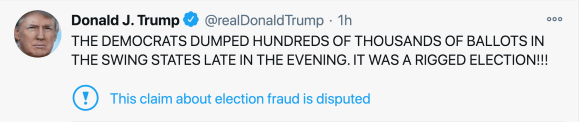
“In a hearing on November 17th, Dianne Feinstein, the senior Democrat on the Senate Judiciary Committee, who, at eighty-seven, is the oldest member of the Senate, grilled a witness. Reading from a sheaf of prepared papers, she asked Jack Dorsey, the C.E.O. of Twitter, whether his company was doing enough to stem the spread of disinformation. Elaborating, she read in full a tweet that President Trump had disseminated on November 7th, falsely claiming to have won the Presidential election. She then asked Dorsey if Twitter’s labelling of the tweet as disputed had adequately alerted readers that it was a bald lie.

It was a good question. Feinstein seemed sharp and focussed. For decades, she has been the epitome of a female trailblazer in Washington, always hyper-prepared. But this time, after Dorsey responded, Feinstein asked him the same question again, reading it word for word, along with the Trump tweet. Her inflection was eerily identical. Feinstein looked and sounded just as authoritative, seemingly registering no awareness that she was repeating herself verbatim. Dorsey graciously answered the question all over again.”

If that’s not concerning enough, how ’bout this:

“Schumer had several serious and painful talks with Feinstein, according to well-informed sources. Overtures were also made to enlist the help of Feinstein’s husband, Richard Blum. Feinstein, meanwhile, was surprised and upset by Schumer’s message. He had wanted her to step aside on her own terms, with her dignity intact, but “she wasn’t really all that aware of the extent to which she’d been compromised,” one well-informed Senate source told me. “It was hurtful and distressing to have it pointed out.” Compounding the problem, Feinstein seemed to forget about the conversations soon after they talked, so Schumer had to confront her again. “It was like Groundhog Day, but with the pain fresh each time.”

What the hell is going on? Why did Californians elect an 87-year old for a six year term? Was it because there wasn’t anyone a little younger and of sounder mind? And as Mayer makes clear, it’s not just California. Other citizens in other states are doing the same thing.

Thursday Required Reading

1A. The Resentment That Never Sleeps. Rising anxiety over declining social status tells us a lot about how we got here and where we’re going.

1B. Why So Many Men Stuck With Trump In 2020.

Sociology y’all.

Given your intellectual nature, no doubt you need more reading, but take your time with 1A in particular with its numerous substantive links. And seeing that you haven’t submitted it yet, I suspect your EDUC 205 exam is still a work-in-progress. 

Laugh To Keep From Crying

Alternative title, “The Truth is Stranger Than Fiction”.

Unless you’re a MAGA True Believer, it’s impossible to read this Politico piece, “‘Every Day Was Like a “Veep” Episode’: The Veepiest Moments of the Trump Era” without at least smiling if not laughing out loud.

Nice framing:

“When House of Cards debuted on Netflix in 2013, Americans were shocked and a little thrilled to imagine that its sharp, murderous plotlines might reflect the real Washington—a sinister place where calculating, ruthlessly effective pols achieved their dreams by shoving reporters in front of Metro cars. But the people who actually work in D.C. were quick to log a correction: The day-to-day experience of politics in the nation’s capital is really much more like HBO’s Veep—a constant near-train wreck of bumbling, improvisation and profanity.

Presidents have generally succeeded in keeping that aspect of the job well-hidden, managing to project an image of executive competence no matter how absurd the backstage dynamics.

And then came Donald Trump.”

The anecdotes are especially funny, if like me, you savored every episode of HBO’s Veep staring Julia  Louis-Dreyfus. Who I’ve had a thing for ever since Seinfeld. Please don’t tell the Good Wife. 

Good Luck With That

Mr. President, Sir, It’s Time to Do What’s Best for the Country by Resigning and Never Speaking Again.

Great last paragraph:

“Detractors may point out that we have called on Donald Trump to resign four times this year already and that it won’t work because he doesn’t read Slate and is not a fan of the ‘ideas journalism’ sector in general. Those detractors are traitors to the United States and President Pence should arrest them.”