Disappointingly, 30 years ago, I wasn’t invited to this party. No grudge. Just hoping against hope I get invited to a few 2021 variations of it.
Category Archives: Spirituality
Prince’s Creative Genius
Christianity Post Covid-19
Luo contrasts the early Christians’ courageous and inspiring collective witness during pandemics with the contemporary Church’s Covid-19 response.
“For years, the church in America has been in retreat, in cultural influence and in numbers. According to a survey by the Pew Research Center, in 2019, sixty-five per cent of Americans identified as Christians, down twelve per cent from the previous decade; meanwhile, the numbers of the religiously unaffiliated have grown to twenty-six per cent. The co-opting of white evangelicalism by Republican politics helps to explain the confrontational attitude of conservative Christians, but so does the fear of many believers that they are losing their place in a secularizing America. A pluralistic society needs to insure that people of faith, as well as those without any faith, have a role in the public square. But the defiance of the church during the pandemic has come with a cost. The pandemic in 2020 has held a mirror to Christianity, just as the epidemics of antiquity did, but today’s reflection carries the potential to repulse rather than attract. Once the vaccine is widely distributed next year, the church, along with the rest of society, will begin to move on. Yet the world will not be as it was. Churches will have to reckon not only with whether their congregants will return in person, but with how much their collective witness––the term Christians use to describe their ability to point to Jesus in their lives––may have been diminished.”
Another ‘Rona Silver Lining
People are learning maybe ‘less is more’ isn’t a mindless cliché. Maybe less long distance travel, means more appreciation for one’s local ecology. Maybe less cluttered calendars and fewer obligatory activities, means more stillness and thinking and personal change. In that spirit, maybe less concern for outward appearances, means more self acceptance. And maybe less certainty about one’s health, means more appreciation for one’s health.
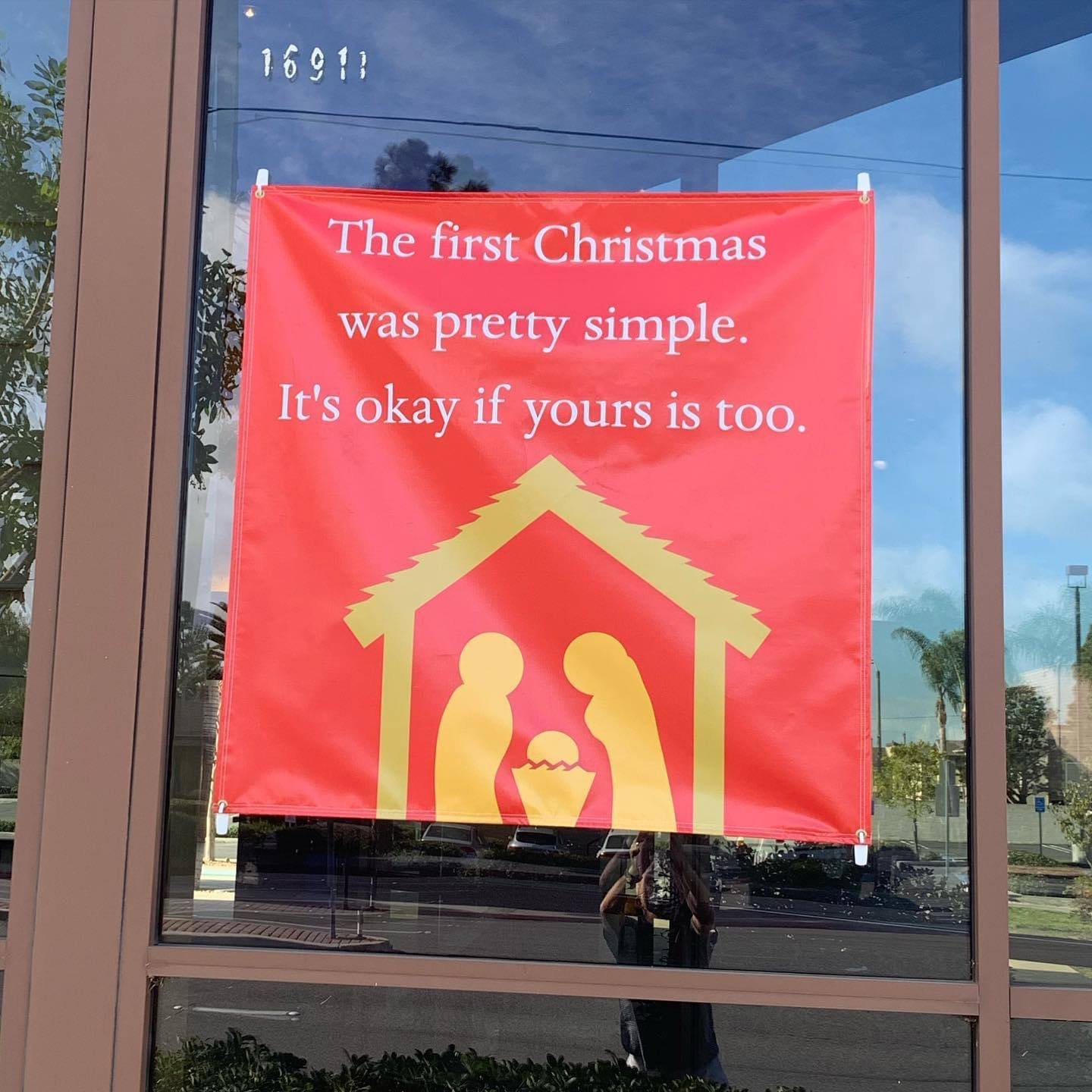
A pastor friend created this Christmas banner for his church this year. I hope he displays it for many more to come.

There’s an exception to every rule, as the Los Angeles Lakers’ new diamond encrusted championship ring, poignantly illustrates.

Oregon’s Salmonberry Trail
Maradona Counterpoint
Argentina’s Juan Manuel Rótulo sees things differently than Australia’s Will Swanton.
Diego Maradona, Argentina’s Hero, and Mine.
Who wants to design an interdisciplinary curriculum tentatively titled “Contrasting Perspectives on Maradona’s Legacy” with me? Touch points. . . The Falklands War, the Argentine economic crisis, the sociology of soccer, the 1986 World Cup, Maradona’s off-field demons, Latin American politics, and maybe some southern Italy organized crime for good measure.
Or maybe a novel. Then a Hollywood bidding war for the film rights.
The Trump Quandary
We desperately need to pivot from Donald Trump and Dan Barry is here to help. If I could only share one article on Donald Trump with some person in the future curious about the Trump Era, it would be Barry’s from today’s New York Times, “‘Loser’: How a Lifelong Fear Bookended Trump’s Presidency“.
It’s not angry or mean, it’s thorough, thoughtful, and explanatory without succumbing to rampant psychological speculation. Barry doesn’t inflame and doesn’t even analyze Trump as much as he describes what has happened, or more accurately, is still happening.
I could excerpt most of it, but in case you’ve already exceeded your recommended daily calories, here’s just a taste:
“. . . his famous aversion to the label of loser has now reached its apotheosis.
Since Joseph R. Biden Jr. was declared the winner of the Nov. 3 election — and Mr. Trump therefore declared the loser — the president has repeatedly trafficked in baseless allegations of a fraudulent and corrupt electoral process. What was once considered the quirky trait of a self-involved New York developer has become an international embarrassment, nearly upending the sacred transition of power and leaving the world’s foremost democracy — grappling with a deadly pandemic and a teetering economy — with a leader who refuses to concede despite the basic math.
‘AND I WON THE ELECTION,’ Mr. Trump tweeted last week. ‘VOTER FRAUD ALL OVER THE COUNTRY.'”
We’re in a quandary. We need to move on from DT for the sake of our own mental health and our relationships with our conservative friends, but we also need to remember the past.
It’s not psychological speculation to assert that Trump’s preoccupation with winning is his dad’s fault. Pay attention to the stories from his childhood. When I do that, I feel extremely sorry for him. He never stood a chance.
I suppose, like many people approaching sixty, I now realize internal, personal contentment is preferable to any exterior notions of life success.
More specifically, I now realize you can’t beat me in anything if I refuse to compete with you. Knock yourself out winner. I’ll be seeking contentment, quietly, outside of your view.
I’m profoundly thankful on this day that my dad was Donald J. Byrnes and not Fred Trump.
Weekend Required Reading
1. Running a two-hour marathon. Strong opening:
“Here’s a quick and convenient way of finding out whether you’re ready to run a two-hour marathon. Head to the track and run six laps (roughly 1.5 miles) at two-hour pace (4:34.6 per mile), then run one more lap as fast as you can. Have a nearby exercise physiologist fit you with a portable oxygen-measuring mask, to measure your energy consumption at that pace. Then crunch the data to see whether your metabolism is settling into a sustainable pattern, or whether it’s spiraling out of control toward a fiery explosion.”
2. A female high schooler ran a 2:31:49 marathon. Leaving my brother disgusted with her parents.
3. Florida man becomes first person with Down syndrome to finish Ironman triathlon. Incredibly impressive, especially at 21 years young.
“Inclusion for all of us with all of you.”
4. The heartbreaking reality — and staggering numbers — of NCAA teams cut during the pandemic. Damn invisible enemy. Meanwhile, this week I was very pleasantly surprised to see an Olympia High School senior sign to play Beach Volleyball at Stanford. Take that SoCal!
5. And because we can’t live on swimming, cycling, and running alone, Mark Bittman’s Master List of Interchangeable Ingredients.
Today’s Lecture Notes
In her last paper, a classmate of yours wrote, “From being isolated, I have transitioned from thinking ‘is my work good enough’ to ‘am I good enough’.”
- Everyone honest sometimes question whether they’re good enough. You are good enough whether you’re capable of doing your best work right now or not. The importance of your life dwarfs the importance of your academic performance this semester.
- Things are going to get better, and regardless of your grade point average, you’re going to make a positive difference in people’s lives.
- We can’t improve our mental health without other’s help. The hardest thing to do is the most important. Asking for help.
How Long Will We Slight The Social-Emotional Costs Of On-Line Learning?
Thursday, First Year Writing, The Morken Building 131, the first in-person class of the academic year. Students take turns summarizing their first papers about whether one needs, as a Stoic philosopher we read argues, a coherent philosophy of life and a “grand goal of living” to avoid squandering one’s life. They’re smart, so they push back at the suggestion one can neatly plan their life. They talk about some things being outside of our control, like viruses.
If not a coherent philosophy of life, what about guiding principles I wonder. And if so, which ones? They’re not quite ready for subtly, nuance, ambiguity, complexity. That’s why college is four years long. For now at least, I keep those thoughts to myself and just listen.
One student says her mother died in February. Not expecting that, I loose track of what follows, wondering how she died and what would it be like to lose your mom at 17 or 18. She says doing well in school doesn’t matter as much as it did previously.
The students, many who say they struggle with anxiety, have never enjoyed going to class more. Not because of the doofus facilitating things, because they’re famished for friendship. Flat out famished. They linger afterwards, partly to disinfect the tables, but mostly to extend our shared sense of normalcy as long as possible.
The student whose mother died walks up to the front to talk to me. Through my mask I thank her for having the courage to share that news and gently inquire about her mother’s passing. She tells me her mother chose “Death With Dignity” after a lifetime of being severely disabled. And she wanted me to know the paper was really challenging to write, but my sense was, not in a bad way, in an important way. I think it caused her to grieve her mother in a way she hadn’t. She ended up writing her mother a letter and using parts of it to begin her paper.
For those few moments, as her classmates slowly filed out of the room in small groups, she and I shared a human connection that superseded our teacher-student identities. I saw her and heard her in a way that’s utterly impossible on-line.
I am all in on the scientific consensus regarding masks, social distancing, maximizing time outdoors, and washing hands. I am comfortable enough returning to the classroom because my university has done an excellent job preparing for as safe as possible a return to in-person classes. I will not help politicize this public health crisis.
What follows is a non-partisan question, my reference point is the social-emotional health of young people.
If we don’t begin implementing “blended” or “hybrid” teaching methods soon, with at least some in-person instruction, what are the social and emotional costs to friendless students who are not being seen or heard in any kind of meaningful way?