“In towns like mine, outsourcing and automation consumed jobs. Then purpose. Then people. Now the same forces are climbing the economic ladder. Yet Washington remains fixated on global competition and growth, as if new work will always appear to replace what’s been lost. Maybe it will. But given A.I.’s rapacity, it seems far more likely that it won’t. If our leaders fail to prepare, the silence that once followed the closing of factory doors will spread through office parks and home offices — and the grief long borne by the working class may soon be borne by us all.”
My “friends” like to bust my chops for buying and selling cars too often. And yet, they give me no credit for my seven year old iPhone. The whole lot, consistently inconsistent.
One of my besties visited last week from CA. While in the kitchen, he glanced at my ancient iPhone XS Max on the counter, smiled, make that laughed, and asked, “Do you still keep it in a tube sock?”
“What the hell are you talking about?”
“When you first got it, you used to keep it in a tube sock!” followed by more guffawing.
Damn if I hadn’t repressed that memory. It started to come back. Walking into Department meetings slinging a tube sock on the table next to me. Too bad I can’t rewind that tape. Had to have been the phone before the ancient phone and I vaguely remember waiting on a proper cover. Still, hard to live that down. Damn his very good memory.
I just watched a vid of tips and tricks to customize the brand new IOS 26. Only one problem, IOS 26 only works on 11s forward. Tim Apple, what are you doin’ to me, a longtime investor?
Yeah, it’s probably time to upgrade, but I don’t like being pushed. I wanna jump into the new tech pool of my own volition.
The AirPod Pro 3 reviews are smashin’. I will get those despite the 2’s still being fine. The bonus being that will give my “friends” more fodder.
“Ryan Rzepecki, 44, said his Vision Pro has replaced his TV and laptop for watching movies.
‘It’s the best media player,’ he said, adding that he and his wife also have different show preferences. Same for Chad Christian, 50, who has been putting on the headset to watch movies while on his Peloton bike.
And yes, everyone I spoke to was a male between the ages of 30 to 50. Vision Bro, indeed.”
Everything exists on a continuum. For example, while running down San Vicente Blvd in Santa Monica last week I marveled at the amount of money a fair number of West Los Angelenos spend on cars. Why do they do that I wondered? I concluded, rightly or wrongly, it was because they’re vain. Porsche, Mercedes, and Range Rover make bank on people’s vanity.
Just as I was starting to feel really superior I caught myself. Glancing at my watch, I saw my average pace for the run was 9 minutes and some seconds. Prompting me to pick up the pace in order to avoid uploading a 9 minute per mile run to Strava.* Why you’re asking yourself. See above paragraph. Granted, more subtle and nuanced, but same concept. The only difference, the degree of vanity.
What does this have to do with Apple’s new Vision Pro you’re wondering. Well, I’m here to connect those seemingly disparate dots.
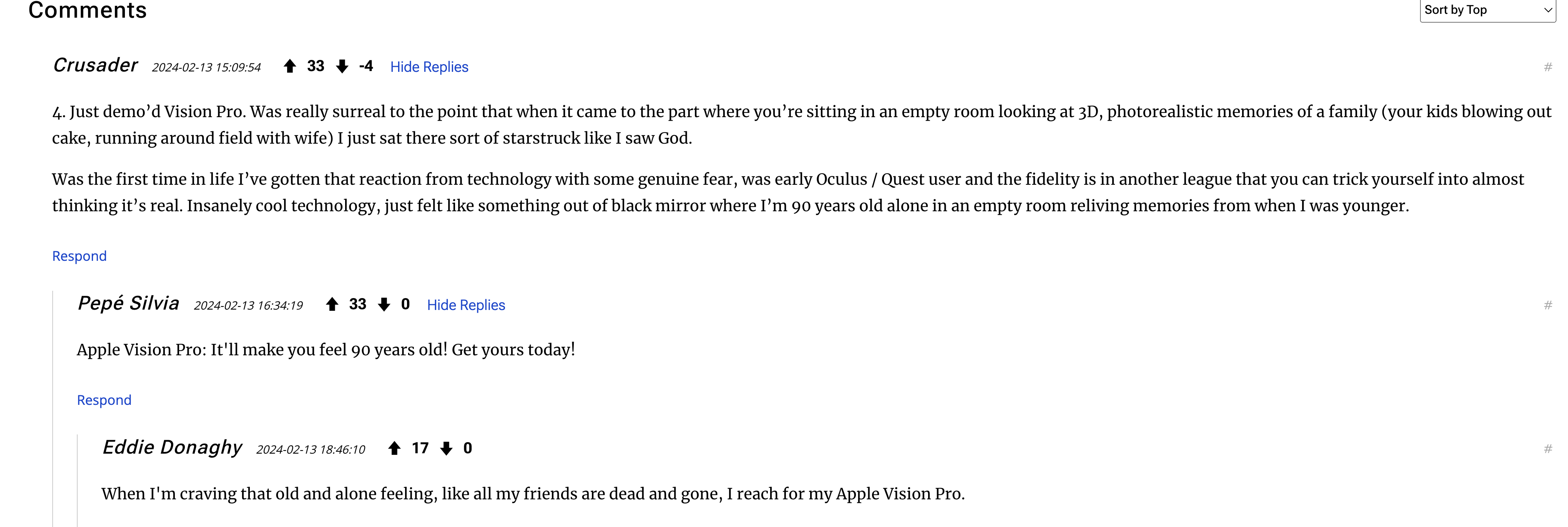
Maybe the mostly likely reaction to the Vision Pro is to fear for a future where tech laden introversion obliterates interpersonal relations even further. But when I walk into the Plum Street Y weight room almost everyone is already listening to their own music and/or podcasts making spontaneous meetings and convo highly unlikely. Including me.** Same on subways and lots of other public spaces. People are already using smart phones, head phones, and related personal tech to tune out the outside world, including the people they are damn near rubbing elbows with.
Steve likes to talk to me whenever he sees me at the pool or in the weight room. In the weight room, when I see him approaching, I pop out one of my AirPods. Easy-peasy. This is what came to mind when watching this Casey Neistat’s review of the Vision Pro.
Just watch from the 7+ minute mark. The first seven minutes are ridiculous, dystopian, depressing, pick your most negative adjective. But let’s do what Casey does at the end of his review and fast forward to a future where Vision Pro-like products are way way lighter, less obtrusive, and less dorky.
Something like eye glasses that morph into sun glasses in the sun seems likely. It would be easy to sit alone on a bench in New York City and switch seamlessly from being alone in your own multimedia world and then either resting the glasses on top of your head or letting them dangle around your neck whenever someone sits down next to you.
There’s no putting this personal tech toothpaste back in the tube, but my tribe, the introverts, will not roam the world alone, figuratively or literally. There will still be a normal distribution of extroverts. And we will still talk to one another even after the Vision Pro becomes semi-affordable and reaches critical mass.
Vain people will even continue expanding their circle of friends, and sometimes even fall in love, and sometimes even have children.
Vision Pro. John Gruber, of Daring Fireball, is the rare “Elements of Style” writer who says things simply and succinctly. Vision Pro’s importance is evident in what may be his longest post ever.
Quite literally, for AAPL investors, here’s the money paragraph.
“But I can recommend buying Vision Pro solely for use as a personal theater. I paid $5,000 for my 77-inch LG OLED TV a few years ago. Vision Pro offers a far more compelling experience (including far more compelling spatial surround sound). You’d look at my TV set and almost certainly agree that it’s a nice big TV. But watching movies in the Disney+ and TV apps will make you go “Wow!” These are experiences I never imagined I’d be able to have in my own home (or, say, while flying across the country in an airplane).”
Fast forwarding to Gruber’s final paragraphs:
“Spatial computing in VisionOS is the real deal. It’s a legit productivity computing platform right now, and it’s only going to get better. It sounds like hype, but I truly believe this is a landmark breakthrough like the 1984 Macintosh and the 2007 iPhone.
But if you were to try just one thing using Vision Pro — just one thing — it has to be watching a movie in the TV app, in theater mode. Try that, and no matter how skeptical you were beforehand about the Vision Pro’s price tag, your hand will start inching toward your wallet.”
If you know Gruber’s work, you know it’s not hype. However, the question Gruber and his fellow tech analysts never seem to get around to is whether it will improve our quality of life. Based on Gruber’s review, maybe it will if what’s keeping you from living a more fulfilling life is the unsatisfying quality of your home television and movie watching experience.
A few days ago I was cycling southbound on the Chehalis Western Trail (CWT), a gem of Thurston County public infrastructure. And thanks to attentive parents, I successfully dodged a few 3 year-oldish riders on those amazingly small bikes that darn near enable babies to ride home from the hospital under their own power.
And I wondered what would it be like to be three years-old, to live through the 21st Century and check out sometime in the 2100’s? On the surface, probably pretty great since technology and medical advances continue to amaze and you don’t have to go the Department of Motor Vehicles in person anymore. And some of us don’t have to go to gas stations. And global poverty is way down. And despite Fox News propaganda, crime is down. And despite serious income inequality and low savings rates, people can find jobs and the economy is resilient.
And yet.
I wouldn’t want to be my tiny CWT cycling friends because if I had to capture the current zeitgeist in one word it’s “sad”. Despite continuing substantive improvements to our quality of life, a critical mass of people in the (dis)United States seem, for lack of a better term, sad. Why is that?
And why don’t I know the answers to that. Does my multi-layered privilege blind me? Short answer, of course.
I don’t think I’ll beat myself up for not knowing, because as I tell my students, “It’s okay to not be okay. And it’s okay to be okay.” Still, I would like to better understand why you are sad or why people you know well are sad. Is it as simple as the rent is too damn high or is it climate anxiety or is the answer more abstract, philosophical, even spiritual?
If you accept my premise, that we’re in the grips of a wave of sadness that shows no signs of abating, please enlighten me as to why. Thank you in advance.
I knew there was real downside wading into the vax debate, but I didn’t expect a PressingPauser to spring into action with a reasoned rebuttal.
A decidedly non-knuckle head Pressing Pauser wrote to me, “This material cut and pasted below is from NPR on how long the protection lasts. You seem to have addressed only the mild symptom category, not the risk of severe responses. I see no suggestion that anyone should or would get this shot ‘every 2 months.’ As a renowned blogger with tremendous influence over many many readers (well, maybe a few), you should consider the fact that you and your ‘non-knucklehead recently retired doctor friend’ may have cherry picked a bit.
From NPR—How long will protection last?
“You’ll get a boost in immunity within about two weeks after getting the shot that could reduce your risk of coming down with COVID – and that protection will likely last for a few months. It should also make you more likely to get a more mild case if you do get sick.
The boost in protection against severe disease – the kind of scary symptoms that can send you to the hospital – should last a lot longer. Exactly how long depends on a variety of factors including your immune system, your health, your age and your prior exposures to both the vaccines and infections. But for many people, the hope is the COVID shots can be annual, like flu shots.
“It will markedly increase your protection against getting very sick for about a year or so,” says Dr. Robert Wachter, professor and chair of the Department of Medicine at the University of California San Francisco.”
The point is so well taken, I will in all likelihood get the new jab. Thanks to the reader for taking the time to deepen the discussion. That said, comparing me to Kyrie Irving was totally uncalled for. Except for the ball handling skills.


 Pressing Pause