What I Got Wrong About Professional Golf

I grew up playing golf.

My first job was parking golf carts and picking up range balls at Los Alamitos Golf Course. One benefit of that job was practicing and playing for free. The guy I played behind in high school, Mike Miles, is playing in the US Senior Open right now. Once, another teammate, who just happened to be wearing his golf shirt on an off-day, an act that required serious chutzpa in the pre-TWoods era, told our substitute teacher we had a match and had to leave our 11th grade English class early to warm up. That day we got a few extra holes of practice in on account of her naivete. Who knew at the time we’d both end up being college administrators.

Growing up I used to think that playing professionally would be la ultima. Traveling to exotic places, being on television, being pampered by tournament committees, making mad money, basically living large.

Fast forward to the US Open where I watched a new wave of rookies like Cheng Tsung Pan and Cameron Smith methodically go about their business. With their swing coaches, sports psychologists, nutritionists, and fitness trainers. Pan grew up in Taiwan, spent a chunk of his youth in a Florida golf academy, and starred at the University of Washington. Smith is a 21 year-old Australian who finished fourth after nearly making a “2” on the par 5 18th. On the practice range their ball flight is so consistent it’s mesmerizing. On the greens, their strokes are so silky smooth it’s stupifying. To say these guys got game is an understatement.

The thought I couldn’t shake was that the Tour is like a life saving dinghy floating in the open ocean. For every Pan and Smith that makes it on, two other guys have to be tossed overboard, most likely journeymen in their 40’s. Approximately 500-1,000 guys around the world make a decent living playing professional golf, but at least 50,000-100,000 are seriously pursuing the dream on driving ranges, courses, and tours in Asia, Australia, Europe, South Africa, South America, and Canada. Then throw in NCAA college golf and the Tony Finau’s of the world who bypass college and learn to win on the Web.com Tour and you have a hyper-competitive field of work. Take a breather at your own and your family’s risk.

Every time a PGA journeyman goes to sleep, thousands of guys on the otherside of the world—a younger Pan in Taiwan and a younger Smith in Australia for example—are honing their craft. Professional golf is la ultima, la ultima meritocracy. Every year 90-95% of the players who don’t have any kind of cushion created by victories, have to prove themselves all over again.

The top 50 in the world get a disproportionate amount of the media’s and our attention. Thus, our perspective is grossly distorted. Imagine having a few thousand driven people from all corners of the world strategizing day and night on how to displace you. Then imagine having a family and being on the road two-thirds of the time. Then imagine losing a little confidence with the flat stick (e.g., Michael Putnam, Ernie Els).

It only took me forty years to learn that for the vast majority of journey men and women golfers, it’s an extraordinarily difficult way to make a living.

US Open Postscript

Sunday’s 6-11a shift was my favorite. Left the house at 4:52a and walked onto the grounds at 5:51a. The sunrise was spectacular and it was nice watching the course slowly come to life under overcast skies and cool temps in the mid 50’s.

A lot of disabled spectators had either tired and turned to their televisions or simply slept in so I ate my annual donut, shot the breeze with fellow volunteers, walked a bit of the course, and made occasional runs around the course.

The Cowboy will be pleased to know there was a brief Holly Saunders sighting. She sped by in the passenger seat of another cart. On a related note, her post round interviews were goofy. Sane people know Fox isn’t fair or balanced, but we have to acknowledge that they are consistent when it comes to their television “talent”. Their coverage more generally was flawed relative to the much more experienced network teams. Norman’s bromance for Day was over the top, the lack of yardage, Pavin awkwardly overreacting to a Faxon dig, “What do we want to go here, best career?”, etc. However, the microphone in the hole was genius and almost compensated for all the other shortcomings.

The highlight of the day was my penultimate trip, from Central Meadows to the top of the 18th hole grandstand. A man flagged me down and said, “I had a hip replacement, and it hurts, and I need to get up to the 18th grandstand for a picture, can you take me?” I looked at his tournament pass everyone wears around their neck and it said, “Robert Trent Jones, Jr.” The course architect and his wife hopped on and we we’re off.

“I heard you interviewed on the radio a few days ago. It was a nice interview.” Phone call with someone involved with the picture and then, “The pros are really savaging the greens aren’t they?” What do you say to that? “Yeah, but everyone has to putt the same greens.” Weak I know, but I was working with 5 hours sleep. Then I said, “You should be proud of the fact that this is a spectacular event.” He shook my hand appreciatively. And told me he had an article in the Sunday Seattle Times about his dad for whom “I wouldn’t be here personally or professionally.”

The locals are too damn defensive about all the criticism of the greens, Jones’s design, noisy trains, and the spectators’ many challenges. I don’t understand why people take it so personally. Given the leaderboard and dramatic ending*, the early word from Tim Rosaforte is that all the greens will be completely redone (much less undulation, much more consistent grass) and the “footprint” will be altered to be more fan-friendly and the USGA will return in 10+ years.

How many majors will Spieth have by then?

After finishing work at 11a, I picked up a Thai Chicken Wrap, banana, and water**, and headed to the practice range. It was strange that more people weren’t there because it was the best place to see the most players up close putting, chipping, hitting balls. I watched Rose, Kopeka, Poults, HMarayauma, Mcllroy, Na, Senden, the Duf who wins the “best shoes” and “most weight lost since divorcing” competitions. At 11:45a, Spieth walked onto the practice range a few feet in front of me and headed to the putting green, exactly three hours before teeing off.

Having gotten too much sun, I headed home at noon, tired from a long week. I’m lucky my vagabond daughters are both home. The Girls Club was wanting to hike Mount Rainier sometime this week before the Eldest returns to the shadows of Wrigley Field. I suggested we take advantage of the Summer Solstice and head to Rainier and the fam proved spontaneous enough.

A glorious hike on the Deadhorse Creek trail was cappped with a picnic dinner a mile above the Paradise Visitor’s Center. After returning home, I watched the tournament which I had recorded.

A full and fun day. I’m appreciative of my health and my daughters who gave me cards with touching messages. I’m also grateful for nature, in particular the Sound that frames Chambers Bay and Mount Rainier which frames large swaths of Western Washington.

Postscript: To the golf averse, I have one more golf post in me and then it will be on to new subjects.

* One take-away from tournament week. America is seriously overweight. One culprit has to be beer. Everyone began drinking beer at around 10a and didn’t stop.

** Would have been even more dramatic if the tournament had been decided by a made putt.

12th hole. Driveable par 4. For them, not us.

12th hole. Driveable par 4. For them, not us.

This is why they're better than me. They warmup with the same balls they play.

This is why they’re better than me. They warmup with the same balls they play.

The wildflowers are in full bloom a month earlier than normal.

The wildflowers are in full bloom a month earlier than normal.

2015 US Open. . . Halftime Report

The handful of faithful PressingPausers are wondering when, if ever again, the humble blog will refresh. I may not have factored the Handful in enough when I recently agreed to assume more responsibilities at work. On top of that I planned an intensive course last week and taught it this week and right now I’m in the middle of a four-day volunteering stint at the US Open at Chambers Bay.

Which is what my golf-addled friends are most curious about. I’m on the Disabilities Access Committee. Thursday, beside the green at the brutally tough fifth hole*, I perfected the badass Secret Service agent look with sunglasses, earpiece, and radio. I decided talking into my sleeve would be overclubbing. It was uneventful because no able-bodied person dare sit in the designated handicapped section given my intimidating presence.

Friday, I spent an hour riding shotgun in another cart, and then when I had the lay of the land, drove disabled spectators in my own cart over most of the 1,000 acres (the course is 250).

Low point. Cruising behind the scene solo, no one around, who do I see walking alone along the road? The winner of the 1995 US Open who I happened to go to school with. So I say, “Coreeeey!” DOES NOT EVEN LOOK UP. Shit Corey, I used to watch you hit balls on the intramural field on the way to class back in the day! We nearly ate breakfast together in Rieber Hall! I celebrated your 5-wood like I had hit it myself! My depression only lasted about fifteen minutes.

High point. Who is that female commentator walking from the middle of the fairway right towards me?! Closer, closer, eye contact, smile. Thank you Natalie Gulbis** for helping me completely forget what’s his name. After texting some buddies about my Natalie Gulbis encounter, one wrote back to say surely she thought I was her grandfather. Not funny.

Also fun. As I drove back and forth by the practice range sometimes security would raise the ropes so that spectators and I would have to stop for . . . Rory Mac, Adam Scott, Colin Montgomerie.

Like the winner Sunday evening, I probably deserve a very large trophy for my uncanny ability to skillfully weave through masses of humanity on densely packed sidewalks while simultaneously spying every player walking  between tees and every threesome’s scoring signboard.

It turns out that Tom Chambers Bay as some funny radio hosts are calling it is not a great course for spectators. Watch on television, the ropes are much, much further back than normal, so much so it’s as if the players are all alone. Given the length and hilly nature of the course, and the super slippery fescue, spectators are retreating to the grandstands.

Down the stretch on Sunday I hope they let people into the fairways. So much for my darkhorse, Michael Putnam. Now, I will cheer the newest Masters Champion to go back-to-back.

Well, I better get to sleep. I’m back at it in thirteen hours.

* Turns out the fifth hole is the Byrnes family hole. My oldest brother works the fifth hole at Nicklaus’s Memorial tournament every year.

** To Steve Wood, rest assured I am on the lookout for HS, but alas, cannot report a sighting YET.

images

The Humble Blog Hits 100k Page Views

All that means is I’ve been at this for a long time. One thing that’s kept me going is family, friends, and former students telling me they’ve enjoyed something I’ve written—through a comment, or in person, or via Facebook. The other cool thing about the humble blog’s readership is the percentage of international readers. While the overall readership is still small, I’m guessing the proportion of international readers is higher than normal. I’m not sure why that is, but I dig the cosmopolitan nature of my readership.

My “friends” will joke that I would’ve hit 100k a lot faster if my mom hadn’t died three months ago and they’re right. She was my number one fan. I hope to carry on in ways she would’ve liked.

After this post that is because I’m not sure she’d approve of what I’m about to do. It’s Sunday night and I just returned from a two hour training ride—Rainier-Tenino-East Olympia for those keeping score at home. Most of the ride was a dedicated trail so I rocked the iPod. One song I listened to mid-ride troubled me greatly because of the vagueness of the lyrics.

When teaching writing I always emphasize the importance of specific details in place of indefinite pronouns and vague generalities. Note the number of references to “it”. Who knows what she’s referring to, I’m guessing a really cool costume of some sort—”can’t wait to get it on,” although I’m not sure what kind of costume would take all night to put on. And the “somethings” and “everythings” really leave me wondering exactly what this song is about. Could be any number of things.

With no further ado, my nomination for throwback freaky deaky music video of the week.

If You Only Read One Book This Summer

This is “Summer Book List” time of the year, but it’s unlikely you’ll find “The Great Leader and the Fighter Pilot: The True Story of the Tyrant Who Created North Korea and the Young Lieutenant Who Stole His Way to Freedom” on many lists of books to “take to the beach”.

The purveyors of those lists think we’re incapable of drawing upon many of our brain cells during June, July, or August; which is too bad because Blaine Harden’s book is as compelling and consequential as any I’ve read in a long time.

I’ve been a fan of Harden’s since reading Dispatches from a Fragile Continent, a book he wrote while reporting on Africa for the Washington Post in the late 80’s (yes youngsters, there was a time when newspapers had foreign bureaus). It doesn’t matter if you’re interested in Korean history or geopolitics, give Harden a chance and he’ll reel you in with engaging details coupled with clean and concise prose.

Loyal PressingPausers know I’ve become keenly interested in North Korea. In all of my extensive reading on the peninsula, this is the first work that has left me feeling complicit in the creation and continuation of the nightmare state. That’s what’s known as a “tease”.

Stick it to everyone recommending superficial summer fare by taking Harden to the beach. Exercise your mind. Then let me know what you thought.

2Q==

What We Get Wrong About Work and Retirement

A fair number of my friends are in their late 50’s to mid-60’s meaning they’re heading towards the exits at work. Some who’ve recently retired are struggling to adapt to life without work routines. They werent enamored with their work all the time, but it provided a predictable structure for their lives.

Meanwhile, we continually read about how wonderfull everyone’s “Third Act” is, whether traveling the world, volunteering, consulting, or starting new careers which shouldn’t count as retiring at all. Retiring is like investing, we only talk about the most positive examples, thus painting a misleading picture. The truth of the post-work matter is, many people don’t know what to do when they don’t have to do anything.

Yes, you’re right, this is a nice “first world” problem to have. Too many people can never afford to retire, but solving that problem is well beyond the reach of my pea-brain, so here I focus on those fortunate enough to soon pull the work plug.

Maybe the best way to think about the challenge is to consider the experience of a friend of mine in his late 40’s because I think his experience is fairly typical.

“Tom” works 60 hours a week, 49-50 weeks a year. In the limited non-work time he has, he watches reality t.v. and his kids play sports. Despite being friendly, he has few friends because he spends almost all of his time working. He assauges his guilt for working so much by spending all of his non-work time with his family. Consequently, he doesn’t have any independent interests or hobbies. In a few years his kids will be gone and he’ll wonder what to do with that little bit of non-work time. I hope I’m wrong, but I predict that In fifteen years, when he stops working, he’ll be completely lost.

Our typical way of thinking about work and retirement, work too much for several decades and then throw a switch and completely stop working, is seriously flawed. It’s unrealistic to expect anyone to succeed at reshaping their personal identity overnight.

My working friends who make time for their friends right now and love things like cycling, gardening, and traveling, will fair better than my friend who has decided to sacrifice personal interests on the alter of exceedingly long work weeks.

Of course, the closely related challenge is creating a lifestyle that doesn’t require decades of overwork. If Tom’s children decide to live more simply, like many Millenials seem to be, maybe they’ll strike a better work-life balance. One other important “dot” to connect is one’s wages. Obviously, the more specialized and sought after one’s skills are, they better they are compensated, meaning the fewer hours they HAVE to work.

Instead of throwing a retirement switch, more Baby Boomers are gently turning a dimmer switch, choosing to work half time for example. Gradually transitioning from the world of work to the world of non-obligatory work makes real sense. If you can afford it.

Christianity’s Decline

Mark Bauerlein asks “What’s the Point of a Professor?” Kevin Gannon lets loose on Bauerlein in “I Will Not Be Lectured To. I’m Too Busy Teaching.” Which prompts Adam Copeland to ask “What’s the Point of a Pastor?“* Copeland’s insights prompt thinking about the Pew Research Center’s new Religious Landscape Study.

Among other findings, Pew concluded:

• Christians are declining, both as a share of the U.S. population and in total number. In 2007, 78.4% of U.S. adults identified with Christian groups, such as Protestants, Catholics, Mormons and others; seven years later, that percentage has fallen to 70.6%. Accounting for overall population growth in that period, that means there are roughly 173 million Christian adults in the U.S. today, down from about 178 million in 2007.

• Within Christianity, the biggest declines have been in the mainline Protestant tradition and among Catholics. Mainline Protestants represented 14.7% of U.S. adults in 2014, down from 18.1% in 2007, while the Catholic share of the population fell to 20.8% from 23.9% over the same period. By comparison, evangelical Protestants have been more stable, declining only about 1 percentage point between 2007 and 2014 (from 26.3% to 25.4%).

Why is Christianity in decline in the United States in 2015? Copeland implies it’s because pastors don’t challenge people nearly enough. More specifically, here’s what he wants needs from his pastor:

• A reframing of community that moves away from me and my wants as central

• A constant reminder that my money, my possessions, and my very life belong not to myself, but to my Lord and Savior Jesus Christ

• Someone to name the true, ugly, beautiful, painful reality of life together, and to cast a new vision of what the Kingdom of God looks like

• A wise, honest soul who looks me in the eye and says, “You are a jerk and God forgives you anyway. Go and sin no more.”

• A hope-filled, justice-seeking, cross-bearing, advocate for those on the margins

• Consistent Spirit-filled testimony that my identity and accomplishments are not of my own creation, but are only made possible through God’s grace and faithful provision

If every pastor/priest took Copeland’s prescriptions to heart starting today would it slow Christianity’s decline? Reverse it altogether? Why or why not?

* thanks to Pastor SMW for the Copeland link

All Things Considered–Long Weekend Edition

• How to teach personal finance.

• The power of the pen. The bin Laden papers were going to be released independent of Hersh’s London Review story of ObL’s death. And Hilary Clinton really wants all her emails made public. And Tom Brady’s never done anything wrong. The Obama administration says Hersh’s story is “filled with inaccuracies”. Which is a lot different than saying it’s untrue.

• Best sports presser of the week.

• Warren Buffet, minimalist. “Money has no utility to me anymore as I am very happy with what I have but it has enormous utility to others in the world. More possessions to me would actually be a liability more than an asset.”

• The data was faked.

• Seven uncomfortable truths about living in Norway.

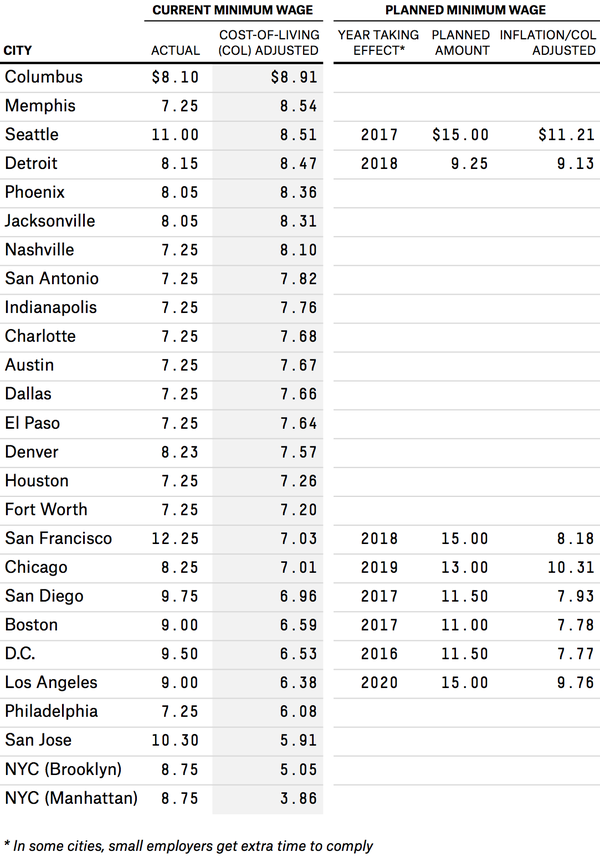
• Minimum wages compliments of fivethirtyeight.com. Look out Columbus, Seattle is closing fast.

CFe6fsMUEAAViTY-1

We Need A Different Sports Narrative

Saturday I rode from Portland to the Pacific Ocean with a friend who is a strong cyclist. The ride was a fund raiser for the American Lung Association. There were three or four different places to start along the route depending upon how many miles you wanted to ride.

Nearly all of the 3,000 other participants were recreational riders of all sizes and shapes. Some were on hybrids and mountain bikes meaning they were sitting up which made the headwinds worse. Some sported handlebar bags containing snacks, radios, tools, and the kitchen sink which made the hills worse. Lots wore backpacks which I didn’t quite understand since there were sporadic aid stations with food and water. Maybe they were stuffed with extra clothes.

The five hours and 39 minutes it took us to finish gave me lots of time to observe the other riders and reflect on their participation. Some had pictures of friends or family who were either fighting or had succumbed to lung cancer. Some were overweight. Some were on fund-raising teams and had matching jerseys or backpacks. Some sported colorful knee-high stockings.

From an athletic standpoint, they were unremarkable, but from a human one, I’m guessing many were impressive. As we powered past, I thought to myself they had double our perseverance because they were going to be spinning slowly into the onshore wind all day long. And I wondered about their stories. What motivated them to undertake such a challenging task? And what had they overcome in their lives? Or what were they overcoming?

As sports fans we fixate too narrowly on who wins and too little on the competitors’ or participants’ stories. Consequently, the Sport Story tends to be about winning at all costs. We long for stories of beauty and strength of spirit, of those who give a total effort for selfless reasons.

Postscript.