A large part of the rationale for the move to the Adult Family Home three months ago was that I could recover, and therefore Lynn and I could heal and get in sync, and spend whatever time is left as positively and peacefully as possible.
I am not in a good place, but a much better one. Way, way less stress. FuFu, Alison, and Jeanette, among many others, have saved me.
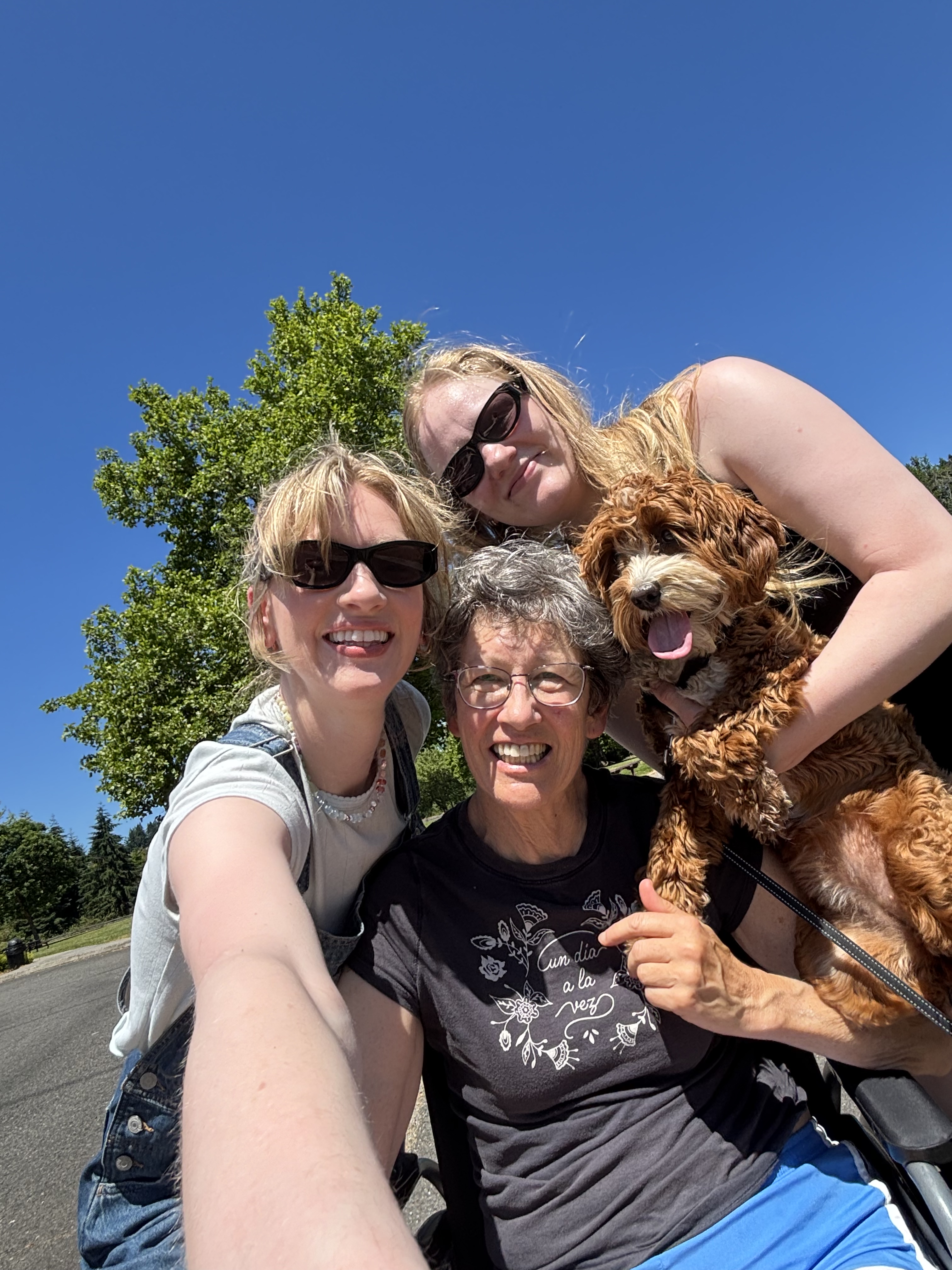
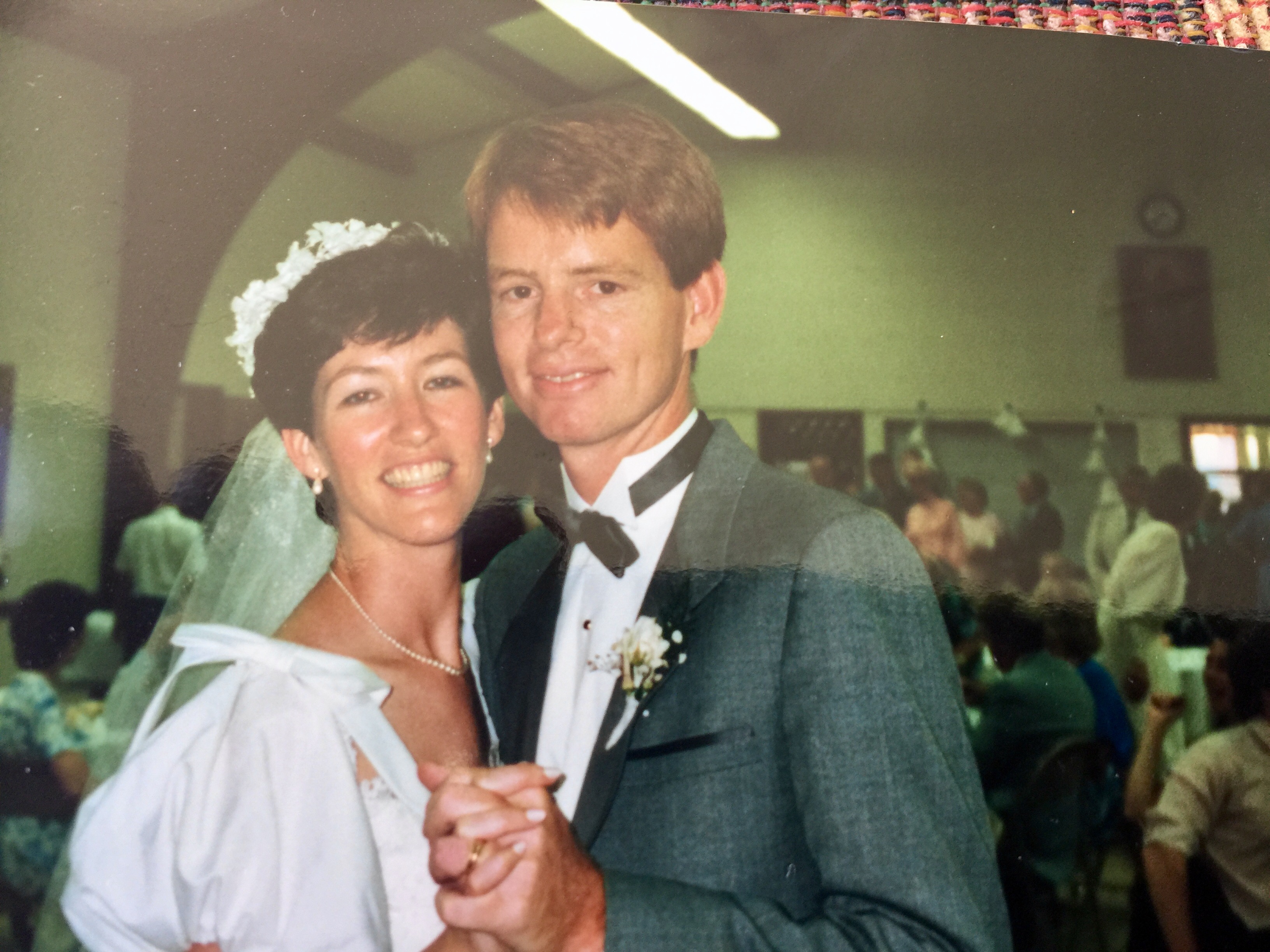
As a result, for the last two months, Lynn and I have enjoyed my visits. We look at photo albums. We listen to music. I tell her about my day. We loop the hood.
Most of all, we touch. I hold her hands and massage her calves. She hugs me tightly as if she’s not going to let go. We press our foreheads against each other. I caress her head as she falls asleep. We kiss.
It’s how we communicate.
I’ve never partnered with someone who is dying, so I’m improvising. All the time. What to say?
Last week I kneeled on the floor next to her hospice bed as she cried before napping. I told her I loved her and that she was okay, which of course, was untrue. Then I told her how sorry I was for what she’s experiencing. And that she’s been fighting it every minute she’s been awake for a few years and that was why she was completely exhausted. And that I wanted her to Rest even if that meant being alone. I told her how much I am going to miss her. More tears.
Then I told her she wasn’t alone and wouldn’t be alone. That she is bearing the fruit of having built such a caring and loving family.
We have had a much more intense relationship than you would probably guess. Intensely good most of the time, intensely bad some of the time.
I told her I was skimming an old Apple Note I wrote from when we were in marriage counseling five or six years ago. And how my one regret is all the time we wasted being mad at each other. I asked her to forgive me for being so stubborn and selfish. More tears.
I suspect she wanted to say something similar, but I was okay with her not being able to because I wanted to take most of the responsibility for our epic, sporadic struggles.
Even though we wanted to at times, I told her we never quit, and that was something.
In hindsight, we probably wasted 10% of our time together being too mad at each other to thoughtfully interact. Even though we learned to repair things, 10% of 38 years is almost four years! What we would do to have four years back.
More than Lynn, I accepted that we were never going to coast conflict free like some couples seemingly do. That the heartache was part and parcel of the intense intimacy. Again, in hindsight though, I wish we had far fewer, less intense conflicts. Fewer days where we couldn’t even talk to one another.
My unsolicited advice. Don’t take whatever committed relationships you’re in for granted. Be as proactive as you can. Trust one another enough to talk about what lies below the surface so that resentments don’t build up. Learn to listen and get more comfortable probing your partners’ feelings. If possible, by yourself, or together, enlist the help of a professional to learn to have fewer, less intense conflicts.*
Most of all, don’t assume you have many years and decades left, because you may not.
*LOL, I’m gonna get slammed for that wee bit of hypocrisy. :)
A word I just made up. An “update” includes positive and negative developments. A “downdate” is a decidedly negative update. Here goes.
Lynn’s symptoms are growing in number and worsening. And she’s darn near non-communicative.
Since the MSA diagnosis, she’s been like a jack spinning so fast on a hard tabletop that you wonder when, oh when, will it stop.
I want to ride my trike. I want to go to the Y. I want to dodge the garbage cans and go from the back yard to the front in my wheelchair. I want to stand up on my own. I want to do it myself. I want to be normal. I want to live. And now that I’ve stopped caretaking, and can exhale, I wonder, who can blame her for her fighting spirit?
Now, though, the jack slows and wobbles. No more trike. No more trips to the Y. Alison said last night she held tight to a few garden tools, but no real gardening took place. It’s like this disease broke into our house, took every single thing in it, and then, not content, broke out a sledge hammer to destroy the walls. Now, I’m afraid, it’s going to torch the exposed wood framing. It’s relentless.
Since Lynn’s move to an adult family home five weeks ago, Alison and Jeanette have been amazing. Investing tons of time and energy. Ready to catch her as the wobbling worsens.
Lots of people continue to be amazing. Ebony, for example, is a hospice volunteer who comes twice a week to help Lynn shower. The last time she didn’t know I had slipped into the bedroom that is connected to the bathroom where she was helping Lynn. Ebony was so ebullient. She kept asking Lynn if the temperature was okay and continued talking to her like she was her own mother. She was having a genuinely good time aiding Lynn, and by extension, our family. Such humanity.
And Lynn’s friends. And their flowers. And cards. And visits. As a group, they are wonderfully unbothered by her decline. Like Alison, Jeanette, and me, they need her smile and probably wonder what they’re going to do without it.
A significant change is that Lynn is coming to grips with the fact that nature is running its course. And that her time is short. Her quality of life is such that she’s more okay with that now. One can only endure so much.
As for me, I’m living a double life. Monday, I had an amazing swim in a beautiful local lake. Tuesday, five friends and I were bearing down on Tenino when a herd of 50+ cows and calves, all the exact same white color, moved in unison towards the road to seemingly spur us on. That was surreal, and when combined with our idyllic weather, and the trees starting to show out, it’s tough not being able to enjoy my favorite time of the year with my favorite person.
When I get home from the lake and the group ride, the kitchen is empty. There’s no one to ask, “How was your swim? How was your ride?” So my autumnal joy is tempered by a void. My love of fall is no match for this loss of intimacy. Unlike Lynn though, I will be okay. In time.
At the end of life, how does one know whether they’ve lived a good life or not? More personally, how will you know if you have? How will I?
Many of us live as if professional reputation, material wealth, and social status are the key ingredients, but watching The Good Wife get closer to the end provides an altogether different litmus test.
Which is this. Have you been a good enough friend, to enough people, long enough, that they’re there for you at the end? Or has a certain self-centeredness and peripatetic life left you mostly alone?
You’ll only know which of these is the case if you die slowly. Some of us will go quickly like a friend of mine who fell over dead on his bike in Italy last summer. Although he didn’t have time for the “close friend” litmus test, his memorial service provided positive clues to a life well lived.
Based on the “close friend” test, Lynn has lived an exceptional life. Unfortunately though, she’s unable to take solace in that knowledge. Because like many of us, she’s incredibly hard on herself. My unprovable hypothesis is that the built-in feeling of inadequacy began at birth with Lynn wondering, “Why didn’t my mom want me?” Almost certainly, it didn’t help when 45 years later she contacted her birth mom only to learn she still didn’t want any kind of relationship.
Consider the last 48 hours. Yesterday, Lynn participated in a zoom call with her four dear college roommates. “Participated” meaning listened intently and smiled throughout. Today, an hour before Pastor Carol was coming by with communion, Susan texted to see if she could pop in. I said she could join Lynn and Carol, Carol happens to be Susan’s pastor, and the three of them visited for over an hour. I could go on and on. Lynn’s support network has blown my mind. She is being loved and supported by so many people none of whom are the least bit phased by her worsening symptoms like her loss of voice.
Some bring art, some bring pictures, a lot bring food. In the end, they just want to be next to her. And to see her smile. When we’re without her smile there is going to be a painful void in a lot of people’s lives, not just A’s, J’s, and mine.
I intend on honoring Lynn’s eventual legacy by prioritizing friendships even more.
Maybe the answer is as simple as my wife, Lynn, is aging at warp speed due to her Multiple Systems Atrophy, a rare degenerative neurological disorder for which there’s no cure. But one thing gnaws at me. Compared to most caregivers, I have so many more resources. So, what’s my problem?
Physically, I am healthy. Not all caregivers are.
Most significantly, we can pay for her care without undue worry. That includes two health care aides who work weekdays. It’s not cheap. Together, they account for about 45% of Lynn’s total care. I am also fortunate to have two helpful daughters who I team with on weekends. Their help equates to about 10% of the total, meaning I fly solo the other 45% of the time.
Also, there are numerous friends and family who love Lynn and are supporting us in myriad ways. Especially my niece and sister, who, like clockwork, fly to Seattle from Salt Lake City and Northwest Indiana, drive down to Olympia where we live, and rent a place for five days every three months. My niece is an ace physical therapist, and when she visits, she works with Lynn almost non-stop mostly making accommodations to our house and improving Lynn’s routines.
Then, there’s Kris, Marybeth, and Joan, who show up every Saturday at noon with Lynn’s favorite lunch from the local deli. They talk, and talk, and talk. And giggle. And garden. And inject much needed levity and normality.
Also, there’s Susan, who brought dinner over this week despite her dad dying, in Seattle, at age 98, a few days ago.
Then, there’s Vince, who knocks at the door, hands over amazing Ziploc bags filled with wonderful produce from his garden and jets. Kevin sends UberEats gift certificates from SoCal. And similar to Susan, Michael, Dan, Mary, and Travis show up with food and good cheer. And Monica. And a few of my daughters’ friends who I have never even met. If I stop long enough to reflect on these random acts of kindness, they bring me to tears.
Altogether, Lynn’s CaringBridge website has 94 people from other neighborhoods, states, and countries who are reading my manic/dorky updates, praying for us, sending supportive messages, and ultimately, seeing us from afar.
And despite this all-world support, I’m completely broken. So again, I wonder, what’s wrong with me? Why am I shattered. Emotionally bereft. Socially toxic as a result of not a short fuse, but no fuse. Why have I not just hit an MSA wall, but been completely crushed by one?
How about an anecdote to give you a feel for my sadsackness. First though, let me summarize how my work colleagues talk about me. In short, they say they most appreciate my poise, thoughtfulness, and calm demeanor. LOL.
Lynn decides to make an ice cream cone. To get the cone, she has to get into a cupboard in the smallish laundry room. She ends up repeatedly moving her wheelchair forwards and backwards in the tight space. Fast forward a few minutes. Part of the door frame lies on the ground. There’s ice cream all over the floor. And counter. The ice cream container fared poorly in this ordeal too and is now too crumpled for the top.
Because you’re rational, you’re thinking, “Big shit. The door can be repaired. The floor and counter quickly and easily cleaned. The container and top? Come on bruh, get real. Altogether, minor trade-offs for Lynn feeling a wee bit independent.”
But what you’re not factoring in is the cumulative effect of this type of experience hundreds of times over. Combined with other, way more substantive challenges, that have completely chipped away at my reservoir of patience, kindness, and humor.
I lost it, yelling, “WHY DIDN’T YOU ASK ME TO MAKE YOU AN ICE CREAM CONE?!” And then stayed Mad. Yes, you’re absolutely right, a complete and total overreaction.
There are two ways I could pivot from here. The more obvious one is to ask the question on most people’s minds, what can/should I do to better manage my anger and heal more generally? Or more specifically, when the hell is Ron going to find a good therapist? Sorry sports fans, I’m choosing the second, less obvious one, where I ask, what exactly has been MSA’s toll on me? Buckle up.
The losses are overwhelming because the challenges are multilayered. Some hard, others harder, two especially hard.
Hard
• We can’t do the ordinary day-to-day things we always took for granted because they were so easy to do. Things you mostly like still take for granted because they’re still easy for you and yours to do. We can’t go out to dinner. We can’t go for a walk. Or for a lake swim. We can’t go to Victoria for the weekend. In the end, these small things are the lifeblood of intimate friendship. Gone.
• We can’t plan for the future. Before MSA hit, we never made the time to make a list of fun future activities, but it’s still hard to come to grips with the fact that there’s nothing to look forward to on our calendar. The four of us will not be going to Spain or hanging in an Alderbrook cabin anymore. Hope for fun in the future. Gone.
Harder
• It feels like my second global pandemic with all the lockdown rigamarole. Since returning from a cycling trip to Bend, Oregon on June 1, 2024, I have been completely housebound because Lynn’s so dependent upon her meds, her bathroom, and her hospice bed. I’ll spare you the details, but her digestive system is completely whacked, meaning even day trips are too difficult to tackle. Spending a few hours at Alison’s apartment in Seattle recently felt like an international trip.
For fourteen straight months my daily routine has been the same. I wake up and wait for Lynn to ring my intercom doodad which I can’t wait to chuck in the trash. Then, absent our healthcare aides, I help her with everything, pretty much non-stop. Because MSA is like a demented dimmer switch that someone’s slowly turning, she needs more help each month, meaning my breaks have grown increasingly short. And ultimately, insufficient. Lynn mistakenly thinks if I could just get away for a few days I’d be fine. I tell her I don’t need 4-5 days, I need 4-5 months where I don’t have to cook, clean, or care for anyone. At all. Any meaningful flexibility of movement. Gone.
• We’ve had a modern marriage meaning we’ve split the work pretty evenly. Now, I’m wilting from the pressure of having to do everything I’ve always done plus everything Lynn always did. Among other things, she used to help with groceries and she did the bulk of the cooking, and all of the laundry, and half of the housework. And she called the service peeps. Now, it’s all me, all the time. I cook every meal, clean the kitchen every night, do the dishes, the laundry, take care of the trash/recycling/compost, vacuum, take care of the yard, stay on top of our personal finances, and ended up having to partner with a CPA to close Lynn’s parents’ estate for which she was the executor. That old energy saving division of labor. Gone.
Hardest
• Overwhelmed by her symptoms, Lynn has lost the ability to perspective take. She’s always been uber-caring, but now, not so much. Here’s what I wish she’d say, “I’m really sorry for what this disease has taken from you.” I’ve tried to understand this change. All I can come up with is her life is so hard, there’s not any psychic energy left for anyone else, even me. Whenever I try to express my profound sadness, she tends to take it personally, gets defensive, and immediately starts talking about her own feelings. Instead of doing the only thing that creates connection, asking follow up questions, and genuinely probing for more insight. I want her to say, “Tell me more so I can understand even better.” But it’s not going to happen. Because of MSA. Curiosity and perspective. Gone.
• I am the loneliest I’ve ever been. There’s two parts to it. The first is I’m disconnected from my friends. Because, remember, I’m housebound. On top of everything else, I keep Lynn’s social calendar. I organize friend visits for her almost daily. But ironically, I almost never see my friends. Not to mention, meet anyone new. Zilch socializing.
On top of that, right now, my connection with Lynn is tenuous at best. We’ve always enjoyed an intense physical connection. Now, MSA has doused those flames. The mind is willing, but the body is not. Which saddens both of us greatly.
We don’t have in-depth conversations either. The other day I told her about an article I had read about “anchor offs” which you can see from our deck. These are destitute people living on boats anchored in Budd Inlet. I summarized the article, explained how they prefer the water to the streets, and . . . nothing. I’m sure she was thinking about what I was saying, she just couldn’t communicate her thoughts. She doesn’t really maintain eye contact either. So, it’s like playing tennis against a wall instead of with another person. Mark told me Lisa got a real kick out of his story about the 30 mopeders who passed us on 113th on a recent ride. I was a little jelly. Lynn isn’t able to ask about where I’ve cycled or how it’s gone. Post ride, I think to myself, she’ll never have any feel for those two hours of my life.
A few weeks ago, I told her I was thinking of buying a house in Bend. I wanted her to say, “You’re crazy” or “Cool, which ones are you considering? Show me.” Ultimately, like with the “anchor off” story, I was looking for connection. But there was none. If a convo happens in the forest and no one is around to hear it, does it make a sound? Deep-seated, profound connection, built over decades. Going.
Public and private. All of us behave a little or a lot differently whether we’re in public or not. In extreme cases, people live “double lives”.
The dichotomy between Lynn’s public life, by which I mean when friends and family visit, and private one, where I’m the only person around, is so glaring that it got me thinking.
Specifically, I’ve been pondering why she’s not just okay when friends and family are around, but especially smiley (and today, extremely giggly) and physically better than normal. There’s a wonderful lightness. I guess it makes sense learning what we’re learning about the importance of close interpersonal relationships to our overall health and well-being.
But man, the whiplash that comes when friends and family leave is intense. And disorienting.
When home alone she pops boosters between timed meds and her body is off and on, and when on, she’s bored, and she struggles with any sense of purpose. There’s a heaviness.
Why am I telling you this? Not sure. Maybe to help you mentally prep for this phenomenon if you’re ever a primary care giver. Or maybe I’m letting you in hoping for some sort of connection.
Last night, I had an epiphany. A tough one that I was hesitant to share with Lynn because I expected a negative/defensive reaction.
I told her I had an observation I wanted to share with her. “You have a restless spirit.” There, I said it. Fortunately, I was wrong, because she didn’t argue the point. She listened carefully as I told her I missed her, that it felt like all of her time and attention was taken fighting her Multiple Systems Atrophy. That there was no time or attention left for me.
That I felt more like an employee than best friend.
Most people confined to a wheelchair and unable to do hardly anything independently watch a lot of tv and read. Since Schitt’s Creek ended, Lynn doesn’t watch tv and her reading glasses, despite repeated trips to the optometrist, aren’t working well enough for her to read much.
Thus, when alone, if she’s feeling okay, she’s in constant motion searching for something to do. Anything to do. Or she’s laid out on the couch waiting for her meds to kick in. The only time she’s not on the move is when her body completely quits or she’s asleep.
Our convo, mostly about how dying is scary and spiritual malaise, deepened. She cried and said she didn’t know “I loved her that much”. I took in what I think was her deeper message, “I didn’t know I’m that lovable.” I told her lots and lots of people love her.
I told her I was having a hard time dealing with her restlessness and with her constant MSA fight. That caring for her took all my energy, that there was no leftover energy to just hang. And that it would be really sad to spend our final months or years together not really together.
Case in point. Saturday and Sunday nights I throw dinner together for the fam and then sit at the kitchen island with my own dinner while one or both daughters join their mom at the dining room table. Hell, during the week I do it too, leaving Lynn to eat by herself. Yeah, you’re right, I am a lowlife.
While I am a lowlife, I probably deserve a few points for being vulnerable and risking the convo. Sadly, in part, I risked it because soon we won’t be able to have back-and-forth conversations of that sort.
But not being especially centered myself these days, it’s really tough to take on her anxiety about dying, her exasperation at MSA’s relentless progression, and her general unease and utter restlessness. Especially given the cost that restlessness is taking on our friendship. For now.
Postscript: We ate dinner together. Afterwards, there was more slow dancing in the kitchen. The roller coaster keeps rolling.
Owe the Slo-mo Turtle* an apology. Of sorts. One day last week I was running around baby Cap Lake when I had an inconvenient epiphany. Of sorts.
After pulling the plug on the run, I did what I almost never do. I pressed pause and sat on a bench by the lake to gather enough energy to scale the 4th Street bridges. And I reflected on all the things I do every day to extend my life, like run, lift weights, and eat vegetables. I don’t do those to consciously extend my life as much as I do to improve the quality of however much time is left.
But still, it’s hypocritical for me to be critical of the SmT for doing everything in her power to beat back MSA’s progression. Yes, it does make it harder to care for her, but I’d have the same inclinations if I was in her shell.
Because there’s no way to control for all the variables, and there’s no counterfactual, I don’t know whether her efforts are having any real effect. I see them more as grasping at some semblance of normality.
Today the SmT fell asleep while eating lunch. Afterwards, Hospice Audrey, a very nice PLU grad, came for a visit. We talked about sleep among other things. The SmT is bothered by sleeping way more than normal. Audrey encouraged her to listen to her body. As I repeatedly do.
She’s not good at that. She’s choosing to crawl into the ring with twenty-something Mike Tyson.
All of us are trying to delay the finale. Aren’t we? All of us fight inevitable decline in some combo of small subtle ways and larger more dramatic ones. Don’t we?
Sorry SmT, upon further thought, we are more alike than different.
*Another nickname for the GalPal inspired by her morning routine.
Inner peace is elusive the more we try to control others. True contentedness results from relinquishing control over other people’s thoughts and behaviors.
That’s what I’m in the process of learning. Am I half way? Who the hell knows. All I know is I will never arrive at the Total Acceptance train station.
When Lynn was diagnosed with Multiple Systems Atrophy and the symptoms started taking over our lives, I had unusual clarity about what I wanted to provide her in whatever time was left. I said to her, “I want this final chapter of your life to be as calm and comfortable as possible.”
As it has turned out, what I wanted was totally irrelevant. Her thought process was completely different, saying through her actions, “I want to ignore this diabolical disease to the best of my ability and maintain as much normalcy for as long as possible.”
Which makes caring for her so much more difficult. She’s always been uber-considerate and kind to a fault. Now though, her preternatural consideration is getting squelched by widespread atrophy. The lack of dopamine in her brain is wreaking havoc on her body and mind. I have to remind myself she’s not making a difficult situation more difficult on purpose. It’s brain chemistry.
A few examples. Six months ago or so, after dinner, I was able to say to her, “I’m going upstairs to read in the bath. I’ll be back down in one hour. Sit tight until then.” One fall night while I was decompressing in hot water, the bathroom door slowly opened. “What the hell!” No one else was home. Lynn entered on all fours. She had wheeled herself to the base of the stairs, gotten out of her wheelchair, and crawled up the stairs and across the t.v. room into the bathroom. Because she “wanted to see what the upstairs looked like now”. It wasn’t pretty getting her back downstairs.
A couple of nights ago, she appeared in my peripheral vision as I was watching basketball in the office. “WHAT are you doing?!” “Crawling.” “Why?!” “Why not?”
“Why not” is her philosophy.
Yes, you’re right, her stubborn resistance to the disease’s progression is better than giving up on life, but man oh man, I wish I could get her to accept the ways her body is failing her. At least a little bit.
But I can’t. And the more I accept that she gets to decide how to live out her final chapter, the better for both of us.
Who are you trying to control? How? When will you throw in the towel? The sooner, the better.
Both beautifully nudge the reader to contemplate the end-of-life. Patchett’s piece is the single best thing I’ve ever read on decluttering as an intentional act of preparing to die. If you think you might die someday, forget Marie Kondo, just sink deeply into Patchett’s story.
Patchett had me from the jump when she described the stages of life as “. . . youth, middle age, and . . . the downhill slalom.”
Conventional wisdom is sometimes wrong, but when it comes to mourning, it’s correct. Everyone mourns differently, some inwardly and quietly, others with much more feeling. Some mourn briefly, others for extended lengths of time. There is no right way to mourn, the key is to respect everyone’s individual approach.
At the same time, the recent passing of Kobe Bryant, the other eight victims of the helicopter crash, and also Leila Janah, have me thinking more about death.
Intense grieving for the likes of Kobe and Leila makes perfect sense given their relative youth, 41 and 37 years old respectively. In that same spirit, one of the most sad passings I’ve ever observed was that of a friend’s 7 year-old son. We are understandably most saddened by people who do not get to experience the full arc of life.
And yet, Kobe, Leila, and my friend’s son left the world a better place. Leila, for example, founded a company that . . .
“. . . employs more than 2,900 people in Kenya, Uganda and India, creating data for companies around the world that need to test numerous artificial intelligence products, including self-driving cars and smart hardware. The company has helped more than 50,000 people lift themselves out of poverty and has become one of the largest employers in East Africa. . . .”
And as we’re learning, Kobe’s imprint was also large, most significantly off the court through his parenting, writing, and support for technology startups, young athletes, and women’s professional sports.
My friend’s son’s legacy was less public, but still profound, a lasting impact on his family, classmates, and community. Until cancer appeared in his blood, he was pure joy, a natural peacemaker.
To me, the saddest deaths are those of people who do not leave even some small sliver of the world better off. People whose words and actions didn’t console, inspire kindness, or help others be more humane. Those are the passings we should grieve the most.
That’s how one pro football coach described the moment to his players right before game 9 of 16 this weekend. Hearing that, I thought it aptly described my present stage of life. Then again, life is fragile, so who knows, I could be a little or a lot closer to the End than I realize.
If it’s hard to figure out how to approach the End, it’s doubly hard when married because everyone thinks about the End a little, or a lot, differently. The Good Wife and I are thinking fairly differently about how to live at the beginning of the end. It would be a lot easier if she would start thinking more like me.

 Pressing Pause