The Winter Of Grief II

My mom was 64 years 10 months old when my dad died from a heart attack while driving to work in Tampa, FL.

I’m 63 years 10 months old.

I wish I could go back in time and interact with my mom with the wisdom gained from what I am experiencing. It’s not that I wasn’t compassionate, it’s just that my compassion would be on a whole different level.

One painful insight that I’d bring to our relationship is the knowledge of how the person’s life lingers and how the trail they left offers constant memories which both deepen and lengthen the grief.

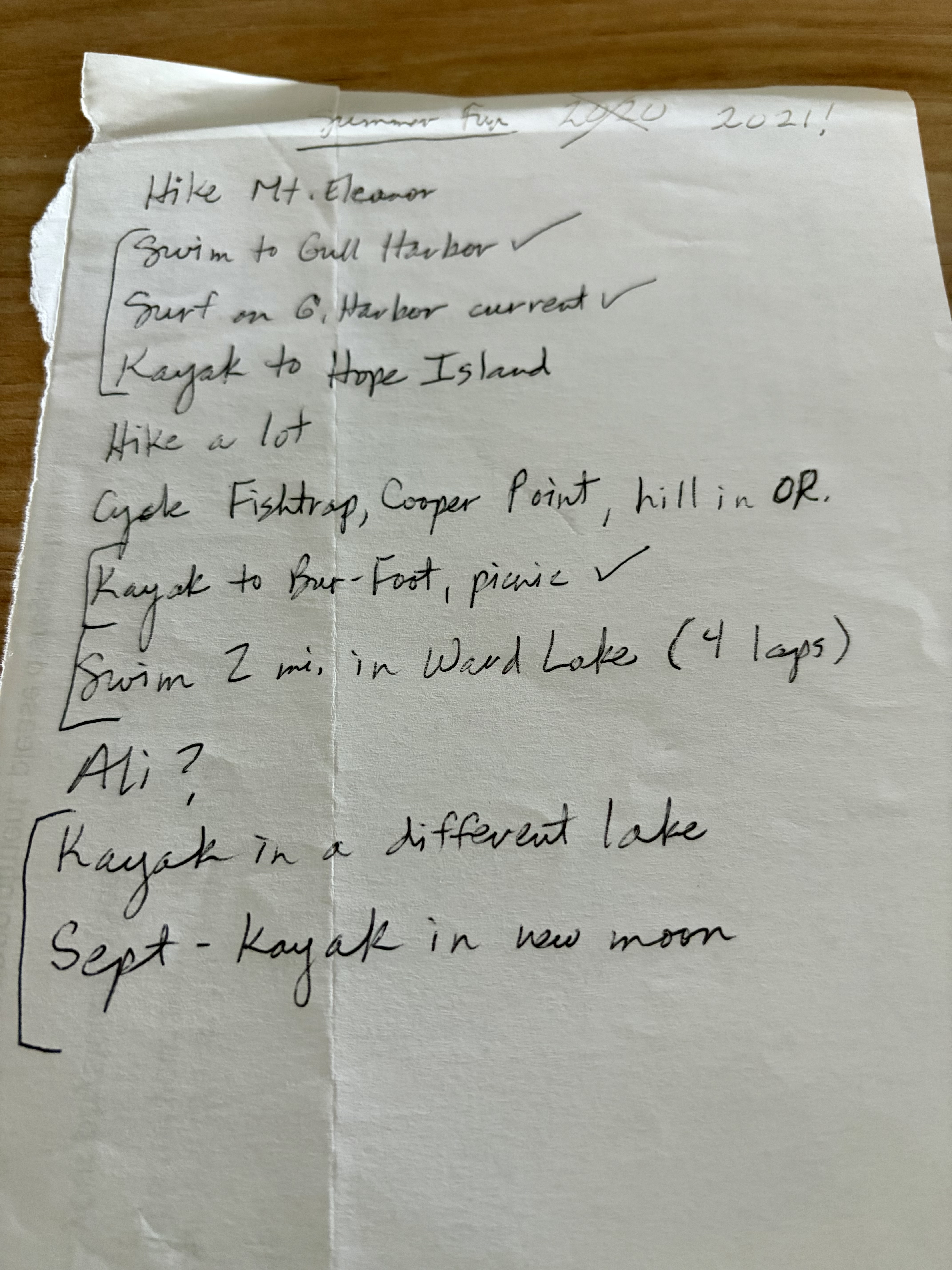
For example, today, after visiting Lynn I went through her collection of papers and books from the last few years. A literary tower balancing precariously on the piano bench.

And I stumbled across the attached picture. The crossed out “2020” speaks to some procrastinating, but I love how dang aspirational her list was. Ward Lake laps, haha. The “Oregon hill” is McKenzie Pass which I raved to her about after each of my ascents.

“Surf in Gull Harbor current” meant kayaking to the mouth of the harbor then riding the current into the harbor. Sometimes in the boat, sometimes not.

“Hike a lot” unchecked. “Hike Mt. Eleanor” unchecked. Fuck, why didn’t we go on more hikes?

The wisest thing anyone has said to me during this ordeal was a hospice chaplain who said don’t focus so much on Lynn’s mortality that you ignore your own. That was piercing. And stuck.

I wonder, what if things were reversed and Lynn had to interact with my material wake. Would she take the seven iron out of my golf bag and hold the grip seeking some sort of cosmic connection? Yeah, I think she prob would.

Here’s what I think about my own mortality. Lynn had just over four years left when she cobbled together her “Summer Fun” list. I’m guessing she assumed she had more than four summers left. I know I did.

I do not want to save up for the future, to put things off, to assume a long, healthy future.

One of the simplest ways I’m doing that may seem silly. These days, my uniform is t-shirts and jeans. I have about 10 t-shirts, some that I like to wear more than others. And I have one fave, that I used to reach for and then stop and say to myself, “I should save that for next time.” Now, I look for it and wear it whenever it’s clean. Because of Lynn.

Without being morbid, take your mortality seriously. Don’t wait. Hike. Cycle. Be on or in the water. In your favorite t-shirt.

It’s Happened

A large part of the rationale for the move to the Adult Family Home three months ago was that I could recover, and therefore Lynn and I could heal and get in sync, and spend whatever time is left as positively and peacefully as possible.

I am not in a good place, but a much better one. Way, way less stress. FuFu, Alison, and Jeanette, among many others, have saved me.

As a result, for the last two months, Lynn and I have enjoyed my visits. We look at photo albums. We listen to music. I tell her about my day. We loop the hood.

Most of all, we touch. I hold her hands and massage her calves. She hugs me tightly as if she’s not going to let go. We press our foreheads against each other. I caress her head as she falls asleep. We kiss.

It’s how we communicate.

I’ve never partnered with someone who is dying, so I’m improvising. All the time. What to say?

Last week I kneeled on the floor next to her hospice bed as she cried before napping. I told her I loved her and that she was okay, which of course, was untrue. Then I told her how sorry I was for what she’s experiencing. And that she’s been fighting it every minute she’s been awake for a few years and that was why she was completely exhausted. And that I wanted her to Rest even if that meant being alone. I told her how much I am going to miss her. More tears.

Then I told her she wasn’t alone and wouldn’t be alone. That she is bearing the fruit of having built such a caring and loving family.

We have had a much more intense relationship than you would probably guess. Intensely good most of the time, intensely bad some of the time.

I told her I was skimming an old Apple Note I wrote from when we were in marriage counseling five or six years ago. And how my one regret is all the time we wasted being mad at each other. I asked her to forgive me for being so stubborn and selfish. More tears.

I suspect she wanted to say something similar, but I was okay with her not being able to because I wanted to take most of the responsibility for our epic, sporadic struggles.

Even though we wanted to at times, I told her we never quit, and that was something.

In hindsight, we probably wasted 10% of our time together being too mad at each other to thoughtfully interact. Even though we learned to repair things, 10% of 38 years is almost four years! What we would do to have four years back.

More than Lynn, I accepted that we were never going to coast conflict free like some couples seemingly do. That the heartache was part and parcel of the intense intimacy. Again, in hindsight though, I wish we had far fewer, less intense conflicts. Fewer days where we couldn’t even talk to one another.

My unsolicited advice. Don’t take whatever committed relationships you’re in for granted. Be as proactive as you can. Trust one another enough to talk about what lies below the surface so that resentments don’t build up. Learn to listen and get more comfortable probing your partners’ feelings. If possible, by yourself, or together, enlist the help of a professional to learn to have fewer, less intense conflicts.*

Most of all, don’t assume you have many years and decades left, because you may not.

*LOL, I’m gonna get slammed for that wee bit of hypocrisy. :)

Downdate

A word I just made up. An “update” includes positive and negative developments. A “downdate” is a decidedly negative update. Here goes.

Lynn’s symptoms are growing in number and worsening. And she’s darn near non-communicative.

Since the MSA diagnosis, she’s been like a jack spinning so fast on a hard tabletop that you wonder when, oh when, will it stop.

I want to ride my trike. I want to go to the Y. I want to dodge the garbage cans and go from the back yard to the front in my wheelchair. I want to stand up on my own. I want to do it myself. I want to be normal. I want to live. And now that I’ve stopped caretaking, and can exhale, I wonder, who can blame her for her fighting spirit?

Now, though, the jack slows and wobbles. No more trike. No more trips to the Y. Alison said last night she held tight to a few garden tools, but no real gardening took place. It’s like this disease broke into our house, took every single thing in it, and then, not content, broke out a sledge hammer to destroy the walls. Now, I’m afraid, it’s going to torch the exposed wood framing. It’s relentless.

Since Lynn’s move to an adult family home five weeks ago, Alison and Jeanette have been amazing. Investing tons of time and energy. Ready to catch her as the wobbling worsens.

Lots of people continue to be amazing. Ebony, for example, is a hospice volunteer who comes twice a week to help Lynn shower. The last time she didn’t know I had slipped into the bedroom that is connected to the bathroom where she was helping Lynn. Ebony was so ebullient. She kept asking Lynn if the temperature was okay and continued talking to her like she was her own mother. She was having a genuinely good time aiding Lynn, and by extension, our family. Such humanity.

And Lynn’s friends. And their flowers. And cards. And visits. As a group, they are wonderfully unbothered by her decline. Like Alison, Jeanette, and me, they need her smile and probably wonder what they’re going to do without it.

A significant change is that Lynn is coming to grips with the fact that nature is running its course. And that her time is short. Her quality of life is such that she’s more okay with that now. One can only endure so much.

As for me, I’m living a double life. Monday, I had an amazing swim in a beautiful local lake. Tuesday, five friends and I were bearing down on Tenino when a herd of 50+ cows and calves, all the exact same white color, moved in unison towards the road to seemingly spur us on. That was surreal, and when combined with our idyllic weather, and the trees starting to show out, it’s tough not being able to enjoy my favorite time of the year with my favorite person.

When I get home from the lake and the group ride, the kitchen is empty. There’s no one to ask, “How was your swim? How was your ride?” So my autumnal joy is tempered by a void. My love of fall is no match for this loss of intimacy. Unlike Lynn though, I will be okay. In time.

On Dying

Great title, Ron. What’s the opposite of clickbait?

The rollercoaster that is living with and caring for someone with Multiple Systems Atrophy careened down to the bottom of the track Tuesday late afternoon/early evening. Lynn’s body shut down. And I couldn’t understand a word she was saying. This was late into a long two-day stretch without our normal a.m. help. So I wasn’t in a good place, and Lynn, of course, was in a much worser one.

Then the 5p meds and my amazing dinner kicked in and she bounced back enough to ask, “What would you do?” And so, I told her.

“I’d probably give up. It’s hard to know for sure, but yeah, I might throw in the towel and let nature run its course. You’re way tougher than me. Which is kinda ironic isn’t it, since I often said you were too damn delicate? Yeah, in the end, you turned out to be way tougher than me. Maybe I have some Erwin Byrnes in me.”

Then I told her that a not inconsequential subset of people on the MSA listserv choose death with dignity or they voluntarily stop eating and drinking. Because they want to assert some modicum of control over the downward spiral.

In the past, after reflecting on her mom’s decision to stop eating and drinking in her final two weeks, she’s said she’d do the same someday. That time is not now, but her will to live isn’t what it appears on the surface when she flashes her golden smile. Her will to live is gradually flagging. Hence her question, “What would you do?”

Last night J asked her if she enjoyed visiting with her college roommates online and she surprised J by saying, “Not really.” Having eavesdropped on the conversation, I intuitively knew why. Because she will not be giving a toast at either of her daughters’ weddings. And she will not be traveling anywhere. The roommate’s normal catching up was a painful reminder of things lost and how her world keeps getting smaller and smaller. Of course, they didn’t intend for that, and they didn’t realize it because of . . . the golden smile.

Lynn’s question, “What would you do?” prompted me to think even more deeply about her daily life. Yes, I am a complete mess right now, but I’m going to get better. And I’m going to renew my passport next year, and I’m going to catch up with you hopefully, and add lots of events to my calendar that I’ll look forward to. I am bullish on the future.

What does Lynn have to look forward to? Or maybe, more immediately, what brings her joy? Me, especially when I’m okay enough to joke around. The labradude appearing suddenly under the wheelchair. Picking dead leaves off the tomato plants. SchittsCreek with the hijas. Saturday lunch with the gfriends. Always, Saturday lunch.

For me, I don’t know if that would be enough. If I was her, I’d feel almost entirely like a spectator of others’ lives, not an active participant. I’m not sure I’d feel enough purpose to keep fighting through all of the adversity. To be so damn dependent upon everyone for everything. Again, she’s starting to wonder if it’s enough too.

Whether to passively live as long as possible or more actively speed up the dying process a little or a lot is a deeply personal question upon which reasonable people disagree.

One thing I know for sure however, is that everyone who is dying slowly, should get to decide for themselves what to do, if anything, without any outside pressure. That’s why I keep telling Lynn my probable throwing in of the towel doesn’t matter. That she gets to decide how to live out her ninth inning. Which is one important factor in the move to an adult family home. She will be cared for by pros, not a shattered, amateur, impostor of a caregiver.

In saying I’d prob let nature run its course, I also shared my way of thinking about death which took shape following my dad’s sudden death when I was 33. At first, I was mad at the world that I’d never get to find out where our newly evolving friendship was headed. That he didn’t get to hold Jeanette. That so much promise was cut unfairly short. Then, somehow, I consciously pivoted to celebrating our nascent friendship and all the positive memories I had of him growing up.  

My intentional approach is “choose to celebrate” all the positive memories instead of being eternally upset that the movie cut off before the ideal end.

I told Lynn not everyone lives 64 years. And not many people have as fulfilling a 40 years (38 married) as we’ve enjoyed. I told her that, eventually, I will be okay, largely because of all the positive memories we made. She seemed receptive to my quirky thinking, but I can’t be entirely sure. Equally possible, she thought, “How did I get stuck with a bonafide whacko?”

I just don’t think we can do both simultaneously, we have to choose one or the other. I choose to celebrate. Is it a panacea for softening the blow of loss? Does it speed up the grieving process? No and probably not. Is it better than the alternative? Of being mad at the world? Of staying mad at it? Most definitely.

The Ultimate Litmus Test

At the end of life, how does one know whether they’ve lived a good life or not? More personally, how will you know if you have? How will I?

Many of us live as if professional reputation, material wealth, and social status are the key ingredients, but watching The Good Wife get closer to the end provides an altogether different litmus test.

Which is this. Have you been a good enough friend, to enough people, long enough, that they’re there for you at the end? Or has a certain self-centeredness and peripatetic life left you mostly alone?

You’ll only know which of these is the case if you die slowly. Some of us will go quickly like a friend of mine who fell over dead on his bike in Italy last summer. Although he didn’t have time for the “close friend” litmus test, his memorial service provided positive clues to a life well lived.

Based on the “close friend” test, Lynn has lived an exceptional life. Unfortunately though, she’s unable to take solace in that knowledge. Because like many of us, she’s incredibly hard on herself.  My unprovable hypothesis is that the built-in feeling of inadequacy began at birth with Lynn wondering, “Why didn’t my mom want me?” Almost certainly, it didn’t help when 45 years later she contacted her birth mom only to learn she still didn’t want any kind of relationship.

Consider the last 48 hours. Yesterday, Lynn participated in a zoom call with her four dear college roommates. “Participated” meaning listened intently and smiled throughout. Today, an hour before Pastor Carol was coming by with communion, Susan texted to see if she could pop in. I said she could join Lynn and Carol, Carol happens to be Susan’s pastor, and the three of them visited for over an hour. I could go on and on. Lynn’s support network has blown my mind. She is being loved and supported by so many people none of whom are the least bit phased by her worsening symptoms like her loss of voice.

Some bring art, some bring pictures, a lot bring food. In the end, they just want to be next to her. And to see her smile. When we’re without her smile there is going to be a painful void in a lot of people’s lives, not just A’s, J’s, and mine.

I intend on honoring Lynn’s eventual legacy by prioritizing friendships even more.

Paragraph to Ponder

Susan Rothchild in The New York Times:

“My son, Chauncey, died a few years ago of a fentanyl overdose. He was a brilliant, eccentric autodidact, an excellent farmer and chef, but he chose to work as a carpenter and plumber. He was not good at either job. Yet, when he offered to build my new bathroom, I said yes. Now every time I take a shower and see the dribbles of grout on the wall, stand on the still-unattached drain plate or get drenched using the hand nozzle with a mind of its own, I think of him. I will never get them fixed.”

Two Worlds

Public and private. All of us behave a little or a lot differently whether we’re in public or not. In extreme cases, people live “double lives”.

The dichotomy between Lynn’s public life, by which I mean when friends and family visit, and private one, where I’m the only person around, is so glaring that it got me thinking.

Specifically, I’ve been pondering why she’s not just okay when friends and family are around, but especially smiley (and today, extremely giggly) and physically better than normal. There’s a wonderful lightness. I guess it makes sense learning what we’re learning about the importance of close interpersonal relationships to our overall health and well-being.

But man, the whiplash that comes when friends and family leave is intense. And disorienting.

When home alone she pops boosters between timed meds and her body is off and on, and when on, she’s bored, and she struggles with any sense of purpose. There’s a heaviness.

Why am I telling you this? Not sure. Maybe to help you mentally prep for this phenomenon if you’re ever a primary care giver. Or maybe I’m letting you in hoping for some sort of connection.

Last night, I had an epiphany. A tough one that I was hesitant to share with Lynn because I expected a negative/defensive reaction.

I told her I had an observation I wanted to share with her. “You have a restless spirit.” There, I said it. Fortunately, I was wrong, because she didn’t argue the point. She listened carefully as I told her I missed her, that it felt like all of her time and attention was taken fighting her Multiple Systems Atrophy. That there was no time or attention left for me.

That I felt more like an employee than best friend.

Most people confined to a wheelchair and unable to do hardly anything independently watch a lot of tv and read. Since Schitt’s Creek ended, Lynn doesn’t watch tv and her reading glasses, despite repeated trips to the optometrist, aren’t working well enough for her to read much.

Thus, when alone, if she’s feeling okay, she’s in constant motion searching for something to do. Anything to do. Or she’s laid out on the couch waiting for her meds to kick in. The only time she’s not on the move is when her body completely quits or she’s asleep.

Our convo, mostly about how dying is scary and spiritual malaise, deepened. She cried and said she didn’t know “I loved her that much”. I took in what I think was her deeper message, “I didn’t know I’m that lovable.” I told her lots and lots of people love her.

I told her I was having a hard time dealing with her restlessness and with her constant MSA fight. That caring for her took all my energy, that there was no leftover energy to just hang. And that it would be really sad to spend our final months or years together not really together.

Case in point. Saturday and Sunday nights I throw dinner together for the fam and then sit at the kitchen island with my own dinner while one or both daughters join their mom at the dining room table. Hell, during the week I do it too, leaving Lynn to eat by herself. Yeah, you’re right, I am a lowlife.

While I am a lowlife, I probably deserve a few points for being vulnerable and risking the convo. Sadly, in part, I risked it because soon we won’t be able to have back-and-forth conversations of that sort.

But not being especially centered myself these days, it’s really tough to take on her anxiety about dying, her exasperation at MSA’s relentless progression, and her general unease and utter restlessness. Especially given the cost that restlessness is taking on our friendship. For now.

Postscript: We ate dinner together. Afterwards, there was more slow dancing in the kitchen. The roller coaster keeps rolling.

Paragraph to Ponder

Via LOliver by way of JByrnes:

“There is so much to tend to, hold, be with, feel. May you find so much gentleness for your own process. May you let your humanity unfurl, over and over again. May the grief and hurt wrapped up in facing the world be held by your own willingness to look. May love soften the hard edges. May light soothe the dark places. May you return to your own heart’s knowing and trust what it whispers to you. May you let yourself do all of this so imperfectly, that imperfection a reminder that you are a human being, figuring it all out for the first time. I’m with you.”

Early evenings, like a lot of the time that I care for Lynn, I’m on the move. Making dinner, getting her fed, eating myself, doing dishes, cleaning the counters, taking out the trash, vacuuming the hardwood floor.

Activity blunts the grief. But I pressed pause Monday evening and it rushed in.

I stopped cleaning to dance. In the reflection of the oven, I saw the real dancer watching me. When I try dancing, she just smiles.

And now, the dancer pushes her wheelchair away from the table so that she can move toward the pretend dancer.

“You want to dance, don’t you?” Bigger smile. I expedite things by wheeling her into the kitchen. Where I help her up and embrace her. We slow dance like first-time junior highers slowly swaying back and forth.

But dammit, it’s The National singing “I Need My Girl”.

The refrain rips through. “I need my girl. I need my girl. I need my girl.”

My girl has no clue I’m crying.

May love soften the hard edges. May light soothe the dark places.

Sorry

Owe the Slo-mo Turtle* an apology. Of sorts. One day last week I was running around baby Cap Lake when I had an inconvenient epiphany. Of sorts.

After pulling the plug on the run, I did what I almost never do. I pressed pause and sat on a bench by the lake to gather enough energy to scale the 4th Street bridges. And I reflected on all the things I do every day to extend my life, like run, lift weights, and eat vegetables. I don’t do those to consciously extend my life as much as I do to improve the quality of however much time is left.

But still, it’s hypocritical for me to be critical of the SmT for doing everything in her power to beat back MSA’s progression. Yes, it does make it harder to care for her, but I’d have the same inclinations if I was in her shell.

Because there’s no way to control for all the variables, and there’s no counterfactual, I don’t know whether her efforts are having any real effect. I see them more as grasping at some semblance of normality.

Today the SmT fell asleep while eating lunch. Afterwards, Hospice Audrey, a very nice PLU grad, came for a visit. We talked about sleep among other things. The SmT is bothered by sleeping way more than normal. Audrey encouraged her to listen to her body. As I repeatedly do.

She’s not good at that. She’s choosing to crawl into the ring with twenty-something Mike Tyson.

All of us are trying to delay the finale. Aren’t we? All of us fight inevitable decline in some combo of small subtle ways and larger more dramatic ones. Don’t we?

Sorry SmT, upon further thought, we are more alike than different.

*Another nickname for the GalPal inspired by her morning routine.

Trying To Keep It Real

Newish ritual. When Abigail comes at 8p during the week, I take advantage of the evening light and walk towards the co-op and then down the Garfield Nature Trail, popping out on West Bay and up West Bay back to basecamp. A serene 2k. All while whittling down the podcast queue. Since starting this ritual my sleep score has risen a bit. Cowinkydink?

The last “evening walk” pod was an interview with a male family therapist who explained men don’t learn to be vulnerable. Dude, not an original insight, but one that trigged one in me. While listening to him it dawned on me that The Good Wife wasn’t being vulnerable with me about her worsening condition and finite time. At all. And that, as a result, I wasn’t feeling very connected to her. Just the guy who helps her in and out of bed and the wheelchair. The bloke who cooks, cleans, and keeps her calendar.

And so I told her that, and said, “What gives?” And she deflected, saying I wasn’t being vulnerable, which was humorous because I had just defied my gender and communicated a heartfelt feeling. And I told her that too. And she was silent for awhile. And then.

She talked about my first marathon back-in-the-day which went by our street at mile 21 and how I had dropped out and didn’t even make it to there. And how I felt so bad for failing A and J. That it was a perfect opportunity to model toughness and I blew it. And how my beating myself up stuck with her. And she said I always praised her for any toughness she showed. And that if she’s tough now maybe she’ll slow down the disease’s inevitable progression.

Ah shit. Any chance of rewinding the tape? Of a do-over?

I told her I didn’t think toughness would slow down the atrophy, but that it most certainly would make it more difficult for us to connect.

Then she went deeper. Talked about being afraid of dying. About questioning lifelong religious assumptions. About specific anxieties tied to what will happen to her body upon dying.

Which allowed me to return to the old familiar fold of closest confidant and best friend.

I thanked her for her honesty and encouraged her to think about dying as a natural process that happens to her beloved plants, animals, all aspects of nature. To think of it as falling asleep, but not having to wake up.

I said it would be unbearably sad alone, but that she’ll be surrounded by people who love her dearly. People who are much better off having known her.

Right now, I’m the oldest and wisest I’ve ever been, so I don’t expect any of those words to ameliorate her end-of-life anxieties and fears.

But maybe, hopefully, a little.