Think Globally, Yeah Right

I predicted this story about Ethiopia becoming the next China nearly twenty years ago after living there, traveling in other sub-Saharan African countries, and becoming a student of globalization.*

Long story short, the outsourced manufacturing race to the bottom has entered it’s final stage. China’s average manufacturing wage is 3,469 yuan ($560) per month. Pay at Ethiopia’s Huajian shoe factory (18 miles outside of Addis Ababa) ranges from the basic after-tax minimum of $30 a month to about twice that for supervisors.

A paragraph to ponder:

Huajian’s 3,500 workers in Ethiopia produced 2 million pairs of shoes last year. Located in one of the country’s first government-supported industrial zones, the factory began operating in January 2012, only three months after Zhang decided to invest. It became profitable in its first year and now earns $100,000 to $200,000 a month, he said, calling it an insufficient return that will rise as workers become better trained.

Meanwhile, last week, George Mason economist and blogger extraordinaire, Tyler Cowen, wrote in the New York Times about income inequality. The title is the thesis, “Income Inequality is Not Rising Globally. It’s Falling.

Here’s the gist of Cowen’s argument:

We have evolved a political debate where essentially nationalistic concerns have been hiding behind the gentler cloak of egalitarianism. To clear up this confusion, one recommendation would be to preface all discussions of inequality with a reminder that global inequality has been falling and that, in this regard, the world is headed in a fundamentally better direction.

The message from groups like Occupy Wall Street has been that inequality is up and that capitalism is failing us. A more correct and nuanced message is this: Although significant economic problems remain, we have been living in equalizing times for the world — a change that has been largely for the good. That may not make for convincing sloganeering, but it’s the truth.

A common view is that high and rising inequality within nations brings political trouble, maybe through violence or even revolution. So one might argue that a nationalistic perspective is important. But it’s hardly obvious that such predictions of political turmoil are true, especially for aging societies like the United States that are showing falling rates of crime.

I’m positively predisposed to counter-intuitive thinking, but Cowen was hopelessly naive if he thought his NYT readers might concede even some aspects of his argument.

Here’s the comment Cowen’s readers most liked:

You’ve Got to be Kidding

This article is a classic example of a divide and conquer strategy. The gist is that less educated and skilled people in countries like the U.S are suffering but those in other countries are gaining. Hence, the world is equalizing. So, if you complain about the U.S., you are essentially wishing harm on others. In reality, what the “miracle” of capitalism has done is what it always does — it enriches owners of capital and exploits labor. Developing countries are, of course, better off; they started from nothing, and so anything is an improvement. So production is moved to places where people are desperate, and profits rise because of poor wages, no attention to work place safety, no regard for environmental concerns, etc. Yet, we are to celebrate because the workers in the poor countries are no longer earning zero. This logic then absolves companies from any criticism about the horrendous working conditions. After all, global inequality is falling!

The author also glides over the fact that people live in particular societies and their own inequality is most important. It matters for the distribution of political power (Citizens United, anyone?), for health (see, e.g., studies by Richard Wilkinson), for education, for housing and for a host of other things.

Finally, the author predictably criticizes redistribution (what, not unions?) But the real issue is changing the rules of the game so things aren’t rigged for elites. If so, redistribution will be less needed.

The other most highly rated reader responses were similarly critical. Taken together, they illustrate people’s unwillingness to compare themselves to foreign people in distant places. It’s no surprise that economically secure professionals like Cowen and myself choose cosmopolitanism, but for anyone else who lacks economic security, its a luxury they can’t afford.

It’s the same reason the well-to-do, who can afford higher prices elsewhere, brandish “I Don’t Shop at Walmart” bumper stickers. Cowen embraces cosmopolitanism because his university and book publishers and blog sponsors pay him handsomely; and his university provides his health care; and, like me, he has extraordinary job protections as a tenured professor; and he travels the world doing research, lecturing, and teaching.

I don’t begrudge him his professional success, but for him to assume others will embrace cosmopolitanism based upon his logic suggests he’s woefully out-of-touch with those that are struggling to get by.

Cowen might respond to that criticism by insisting that it’s in everyone’s best interests to think more globally, and I’d agree, but it’s going to take far more than abstract New York Times essays to get people to think beyond their household, community, state, and nation.

imgres * Rest assured, normally my predictive skills are nothing special. For example, I was sure Jay-Z and Beyonce would live happily ever after.
Frugality’s Point of Diminishing Returns

Frugal people like me sometimes take bargain hunting too far. We need to be smarter about frugality’s point of diminishing returns.

Writing in the New York Times, Henry Petroski states the obvious—U.S. airports, harbors and highway systems are often poorly designed, built, maintained, and funded.

He adds:

. . . infrastructure can also refer to things on a much smaller scale, like private homes . . . . Thinking about the construction, aging and care of this domestic infrastructure can provide insight into how we as a nation might better respond to our mounting public works problems.

Our 60-year-old home is an example of how infrastructure can be built to stand strong, age gracefully and be almost maintenance-free. The foundation sits firmly on solid granite. From the full basement you can see how the exposed beams, joists and underside of the flooring were made of good wood, built to last.

When I see a commercial building under construction today, I see nothing like this in the materials and workmanship, perhaps because it is simply a function of finance, expected to survive only until it is fully amortized in a company’s budget.

I can see the same decline in quality when I try to do work on our house. When it was built, two-by-fours were actually only an eighth of an inch short of those nominal dimensions. Today, a two-by-four is a full half-inch shy. This sort of thing frustrates carpenters and do-it-yourselfers alike, making old construction more difficult to fix and encouraging tearing down and starting over with inferior newer materials and less skilled labor. What a waste of time, effort and money — and, more important, superior infrastructure.

Why the marked decline in the quality of home building? Petroski argues it’s because “expert craftsmen—carpenters, roofers, painters—who work with precision and pride, are increasingly being pushed out by cheaper labor with inferior skills.”

And then adds:

This is not the fault of homeowners, but of the industries whose practices favor the use of inferior products and labor that drive modern construction: the developers, lenders, builders and realtors who, to make quick money, have created a stock of domestic and commercial infrastructure that is a waste of resources and will not last.

One commenter vehemently disagreed:

“‘This is not the fault of homeowners’. Wrong wrong wrong! I work for homeowners remodeling their homes in San Francisco and environs, and their relentless pursuit of the lowest cost is costing them dearly in the long run. Many do not want to hear that I am licensed, insured & bonded; that I have only full-time long-term employees on whom I pay all required taxes and insurances, and who are respected with medical & retirement benefits; that I pay to have my hazardous waste disposed of legally (rather than pouring it down the toilet); that their toddlers will be in college before they will need my services again; in fact that their toddlers will not be intellectually impaired by improper disturbance of lead-based paint. No, many prefer the fantasy that Yelp is wise, that the China price is obtainable, that my price is merely my opening bid. We here have just built a multi-billion dollar bridge that took a quarter-century, went to the lowest bidder who subbed out major components to China, which is already showing alarming signs of premature senility, and which may not even meet it most elementary function of surviving the next Big One. Some bargain! No, we homeowners, we taxpayers, you & I, us cheapskates, we are at fault.”

In this blame game debate I side with San Francisco. My relentless pursuit of the lowest costs helps create the razor thin profit margins that give rise to all kinds of corner cutting. Us cheapskates are at fault.

This is true with respect to home building and our national infrastructure. Petroski returns to our faltering infrastructure:

We have seen short-term fixes and shoddy workmanship at home, and we see our bridges and roads the same way.

. . . we do not have to be homeowners or highway engineers to know that good materials are better than poor and a job done well from the outset will outlast one done shabbily.

As we debate how to pay for infrastructure, we should also have a discussion about raising expectations for what we’re buying. Homeowners, project managers and legislatures alike must call to account suppliers and contractors who do not produce the quality of materials and work they promise.

Again, Petroski places the blame on “suppliers and contractors” and is silent about my tendency to do everything possible to reduce my tax liability.

Meanwhile, some fellow citizens shout that they are “Taxed enough already!” and mindlessly argue that “the government is so wasteful and incompetent, it must be starved.” Any notion of public goods is lost on them. As is the quality of life of our children’s children.

My politics are different than theirs, but I’m susceptible to the same mindless, short-sighted frugality. Until I adopt a more nuanced, enlightened form of frugality, I’m partly to blame for our deteriorating homes, airports, highways, and harbors.

Flipped Classrooms

A few weeks ago, I showed a 75 minute long documentary to my graduate students. That only left us 25 minutes to discuss it. Next year, I thought to myself, why not assign the viewing of the film before class and then use class time to explore it and a related case study in greater depth.

“Flipping” classrooms is a promising new educational phenomenon. Here is how a New York Times education blogger describes the flipped classroom:

Teachers record video lessons, which students watch on their smartphones, home computers or at lunch in the school’s tech lab. In class, they do projects, exercises or lab experiments in small groups while the teacher circulates.

Initial experiences and findings are positive.

My favorite education reform metaphor is an ocean storm. The water surface is dramatically changed by high winds. There’s also unusually dark skies, lightening, and extremely high surf. But the farther you go below the surface, the less significant the changes. Until, on the ocean floor, the animal life, water chemistry, the entire environment is unchanged. In education reform, the teacher-student relationship is the ocean floor. Schools change bell schedules, require uniforms, buy tablets for students, and implement site based management, but the teacher-student relationship remains the same as one hundred years ago.

Flipped classrooms and schools may mix up the ocean floor.

The Problem with the Simple Living Movement

The high priests and priestesses of minimalism don’t know it, but they have a problem. They’re seriously disliked by the majority of people who are struggling to get by. Ordinary people deeply resent the “voluntary” nature of most high-profile minimalists who write about the joys of downsizing on their numerous blogs, or for the New York Times, or Sunset Magazine.

Take for example how Graham Hill starts his New York Times essay titled “Living With Less. A Lot Less.” 

I LIVE in a 420-square-foot studio. I sleep in a bed that folds down from the wall. I have six dress shirts. I have 10 shallow bowls that I use for salads and main dishes. When people come over for dinner, I pull out my extendable dining room table. I don’t have a single CD or DVD and I have 10 percent of the books I once did.

I have come a long way from the life I had in the late ’90s, when, flush with cash from an Internet start-up sale, I had a giant house crammed with stuff — electronics and cars and appliances and gadgets.

Somehow this stuff ended up running my life, or a lot of it; the things I consumed ended up consuming me. My circumstances are unusual (not everyone gets an Internet windfall before turning 30), but my relationship with material things isn’t.

Half way into Hill’s story, I started to guess at the vibe of the 329 comments already posted. As David Brooks can confirm, New York Times readers are an unhappy bunch. Hill probably wanted praise, but I’ve seen this car crash enough times to know how it transpires. A lot of readers tore into him. Like Michelle from Chicago:

There is a big difference between choosing minimalism and minimalism being a harsh aspect of daily life. At any moment, Mr. Hill could choose to buy more things. If one of his 6 dress shirts rips, he can simply buy a new one. It’s a far cry from a minimum wage worker who has this lifestyle by default, because there isn’t money to rent a larger apartment or money to replace a torn shirt.

The sad fact of the matter is the gap between the “haves” and “have nots” is so great the “have nots” are unable to give any credit to the “haves” for living below their considerable means. I believe Hill and others like him deserve credit for their thoughtful and principled simplicity, but it’s naive for him, for me, for anyone to expect those trying to live month-to-month to cheer well-to-do minimalists for critiquing conspicuous consumption.

I was mindful of this dynamic when commenting on a blog recently. I was responding to a post about the recent highs in the stock market. I wrote that many people are starting to invest in stocks which means it might be a good time to take some profits. And then consciously added, “for those fortunate enough to have them.” If I hadn’t added that phrase, my comment would’ve prompted other replies of the “who has profits these days” variety.

Where does this leave Hill, myself, and many other minimalists who recommend voluntary simplicity? Can it be done without offending? Probably not. Which makes me think maybe we should stop writing about it altogether. Maybe we should just live it and wait to see if anyone asks, “What gives? Why do you live the way you do? Why such a small apartment? Why so few possessions? Why don’t you ever check bags when flying?”

Someone now leave the obvious comment. Nevermind, I’ll do it myself. “What the hell Ron, why do you assume people can afford to fly?”

Embracing Children for Who They Are

When you buy a new car you’re provided with a detailed owner’s manual, but even though human beings are far more complex than cars, when new mothers and fathers leave the hospital with a new born, they’re completely on their own.

Jane Brody, in an insightful New York Times blog post of the same title, exhorts parents to appreciate and adapt to their childrens’ differences.

Consider that critical phrase a second time—appreciate and adapt. Easier said then done. Most parents start out parenting each successive child the same. More often than not, they’re too slow to appreciate and adapt to inevitable differences.

Despite the absence of any type of owner’s manual, there are wise parent authors, like Brody herself, and Andrew Solomon (appropriately named), offering excellent help.

Key excerpts from Brody’s post:

Contrary to what some parents might believe or hope for, children are not born a blank slate. Rather, they come into the world with predetermined abilities, proclivities and temperaments that nurturing parents may be able to foster or modify, but can rarely reverse.

The goal of parenting should be to raise children with a healthy self-image and self-esteem, ingredients vital to success in school and life. That means accepting children the way they are born — gay or straight, athletic or cerebral, gentle or tough, highly intelligent or less so, scrawny or chubby, shy or outgoing, good eaters or picky ones.

Of course, to the best of their ability, parents should give children opportunities to learn and enjoy activities that might be outside their natural bent. But, as attested to in many a memoir, forcing children to follow a prescribed formula almost always backfires.

For example, everyone in my family is a jock. . . except one of my four grandsons. Now 10, he is an intellectual, and has been since age 3, when he learned the entire world’s atlas of animals. He absorbs scientific information like a sponge and retains it. He can tell you about deep-sea creatures, planets and stars, chemical reactions, exotic caterpillars, geological formations — you name it — and he’s a whiz at the computer. But he has no athletic interest or apparent ability. His parents have introduced him to a variety of team and individual sports, but so far none has clicked.

Rather than try to remake him into someone he is not, the challenge for all of us is to appreciate and adapt to his differences, love him for who he is and not disparage him for what he is not. While the other three boys get basketballs, bicycles and tennis rackets as gifts, for his 10th birthday I gave him a huge book on the universe, which became his bedtime reading.

One persuasive voice for differences in children and how families must adapt better is Andrew Solomon, author of an ambitious new book, “Far From the Tree: Parents, Children and the Search for Identity,” published this month by Scribner.

He makes a strong case for accepting one’s children for who they are and, at the same time, helping them become the best they can be. Especially poignant is his account of a family with a high-functioning son with Down syndrome. For years, the boy progressed academically on pace with his peers and was a poster child for what a person with Down syndrome could do. But when the son could go no further, his mother recognized that he needed to be in a group home.

“We had worked so hard to make him the Down syndrome guy who didn’t need it,” the mother told Mr. Solomon. “But I had to look at what was best for him, and not some ideal we had built up for ourselves.”

Most of the parents interviewed found a lot of meaning and many rewards in dealing with a child who was different. “They told me it has given them a so much richer life that they wouldn’t have given it up for all the world,” Mr. Solomon said. “There are many ways to exist in this world and many different ways to be happy.”

He added: “You want your children to achieve and be comfortable with who they are. You should advocate for them and help them develop the skills to advocate for themselves. But parents shouldn’t try to mold their children. When you expect your kids to fit into a mold, especially a mold of your own making, you’ll be disappointed.”

Parents shouldn’t beat themselves up for not getting the appreciating and adapting just right. They should seek out and embrace positive examples of flexible, loving parenting all around them.

Of Breakfast Tables and Technological Change

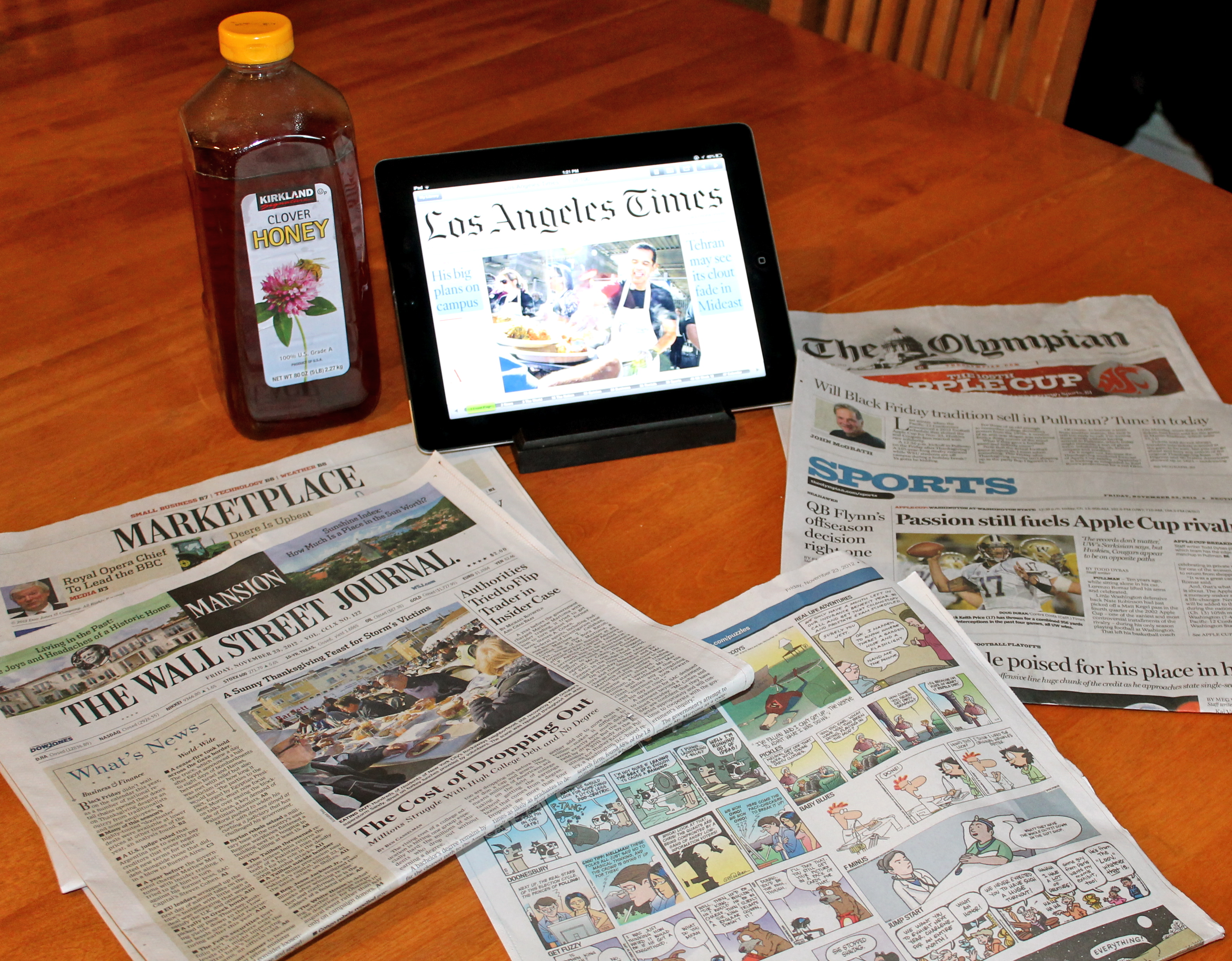
One of my fondest childhood memories involves my older brother who loved making my life miserable. He routinely read the morning sports page and comics while eating toast weighted down by peanut butter and honey. Inevitably, a few drops of the honey would spill over onto the paper, so that when our dad read it, pages would stick together. Prompting dad to snap and drop a “g*d dammit” much to my delight.

Fast forward forty years to our Olympia, WA breakfast table. The GalPal and I grew up in newspaper reading families so we’re part of the diminishing newspaper reading minority. I read lots of local and national newspapers on my laptop and iPad. But as you know, the heavy hitters—led by the New York Times—have started to charge for more than very minimal access.

We have a local paper weekend subscription which runs $13.33/month or $160/year. 52 weekends times three days equals 156 issues a year at a cost of $1.02/per. That’s a terrible value, but it’s a concession to marital peace. For some reason Betrothed has to hold the paper in her hands on the weekends. I hear divorce costs more than $160.

And we subscribe to the Wall Street Journal which runs $8.33/month or $100/year. That’s the educator’s discount price. The regular price is three times more at $26/month. 52 weeks times six days minus holidays equals about 305 issues/year at a cost of 32.7¢/per for me and 98¢ for the masses. That’s for home delivery and complete digital access on any device.

The WSJ subscription is about to expire and I’m thinking about switching to the New York Times digital/tablet edition. No home delivery. Unlimited access on any computer and tablet. Smart phone access is a little more. Educator’s discount price, $10/month; regular price, $20/month. That’s $120/year for 365 issues meaning about 32.9¢/per for me and 66¢ for the masses.

Another option is PressReader, the best choice for serious news junkies. It’s like a cocaine addict buying a personal cocoa field. For $30/month subscribers gain access to 2,300 newspapers from 95 countries, representing 54 languages. Here’s a 4+ minute video introduction. They’ve provided me with a sample subscription which I’ve been trying out. It’s a promising application, but it may not have your local paper. Also, it takes 10-15 seconds for papers to download and moving around within papers takes some getting used to. If it was my only option, I’d adjust quickly and like it, but I’m going to pass on paying three times more for way more content than it’s possible to process.

As if the newspaper subscription water isn’t muddy enough, two more options include the online news aggregator Zite which I’ve reviewed before (here) and Pulse another news aggregator which I really like and highly recommend (both available at iTunes). Pulse works especially well for skimmers. In fact, I dare you to find a rival.

For the love of all things digital, someone please convince the GalPal the answer is obvious. Read the local paper online, use $120 of that $160 in savings to subscribe to the New York Times, and use the remaining $40 to buy more dried mangos.

Empathy Impaired

The New York Times’ commentators have been writing a fair amount about how to revive our moribund economy and related issues like consumer and government spending, taxes, and unemployment. Sometimes I find the readers’ “recommended comments” more interesting than the essays themselves. They’re liberal and decidely cynical about life in the U.S. today. Their most common rallying cries are corporate greed, class warfare, out-of-touch politicians, and right-wing media.

Recently, they’ve been most fired up about members of Congress being out-of-touch with ordinary citizens, many who have been laid off, and too many that appear to be entering into permanent unemployment.

The question I haven’t seen asked is how does one, whether a member of Congress, or a college professor, develop empathy for the under-employed or short, medium, or long-term unemployed? The best answer of course is direct personal experience, but giving up one’s job in the interest of greater empathy doesn’t make much sense.

There have to be better ways, whether documentaries, essays, novels, photographs, music, and plays, that can help humanize the out-of-touch among us. The arts seem especially well suited to this task. I wish The Times’ irate, cynical commentators would each choose an art form and begin telling their stories with the out-of-touch Congress as their primary audience.

April Miscellania

• The wife got me with a pretty good April Fools, said the new car “wasn’t starting in the morning” and “we should have someone look at it.” I had to return serve. So a few hours later I told her “Good news, the NYT is reporting that young trendsetters are dying their hair gray.” She laughed heartily until I said “April Fools!” That fact that it wasn’t a joke, is now the joke. That’s just the multi-layered way I roll.

• Got some rare direct blog feedback at dinner last week. One of my sibs said indignantly, “Why should anyone care about the details of your fitness routine?!” I explained those posts are primarily for Lance. Consider them optional, not required reading. Lance NEEDS to know how hard to work to maintain his running and cycling superiority.

• So here’s my indignant sib-adjusted fitness report for March. Battled a micro-tear in one calf and then threw my back out lifting/twisting dumbbells to and from the rack without my legs. Lost about a week. Swam 23,900m; cycled, 340; ran 97. WOM (workout of the month) was a 33 mile ride and 2.25 mile run with my 22 year old uber-niece who is about to kick some serious butt at the College Nationals Triathlon in Texas.

• March Madness update. The WSJ computer and I are currently in sixth or seventh place out of eleven in the office pool. If Duke wins, I will probably end up on the podium, but no one remembers who came in second. The first five participants don’t even follow college bball. I’m actually glad computers apparently can’t quantify something as complex as a 64 team tournament. It won’t be the same when it goes to 96 teams. Classic case of less being more. Of course this year I wish it had been 196 because then UCLA might have qualified.

• This recent David Brooks essay is one of my favorites of his of all time. Brooks got killed by the most recommended commenters. I found some of their comments perceptive, but most of those were of the “Look at me, I caught you being inconsistent” variety. No one is always perfectly consistent. Many of the most recommended comments struck me as weakly argued, mean-spirited, knee-jerk liberalism. I’m a liberal, but not a fan of knee-jerkism of any variety. Very easy to criticize especially so indirectly. I give Brooks credit for courage. He knows he can’t win when it comes to most NYT readers.

• Personal record for blog readership in March 2010; however, no reason to get carried away, you’re still a member of a select group. For reasons I’m not entirely sure of, people never comment on my personal finance posts, so I think I’ll retire that thread. Even though readership is up, commenting is not. Maybe I’m not angry enough? Maybe I need to tap my inner-Glenn Beck. Also, for reasons I’m not entirely sure of, I can’t get many readers to follow the small number of links I sometimes include. Case in point, you didn’t even open the previous Brooks’ link did you? I know everyone is pressed for time and I appreciate the fact that more people are at least logging on and skimming posts.

• Turns out I was exaggerating when I wrote that I’d pay anything for an iPad. I have not ordered one yet not because I wanted to read the reviews that were just published and let the application/software dust settle a bit. I anticipate buying one sometime before the summer equinox, but as a card carrying late adaptor, if so moved, I reserve the right to postpone the purchase indefinitely. Not owning one won’t stop me from adding “Sent from my iPad” on the bottom of my emails. Faux tech cache. Sometimes I amaze myself.

• Speaking of email, publicly admitting that I suck at it in my last post proved cathartic. Oddly, it inspired me to turn over a new email/internet leaf captured in this sticky note. Three days later, I’m stickying to it. Now email is not the boss of me, I’m the boss of email!

The note doubles as a logo cover, sorry Apple

Tech Notes

Personal record for links in this post.

By the time you read this, I hope Steve Jobs will have changed personal computing again with Apple’s long awaited tablet. I invest in vanilla bond and stock index funds, except for one stock, AAPL. Wednesday night, I expect the value of my AAPL shares to be flat or slightly down due to the Obama-effect, unrealistic, unmeetable expectations. More importantly, I’m hoping the tablet makes reading even easier and more enjoyable, makes flying more tolerable (via a mobile library or t.v./movie viewing), is as simple as a toaster to use, and enables me to reduce my personal tech footprint. Bonus points if it drags me into the 21st Century cell-phoning, texting world.

I recently purchased a desktop computer which, four or five years ago, I swore I’d never do again. At that time, I didn’t factor in my worsening vision. One complication is keeping the university’s laptop and my personal desktop in sync. Apple’s MobileMe program was okay, but I didn’t want to pay $100/year for it. So I resorted to thumbdriving, which is a hassle. Then I read this. Love it. Hard to believe the Late Adaptor is cloud computing. Check it out if you’re digital life is out of sync.

I also joined the DVR-world recently, Tivo more specifically. What was I thinking trying to watch t.v. without Netflix and Tivo? To quote my previously brilliant/illuminating review, “love it.” One unintended benefit. Fourteen is watching a lot more t.v. That translates into worse grades, which translates into a less expensive college. Genius. Sometimes I amaze myself.

The New York Times has announced plans to charge nonsubscribers for some content in about a year. Others have tried this unsuccessfully and I predict this effort will fail too. There’s simply too much competition, meaning substitutes. Tonight in the tub I’ll read an article from GQ and the Atlantic Monthly. That reminds me, I also hope the tablet is water proof.

Lastly, if you fancy yourself a runner, swimmer, or cyclist, check this blog post out. The triathlete author is a blogging and technology savant.

David Brooks. . . It’s Not About Race

Somewhere along the line, over the last five or so years, David Brooks became our national political analyst. I read him this morning in the New York Times, I listened to him on National Public Radio while making dinner, and in short order I’ll watch him on PBS’s NewsHour. The DB trifecta.

Unlike most of his NYT readers, I like Brooks’ work, which doesn’t mean I always agree with him. Today’s commentary wasn’t his finest moment. Before ripping him, I acknowledge it’s impossible to be lucid, let alone insightful, perceptive, and provocative a few times a week in print and several times a week on air.

Maybe when it comes to our NPA, we’ve reached a point of diminishing returns. In today’s essay he reads way too much into his anecdote of white tea party protestors eating at an African American family reunion.

I’m supposed to find more meaning in Brook’s mid-jog Beltway anecdote than the analysis of numerous African-American and other analysts who cogently argue recent events convincingly illustrate race still clearly matters?

David, beware the “Tom Friedman effect”. Friedman, Brook’s colleague at the Times and a Pulitzer prize winning author suffers from what might be referred to as an “entrenched elite echo chamber”.

Friedman travels the world reporting on geo-politics and writing books about all things global. I’ve read him closely and concluded he’s almost completely clueless about ordinary people’s lives in the places he travels to and reports from because he almost never comes into contact with ordinary citizens in any substantive way. He almost exclusively references elites, favoring business and political heavyweights. Sometimes he’ll quote his cab driver in a strained stab at psuedo-populism.

Here’s how I suspect the entrenched elite echo chamber evolves: 1) grow up in a privileged family; 2A) attend elite K-12 schools; 2B) pick up a few degrees at highly selective colleges and universities with a majority of people from privileged families that attended elite schools and 2C) participate in extracurricular activities with other elites; 3A) enter a profession which pays well with 3B) a majority of people from similarly privileged backgrounds; 4A) move into a mostly white, well-to-do neighborhood; 4B) form friendships with neighbors whose kids attend elite schools and participate in the same extracurricular activities; 4C) attend the same kid’s activities and dinner parties with the parents of your children’s friends in the same economically homogenous neighborhood. 5) Do everything possible to get kids into highly selective colleges and universities. 6) Repeat.

I’m not immune from the echo chamber although it’s probably not quite as elite as DB’s and TF’s. My neighborhood has some cultural, but minimal, economic diversity. In all honesty, I’m not friends with many working class or poor people; consequently, I can’t pretend to understand them.

By acknowledging those two things I’m not quite as susceptible to the “Tom Friedman” effect.