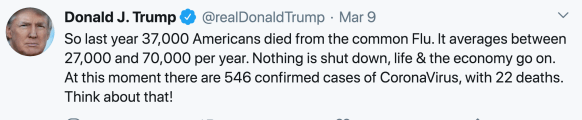
That will draw a lot more eyeballs to the VF piece. More importantly, consider that at a time like this the President is making time to read what magazines think about him and to respond to them. Priorities.
It’s early, in the both the 2020 election and the Coronavirus build, but the election could turn on tweets like that.
“Trump is the first president to use the stock market as a near-daily measure of his success — and his virility — and now the market is slumping. If you want to own it on the way up, you have to own it on the way down.”
His “success” and “virility” may take serious hits on Monday.
“One kind of queer politics is rooted in ideas of liberation, revolutionary change, and solidarity. The vision of this politics is a society that is radically changed by many kinds of people fighting many kinds of injustice, a society in which economic, social, political, and sexual relationships have been transformed. The roots of this politics are acknowledged in an open letter authored by a group called Queers Against Pete. (The letter was signed, according to the organizers, by more than two thousand people.) They wrote, ‘We are clear that LGBTQIA people are directly and disproportionately impacted by police violence, incarceration, unaffordable healthcare, homelessness, deportation, and economic inequality among other things.’ The strategy of this brand of politics is to work across differences to bring about change.
The other, more mainstream, and often more visible kind of L.G.B.T. politics aims to erase difference. Its message to straight people is “We are just like you, and all we want is the right to have what you have: marriage, children, a house with a picket fence, and the right to serve in the military.” The vision of this politics is a society in all respects indistinguishable from the one in which we live now, except queer people have successfully and permanently blended in. To be sure, all kinds of queer people have been involved in both kinds of queer politics. But the politics of being “just like you” leaves out the people who cannot or do not want to be just like conventional straight people, whether in appearance or in the way we construct our lives and families.”
I’ll give you one guess on which one is Pete’s track.
“If you’re assuming the best about the kid, that they want to learn appropriate behavior, they want to be positively connected to you, but they somehow can’t, there’s something in the way. What can you imagine the invisible subtitle is for ‘I don’t care?’
‘For me, the invisible subtitle for ‘I don’t care’ is, Mrs. Dearborn, I really, really care, but I can’t tell you that. Do you care?’
Reading the ‘subtitles,’ as she calls them, has helped Dearborn to stop perceiving misbehavior as disrespect. That doesn’t make her a pushover, she said. It makes her an advocate for the student.
So now when kids say, ‘I don’t care’ to me, I say, ‘That’s OK because I care, and I can care for the both of us right now, so let’s do this.’”
“I can care for the both of us right now.” Beautiful.
I took a class in college on the history of religion in the United States. About all I can recall from it was being intrigued by the unwieldy, far out nature of one of the “Great Awakenings”.
“The Great Awakening refers to a number of periods of religious revival in American Christian history. Historians and theologians identify three or four waves of increased religious enthusiasm occurring between the early 18th century and the late 20th century. Each of these “Great Awakenings” was characterized by widespread revivals led by evangelical Protestant ministers, a sharp increase of interest in religion, a profound sense of conviction and redemption on the part of those affected, an increase in evangelical church membership, and the formation of new religious movements and denominations. The Awakenings all resulted from powerful preaching that gave listeners a sense of personal guilt and of their need of salvation by Christ.”
What’s the opposite of religious revival? A secular surrender?
A Secular Surrender is when we talk about public health threats in the context of stock market volatility and don’t think of it as sordid.
A Secular Surrender is when “leaders” ignore religious violence like that perpetrated by Hindu mobs against innocent Muslims in India this week.
“It has been the bloodiest days of protest in India since Modi’s government passed a new citizenship amendment act, which grants citizenship for refugees of every major South Asian religion except Muslims, in December.”
In fairness, Modi did take to his keyboard to tweet an appeal for “brotherhood and peace” (that was sarcasm).
The Guardian describes the violence:
“The death toll from the worst religious violence in Delhi in decades has risen to 24, as Muslims fled from their homes and several mosques in the capital smouldered after being attacked by Hindu mobs.
The deathly clashes between Hindu and Muslim groups that began on Sunday continued into their forth consecutive day, with reports of early morning looting on some Muslim homes which had been abandoned out of fear.
More than 200 people were admitted to hospitals for injuries mainly from gunshot wounds as well as acid burns, stabbings and wounds from beatings and stone pelting. Several of those who died had jumped from high buildings to escape the attacking mobs.”
You would never know it by evangelicals’ enthusiastic embrace of President Trump, but his and Modi’s words and actions contribute to The Secular Surrender.
Wikipedia again on The Great Awakenings:
“The Awakenings all resulted from powerful preaching that gave listeners a sense of personal guilt and of their need of salvation by Christ.”
I’m uninterested in guilt and my notion of salvation is far more funky than Whitfield’s, Edwards’, and Tennent’s, but I would like to live in a world where we think and talk about public health without any reference to stock market volatility. And in one where political and religious leaders condemn violence perpetrated by Hindu mobs against innocent Muslims.
Biden. “C-“. Came across as desperate. Clearly “his people” told him it’s now or never. Kept saying, “I’m the only guy who. . . ” Once referred to the Obama Administration as “My administration”. The repeated references to the past, coupled with his age, makes one wonder why we should put our future in his hands. Peeved at the moderators for slighting him. Reminded me of a once great athlete unable to walk away from the game.
Bloomberg. “D”. What a waste of $419m, the amount he’s spent on on t.v. ads so far. Of course, to him, that’s parking ticket money. I would love to see him debate Trump because he’s so good at trolling him and he’s clearly not afraid of him, but after he was eviscerated by Warren, the odds of him winning the nomination are about the same as me. His not crying or disappearing during one of the commercial breaks saved him from an “F”.
Buttigieg. “C”. Seemed resigned to not winning the nomination, but continued trying to position himself as the sensible alternative. Did a good job of repeating the $29,000 line, the amount at which people who support Sanders “Medicare For All” will see their taxes increase. Smiled a fair amount. His line about “living in his one house” in Indiana was excellent. Obviously thinks his geography is a distinct advantage, but has not acknowledged how it might limit his appeal to people of color. Tried to be mean to Klobuchar on her Mexico faux pax, but he’s not a natural cabrón. Should’ve shaved beforehand. Reminded me of a young athlete who may be great some day.
Klobuchar. “C”. Seemed resigned to not winning the nomination, but continued trying to position herself as the only person who can beat Trump because of her winning record. Came across like a car in a Minnesota blizzard with its back wheels spinning, spinning, spinning. Displayed an impressive array of “Oh shit, you did NOT just say that” facial expressions when attacked by Buttigieg and Warren. Gets credit for a sense of humor (“Post-it notes were invented in my State”) and poise when under attack. Sadly, she is the one candidate who is consistently cut off by moderators.
Sanders. “B”. Didn’t do anything obvious to slow his momentum. Sticked to his now predictable talking points. Handled the Culinary Workers Union controversy adequately. Avoided front-runner attacks thanks to Bloomberg’s presence. Someone from his team should send Bloomberg a $25 Starbucks gift certificate. How many people, like me, googled his age mid-way through? He’ll be 79 on election day. His campaign is an interesting political science experiment. Can people handle the truth about our country’s decline? About how social mobility has grinded to a halt? About how the quality of life is better in some other countries? That we’re lagging behind Denmark? Sadly, I don’t think so.
Warren. “A”. Yeah, I’m biased since I’ve thought she would make the best President all along. I loved the FIREY comeback. Her evisceration of Bloomberg had to make Trump nervous. She was the most prepared, most intelligent, most detailed, most focused of the candidates. But she wasn’t just flame throwing. Her defense of Klobuchar for not knowing Mexico’s president’s name (Andrés Manuel López Obrador) was one of her strongest moments. Girl power and all that. Reminded me of a great athlete in her prime.
A hypothesis. The 2020 Presidential election isn’t going to be decided on policy differences. As always, both candidates will make lots of promises, some partly fleshed out, others not. It isn’t even going to be decided on “kitchen table economics”, or tax proposals, or other manifestos for further weakening or strengthening our frayed social safety net.
It’s going to be decided on emotions, how the candidates make people feel about themselves, even more than how they feel about the country.
Remember Bruni’s description of how Trump makes his followers feel like victims:
“He has turned himself into a symbol of Americans’ victimization, telling frustrated voters who crave easy answers that they’re being pushed around by foreigners and duped by the condescending custodians of a dysfunctional system.”
The Demo candidate should rebut Trump victimization head on, repeatedly saying, “We are not victims. Your neighbors and you control your destiny. Together we can strengthen labor unions, create jobs that pay a livable wage, preserve our natural environment, and take care of the most vulnerable among us. Immigrants and foreigners are not our foes, our only foe is unfounded fear of the other.”
Trump also plays brilliantly on his followers sense that they’re being pushed around by the mainstream media, “coastal elites”, and anti-religious liberals whose common thread is a sense of superiority.
That’s why television segments like this (start at 2:33) are a serious problem for anyone who wants to defeat Trump in November. Like Hillary Clinton’s infamous “deplorable” slur, the single worst thing anyone who wants to defeat Trump can do is laugh at people susceptible to his victimization bullshit because it plays right into their belief that liberals are arrogant; that Democrats, whether they know it or not, whether they accept responsibility for it or not, can be counted on to convey a sense of superiority.
The larger context of this clip, Pompeo’s unconscionable treatment of a female reporter doesn’t matter. The fact that geography is not Trump’s strong suit doesn’t matter. The only thing that matters is how their laughing makes those susceptible to his victimization push feel because perception is reality.
For Democrats to win, they can’t let their animus for the Trump Administration spill over into disrespect for the dignity of moderates, independents, and “still undecideds” in Michigan, Wisconsin, Pennsylvania, Florida, Ohio, and elsewhere.
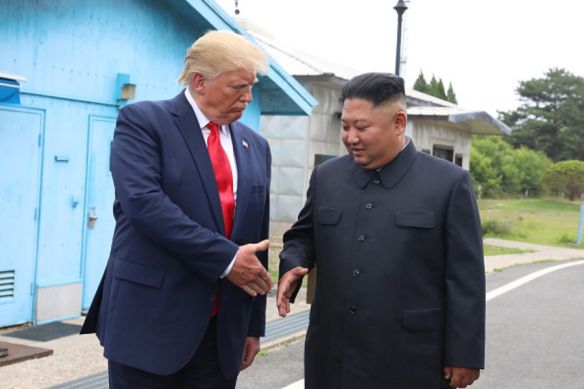
Long story short, the West has underestimated his dictatorial acumen ever since he assumed power. He’s much more like his grandfather than his father, meaning especially brutal, strategic, and politically shrewd. His position inside North Korea is extremely strong.
North Korea’s economy has improved under KJU whose loosening of rules, or looking the other way rather, has freed up market activity throughout the country. Far from an “invisible hand” though, entrepreneurs have to pay off local authorities to ignore repressive laws on the books. No one is starving anymore, but some people are malnourished due to a lack of variety in their diets.
On the other hand, and most importantly, concentration-like labor camps packed with alleged political dissidents continue to operate with the same brutality. I suspect the people in those camps face the most inhumane living conditions on the planet. No one has ever been known to escape one.
And yet, President Trump shows no concern for those victims. Instead he talks of condos at North Korea’s Wonson beach resort.
Moderate Republicans (not sure I should have used the plural) are using an “inappropriate, but not impeachable” line of defense to sleep at night. But what about the True Believers? Here’s how they think:
When candidate Trump promised to “drain the swamp” it sent shivers up their collective spine. How would they make ends meet at something less than $1,000/hour? Rumor has it some began playing public golf courses, others went plant-based to save on groceries, still others enrolled in certificate programs at Prince George’s Community College.
But based upon the live blogging of Michael S. Schmidt, a New York Times Washington Correspondent, it looks like D.C. legal beagles are going to be able to hang onto their Georgetown brownstones.
As the hearing slows down a bit, I’ve been doing back-of-the-envelope math on Sondland’s legal fees. He had a nine-hour deposition in October and preparation time for that. He submitted an amended statement two weeks later. Then he had more prep for today’s testimony. It is certainly over $100,000 and likely much much more.