
Mitt’s Grand Idea—Let’s Spend More on Defense

This is written for the three independent voters—one in Montana, one in Vermont, and the other in Oregon—that will most likely decide the 2012 presidential election.

Completely lost in the weekend “Mormonism is a cult” hubbub, is a much more serious two-part problem. Mitt Romeny is a liar and in serious denial about our nation’s finances.

Indira A.R. Lakshmanan reporting for Bloomberg Business on October 8th:

Republican presidential hopeful Mitt Romney accused President Barack Obama of bowing to global adversaries and promised, if elected, to boost America’s military strength by expanding the Navy and missile defenses.

“America must lead the world, or someone else will,” Romney said, reprising the argument from his 2010 book, “No Apology,” that U.S. military strength and leadership are essential to deterring tyrants and keeping world peace. “In an American century, America has the strongest economy and the strongest military in the world.”

Note to Mitt: “Our century” was the Twentieth. We’re in decline in large part because we’re spending way too much on Medicare and defense.

Romney pledged in his first 100 days in the White House to boost naval shipbuilding, deploy Navy carriers to deter Iran’s suspected military ambitions. . . and invest heavily in missile defense and cybersecurity.

At The Citadel and Oct. 6 aboard a World War II aircraft carrier in Mount Pleasant, South Carolina, Romney repeatedly said Obama is slashing defense spending and gutting missile defense, assertions that are contradicted by official data.

According to government figures, military spending under Obama is higher than it was under former President George W. Bush. Total Defense Department budget authority for non-war and war spending increased 3.6 percent from fiscal year 2009 to 2010, according to Pentagon budget data. Obama requested $708 billion in budget authority for war and non-war spending in fiscal 2011, an increase of 2.5 percent. 

Romney showed “once again that he is willing to say anything, regardless of the facts, to get elected,” Obama’s re- election campaign press secretary Ben LaBolt said in an e-mail.

The former Massachusetts governor on Oct. 6 released a list of foreign policy advisers, including many who served former President George W. Bush and advocated the invasion of Iraq. Several had supported so-called enhanced interrogation techniques or rendition of terrorism suspects to third countries, including former State Department counter-terrorism coordinator Cofer Black, former CIA Director Michael Hayden, and former Secretary of Homeland Security Michael Chertoff.

Aboard the USS Yorktown Oct. 6, Romney called for reinforcing the Navy and Air Force and adding 100,000 active- duty troops to reduce battlefield rotations.

One U.S. service member costs the government $100,000 per year on average, according to the non-partisan Congressional Research Service, meaning Romney’s plan would cost $10 billion per year, or $100 billion over the 10-year timeframe for reducing the nation’s deficit. 

Echoing a theme of American exceptionalism that was a favored Bush motif, Romney asserted that “God did not create this country to be a nation of followers. America is not destined to be one of several equally balanced global powers.”

Yes we most definitely are destined to be one of several equally balanced global powers.

Romney told listeners that he would ensure U.S. “leadership in multilateral organizations and alliances.” Romney has previously swiped at Obama for “leading from behind,” a reference to the White House’s push for NATO to take joint ownership of the military support campaign that allowed Libyan rebels to oust Qaddafi.

So this is what it’s come to, both sides competing to be the “Defense” party. I’ll spend more than you. No you won’t. Meanwhile, that frees up all the “follower nations” to use their finite economic resources to rebuild their infrastructure, strengthen their education systems, and improve their public health systems. Which in turn will enable them to close the economic gap with us even more quickly.

And to think some people are more worried about Mormonism’s multiple heavens and belief that Jesus visited the Americas.

This “my defense budget is larger than yours” bullshit makes me long for a third party. Since that’s not likely, I guess the only thing that “global military superpower” weary fiscal conservatives like me can do is support the side that will increase defense spending the least.

Shortcut Nation

From the September 29th, 2011 Wall Street Journal:

Reebok International Ltd., a unit of Adidas AG, agreed to pay $25 million in customer refunds to settle charges of false advertising brought by the FTC over the shoemaker’s claim that its “toning shoes” could work better than normal footwear to whip muscles into shape.

Its TV commercials featured women with shapely legs prancing around in the shoes while doing everyday activities such as walking, vacuuming, browsing a bookshelf and cooking.

Such shoes were one of the footwear industry’s smash hits, generating more than $1 billion in revenue last year though sales have slowed this year.

“The FTC wants national advertisers to understand that they must exercise some responsibility and ensure that their claims for fitness gear are supported by sound science,” said David Vladeck, director of the FTC’s bureau of consumer protection.

Sound science?! Does that mean Rick Perry can’t lace up his toners and run for the Republican presidential nomination?

Amazingly, the FTC didn’t find proof for Reebok’s claims.

Mary Lee Wagner of Fairfax, Va., bought into the craze four years ago, paying $230 for a pair of sneakers. The 58-year-old wore the shoes religiously for six months with hopes of shaping up her thighs. “There was no difference whatsoever,” she says.

She decided to give toning shoes another try after they went mainstream, reasoning that bigger companies had figured out a way to develop a more effective shoe. Two years ago, she bought a pair of Skechers Shape-ups for $75. After three months of use, she switched back to her $35 Ryka walking shoes. 

And dig this. Different article, same paper, same day. Can’t make this stuff up:

Scented products, including crystals you sprinkle on your food and products you inhale before eating, can trigger your body to think it’s full, aiding weight loss, say companies who sell the products. Nutritionists and doctors who specialize in weight loss say the research conducted so far isn’t convincing.

SlimScents LLC of Marlton, N.J., sells a $50 set of three pen-shaped inhalers, which it says last four to six weeks before losing their scent. Glacier Point Solutions Inc., of Long Beach, Calif., sells an $18 package of three Happy Scent jars—peppermint, banana and green apple—which it says last a year. Both products are designed to be sniffed five minutes before eating.

Another method is crystals you sprinkle on your food before eating. A six-month “starter kit” of Sensa crystals, from Intelligent Beauty LLC, of El Segundo, Calif., costs $289. The kit includes a new set of two types of crystals—one for sweet and one for other food—each month. On its website, Intelligent Beauty says the crystals, which it calls tastants, are designed to “trigger your ‘I feel full’ signal.”

The idea that scent can help you lose weight is “intriguing,” says Louis J. Aronne director of the Comprehensive Weight Control Program at NewYork-Presbyterian Hospital/Weill Cornell Medical Center in New York. But the research done so far is “not adequate” to show the currently marketed products work, he says.

Better name would be Louis J. Killjoy.

Intelligent Beauty says participants lost an average 30.5 pounds over six months in a 1,436-person study conducted by Alan Hirsch, a scientist it describes as the “founder” of its weight-loss system. However, Intelligent Beauty—which puts Dr. Hirsch’s photo on its Sensa packages—declined to answer questions about the study or whether Dr. Hirsch is on staff at the company, whether he has an ownership stake or whether he receives financial compensation from sale of the product. Intelligent Beauty initially set up a phone interview with Dr. Hirsch and then cancelled it, citing an “urgent matter.” Dr. Hirsch, an assistant professor of psychiatry at Rush University Medical Center in Chicago, didn’t return a call seeking comment.

James O. Hill, co-founder of the National Weight Control Registry, a database of more than 6,000 people who have lost an average of 70 pounds and kept it off for six years, says there is no quick fix for people who successfully lose weight.

No. Quick. Fix. Damn you, James O. Hill.

Registrants exercise a lot and are “conscious of every morsel they put in their mouths,” says Dr. Hill, who is executive director of the Anschutz Health and Wellness Center at the University of Colorado in Denver.

That doesn’t sound like much fun.

Steve Jobs

John Gruber of Daring Fireball quotes Steve from his 2005 Stanford commencement address:

Remembering that I’ll be dead soon is the most important tool I’ve ever encountered to help me make the big choices in life. Because almost everything — all external expectations, all pride, all fear of embarrassment or failure — these things just fall away in the face of death, leaving only what is truly important. Remembering that you are going to die is the best way I know to avoid the trap of thinking you have something to lose. You are already naked. There is no reason not to follow your heart.

Puts the negative press coverage of the iPhone 4S in perspective. We forget we’ll be dead soon and lose sight on what is truly important and instead focus on the status phones provide, stock prices, and market share.

[Besides the commencement address, fav read from last night—The Steve Jobs I Knew by Walt Mossberg]

Groundhog Day: Surprised Again By A Star Athlete’s Flaws

Jeff Pearlman’s book, Sweetness: The Enigmatic Life of Walter Payton, was released yesterday. Payton played professional football for da’ Bears from 1975-1987. The Walter Payton Man of the Year award is given annually by the NFL honoring a player’s volunteer and charity work, as well as his excellence on the field. Prior to 1999, it was called simply the NFL Man of the Year Award. Shortly after Payton died from cancer in 1999 the award was renamed to honor his legacy as both a great player and a humanitarian.

A humanitarian who, according to Pearlman, was in a long-standing close relationship with another woman besides his wife (who insisted not only on attending his Hall of Fame induction ceremony, but sitting in the front row), was addicted to pain pills, and seriously contemplated suicide. Apparently Pearlman spends twenty to thirty of the four hundred pages on the unseemly underside of Payton’s private life.

Payton’s coach, Mike Ditka, is leading a backlash against Pearlman’s book. “I’d spit on him,” he said recently. “I have no respect for him.”

In which case I have no respect for Ditka who needs a primer on the first amendment.

Dan Patrick, my favorite sports media person, recently discussed the controversy engendered by the book. His question was, “Do you the fan want to know the truth about the athletes you follow?” Patrick said he did. Others on his show said they did not. Patrick went on to say the fans don’t realize athletes are human beings. Ordinary human beings, a mix of good and bad, like all of us.

Wouldn’t it be nice if they were more like us. If we limit the discussion to professional basketball and football players (versus professional marathoners, swimmers, or amateur athletes for instance) from the last decade or two, there’s ample legal evidence that their behavior, on average, is far worse than the ordinary human beings that pay to watch them play.

Why? Some possibilities:

1) If power corrupts and absolute power corrupts absolutely, the same is probably true for money. I suspect, especially in cases where someone grows up without any, mad money blows those teetering on the fence of adhering to society’s norms off onto the “laws don’t apply to me” side.

2) Public adulation is another wind blowing those teetering on the fence of society’s norms off onto the “laws don’t apply to me” side. The star professional athlete’s classic line when pulled over, “Don’t you know who I am?”

3) In the case of football at least, the more violent the player is on the field, the more successful. Maybe it’s hard, when the stadium and television lights are turned off, to throw the non-violent switch.

4A) Some athletes blow through their money while playing short careers, don’t have enough of an education to fall back on after retiring, and turn to the “informal” economy to get by. See Lenny Dykstra. 4B) Some suffer from public adulation withdrawal. The Dennis Rodman effect. They’re committed to staying in the public’s conscience even if they have to repeatedly get arrested to do so.

5) Sociology. You are the company you keep. Middle school students aren’t the only ones susceptible to negative peer pressure. Locker rooms no doubt have tipping points.

Of all people, Ditka should know that every athlete is a one-person public relations firm. There are lots of faithful, law-abiding professional athletes making worthwhile contributions to society off the field. Just not as large a percentage of the readers of this blog.

Developing In-depth, Intimate Friendships

Who knew there’s something really nice about driving to swim meets way out on the Kitsap Peninsula. Or more specifically, driving home from them.

Four years ago, following the South Kitsap meet, Nineteen and I started out listening to National Public Radio, and then as the sun set on Commencement Bay and the Narrows Bridge, talked about the world, her world, our worlds. Not a top-down father-daughter talk, a balanced adult one.

Last week, as Sixteen’s (S’s) passenger, I was in the right place at the right time for another thoughtful and memorable conversation. I mostly listened as she described a moving letter she had received earlier in the day from a close friend who struggled with anxiety last year. The friend wanted S to know how important her help had been and how much her understanding presence meant to her. Her other friends, she explained, ran a little hot and cold, which made her especially appreciative of S’s consistent care.

“What I like about A.F. is she’s vulnerable,” S reflected while hugging the right line of the two lane highway. “She’s not afraid to admit everything’s not all right. That gives me the opportunity to help.” She explained how good it felt to help her friends, to share insights from the serious difficulties she experienced as a middle schooler. It gives purpose to that especially challenging chapter of her life.

S’s story reminded me of two important steps in developing in-depth, intimate friendships—admitting one’s vulnerabilities and humbly asking for help.

Taken together, sometimes saying, “I’m afraid. I’m anxious. I’m lost. I’m stuck. Can you help me?”

Knowing that doesn’t mean I do it well. I don’t. At all. I probably inherited my stubborn, sometimes self-defeating self-sufficiency from my parents who grew up in barren eastern Montana on the heels of the Depression.

Paradoxically, I enjoy helping my friends whenever they ask for help, but I don’t like inconveniencing them. At all. A tip of the iceberg example. I spent twenty minutes in the garage last week unsuccessfully trying to tighten a bolt, while holding a washer, and screw in a very awkward position because I didn’t want to inconvenience the wife. Finally threw in the towel, asked for her help in applying pressure to the top of the screw, and had everything assembled in less than a minute.

More significantly, I’m almost always resistant to counseling, yet the few times I’ve committed to it, it’s proven helpful.

Obviously, everyone has to be somewhat self-sufficient, but there’s a point of diminishing returns, a point I cross fairly regularly. I’m not sure how to explain my stubborn, sometimes self-defeating self-sufficiency. It’s irrational. If I could throw a “start depending upon others more on occasion” switch, I would have already.

I’d ask you for help, but I don’t want to inconvenience you.

Maybe I’ll just groove some more to Bill Withers in the hope it’ll eventually sink it.

Thanks S for the inspiration.

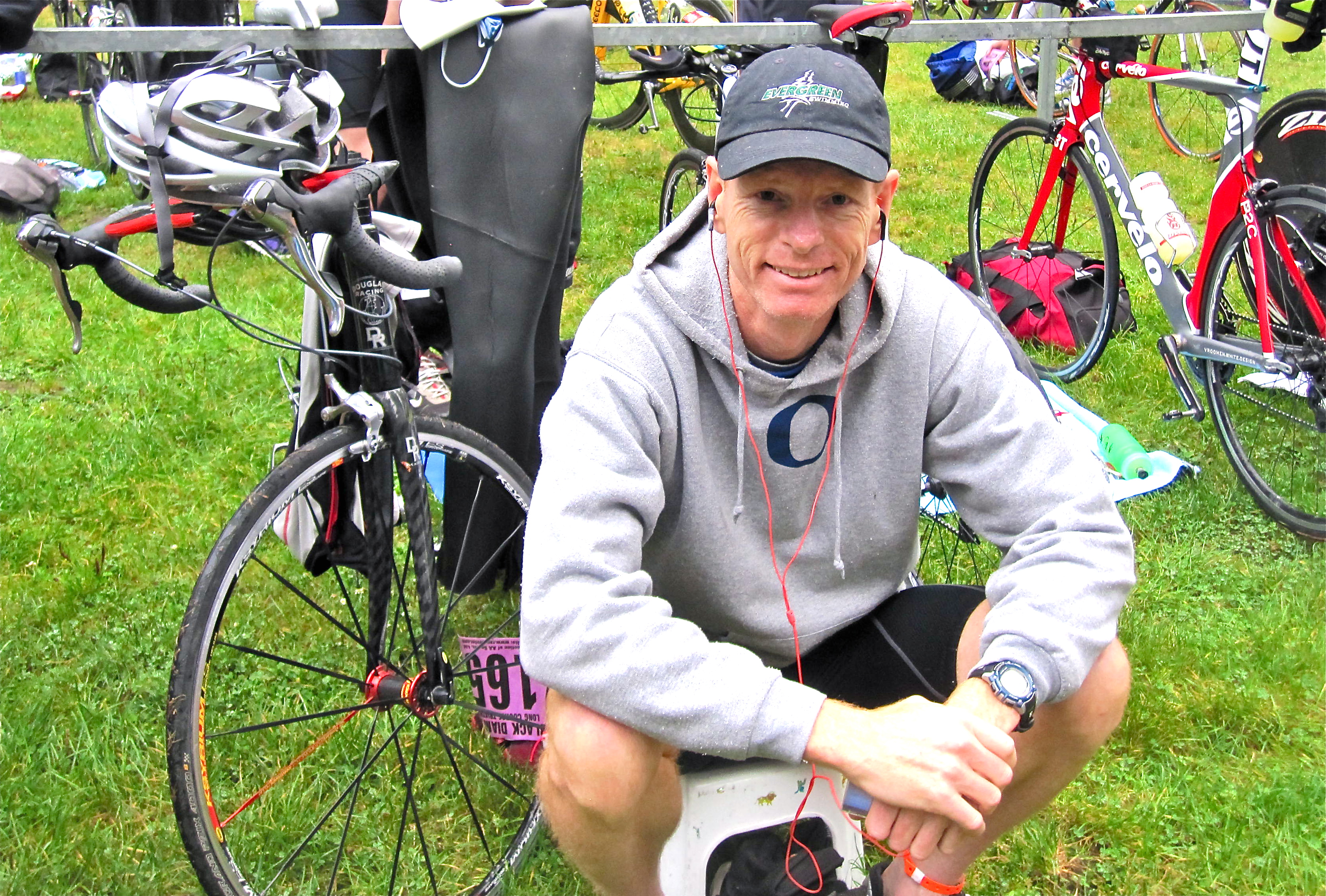
I’m Registered for the 2012 Penticton BC Long Distance Triathlon

Assuming I’m alive and well, I will wade into Lake Okanagon around 6:45 a.m. on August 26th, 2012.

It’s only taken me about fifteen years to commit to going crazy long—2.4 mile swim, 112 mile bike, and 26.2 mile “run”. My brother, who calls it Ironman Canada, did it when he was in his early 40s. Me at 50, figure that’s a fair fight.

Why now when I haven’t been racing at any distance? A perfect storm of cognitive slippage, turning 50, watching my friends race all summer, getting stronger on the bike, and reflecting on the GalPal’s health struggles.

I’m more anxious than excited because it’s the most I’ve ever asked of my bod. The training is going to require unprecedented self-discipline and I’m going to suffer big time on race day. I’ve already lost some sleep with jarring images of the swim start and “running” for four hours plus in 90 degree weather after 112 miles in the saddle.

If it’s 90+ degrees on the run like it was this year, my brother’s family record of 11:45 is probably safe. I know he’ll be rooting for me. . . to blow up early in the run.

Can’t wait to embrace the triathlon subculture I’m so enamored with. I love the World Triathlon Corporation’s single-minded bidness focus so I’ve decided to rent myself out to the highest bidder. That’s right, I’m officially for sale. NASCAR has nothing on me. I’ve already been contacted by representatives from AAPL, Coca-Cola, and Tide. I’ll wear their logos, or if the price is right, have them permanently tattooed on the body part of their choice.

I’m going to use that revenue flow to hire a coach who I will pay more than two-thirds of the world’s people earn. Also, don’t tell the GalPal, but I’ll be tapping our retirement accounts to buy lots of very expensive bike equipment, shaving grams as I go. Hyperbaric chambers aren’t cheap either.

And rest assured, I’ll embrace the narcissism that often seems endemic to the sport. That means I’ll be posting pillions of pictures of myself getting fitter and fitter and blogging about all of my training details until every last reader’s eyes glaze over. And even though my brother looked roided up in 2002, I’ve decided to race clean, again in an effort to level the playing field.

Just kidding. My primary goal is to put in the necessary work without letting it take over my life. More easily written than done I suppose. Appropriately starting on April 1, just under five months of prep. Eight week build, followed by eleven weeks of high volume, and a ten day taper.

Ron Byrnes has agreed to coach me. And with the goal of not letting it take over my life, I don’t intend on blogging much about my prep. If all goes well, I will toe the line in the best shape of my life and then race smartly, meaning steadily.

Can I put in the work without breaking down or losing balance, survive the swim start, avoid tacks on Maclean Creek, run slowly all afternoon instead of walking, go sub 11:45, and get home without cramping up uncontrollably and driving off the road?

Stay tuned sports fans.

2011 Black Diamond Half Iron Race Report

With apologies to Lorne, swim-bike-run posts today and Friday. We return to regular programming Monday, October 3rd.

Like Brett Farvah, came out of retirement to compete in the Black Diamond Half Iron last Saturday. The weather was ideal, calm, partially sunny, 60’s-lower 70’s.

Only my second half iron—1.2 mile swim/56 mile bike/13.1 mile run. Finished in 5:13+ in 2006 after cycling too hard for my fitness and unraveling on the run. Took me five years to recover.

The deets—30:42 swim, 3:12 T1, 2:42:54 bike, 1:52 T2, 1:40:09 run, 4:58:49. One of the athletic accomplishments I’m most proud of along with extricating myself from the top of my roof after getting spread eagled putting on Christmas lights and scoring five goals in a sophomore water polo game against Western High in Cypress, CA back in the typewriter era.

Chillin' pre-race

Heaven help me if Chip Schooler ever sees this playlist!

Went in with modest swim volume and three short runs off the bike. Hadn’t ran 13.1 in ages either. On the other hand, my cycling was really solid all summer, I’ve strengthened my core, and I’ve been churning out 30 mile running weeks. Despite being fit, I was nervous about going out too fast and then unraveling again. So the plan was to stay within myself, cruise/bilateral breathe throughout the swim, keep the cadence high on the bike, and run conservatively from start to finish.

The fog just waiting for the start gun

Fog rolled in right as we were starting the swim. It was a two loop .6 mile diamond shaped course so the buoys were closer together than normal, but the fog got so thick it was hard to see them. I was sighting off the arms of a guy in front of me in a sleeveless wetsuit. Felt like I zigged and zagged a bit inside and outside the buoy-line which gives me a sponsorship idea.

The other problem with the swim was I couldn’t dial it back after going hard for the first 150 yards to get into some open water. I didn’t bilateral breathe once and swam harder than I had intended. Theme of the day. Decent time/start.

The bike course was nice, wide shoulders, smooth pavement, rolling. Just over 2k’ in elevation. And it was the cleanest race I’ve ever seen. A couple out and backs, two loop course so lots of opportunities to see others, and not one instance of drafting. With my road bike, pseudo-aero bars, and non-race wheels, I was outgunned in the hardware department, but I put up an admirable fight. I also road differently, like the roadie I am, standing on the climbs, coasting in a crouch on the descents, only aero maybe half of the time. Everyone else seemed like they were aero all the time, always seated, pedaling downhill, perfect spike-free wattage charts no doubt. My wattage chart would probably resemble that of a major earthquake.

Late in the ride, going pretty hard at over 20mph, I felt a wee bit of lactic acid forming. Internal dialogue. “How are you planning to run after this?” Again, couldn’t get out of my mod-hard groove. “We’ll, we’ll know whether we rode too hard by the two mile mark of the run.”

The run was on rural roads with a couple of out and backs, one ran twice. I liked it because again you could see where you were relative to the other competitors. Right out of T2, I exited stage left into a PortaPit. I’ve watched televised college football games that took less time than that whiz.

Once I started running in earnest, a 25 year old passed me like I was standing still. I figured that was a good sign that I hadn’t started too fast. Shortly afterwards, he cramped up and stopped. Eventually he recovered and later passed me, ultimately finishing about a minute ahead of me. Youthful exuberance, terrible pacing. Only dude to pass me during the run (because the burners outcycled me)*. I was cruising, thinking I was running my planned 8:00/minute miles, but my splits were crazy fast–7/7:20ish. What the hell? I had my legs and the turnover was there. I began picking off people, looking past the person in front of me to the one in front of them and then pulling them back. Only once got out of my comfort zone when I didn’t realize the road had kicked up a few degrees.

I was cruising so comfortably I was pre-writing this blog post in my head, not racing per se, just running within myself, not chasing people, just watching them come back to me. Then everything changed at mile 8. I decided my 7:20’s were suicidal and decided to sit on a guy I ran up on until mile 10. “Use him to slow down,” I told myself. Just about then, my hammies seized up as they often do when I ask too much from them. Did the straight legged walk a bit, managed to work it out enough to slowly jog to the aid station, downed some electrolyte drink, and then eased back into running. Too strong of a performance to succumb to walking. Now 43 (his age as noted on his right calf) was at least 100 meters up on me. Both hammies were on the edge, but I tentatively pressed on.

Between mile posts 10 and 11, I came back up on 43 and now 46 who he was sitting on. Pass or rest for the final two miles? I decided not to adjust my pace and made the pass. 43 said something like “Didn’t know if you were cramped up for good” and I assured both of them I was on the edge and my hammies could go at any minute especially on the downhills. Didn’t know if one or both would come with me, but neither was able to. Finished steadily over the last mile of trail around the lake. I was pleasantly surprised by my run and the day more generally.

Walked straight to the beach, stripped down to the bike shorts, and disappeared into the cold lake. Nothing speeds recovery like that. Well, besides a Big Tom’s chocolate shake.

* Except for John Brewer (47) of Kirkland. Check out his splits for a chuckle. I went to the race director to get a print out of the results so the mean lady guarding the age group awards would give me mine. Tangent—if I had known it was another very hokey (made in China) medal with nothing imprinted on it and not the cool clear/plexiglass engraved plaques for the winners, I wouldn’t have bothered. Anyways, I watched the Race Director spend fifteen minutes trying to explain to JB that he cut the course. He was incredulous. The Race Director drew a detailed map of the course and went over it and over it. Then afterwards his friend said “Yeah, I should have seen you here (pointing to an out and back on the hand drawn map) and I never did.” I would have been more direct than the Race Director. “You were 102nd in the swim, 78th in the bike, but somehow rallied to run the fifth fastest run split of the day?! Any relation to Rosie Ruiz?!”

The Politics of Travel

The North Korean dictatorship now sees tourists on cruises as the best way to generate some foreign currency with which they can keep buying western luxury goods for themselves. Fifty-four pictures here.

Do the mostly Chinese tourists have no conscience? Don’t they realize they’re propping up the most heinous dictatorship in the world?

Easy to rip them I suppose, harder to reflect on the ways our travels sometimes negatively impact the people and cultures we visit.

When teaching and living in Ethiopia, I took what I thought at the time was an excellent picture that captured the harsh reality of poverty in the developing world. It was of two young girls who had hiked up to the top of the hills north of the capital city, Addis Ababa, with a huge thicket of wood branches on their tiny arched backs. Technically it was National Geo-like, and even more impressive after the excellent matting and framing job. After having it hanging in our home for quite a few years, the haunting, absent look on the girls’ faces started to trouble me. Despite being someone who values my privacy, I hadn’t asked for their permission. I raised my camera with my fancy zoom lens, pointed it right at them, and snapped.

There was no reciprocity in our interaction, no balance. I’ve since taken it down and use it as a discussion starter when teaching about cultural globalization.

I have other similarly unflattering travel stories. We don’t like to think about, let alone tell those stories though, opting instead for innocuous ones as if our travels are apolitical.

Our travel negatively impacts the physical environment; our physical presence inevitably changes the cultural environment; and our loding, dining, and recreational decision making tends to create distant economic winners and local losers.

To mitigate our negative impact, maybe we should travel less often, over shorter distances. And when we do travel far afield, we should strive to do so as global citizens, not amoral global tourists like the damn Chinese on the North Korean cruises.

How Well Do You Know Yourself?

The wife recently asked me to take the Jung/Myers Briggs personality test available here. Probably wanted to find out what’s wrong with me. It was relatively pain free and the results mostly jived with my sense of self. Take it and tell me what you think of the results.

I’m an INFJ or “Idealist Counselor”. Here are some excerpts from the “Idealist Counselor” description:

Counselors have an exceptionally strong desire to contribute to the welfare of others, and find great personal fulfillment interacting with people, nurturing their personal development, guiding them to realize their human potential. Although they are happy working at jobs (such as writing) that require solitude and close attention, Counselors do quite well with individuals or groups of people, provided that the personal interactions are not superficial, and that they find some quiet, private time every now and then to recharge their batteries. Counselors are both kind and positive in their handling of others; they are great listeners and seem naturally interested in helping people with their personal problems. Not usually visible leaders, Counselors prefer to work intensely with those close to them, especially on a one-to-one basis, quietly exerting their influence behind the scenes.

Except for the fact that I could be a much more patient listener, that’s accurate to the point of almost creepy. Helps explain why I prefer small dinner get-togethers to large cocktail parties and why I loathe self-promoters. There’s more.

Counselors are scarce, little more than three percent of the population, and can be hard to get to know, since they tend not to share their innermost thoughts or their powerful emotional reactions except with their loved ones. They are highly private people, with an unusually rich, complicated inner life. Friends or colleagues who have known them for years may find sides emerging which come as a surprise. Not that Counselors are flighty or scattered; they value their integrity a great deal, but they have mysterious, intricately woven personalities which sometimes puzzle even them.

Isn’t blogging going against the Counselor grain? Not necessarily. I share thoughts and emotions, but not my innermost thoughts or most powerful emotional reactions. I’ll probably peel more layers off over time, but never get to the core in this format at least.

Counselors tend to work effectively in organizations. They value staff harmony and make every effort to help an organization run smoothly and pleasantly. They understand and use human systems creatively, and are good at consulting and cooperating with others. As employees or employers, Counselors are concerned with people’s feelings and are able to act as a barometer of the feelings within the organization.

That explains in part why I’ve been in a professional funk. My workplace has lacked harmony for quite awhile. Outnumbered by those who think people’s feelings are unimportant, I’ve thrown in the towel on trying to help things run smoothly and pleasantly.

Blessed with vivid imaginations, Counselors are often seen as the most poetical of all the types, and in fact they use a lot of poetic imagery in their everyday language. Their great talent for language-both written and spoken-is usually directed toward communicating with people in a personalized way. Counselors are highly intuitive and can recognize another’s emotions or intentions – good or evil – even before that person is aware of them. Counselors themselves can seldom tell how they came to read others’ feelings so keenly. This extreme sensitivity to others could very well be the basis of the Counselor’s remarkable ability to experience a whole array of psychic phenomena.

Psychic phenomena strikes me as over the top. And do you think they purposely write all the descriptions as positively as possible so that everyone feels better about themselves? And you gotta love the examples of other Counselors—Gandhi, Eleanor Roosevelt, Jane Goodall. Nice company to keep. I’m a confident writer and speaker, but as clearly demonstrated in Wednesday’s “Fall” post, I’m anything but poetic. And when it comes to others’ feelings, my antenna do seem more finely tuned than most.

For example, I picking up on things right now. You think I’ve been a bit self-absorbed in this post and I’ve gone on too long. Points well taken.

Genuine Social Progress—The Repeal of Don’t Ask, Don’t Tell

From Margot Adler on National Public Radio:

“Don’t ask, don’t tell” is no more. The policy barred openly gay, lesbian or bisexual people from serving in the military.

As to what really propelled the change: changes in attitudes in the country as a whole, shifting attitudes among top military brass, gay activism, legal action and the increasing needs of a military waging several wars.

In Adler’s story, Sue Fulton, a West Pointer and former Army Captain, cut to the chase:

When we’re at war what matters is: Do you have my back? Are you supporting me down range? All of this other nonsense about who is waiting for you back home, or what the color of your skin is, or who you worship, those things don’t matter when you’re down range, when you are under fire. It comes down to do you have the character and the ability to have my back. Gays and lesbians have proven throughout this conflict that they do.

In twenty-five to fifty years, we’ll look at the last few decades of anti-gay posturing and policy in the same way we do Jim Crow-based racial segregation today.