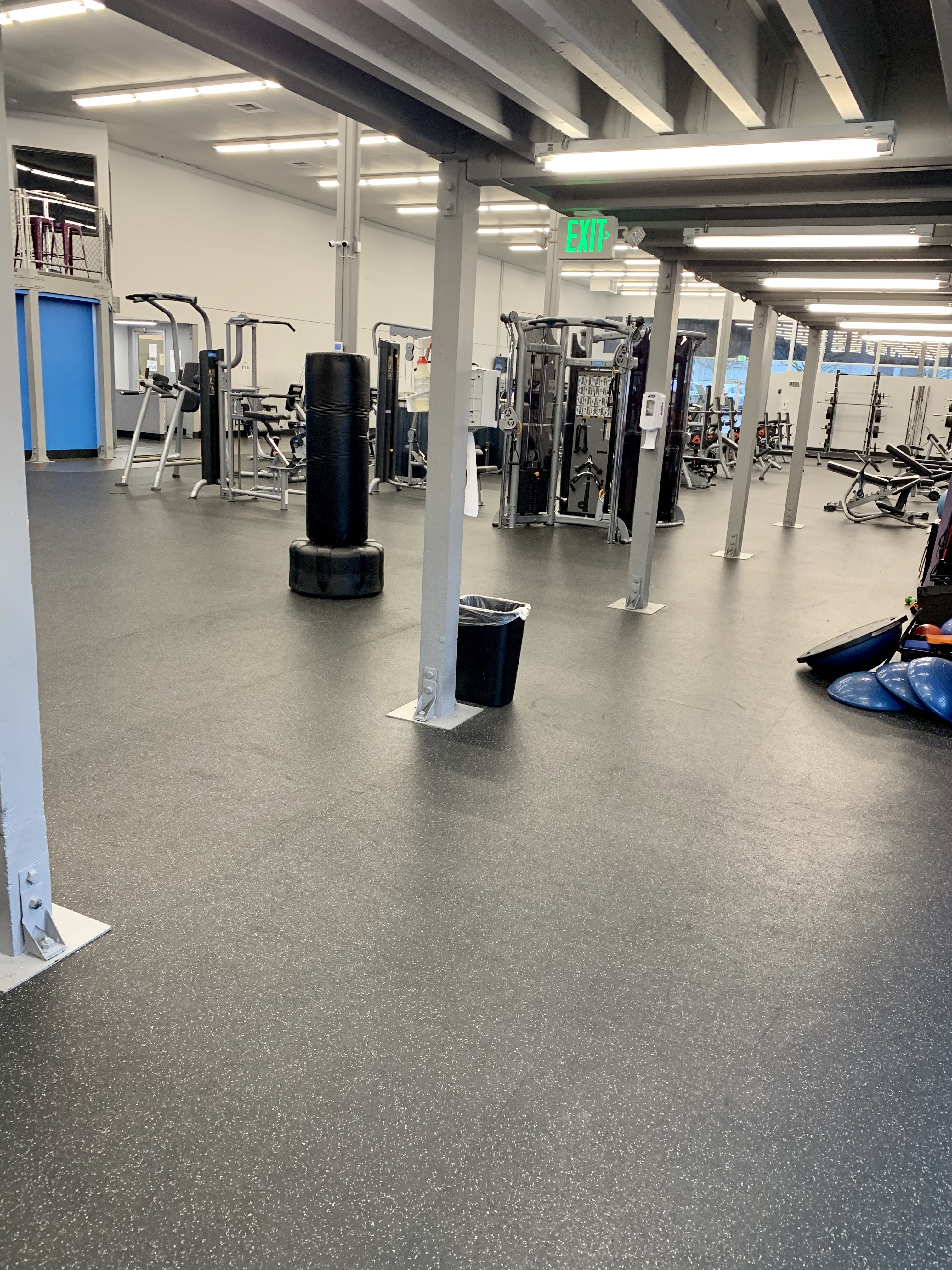
On Friday I posted a picture of my empty YMCA weight room and asked if anybody wanted to workout.*
Since then, like a lot of people, I’ve educated myself on the necessity of “physical distancing”—a term some are suggesting in place of social distancing since we also need to be showing social solidarity.
Some astute people probably viewed that post the same way I’ve been thinking about pictures of acquaintances on Facebook bragging about eating out all weekend in different restaurants. Under normal conditions, I’m down with nonconformity, in large part, because I am a nonconformist. When it’s a victimless crime, if everyone is going left, I admit, I prefer right.
But this is different. This is people whose politics prompt them to say fuck public health “experts”; fuck science; fuck the media; fuck all the stupid, crybaby, scared liberals.
It’s one thing to pat yourselves on the backs because you’re “rebels” and you’re the only ones supporting local businesses, it’s another to take pictures of yourselves and advertise your selfish, anti-social disregard for other people’s health for everyone to see.
Like I did on Friday. A weekend makes a world of difference. We’re Italy and things will only get worse in part because of your restaurant going resistance. Not that you’ll even know or probably care, but I’ve quit following you on social media. I can’t take your brazen disregard for the Common Good.
The Saturday morning long run is in the bank. But what now when there’s no basketball or golf on the telly? My plan is to read, nap, read some more, nap some more. Basically, I’m morphing into a dog, except for the reading part.
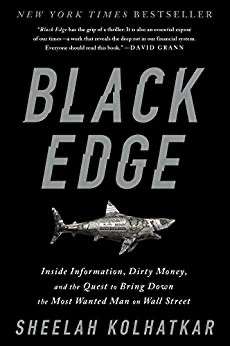
I’m enjoying Kolhatkar’s Black Edge. Traders on Wall St. refer to “white edge” as any information about publicly traded companies that is widely available. “Gray edge” is information about companies that is only known by industry insiders right as quarterly earnings are reported. “Black edge” is illegal inside information about companies that is learned before earnings are reported through targeted, intentional conversations with medical researchers, corporate executives, and other people knowledgeable about a stock’s probable rise or fall.
Thanks to “black edge”, Steve Cohen, a hedge fund manager, earned $10b. The book is about the government’s efforts to prosecute him. Googling “Steve Cohen SAC hedge fund manager” reveals he’s worth $15b today, so we know who “wins”.
People are incredibly misguided to think that poor people of color are more prone to criminal activity. Cohen and his co-workers have no regard for the law. The differences are the scale of their crimes and the fact that they mostly get away with them.
1. The Trump Presidency Is Over. Peter Werner, a former Republican, weaves and bobs through the first half of this essay, and then, midway through, unleashes a flurry of devastating hooks. If it it was an actual fight the refs would’ve stopped it well before the end. Technical knock out for all but the most irrational.
2. Mad About Elizabeth Warren. A friend implores me to “Just get over it.” But how can I with piercing analysis like this?
“Warren the Presidential candidate was that girl with perfect grades in the front row of the classroom, always sitting up straight and raising her hand. “She was too smart, too rigorous, and always right,” as my friend Katherine put it. “‘I have a plan for that’ became a kind of joke at her expense,” another friend added. ‘She was so knowledgeable and so prepared that her life as a brilliant student stood out.”
Even in our famously anti-intellectual country, it is possible for a wonk to win the White House. Bill Clinton and Barack Obama were intellectual superstars, and got elected anyway—indeed, Obama’s brain power was one of his major selling points. But, apparently, for a woman, being “brilliant,” “knowledgeable,” and “prepared” are suspicious qualities, suggestive of élitism and snootiness. On the other hand, if Warren had been obtuse, ignorant, and unready, that wouldn’t have worked, either. Being obviously unqualified to lead the free world only works for men.”
4. I have never really considered what Agnes Callard proposes, that The End is Coming.
“. . . so many of our practices—seeking a cure for cancer, building a new building, writing a poem or a philosophy paper, fighting for a political cause, giving our children moral lessons we hope will be handed down again and again—depend, in one way or another, on positing a world that will go on without us. The meaning of our lives, in the here and now, depends on future generations; without them we become narrowly self-interested, prone to cruelty, indifferent to suffering, apathetic.”
Only to add:
“Because here is something we know for sure: there will not always be future generations. This is a fact. If the virus doesn’t do us in, if we do not do one another in, if we manage to make everything as sustainable as possible, nevertheless, that big global warmer in the sky is coming for us. We can tell ourselves soothing stories, such as the one about escaping to another planet, but we are embodied creatures, which is to say, we are the sorts of things that, on a geological time scale, simply do not last. Death looms for the species just as surely as it looms for each and every one of us. How long have we got? At a recent public talk, the economist Tyler Cowen spitballed the number of remaining years at 700. But who knows? The important thing is that the answer is not: infinity years. Forever is a very long time, and humanity is not going to make it.”
Just because that’s a deeply depressing conclusion, it’s not wrong.
Kinda lonely this morning. Send me a request to workout with your fav blogger. I have just a few questions about whether you’re physically up to spotting my massive amounts of weight, and of course, about your handwashing habits.
We routinely get loose with language. Take “phone sex” for example*. I write a family friendly blog, so it’s not like I have any experience with it, but isn’t it a bit presumptuous to label talking about sexual stuff with another person as “sex”? Granted, “talking about sexual stuff on the phone” is uber-wordy, but far more accurate.
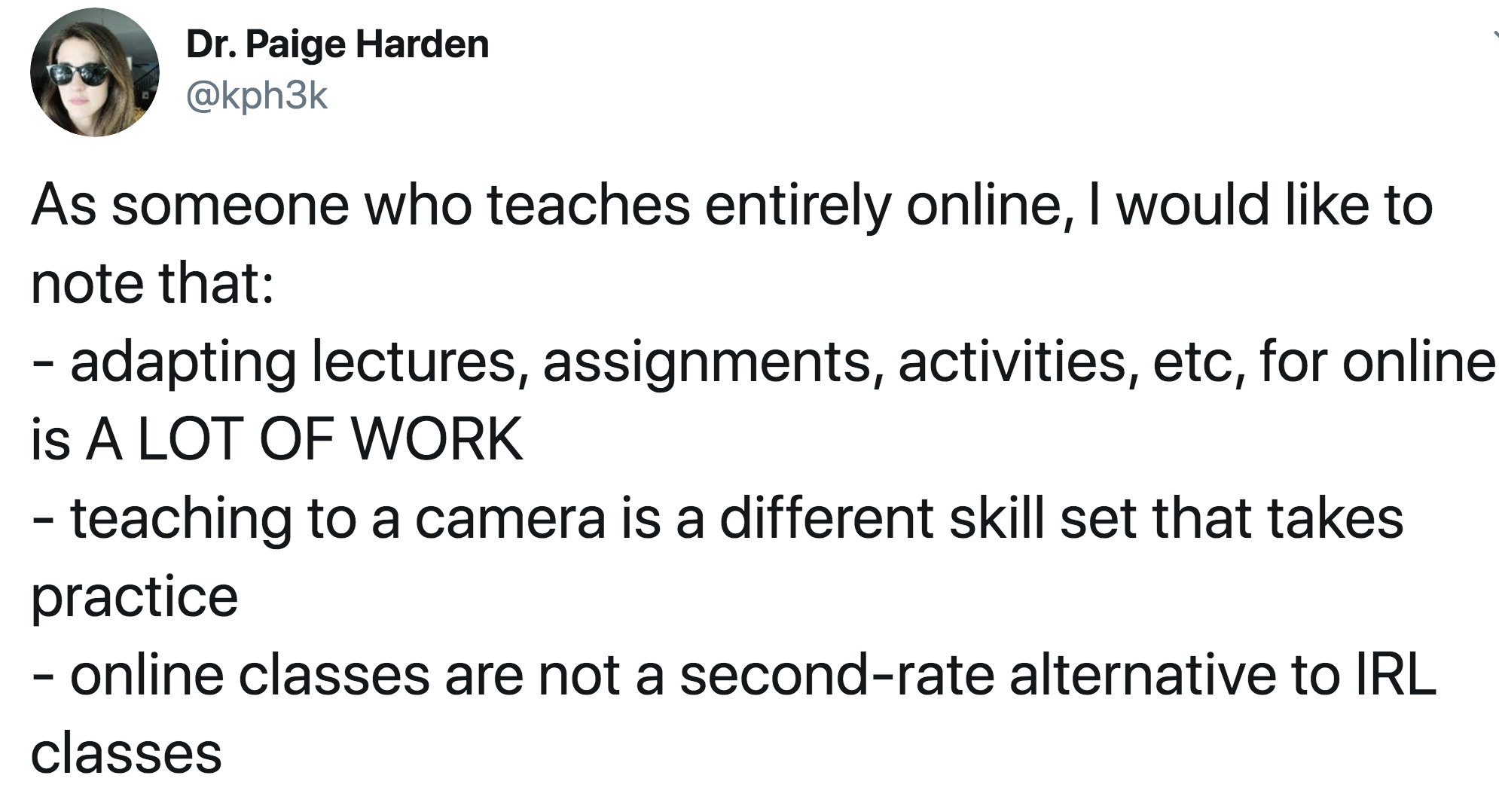
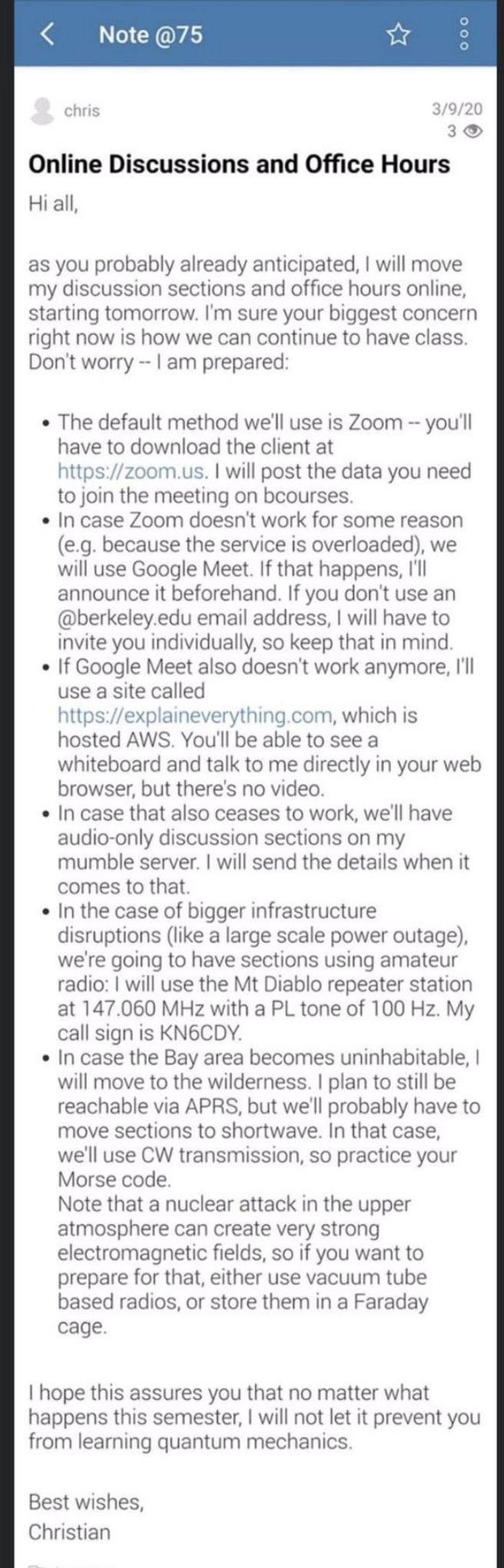
Similarly, as everyone does these days, it’s presumptuous to label “on-line teaching” as teaching. Take Dr. Paige Harden for example:
Harden has an informative twitter thread on how to “teach on-line” and you can see her and a colleague in action here:**
Everyone refers to “teaching on-line”, but Harden’s specific phrase “teaching to a camera” highlights the fallacy of the phrase.
You can present to a camera, but you cannot teach to one. “Okay Boomer” alert. . . the word “teaching” should be preserved for IRL settings. The “on-liners” can go as crazy as they want with “presenting”.
Teaching encompasses more layered relationships with students than presenting. Teaching interactions involve direct eye contact, silences, nonverbal communication, occasional emotion, and one-on-one conversations outside of class where each of those are even more integral. Teaching, at least in the humanities and social sciences, entails learning your students’ stories, tweaking your plans according to those stories, and being spontaneous and authentic in ways that are difficult in a separate studio. Teaching is messy for the same reasons all interpersonal relationships are—because everyone enters into the conversation with different worldviews shaped by contrasting gender identities, class backgrounds, ethnic backgrounds, and political beliefs. And then, for good measure, add in status and power imbalances.
Teachers have a more immediate sense of how a course is going than presenters because technology-mediated feedback is harder to interpret. When I lecture in an auditorium, I can assess audience engagement based upon several subtleties including eye contact, head nods, facial expressions, and the number (and quality) of questions asked afterwards. The technologist will argue they can do the same sort of thing on-line, but I’m skeptical because teaching entails a dynamism that I don’t believe exists in on-line presenting. My “in real life” students routinely alter my lectures, discussions, and activities with unpredictable questions, or comments directed to me or their classmates, whose responses cannot be anticipated either. Again, technologist will say their presenting is similarly organic, but again, everything is relative.
So let me correct the record. As the nation’s professors and students turn to cameras, microphones, screens, and keyboards, some truth-in-advertising is in order. The country’s colleges are not moving to on-line teaching, they’re moving to on-line presenting.
*since no one talks on phones anymore, “sexting” is probably a more relevant frame of reference, another modern phenom I know nothing about
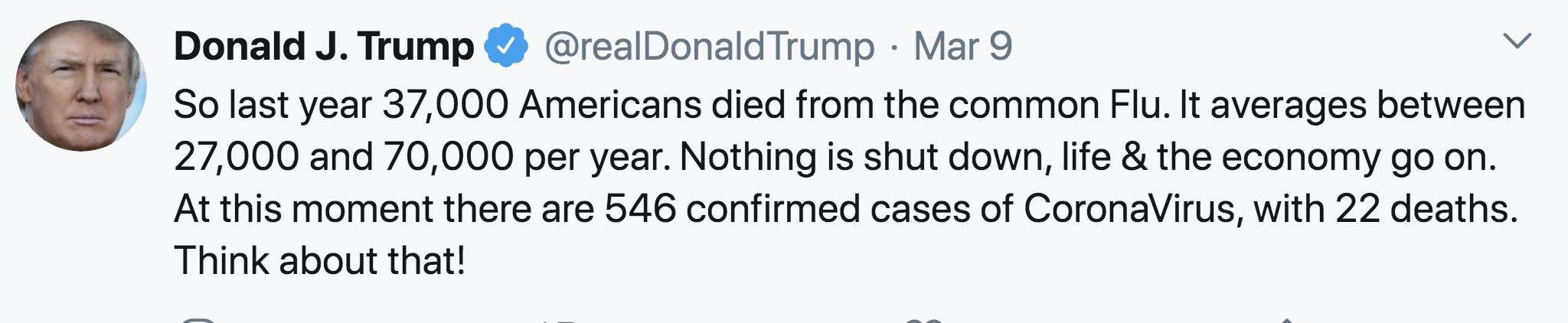
That will draw a lot more eyeballs to the VF piece. More importantly, consider that at a time like this the President is making time to read what magazines think about him and to respond to them. Priorities.
It’s early, in the both the 2020 election and the Coronavirus build, but the election could turn on tweets like that.
1. It’s a reminder that we’re not in control. Normally, we convince ourselves that we mostly are.
2. It’s a reminder that some day we’re going to die. Normally, we are very good at not thinking about that.
These are not normal times. What can you do? Be especially patient and kind to those who may feel a loss of control and fear dying. Even if you do not feel or fear either one.

 Harden has an informative twitter thread on how to “teach on-line” and you can see her and a colleague in action here:**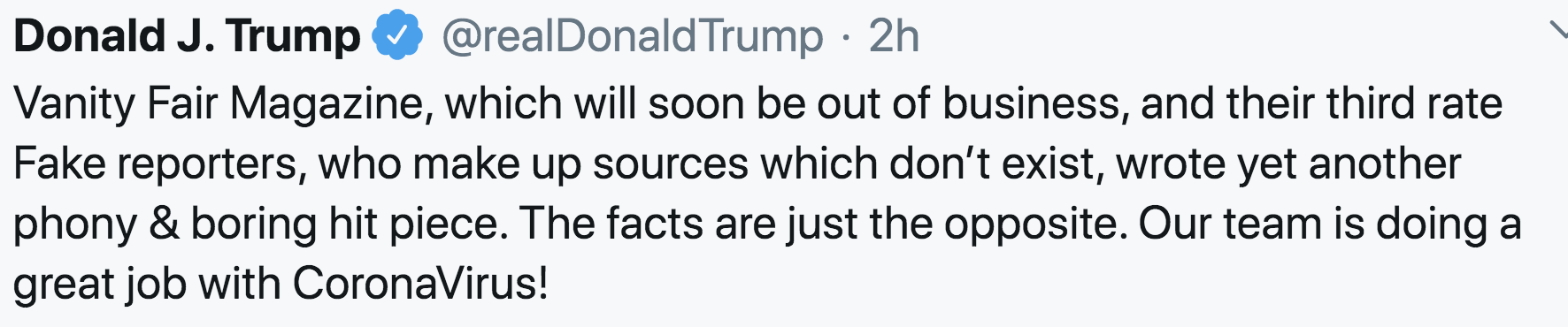
 Pressing Pause