Good and Bad News—Your Life Experience is Unique

No one has followed your exact path. No one has grown up in the same family, attended the same schools at the same time, read the same books, worked the same jobs, traveled to the same destinations, settled in the same place. Ever. Your unique life path is a wonderful strength. As a result of it, you “get” the specific people you grew up with and you’re an insider at the places you’re most familiar.

But your unique life path is a serious limiter too. One that inevitably handicaps you at times. It’s the reason you struggle to understand people and places with which you’re unfamiliar. Clearly, seeing the world from other people’s points of view does not come naturally. More specifically, we routinely fail to adjust for other people’s different life paths. Which is why there’s so much interpersonal and intergroup conflict.

A close friend attended a mostly white, mostly upper middle class liberal arts college. By most conventional measures, she received an excellent education. But in some ways she was ill-prepared for an increasingly diverse world. At one of her first teaching jobs she had a militant African-American colleague who routinely ruffled her feathers. Deeply frustrated, she complained to me, “He’s racist!”

In college she had few opportunities to interact with African-Americans and never with militant ones. If she took the time to learn more about his life path she would have been much more sympathetic to his radical critique of the dominant culture of which she was a part. And consequently, she wouldn’t have taken his anti-white diatribes quite so personally.

Can you supersede your life path? Can I? Partially.

How? By purposefully seeking out unfamiliar people and places through literature, the arts, and travel whether near or far. And when interacting with unfamiliar people, substituting curiosity for negative preconceived notions. Asking, for example, why do you believe what you do? And then listening patiently.

What I Learned From a Forced Digital Sabbatical

Despite my charming personality, my university students have a very hard time unplugging from their phones and the internet for the length of a class session—one hour and forty-five minutes. I just did it for 100 hours. I know, total badass.

My digital sabbatical was forced in the sense that I didn’t volunteer to participate. Some families from church were going to Holden Village in Washington State’s Cascade mountains, a four hour car trip, seventy minute boat ride, and slow 11 mile uphill bus ride away. They asked if we wanted to join them. Betrothed wanted to go. Happy wife, happy life.

Actually, I dig Holden. We had been once before, about ten summers ago. Beautiful setting in a dramatic, heavily forested mountain valley. Simple living. Eat, hike, read, pray, socialize, repeat. This time there was 4-5 feet of snow.

Lessons learned:

1) It’s good for introverts to (interpersonally) stretch on occasion. As a card carrying introvert, I like solitude. At Holden I actually have to talk to other human beings at meals, on group hikes, at church services, and in the evenings. I enjoy socializing in moderation.

2) One can read mad amounts when unplugged. I took an unread novel on my iPad and decided to leave behind a hardcopy nonfiction book I’ve just started. Mistake. Thanks to some reading marathons, I blew through the 300 page novel and then scavenged for additional reading material including three sample chapters previously downloaded to the Pad and the cookbook that derailed my reading in the middle of last year. Then I found and read a recent issue of Sports Illustrated. I often wish I read more. All I have to do is step back from the laptop and television.

3) Group living is more exasperating, but ultimately, more enjoyable. One of our carpooling friends decided on the way to the boat to stop and visit her sister in Wenatchee on the way home. “Your kidding me,” I thought to myself. When we turned away from home for that detour I was running low on patience and wishing we had driven separately. But the visit was short and nice. The sister’s husband sells apples all over the world. He had just returned from Germany and Italy and explained how he had tried unsuccessfully to visit a large (10,000 boxes) new customer in Libya. The apple snack was delicious and the family was personable and interesting. I’m glad I met them even if we got home an hour later. We also would have lost out on a lot of joking and good conversation if we had driven separately.

4) While unplugged, the world will continue pretty much as is. In the summer, I think the boat runs daily, so there’s always a day-old New York Times in the village library, but last week there was only our Friday and Monday boat arrival and departure, so no new papers, causing a serious uptick in blood pressure. To make matters worse, our carpoolers drove all the way home without turning on National Public Radio. What if North Korea nuked the South I wondered? Did UCLA beat Stanford? Did Christine Gregoire get a new job in the Administration? Alas, the Russian asteroid and the South African para-athlete girlfriend’s shooting and death were still headline news. It was as if a global news gatekeeper was saying, “Okay, nothing to look at here, move along.”

5) Teenagers are prone to exaggeration. Everything was going fine until Saturday night Contra dancing. Shit, sounds like something Oliver North might have done in the mid-80s. The GalPal was a tad excited. After sticking a fork in my novel, I dragged myself to the dining hall where the tables had all been pushed aside. Betrothed and Seventeen were having a great time. After their dance, Seventeen made a bee-line for me and said, “You HAVE to dance with mom! It will MAKE her life!” “Nahhhh.” “No SERIOUSLY Dad, it will MAKE her life!” Well, who knew, it turns out I have mad Contra dancing skills. And now, apparently, Betrothed can die in peace. I will spare you the photo album and video library of the event.

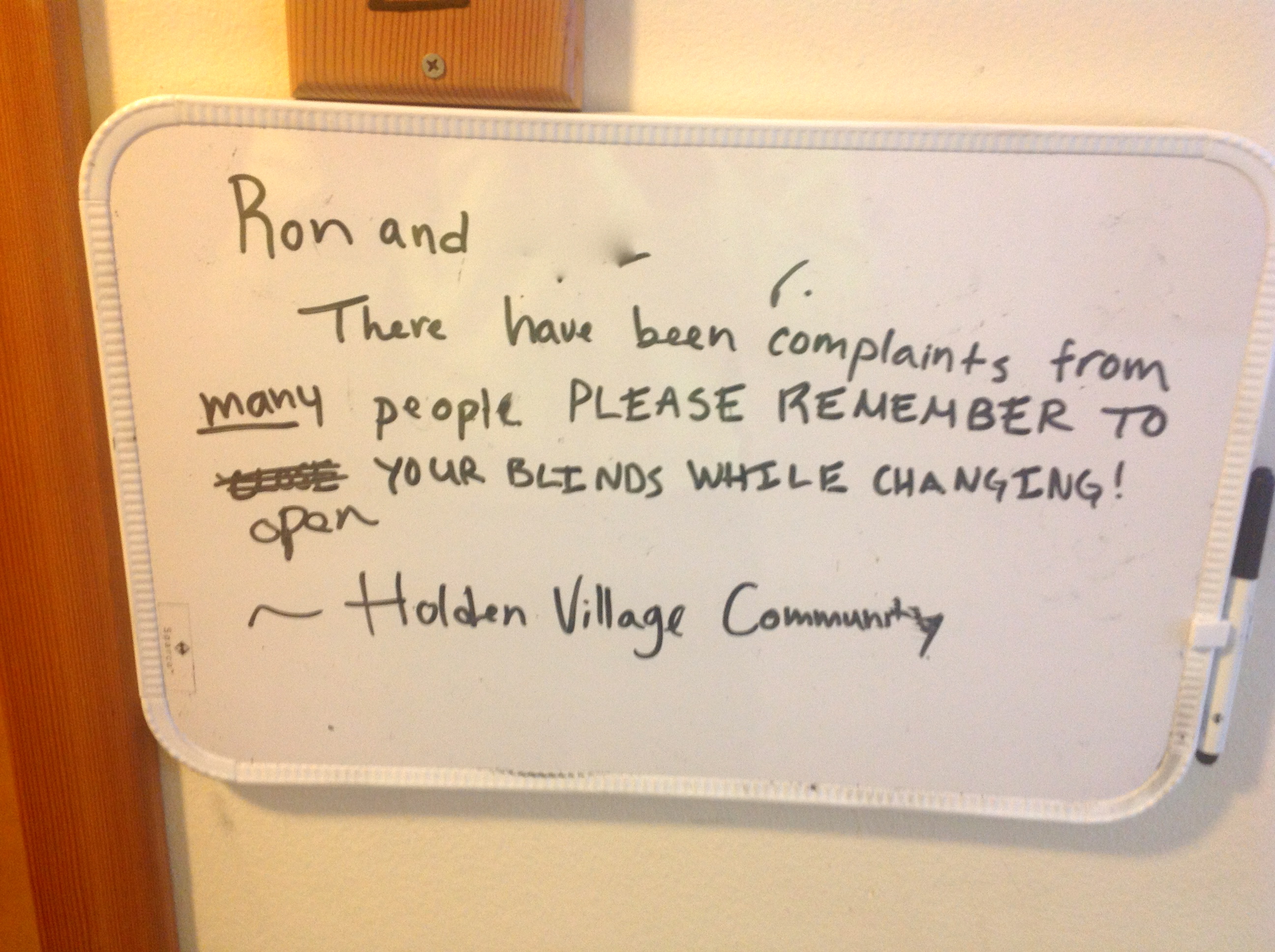
6) Teenagers aren’t just funny looking, they’re funny. I may have doctored the whiteboard next to the teen’s door. Shortly afterwards they returned serve with this salvo, which as you can see, I doctored.

Advantage twelfth graders.

Advantage twelfth graders.

7) In ping-pong, as in life, quit while you’re ahead. The first night I opened a can of whup ass on the GalPal. We rolled through 7-0 and it ended up something like 21-13. The second night, she also made a stirring comeback, but ultimately succumbed, 22-20. The third night, somehow, she couldn’t find me.

8) I’m a legend in my own mind. Despite turning a year older a week ago, I can still reverse slam dunk with a backpack on.

Mad hops

Mad hops

How long could you completely unplug? I’m guessing somewhere between 1 hour and forty-five minutes and 100 hours? Don’t hurt yourself trying to replicate my feat, but do consider a Holden Village get-away. It’s great for the soul. You don’t have to be Lutheran or even Christian, and you can decide how little or how much to participate in Village life. The lodging is rustic, but clean and comfortable enough for a few days or weeks. The food is mostly vegetarian, plentiful, and tasty. And don’t forget, if you volunteer to scoop ice-cream, you get a free serving afterwards.

The Link Between Walking or Biking to School and Concentration

My seventeen year-old supper nanny of a daughter babysits for a Mormon family up the street. They have six children, the oldest in fifth grade. When she got home from their house Saturday night, she excitedly announced that number seven is on the way. The coolest thing about this constantly expanding brood is that they walk, or scoot, or cycle to school during the week and walk to church on Sundays. Whatever the Pacific Northwest weather. They’re quite a spectacle, all dressed up, scattered up and down the sidewalk. School is two miles round-trip, church almost four. Early elementary children walking four miles to and from church, someone call Social Services.

Probably without knowing it, our Mormon neighbors are onto something. Sarah Goodyear recently reported on the results of a 2012 Danish study that found that kids who cycled or walked to school, rather than traveling by car or public transportation, performed measurably better on tasks demanding concentration, such as solving puzzles, and that the effects lasted for up to four hours after they got to school.

The study was part of a Danish project that looked at the links between concentration, diet, and exercise. Researchers were surprised that the effect of exercise was greater than that of diet. According to one:

“The results showed that having breakfast and lunch has an impact, but not very much compared to having exercised. As a third-grade pupil, if you exercise and bike to school, your ability to concentrate increases to the equivalent of someone half a year further in their studies.”

Goodyear writes the process of getting yourself from point A to point B has cognitive effects that researchers do not yet fully understand.

Another research conclusion jives with my experience:

“We learn through our head and by moving. Something happens within the body when we move, and this allows us to be better equipped afterwards to work on the cognitive side.”

Here’s the problem though. Goodyear:

“Nationally, as of 2009, only 13 percent of kids in the United States walked or biked to school, down from 50 percent in 1969.”

Her related questions:

“But if more parents realized that packing the kids into the back seat actually affects their ability to learn, would they change their ways? Advocate for building schools in more walkable locations? Demand improved bicycle and pedestrian infrastructure? Or simply make the time and effort required to get to the kids to school under their own steam, accompanying them if need be?”

And the excellent concluding paragraph:

“Many parents pay for test prep and after-school enrichment programs to make their kids more academically competitive, and go to great lengths to schedule time for those activities. Imagine if they invested those resources instead in something as simple as helping their children to travel safely from home to school on foot or by bike, arriving ready to learn.”

Public policy questions always involve challenging trade-offs. This particular one seems like a rare exception. School transportation costs make it difficult for districts to commit adequate resources to teachers’ professional development, students with special needs, better curriculum materials, and building improvements. If schools districts started requiring students that live within a mile or two of their school to walk or cycle, the savings could be used for those other priorities, teachers would accomplish even more as a result of increased student concentration, students would be healthier (and their adult chaperones), roads would be less congested, and the environmental impact of school travel would be greatly reduced.

Win. Win. Win. Win. Win.

imgres

The Essential Dilemma of Human Intimacy

Oliver Burkeman’s The Antidote: Happiness for People Who Can’t Stand Positive Thinking, with its discussion of Stoicism, has me thinking about the Newtown parents. Burkeman and the heartbreaking portraits of the dead first graders. With their beautiful, innocent smiles, and future promise.

It’s difficult to imagine anything more difficult to overcome than a parent having to bury their six or seven year old child. Friends of ours watched helplessly for a year as their eight year old son died from leukemia. I tried to empathize, but probably failed to scratch the surface of their heartbreak.

The Newtown parents didn’t have any reason to take a little extra time the fateful morning of the shooting to be especially present and loving. One wonders, how will they survive the shooting? Right now, their sadness is bound to overwhelm ancient Greek wisdom and everyone’s best intentions. The best way to support them is to respect their privacy and make sure our representatives enact meaningful gun control.

But what if we shift things a bit to think about Stoicism and our lives, and the people we’re closest too, and their eventual deaths. And the essential dilemma of human intimacy—the closer and more meaningful the friendship, the greater one’s vulnerability, the greater one’s vulnerability, the more intense the pain upon death.

There is a way to minimize the probability of intense grief, keep friendships superficial. But who wants to compromise the quality of their life that way? So what are we to do? Being intimate and dependent upon others doesn’t mean we’re doomed to debilitating sadness upon each of our close friends’ or family members’ deaths.

The ancient Greeks wrote about the impermanence of everything and encouraged people to reflect on the worst things that could happen to them. The result being greater appreciation for their material well-being, their health, their work, and their family and friends. Taking time to think about worse case scenarios, or negative visualization, also mentally prepares one for inevitable changes in life, including especially sad ones such as the death of a loved one.

The ancient Greeks also emphasized living in the present, an “easier said than done” cliche if not developed more fully. Think about how different birthday celebrations might be if everyone committed to living more in the present. Instead of giving the birthday person gifts (kind of an odd practice if you think about it, “Hey congrats on being born!”), and asking him or her to make a wish for the upcoming year, the party would be a celebration of the previous year. The message being that life is fragile and isn’t it wonderful that we had another year to enjoy the birthday boy’s or girl’s friendship. Each person could reflect on the birthday person’s previous year and share what has been most memorable and what they most appreciate about them. And yes, of course we can keep the cake and ice cream.

My dad died suddenly at age 69. I was 33. I was devastated in part because it wasn’t until my mid 20’s that we started to understand and appreciate one another. I thought we had the luxury of time for our friendship to flourish. But shortly afterwards, I started to think like a Stoic before knowing anything about Stoicism. I realized I could be upset that our friendship didn’t get to mature or I could be thankful that we enjoyed a positive and more personal 5-10 years. I’ve chosen the later. And that decision informs the way I try to live. I want to love boldly, fully appreciate my friends and family, and celebrate each passing year as an undeserved gift.

My hope is that with the passing of time the Newtown parents can make a similar switch from understandable anger at the time they won’t get to spend with their sons and daughters to appreciating the six or seven years they did get with them.

That math and psychology will be tough. Godspeed Newtown parents.

imgres

Compared to Teaching, Charles Barkley’s Job is Easy

In a round about way, this provocative Selena Robert’s piece about Tiger Woods highlights what’s unique and especially challenging about teaching well. Robert’s quotes Brandel Chamblee, a former PGA Tour player who isn’t afraid to speak his mind and ruffle feathers. Most damning, Chamblee says Tiger extracts from the game but doesn’t give back to it.

Usually, the most popular analysts and critics—whether in sports, the arts, or politics—are extremely opinionated. People like analysts and critics who aren’t afraid to rip a failing player, actor, or elected official. In sports, Brandel Chamblee is simply following in the footsteps of Howard Cosell and Charles Barkley.

What the best teachers do 180 days a year is infinitely harder than what Chamblee and Barkley and other popular analysts and critics do. Teachers have to thoughtfully provide constructive criticism to young people with whom they work closely day-after-day. Young people whose self esteem is a work-in-progress.

Chamblee knows he’s never getting invited to Tiger’s pad to have dinner so what does he have to lose? When Sports Illustrated wrote about Michael Jordan’s gambling problem he never spoke to any of their writers again. Which of course made it even easier for them to be critical. It’s easy for analysts and critics to rip failing public figures from the safety of their websites, studios, and media stages.

Teachers, on the other hand, often have to tell students up close and personal that their work doesn’t measure up. And most challenging of all, students are sensitive in different ways and to differing degrees meaning teachers have to continuously tweak their message. The best ones challenge students to do better without crippling their confidence or harming their relationship. It requires a mix of respect, tact, diplomacy, and care that the public doesn’t understand or appreciate. I’m most successful at it when I lead with students’ strengths. Encouragement makes everyone more receptive to how they can improve.

Parents face similar challenges on a daily basis. They often have to tell their children, “Sorry, that wasn’t thorough, thoughtful, or responsible enough.” The most successful ones do it in loving and supportive ways that are educative. Their actions communicate, “I want you to become more competent and independent”  rather than “Don’t forget I’m in charge.”

Compared to the teachers at the school down the street from you, Brandel Chamblee’s and Charles Barkley’s television jobs are a piece of cake.

imgres

Living Healthily By Feel

As I wrote recently, modern life requires some dependence upon expert recommendations, but when it comes to our health, we’re too dependent upon scientists; when it comes to our money, we’re too dependent upon financial planners; and when it comes to our spirituality, we’re too dependent upon religious professionals.

A recent Wall Street Journal story described a study of older recreational athletes. The conclusion, past age 50, running more than 15-20 miles a week at faster than 7:30 per mile is associated with higher mortality rates. That makes sense since fast long distance running is a form of stress. So far, I’ve ran about 1,470 miles this year or almost exactly 30 a week. Most of those miles were in the 7:30 neighborhood (well, not the last 8 in Canada). In addition, I’ve swam about 185 miles and rode 5,272—all personal highs thanks to my Ironperson Canada prep.

According to some scientific experts, I’m killing myself in the predawn perpetual light rain, in the sense that I’m shortening my life. If you listen carefully, you can hear couch potatoes everywhere cheering lustily.

So do I dial things back? I accept the studies’ peer-reviewed conclusions, but I’m too skeptical to change my overly active lifestyle as a result of the study. When determining how far and fast to run, swim, and cycle; instead of living purely by science; I choose to live mostly by intuition or feel.

I know myself better than the scientists who conducted the study. Consequently, I’m just arrogant enough to think their study doesn’t apply to me. I’ve slowly built my endurance base over the last twenty years, I eat well, I prioritize sleep, and I’m pretty good about minimizing everyday stress. Regularly going semi-long contributes to the excellent quality of my life. I’m convinced I’m physically, mentally, and even spiritually healthier than I otherwise would be if I cut back based on this study’s recommendations.

I would like to live a long life, but I’m even more interested in maintaining a good quality of life. Late in life I want to remember my past; read The New Yorker; write regularly; and walk without falling down.

I could be wrong. About one of the most important decisions imaginable. The horrors, I may not be special. If some of you are at my funeral in two or twenty years, I give you permission to laugh one last time at me.

Saturday morning, I extended myself for only the second time since Ironperson Canada (the other was the Seattle Half Marathon two weeks ago). I ran 10 miles with my favorite right wing burners, inhaled a large bowl of oatmeal, and then celebrated Hob’s 52nd birthday by swimming 52 100’s. Dear longevity researchers, stick that in your pipe and smoke it.

IMG_1628

Continuous Improvement

A bullshit workplace notion. Midway into artistic or athletic activities, jobs, careers, relationships, life, we plateau. Shortly thereafter, energy ebbs, and our performance erodes.

We improve for a bit, we plateau, we decline.

I observed a good second year math teacher today at the independent middle school. Then we conferenced. After listening to him reflect on the pre-algebra lesson, I listed his many strengths. Then I made a few suggestions. Call on Ben as soon as he puts his head on his desk. Give Robin your marker, take her seat, and have her teach everyone her prime factorization method by illustrating it on the board. Have two more students explain and illustrate their methods and then ask, “Which is most efficient and why?” Let the kite string out a bit and “guide from the side” for awhile. Remember, the educative effect is greater when students do something than when something is done to them.

He told me he likes it when I observe because he’s reminded of effective teaching methods that he has let slip. He’s a good second year teacher who has started to plateau because he’s rarely observed, and rarely gets to observe other, more accomplished teachers.

A small number of the very best teachers, artists, athletes, and people continue improving considerably longer than their peers by seeking out expert, critical feedback; by investing progressively more time and energy; and by surrounding themselves by other positive, hardworking people, who are trending upwards.

And the wisest teachers, artists, athletes, and people have a sixth sense for both when they’ve plateaued and when their performance has begun to decline. And then the wisest, most selfless, most financially secure of them, step aside to provide the next generation opportunities to improve, plateau, and decline.

Embracing Children for Who They Are

When you buy a new car you’re provided with a detailed owner’s manual, but even though human beings are far more complex than cars, when new mothers and fathers leave the hospital with a new born, they’re completely on their own.

Jane Brody, in an insightful New York Times blog post of the same title, exhorts parents to appreciate and adapt to their childrens’ differences.

Consider that critical phrase a second time—appreciate and adapt. Easier said then done. Most parents start out parenting each successive child the same. More often than not, they’re too slow to appreciate and adapt to inevitable differences.

Despite the absence of any type of owner’s manual, there are wise parent authors, like Brody herself, and Andrew Solomon (appropriately named), offering excellent help.

Key excerpts from Brody’s post:

Contrary to what some parents might believe or hope for, children are not born a blank slate. Rather, they come into the world with predetermined abilities, proclivities and temperaments that nurturing parents may be able to foster or modify, but can rarely reverse.

The goal of parenting should be to raise children with a healthy self-image and self-esteem, ingredients vital to success in school and life. That means accepting children the way they are born — gay or straight, athletic or cerebral, gentle or tough, highly intelligent or less so, scrawny or chubby, shy or outgoing, good eaters or picky ones.

Of course, to the best of their ability, parents should give children opportunities to learn and enjoy activities that might be outside their natural bent. But, as attested to in many a memoir, forcing children to follow a prescribed formula almost always backfires.

For example, everyone in my family is a jock. . . except one of my four grandsons. Now 10, he is an intellectual, and has been since age 3, when he learned the entire world’s atlas of animals. He absorbs scientific information like a sponge and retains it. He can tell you about deep-sea creatures, planets and stars, chemical reactions, exotic caterpillars, geological formations — you name it — and he’s a whiz at the computer. But he has no athletic interest or apparent ability. His parents have introduced him to a variety of team and individual sports, but so far none has clicked.

Rather than try to remake him into someone he is not, the challenge for all of us is to appreciate and adapt to his differences, love him for who he is and not disparage him for what he is not. While the other three boys get basketballs, bicycles and tennis rackets as gifts, for his 10th birthday I gave him a huge book on the universe, which became his bedtime reading.

One persuasive voice for differences in children and how families must adapt better is Andrew Solomon, author of an ambitious new book, “Far From the Tree: Parents, Children and the Search for Identity,” published this month by Scribner.

He makes a strong case for accepting one’s children for who they are and, at the same time, helping them become the best they can be. Especially poignant is his account of a family with a high-functioning son with Down syndrome. For years, the boy progressed academically on pace with his peers and was a poster child for what a person with Down syndrome could do. But when the son could go no further, his mother recognized that he needed to be in a group home.

“We had worked so hard to make him the Down syndrome guy who didn’t need it,” the mother told Mr. Solomon. “But I had to look at what was best for him, and not some ideal we had built up for ourselves.”

Most of the parents interviewed found a lot of meaning and many rewards in dealing with a child who was different. “They told me it has given them a so much richer life that they wouldn’t have given it up for all the world,” Mr. Solomon said. “There are many ways to exist in this world and many different ways to be happy.”

He added: “You want your children to achieve and be comfortable with who they are. You should advocate for them and help them develop the skills to advocate for themselves. But parents shouldn’t try to mold their children. When you expect your kids to fit into a mold, especially a mold of your own making, you’ll be disappointed.”

Parents shouldn’t beat themselves up for not getting the appreciating and adapting just right. They should seek out and embrace positive examples of flexible, loving parenting all around them.

Of Breakfast Tables and Technological Change

One of my fondest childhood memories involves my older brother who loved making my life miserable. He routinely read the morning sports page and comics while eating toast weighted down by peanut butter and honey. Inevitably, a few drops of the honey would spill over onto the paper, so that when our dad read it, pages would stick together. Prompting dad to snap and drop a “g*d dammit” much to my delight.

Fast forward forty years to our Olympia, WA breakfast table. The GalPal and I grew up in newspaper reading families so we’re part of the diminishing newspaper reading minority. I read lots of local and national newspapers on my laptop and iPad. But as you know, the heavy hitters—led by the New York Times—have started to charge for more than very minimal access.

We have a local paper weekend subscription which runs $13.33/month or $160/year. 52 weekends times three days equals 156 issues a year at a cost of $1.02/per. That’s a terrible value, but it’s a concession to marital peace. For some reason Betrothed has to hold the paper in her hands on the weekends. I hear divorce costs more than $160.

And we subscribe to the Wall Street Journal which runs $8.33/month or $100/year. That’s the educator’s discount price. The regular price is three times more at $26/month. 52 weeks times six days minus holidays equals about 305 issues/year at a cost of 32.7¢/per for me and 98¢ for the masses. That’s for home delivery and complete digital access on any device.

The WSJ subscription is about to expire and I’m thinking about switching to the New York Times digital/tablet edition. No home delivery. Unlimited access on any computer and tablet. Smart phone access is a little more. Educator’s discount price, $10/month; regular price, $20/month. That’s $120/year for 365 issues meaning about 32.9¢/per for me and 66¢ for the masses.

Another option is PressReader, the best choice for serious news junkies. It’s like a cocaine addict buying a personal cocoa field. For $30/month subscribers gain access to 2,300 newspapers from 95 countries, representing 54 languages. Here’s a 4+ minute video introduction. They’ve provided me with a sample subscription which I’ve been trying out. It’s a promising application, but it may not have your local paper. Also, it takes 10-15 seconds for papers to download and moving around within papers takes some getting used to. If it was my only option, I’d adjust quickly and like it, but I’m going to pass on paying three times more for way more content than it’s possible to process.

As if the newspaper subscription water isn’t muddy enough, two more options include the online news aggregator Zite which I’ve reviewed before (here) and Pulse another news aggregator which I really like and highly recommend (both available at iTunes). Pulse works especially well for skimmers. In fact, I dare you to find a rival.

For the love of all things digital, someone please convince the GalPal the answer is obvious. Read the local paper online, use $120 of that $160 in savings to subscribe to the New York Times, and use the remaining $40 to buy more dried mangos.

Paragraph to Ponder

From Roman Krznaric in The Wonderbox:

The idea of passionate, romantic love that has emerged in the West over the past millennium is one of our most destructive cultural inheritances. This is because the main aspiration—the discovery of a soulmate—is virtually impossible to achieve in reality. We can spend years searching for that elusive person who will satisfy all our emotional needs and sexual desires, who will provide us with friendship and self-confidence, comfort and laughter, stimulate our minds and share our dreams. We imagine somebody out there in the amorous ether who is our missing other half, and who will make us feel complete if only we can fuse our being with theirs in the sublime union of romantic love. Our hopes are fed by an industry of Hollywood screen romances and an overload of pulp fiction peddling this mythology. The message is replicated by the worldwide army of consultants who advertise their ability to help you ‘find your perfect match’. In a survey of single Americans in their twenties, 94 percent agreed that ‘when you marry you want your spouse to be your soulmate, first and foremost.’ The unfortunate truth is that the myth of romantic love has gradually captured the varieties of love that existed in the past, absorbing them into a monolithic vision.