Fitness Flameout

Weekend edition.

If you’re like most people, by now your fitness-related New Year’s resolutions have fizzled out. Why? Because they were too ambitious.

There’s two types of fitness—general fitness for the masses and specialized fitness for the competitive athlete. Everything that follows pertains to the former. This post is for the lethargic person who is fed up with health problems, lower back pain, a compromised quality of life.

Ask someone how they got so out of shape and they’ll probably say, “It started years ago.” Despite that reality, most people want to get in shape in a few weeks or months. And so they set overly ambitious goals. Sedentary in December, they set themselves up for failure by resolving to “run five days a week” starting on January 1st. Or swim three days a week. Or ride a stationary bike four times a week.

They go from zero to sixty and back all before the month is over because they don’t see any benefits from their first few workouts. Even worse, they’re mentally turned off to exercise as a result of overexerting themselves on the track, in the pool, or in the weightroom. They go too hard, too often, too quickly. It’s counterintuitive, but the answer is to go slower, less often.

Here’s a personal example of how less is often more when it comes to developing positive fitness routines. Despite swimming, cycling, and running weekly, I sometimes suffer from lower back pain because I lack core strength. To improve my core strength, I’ve been doing pushups and planking. My baseline was 60 pushups interspersed with three sets of planking, each set consisting of  30 seconds in three separate positions, for a grand total of four and a half minutes of planking. Ten pushups, stretch lower back, ten more, plank, repeat two more times. I could do it quickly and easily after a run or bike workout. As a result, I’d typically do it five times a week for a grand total 300 pushups and 22.5 minutes of planking. A solid start to improved core strength and lower back health.

Eventually, that routine got fairly easy so I upped it to 90+ push ups interspersed with 35 seconds and then 40 of planking (times three positions and three sets). But an interesting thing happened on the way to core strength nirvana. The greater time commitment and degree of difficulty weighed on me just enough for me to skip the whole work out a few times to the point where I only got in two core sessions in a week. So that meant 180 pushups and 10:30-12:00 minutes of planking. More, in the end, resulted in less.

If this paradox resonates with you, have a Stuart Smalley-like talk with yourself, and start over. But this time think about how long it took to fall out of shape and give yourself all of 2011 to get in better shape. Create positive momentum by setting achievable goals that you can repeat week after week. After exercising easily and consistently for a month, you can turn the knob up ever so slightly if you so choose.

Here are related suggestions from a fitness post from an earlier incarnation of the blog.

The Definitive Television Sports Habit Explanation

Super Bowl edition. Full title: The Definitive Explanation of Why Many Grown Men Waste Inordinate Numbers of Hours Watching Much Younger Men Play Sports on Television.

Sexist built-in assumption? Guilty as charged. Granted, there are lots of sports-minded women sprinkled in among the men on the sofas of America, but the vast majority of viewers are of the male persuasion. If you’re a female sports television addict, bless you, and post a comment explaining whether my insights apply to you or not.

I probably shouldn’t assume to know why men waste inordinate numbers of hours watching much younger men play sports on television. All I can do is explain why I enjoy watching sports on television.

I grew up playing the sports I watch. I started playing golf at 5 or 6, about the same time I started dominating in tee ball. In Ohio, in elementary school, my friends and I played football and other sports (depending upon the season) after school every single day. The worse the weather, the better. Sometimes I’d want a take a late afternoon off and I’d beg my mom to tell my friends I wasn’t home. Knowing she was bluffing, they would walk right past her and ferret me out. In elementary school, I honed my lethal forehand, my silky smooth “J”, and my otherworldly chipping and putting. Later on, throw in some YMCA swim meets and water polo awesomeness. More recently, running, cycling, and triathlon amazingness.

The previous paragraph exposes a universal truth about men and sports—the older the athlete, the greater the selective perception. We always exaggerate our athletic excellence. I skipped over the time I got chewed out at dinner for heaving a golf club right as my dad was driving home from work; the time I wrapped and tackled the air when one-on-one with a running back who caught a screen pass right in front of me; the time some idiot age group swimmer jumped out of the pool, dried off, and threw his clothes on before I finished the same race.

I’m guilty of wasting inordinate numbers of hours watching much younger men play sports on television for two reasons. The first is nostalgia. More specifically because of positive associations with my childhood. After sitting through a final four-hour round of the Masters, the galpal’s disgust is palatable, but what she doesn’t realize is that I’m in a time capsule. I’m back at Louisville Kentucky’s Plantation Country Club (sure hope they’ve updated that name) nine-hole par three where I was known to chuck a club or two. I can smell the freshly cut grass. I’m back in Cypress California at Los Alamitos Country Club playing two balls by myself after parking golf carts and picking up thousands of range balls. I’m hitting greens and draining putts in the Southern California dusk. I’m fifteen again. I’m not wasting time, I’m reliving my youth.

The second reason is irrationality. More specifically I often fantasize about being in the same position as the athlete on the screen and coming through in the clutch. Ernie Els has a twenty foot putt with 18 inches of break. I’ve made that putt lots of times. Missed it far more of course, but I’ve made a fair share. As Ernie lines up his putt, I’m subconsciously thinking to myself, I could make that. Watching Super Bowl 45 I’ll engage in a similar thought process. A receiver will beat a defensive back and be all alone, but the ball will slip through his outstretched fingers. I’ll completely block out the fact that I run a 7.4 40 and could never, ever get in the same position, I’ll just say to myself, “Had it been me, I would’ve laid out and pulled it in.”

I remember mother dear driving me home from a little league practice once with a bespectacled, bookish, non-athletic teammate. Mid trip he grilled me about why on earth I dove for a ball during practice. Didn’t make any sense to him. Of course if you have to ask, you’ll never understand. Who cares that I was eight and playing baseball and now I’m forty-eight and watching football. Dammit, I would have made the Super Bowl catch. Sometimes a college or NBA player finds himself all alone just outside the three-point line. That’s happened to me several times—in my mind. Each time I nail it. I hold my follow throw while back pedaling to the cheers of the adoring Pauley Pavillon crowd.

Now you’ll understand that I’m not just putting off mowing the lawn, changing the oil in the car, and emptying the dishwasher, I’m reliving my youth and fantasizing about the catch, the long distance putt, the perfect passing shot on a hot, sun-drenched Australian Open hardcourt.

Young, Anxious, Depressed

Today five to eight times as many high school and college students meet the criteria for diagnosis of major depression and/or an anxiety disorder as was true half a century or more ago. This increased psychopathology is not the result of changed diagnostic criteria; it holds even when the measures and criteria are constant.

That’s from Peter Gray, research psychologist and professor and Psychology Today blogger. The entire post is here.

Readers’ Digest version.

First, Gray explains:

The increased psychopathology seems to have nothing to do with realistic dangers and uncertainties in the larger world. The changes do not correlate with economic cycles, wars, or any of the other kinds of world events that people often talk about as affecting children’s mental states. Rates of anxiety and depression among children and adolescents were far lower during the Great Depression, during World War II, during the Cold War, and during the turbulent 1960s and early ‘70s than they are today. The changes seem to have much more to do with the way young people view the world than with the way the world actually is.

Next, he highlights two reasons. Still quoting:

1) A decline in young people’s sense of personal control over their fate. People who believe that they are in charge of their own fate are less likely to become anxious or depressed than are those who believe that they are victims of circumstances beyond their control. The data indicate that young people’s belief that they have control over their own destinies has declined sharply over the decades. When people believe that they have little or no control over their fate they become anxious. “Something terrible can happen to me at any time and I will be unable to do anything about it.” When the anxiety and sense of helplessness become too great people become depressed. “There is no use trying; I’m doomed.”

2) A shift toward extrinsic, rather than intrinsic goals. Intrinsic goals are those that have to do with one’s own development as a person–such as becoming competent in endeavors of one’s choosing and developing a meaningful philosophy of life. Extrinsic goals, on the other hand, are those that have to do with material rewards and other people’s judgments. They include goals of high income, status, and good looks. There’s evidence that young people today are, on average, more oriented toward extrinsic goals and less oriented toward intrinsic goals than they were in the past.

Gray sees the two primary reasons as interrelated:

The shift toward extrinsic goals could well be related causally to the shift toward an external locus of control. We have much less personal control over achievement of extrinsic goals than intrinsic goals. I can, through personal effort, quite definitely improve my competence, but that doesn’t guarantee that I’ll get rich. I can, through spiritual practices or philosophical delving, find my own sense of meaning in life, but that doesn’t guarantee that people will find me more attractive or lavish praise on me. To the extent that my emotional sense of satisfaction comes from progress toward intrinsic goals I can control my emotional wellbeing. To the extent that my satisfaction comes from others’ judgments and rewards, I have much less control over my emotional state.

Gray concludes by suggesting formal schooling is a large part of the problem. His solution? Less time in school, more time in unstructured outside of school activities. Over time, I’ve become more enamored with alternative education; consequently, I find his argument somewhat convincing. But I find his description of the problem more illuminating than his suggested remedy.

Here are three things, that in my opinion, could reduce anxiety and depression in young people.

1) More sleep.

2) More movement. With friends and minimal adult supervision (so that it’s more fun). Fifteen has been taking “Zumba” aerobic-like classes with a friend a few afternoons a week at the “Y”. Even better, thirty minutes of walking or running or swimming or cycling or weight lifting five or six mornings a week. I’d like to see clinical trials studying the effects of this proposal on adolescent anxiety and depression.

3) Compulsory service-learning as a school requirement. I could be talked into a year of National Service quite easily too. Recall the quote, “Something terrible can happen to me at any time and I will be unable to do anything about it.” I have no evidence, just a gut instinct that a substantive “other-regarding” experience would reduce anxiety and depression.

How to Refresh and Keep Going

In response to my “Causes of Burnout” post, an ace PressingPause reader wrote that the question is how to refresh and keep going.

Nine suggestions:

1) Resist deficit thinking by being intentional about students’ strengths. When I taught high school, I always made a conscious effort to attend student art exhibits, plays, sporting events. And I always left thinking, “What talent, dedication, effort, and academic potential if I tap into those things.”

2) Save notes of appreciation, thank you cards, whatever positive mementos you can. And journal about especially positive interactions and experiences. Sporadically revisit the notes, cards, and journal entries as a reminder of your effectiveness and the importance of your work.

3) Subvert zero-sum thinking about teaching excellence (e.g., your success takes away from mine) by consciously affirming your colleague’s efforts and acknowledging what they do particularly well. Help create positive faculty culture momentum.

4) If a colleague has traveled too far down the deficit thinking road, steer clear. If surrounded by goners, attend local teacher workshops and seminars in order to find and build relationships with more hopeful, supportive colleagues from other schools. Also join professional association’s list serves and blog discussions like this one.

5) Do whatever helps you create energy on a regular basis—spend time outdoors, walk, row, run, cycle, swim, practice yoga, pray or meditate, volunteer, cook healthy meals and prioritize family dinners, read something non-work related, pursue a non-work-related hobby.

6) Be vulnerable with whomever you’re closest to, share your successes/failures and hopes/dreams. Lean on them and let them support you.

7) Be intentional about scheduling events to look forward to, whether a Friday after school get together with with a few colleagues, a Saturday night dinner with a significant other, or a monthly weekend hike.

8) Unplug earlier in the evening, make like the Japanese and take a hot bath, and sleep as many hours as you know you need to be completely rested.

9) Create positive teacher-student professional momentum by continually improving your plans, your methods, and your assessment of student work.

Suggestions for number 10?

Weekend Notes—December 18, 2010

Miscellaneous notes unrelated to the blog’s laser focus on questioning education conventional wisdom.

• Saw a great documentary on Yao Ming five years ago. He’s very personable and likable. Since seeing that film I’ve followed him. It’s disappointing to learn he’s out for the season and that he’s probably played his last NBA game. China’s Bill Walton sans the scruffy beard, unrivaled college education, and Grateful Dead vibe.

• The GalPal turned 50 recently. Sometimes a picture is worth a 1,000 words. Fifteen’s gift tells you everything you need to know about what it’s like to live with a teenager.

• For me at least, swimming is very different from running and cycling in that I have to think about my form all the time. I get lazy and revert to muscle memory which means my elbows aren’t high enough, I cross over a bit, my stroke gets too short, and I don’t complete my stroke underwater. The challenge is trying to change these flaws simultaneously. The obvious answer is to work on one at a time, but sometimes when I try to add an additional correction in, the previous fix unravels. And the harder the set and the deeper in a workout, the worse my form. I’d probably be better off just doing slow drills for a month. Whatever I do, I swim nearly identical splits. Today’s 100’s were 1:25’s with toys (paddles/buoy).

• Just when I thought Lance was over the 2009 Black Hills Triathlon, he wants me to commit to racing the Boise Half Ironperson with him. He’s dastardly. It has a noon start. I’d begin the run around 3:3op in Boise in mid-June. I was born in Boise and I love symmetry. Maybe, like a Pacific Northwest salmon, I should return to and die in Boise? I’d rather do this race.

• The more minimalist in orientation I become, the less I like traditional Christmas gift giving. I know I should focus on the spirit of the giving and be more appreciative, it just seems most gifts don’t fill any real need and unnecessarily contribute to clutter. If you’re still wondering what to get me, massage gift certificates are $47 at the Briggs YMCA.

• It’s nice having Eighteen home from college. She had a great first trimester. Proud of her and just hoping and praying I can hang with her in the pool Monday.

• In the shocker of the week, I created a twitter account (@PressingPause) and as of today, I have one follower. Look out Linkedin and Facebook.

Thanks for reading. Have a nice weekend.

Stop Exercising

If you’re not saving for your seventies, eighties, and nineties.

Olga Kotelko is considered one of the world’s greatest athletes, holding 23 world records, 17 in her current age category, 90 to 95.

From the NYTimes Magazine:

At last fall’s Lahti championship, Kotelko threw a javelin more than 20 feet farther than her nearest age-group rival. At the World Masters Games in Sydney, Kotelko’s time in the 100 meters — 23.95 seconds — was faster than that of some finalists in the 80-to-84-year category, two brackets down. World Masters Athletics, the governing body of masters track, uses “age-graded” tables developed by statisticians to create a kind of standard score, expressed as a percentage, for any athletic feat. The world record for any given event would theoretically be assigned 100 percent. But a number of Kotelko’s marks — in shot put, high jump, 100-meter dash — top 100 percent. Because there are so few competitors over 90, age-graded scores are still guesswork.

Suspected of doping by some of her competitors, OK borrows from Lance’s playbook and repeatedly points out she’s never failed a test. Kidding of course.

Scientists researching the linkages between exercise, fitness, and longevity are busily studying OK and are finding the linkages are even stronger than suspected.

This type of fitness news is always heralded by the exercise community of which I’m a part, but is it really good news? I wonder because of another steady stream of stories about the elderly today—that they’re not saving nearly enough for their post-retirement lives. What if thirty, forty, and fifty-something spenders are also committed exercisers and then have to live through their sixties, seventies, eighties, and nineties on reduced Social Security benefits and their meager savings?

If you’re not saving for your distant future, maybe you should stop exercising.

Sometimes I wonder what a Saturday morning 10 miler with the team costs. Setting aside our time (it’s Saturday morning after all), let’s assume we’re wearing $100 shoes that last for 500 miles. That’s 2% of $100 or $2 in shoe wear and tear. Next, let’s assume we’re wearing a shirt, shorts, and socks that cost $70 new. They last at least 140 runs so another 50 cents. Then I eat and drink a lot more throughout the day than I otherwise would if I was sedentary, so approximately $2.50 for a total of $5. This is where if I had a contract with MasterCard I’d write, “And the raunchy, witty banter, priceless.”

But I’ve never factored in the hidden “Olga Kotelko” cost. Of course there are no guarantees, life is fragile, but the odds are the team and I are extending our lives each Saturday morning. I’m not sure how to quantify that.

That’s okay though because I’m choosing to think positively about my longevity and saving for the distant future. Which is why I’m going to continue training for the 2052 Senior Games.

2010 Seattle Marathon Race Report

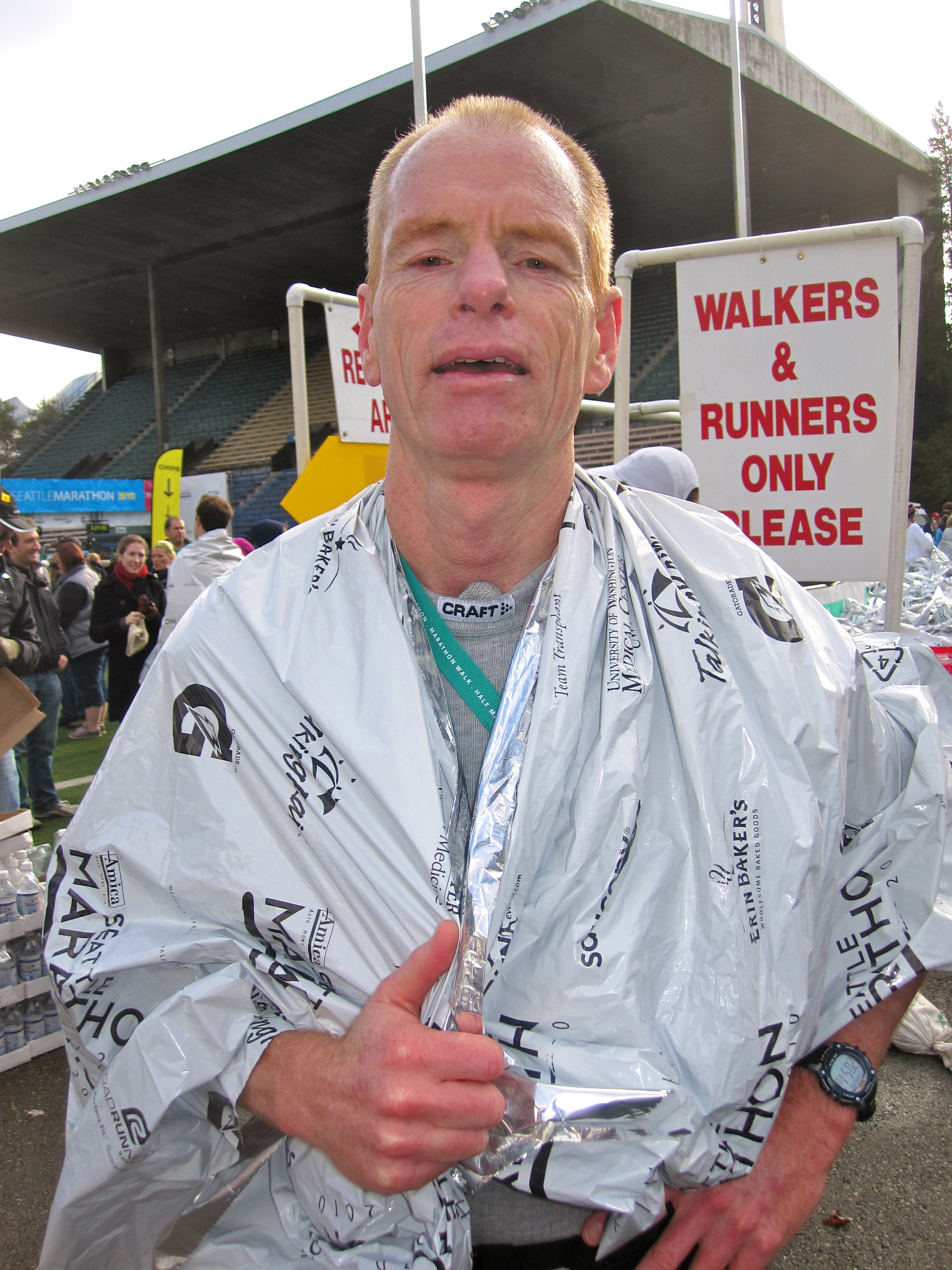
3:21:32. Overcast, wet pavement, high 30’s. Second fastest marathon. Three minutes slower than my fastest and three minutes faster than my third and fourth fastest. Not bad for an oldster.

The question I set out to answer was how many 7:30 miles can I run in a row? I had logged lots of training miles at between 7:35-7:45 and I figured with tapering, perfect weather, smart nutrition and hydration, that was a good number that would also conveniently result in a personal record.

But just before the race I had a talk with my self. “Forget the watch Self. Respect the distance, stay within yourself, and take what the running gods give you on this particular day.”

Since I had my undivided attention, I continued the self coaching. “Let’s break the race into five parts, miles 1-8, 9-16, 17-24, 25, and 26. First eight are a freakin’ warmup. If you as so much hear yourself breathing, back off. Free miles. Enjoy Lake Washington. Settle into a grove. Remember it’s a long day. Use the first hour to shorten the race with as little exertion as possible. Hit mile eight as fresh as a (just changed) baby’s behind.

Executed this to perfection. Hit mile 8 in 59:30. I was cruising comfortably, and for a bonus, I was ripping off one 7:27-7:28 after another. The out and back on the floating bridge allowed me to size up how far behind Jesse Stevick (neighbor and Oly High cross country/track coach) and Jon Riak (former lost boy from Sudan, St. Martin’s alum and apparently all around great guy) were from the leader. He had seriously gapped them. Turned out his lead at mile seven was at least as much as at the finish. The East African looking winner won it with an especially fast opening 10k. Ballsy.

I struggle with multitasking. I wanted to take my two-mile splits, but I was also drinking every two, taking gel every four, and a salt tab every eight. The running, drinking, gel taking was as much as I could handle so I just let the watch run for the first hour.

Then I cleared it and started the 18 miler. “This is such a nice grove, no reason to get excited or play the hero and push the pace, just maintain it for another hour and you’ll be in very good shape. Yeah, let’s shrink this bad boy down to a more humane distance.” This is a really nice section along Lake Wash and around Seward Park. Long story short, ran miles 8-16 in 59:45. Eight more 7:28’s, 29’s. I passed lots of people during this hour. Still felt nearly as fresh as a (just changed) baby’s behind. Great consistency, everything in control, not frantically sighting the mile posts, not even checking the watch too often, not trying to get ahead of myself. The overarching goal was to shrink it down to a 10.2 miler. A Saturday run around Capital Lake with the posse.

Mile 16. Clear the watch, restart. Self, “You know hour three is going to be considerably harder than one and two combined.” I executed part three of the plan really well too for 30-35 minutes or through mile 20.5. Then things kick up pretty seriously, including a ¾ of a mile steep segment that would prove tough on a 10k training run. By mile 21, I had a definitive answer to my question of the day. I could run 20.5 miles @ 7:30/mile pace.

Weather was perfect, didn’t overeat the evening before or morning of, salt tabs kept the cramping at bay, drank a ton of Gatorade, and ran smart, so what went wrong? Simple. I ran too few long runs (two 20 milers) and didn’t have a high enough three month mileage total to run through to the finish. Had I gotten one more massage and switched out my shoes earlier, things might have turned out differently. At mile 21 I began to fight it big time, and the quads were trashed, which made the steep downhills from 25 to 26 especially slow and painful, but it was a classic case of having to go farther than I was physically trained to go.

During the last five miles Fifteen’s question from the car trip up rang in my ears, “Hey Dad, why the marathon this year?” Over the last five miles I wasn’t fighting the “whimp ass” voice DG refers to as much as a surly contingent of whimp ass voices. It didn’t help that I was running through the half marathon walkers. “Just keep running, doesn’t matter how slowly. No walking, no way. Salvage a great day.” I was as proud of my last much slower five miles as the first 21.

Thanks Denny for the kindness and generosity. Thanks especially to the GalPal and Fifteen for great race support especially immediately afterwards. Dano for being the best training fodder a guy could ask for. Thanks DG for the foot tips and inspiration. Katie, Lance, Courter, the Principal, moms, and other family and friends for cheering me on from a distance. I felt it. And my brother for the 3:31 prediction or whatever it was.

Felt even worse than I looked

Marathon Pacing

There are three types of endurance athletes. The first, which make up about 1-2% of the total, are the elites who race one another in an effort to win. The second and third, genetically speaking are the remaining 98-99%. The difference between type two and type three endurance athletes is that type two-ers bring a lot more discipline, consistency, and focus to their training; as a result, they finish well ahead of type three-ers.

Each group has different objectives—1’s) win; 2’s) set personal records of different sorts, qualify for the Boston Marathon, etc.; and 3’s) finish.

I assume each elite athlete enters endurance events with detailed pacing plans which they often have to chuck when the lead group goes unexpectantly slow or fast over the early and middle stages. Have a plan, but be flexible.

Type three-ers, who may also be known as “one and done-ers” or “bucket-listers” go into races seriously undertrained, inevitably go far too fast early on, aren’t quite sure what to drink and consume, and fade big time over the later stages. I don’t know how they can go into marathons with detailed pacing plans when they haven’t done enough long runs from which to extrapolate.

I’m a two. There are two types of twos, those that lean heavily on science to aid their pacing, and those, like me that base their pacing on feel, or perceived rate of exertion.

My science is checking mile splits. Overtime I’ve learned to adjust my pace based on my breathing and my mental state. More specifically, by listening to how hard I’m breathing and thinking deeply about whether I can maintain my pace for another hour or two or three. Like turning a dimmer switch ever so slightly, I’ve learned to modestly increase, hold steady, or slightly back off my level of exertion. As a result, I usually perform very close to my limited potential.

I have a few different paces in my quiver. First speed is what I label my “steady/all day” pace. When I’m in good shape, hydrating, and taking in calories, this is the pace that I feel I can maintain for hours. Third speed is “moderate-hard/on the edge/85%/half marathon” pace. My optimal marathon pace is splitting the difference between the two. Easier blogged about than done because I don’t know if I’m in optimal shape. Trying to run optimal pace on something less than optimal fitness could backfire bigtime.

To be successful, twos have to learn to let faster people go. When passed, the tendency is to to say one’s self, I’ll show him or her. When marathoning, I wear horse blinders until the last 10k when I sometimes try to settle in behind someone stronger to shake things up and expedite finishing. To refine this skill I visualize my eighty-year old mother passing me with her reconstructed knee.

The exercise scientists would have chuckled at me one morning last week when I ran down to Capital Lake, around it, and back. Eight miles. Felt really good for the first four and then glanced over at the lake and saw wave action. Oh oh. A few hundred meters later and I was heading back into the 15mph wind that had assisted me over the first half hour. My worst marathon (Boston ironically) was one where I didn’t adjust my dimmer switch fast or significantly enough in light of the warm temps and how much I was sweating (I was fooled by the breeze that was masking my sweating). Again, the scientists would say that was avoidable and they’re probably right. But I’m stubborn and I accept the unpredicatability that comes with running by feel.

Here’s a summary of Saturday’s run. Don’t tell the team we were short a tenth of a mile.

Seattle Marathon Training Update

After a few solid weeks of Seattle Marathon training I’ve hit a serious speed bump in the form of a bottom of the foot soft tissue bruise. Bad timing since last week was supposed to be my longest week. Had to pull up after a half mile one day, rested the following day, and ran 3 miles the third day. As a result, it’s unlikely I’ll be able to hang with the leaders over the final 10k.

It seems to be improving thanks to DG’s wise counsel, ice water, a tennis ball, new shoes, and flat trail running. And so I hope to put a little time into Subway Jared (New York Marathon time, 5:13) and Edison Pena, the Chilean miner/Elvis singer (5:40).

Monday’s predawn workout on the Olympia High School track was a setback of sorts too. Before hitting the track, Dano and I ran four miles with the right wing nutters. Dano only had time for 400 meters before heading home, but he can vouch for the veracity of the next paragraph.

As Dano and I rounded the first corner, one of four or five women stretching on the football field hollered, “Hey Ron!” It was dark and since I didn’t know which of my female fans it was I uttered a simple “hey” in reply.

Apparently women do love the strong silent type because once Dano peeled off the adoration, like my pace, picked up. 800 meters, “Looking good Ron.” 1200 meters, a reprieve because now they’re hopping on one leg across the width of the football field. 1600 meters, “Nice work Ron.” 2000, they’re hopping again. At 2400 meters I’m feeling part human, part gazelle. A legend in my own mind. This is how Pre must have felt.

Then it all came crashing down in one decisive ego shellacking blow. 2,800 meters, “WHEN ARE YOU GOING TO START YOUR INTERVALS?!”

“I’m nursing a soft tissue bruise.” That had to impress them don’t you think. I spent the last 400 meters thinking about how I should have replied. “I just got back from a training camp in the Rift Valley where I took it to the Kenyans. Today is a recovery run.”

How Autobiographical?

Awhile back, I started out a fitness update with a passing reference to an encouraging sibling of mine who once told me “no one cares” about my swimming, cycling, and running.

That begs a larger question. What type of writing do readers, blog readers more specifically, find most interesting?

I’m not entirely sure, but I have some hypotheses. Think of the blogosphere in terms of a continuum with writers either off the stage altogether, on the stage’s edge, or center stage. Put differently, there are blogs focused almost exclusively on impersonal specialized content of some sort; other blogs that focus on the sometimes personal application of relatively impersonal specialized content, and blogs whose content is in essence the personal details of the author’s life.

I don’t read a lot of blogs, but here are a few that I do that represent fairly well the different points on the continuum. Each is wildly successfully at least measured by readership. Also interesting, Cowen and Trunk self identify as having Aspergers.

Example one, Marginal Revolution by Tyler Cowen, an economist. Written primarily for other economists, the content is sometimes a reach for me, which is nice. Cowen is scarily prolific posting several times a day. The main thing to note about his blog is he’s mostly off-stage. Sure he’ll ask for restaurant suggestions for where ever he’s traveling next, and he’ll summarize what he’s reading every few weeks (also scary, seemingly a book a day), but don’t look for him to write about whether he’s getting along with his wife or daughter or his non-academic interests.

Example two, DC Rainmaker by Ray Maker, a triathlete. I highlighted Ray’s blog recently. Written primarily for other triathletes, the content tends towards the science of triathlon training. His reviews of triathlon related electronics are the clearest, most detailed, and intelligently written up on the internet. He’s also an outstanding photog who sprinkles twenty or so pics in his three or four posts a week. Ray is my “stage’s edge” example. Two-thirds of the time he focuses in on all things triathlon. The other third, you learn about his worldwide travels (I’m guessing he does IT for the State Department), his fascination with sharks, his love of cooking and food, and “The Girl” who he was recently engaged to.

Example three, Penelope Trunk’s Brazen Careerist. Penelope is the undisputed “center stage” champion. She’s successful I suspect for the same reasons the authors my writing students and I are reading—Esme Cadell, Sherman Alexie, and Frank McCourt—are: 1) She understands that not every moment in every day and not every day in every week is equally interesting. She’s skilled at teasing out from the details of her life “critical incidents” that encapsulate the most interesting elements of her life that also resonate with other people. 2) When describing and exploring the meaning of the critical incidents of her life she grabs readers by the collar by providing intimate details even when they are not flattering. Scratch that, especially when they’re not flattering. And there-in lies the third reason. 3) She doesn’t self-censure herself, instead she opts for authenticity, transparency, the unvarnished truth, pick your phrase(s). In the same literary vein, Tina Fey’s or Liz Lemon’s self-deprecation on “30 Rock” is pure genius.

So in essence, my sib didn’t go far enough. If I self-censure myself and churn out safe, vague, self-conscious descriptions of the personal aspects of my life no one will care for any parts of my personal life story let alone the swimming, cycling, and running chapters of it.

And in all honesty, three years in and I still haven’t figured out yet how to follow Trunk’s, Cadell’s, Alexie’s, and McCourt’s examples in this format. For example, I’ve consciously chosen not to write about the most personally significant thing that has happened to me this year. I’m not quitting though and I suppose this post is another step in the process of figuring where I want to sit on the continuum and exactly what type of blogger I want to be.