You are anxious and want to take a “cognitive behavioral therapy” approach to becoming less anxious. Meaning more practice exposing yourself to anxiety inducing content. Or maybe your life is just way too peaceful and you want/need more drama.
I have just the thing. The “Thurston County Scanner, News, and Weather” Facebook site. Which reveals the seamy underside of ThursCounty. Let’s get down and dirty and embrace the underside. Shall we?
Exhibit A. May 15th. Olympia Police Department are responding to the Olympia Farmer’s Market for a report of a naked man with a beard, dancing on the stage. While coming in the area, law enforcement had eyes on the male and reported that he was now wearing pants.
Of all places to nude bomb, why the bucolic center of our charming community?! My fave part of this report is the phrase “man with a beard” as if there were multiple dancing nudies. Thank you for that helpful detail.
Get’s worser.
Exhibit B. May 16th. Another peaceful day at the Olympia Farmers Market was interrupted when Olympia Police Department responded to reports of a male who had climbed onto the roof of Pithos Gyros and began urinating from the roof. After finishing his business, he continued wandering around the rooftop. The subject is also said to be associated with a second individual inside the market. No word on what inspired the elevated decision-making, but we can confirm the Farmers Market does not currently offer rooftop restroom facilities. It does not sound like he has been located.
So, if you’re like me, and enjoy frequenting the Olympia Farmer’s Market, prepare yourself for more than flowers, fruit and veggies, and snow cones. Sheriff Sanders reply, “I hate it when I find myself on the roof of an unassuming business and nature calls” for the win.
“The symptoms of mental illness reinforce one another. An important theory in psychiatry, known as network theory, posits that mental health problems emerge from symptoms pushing and pulling on one another in self-reinforcing loops. Being unable to sleep can fuel daytime nervousness; nervousness can drain energy; low energy can lead to social isolation; isolation can worsen depressive rumination; and rumination can make it difficult to sleep. And so on. Symptoms are often triggered by life stressors, but once the symptom arrangement becomes self-sustaining, it continues on long after the stressor has disappeared.”
I liked the essay, but found it a little too abstract for my peabrain. I wish Aftab had illuminated his intriguing insights with examples from his patients’ lives. I assume, maybe incorrectly, that therapists can finesse client-patient privilege by tweaking contexts and names.
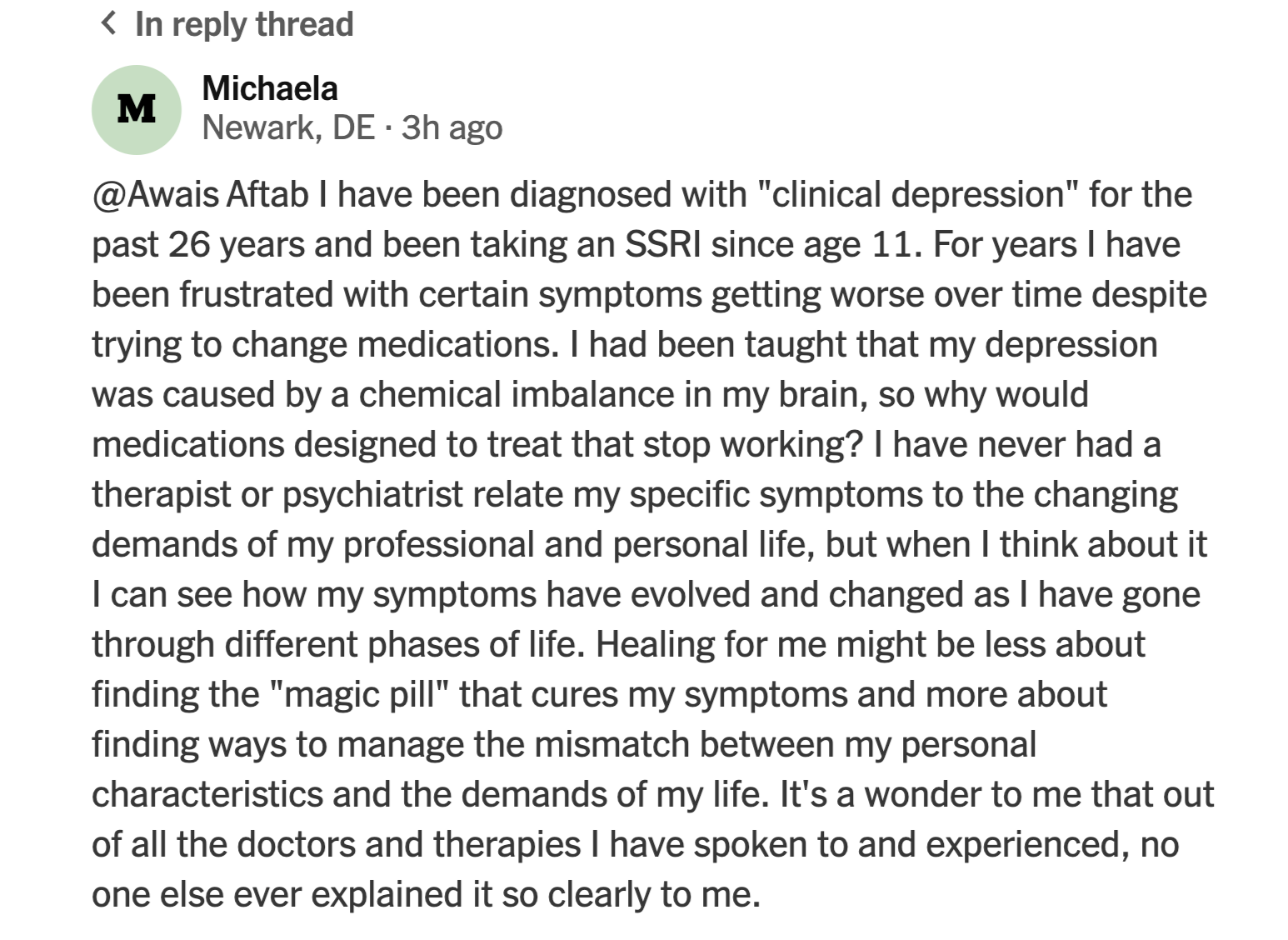
Aftab’s readers, unsurprisingly with bigger brains than me, embraced his insights sans examples. Dig this top comment.
Three weeks after ejecting from my roadbike and skimming across Center Street, I feel somewhere between two-thirds to three-fourths of the way back depending upon how much I’m asking of my bod. I don’t cry when choking on pistachios anymore. And I’m walking a lot, cycling a little, and I ran all of two miles yesterday even though I couldn’t breath very deeply at all. And I’m hoping to get the gills wet Monday at Masters swimming. Thanks to everyone who has checked in. Your texts and calls have meant a lot. They have made me feel a lot less alone.
More importantly, how is my soul five months after Lynn’s passing?
The second hardest adjustment has been the near complete loss of the connectedness to everyone who showed up for Lynn so consistently until the very end. Everyone, of course, quickly returned to their normal lives. I understand that, but it has still been disorienting. The house is so dang quiet.
However, the single hardest adjustment has been the loss of Lynn’s constant love, which as it turns out, I grew more dependent upon than I realized. As an introvert who digs solitude, I always fancied myself as fairly independent and resilient. LOL. In the immediate aftermath of her dying, I felt like the guy in the opening of MadMen.
Despite MSA’s slow motion devastation, I was unprepared for what, at the very end, felt like the pulling of a trap door. Which compelled me, two months ago, to go on a couple of dates which really upset my daughters whose well-being is as important to me as my own. And so now, as a result, I am disconnected from them. So disconnectedness upon disconnectedness.
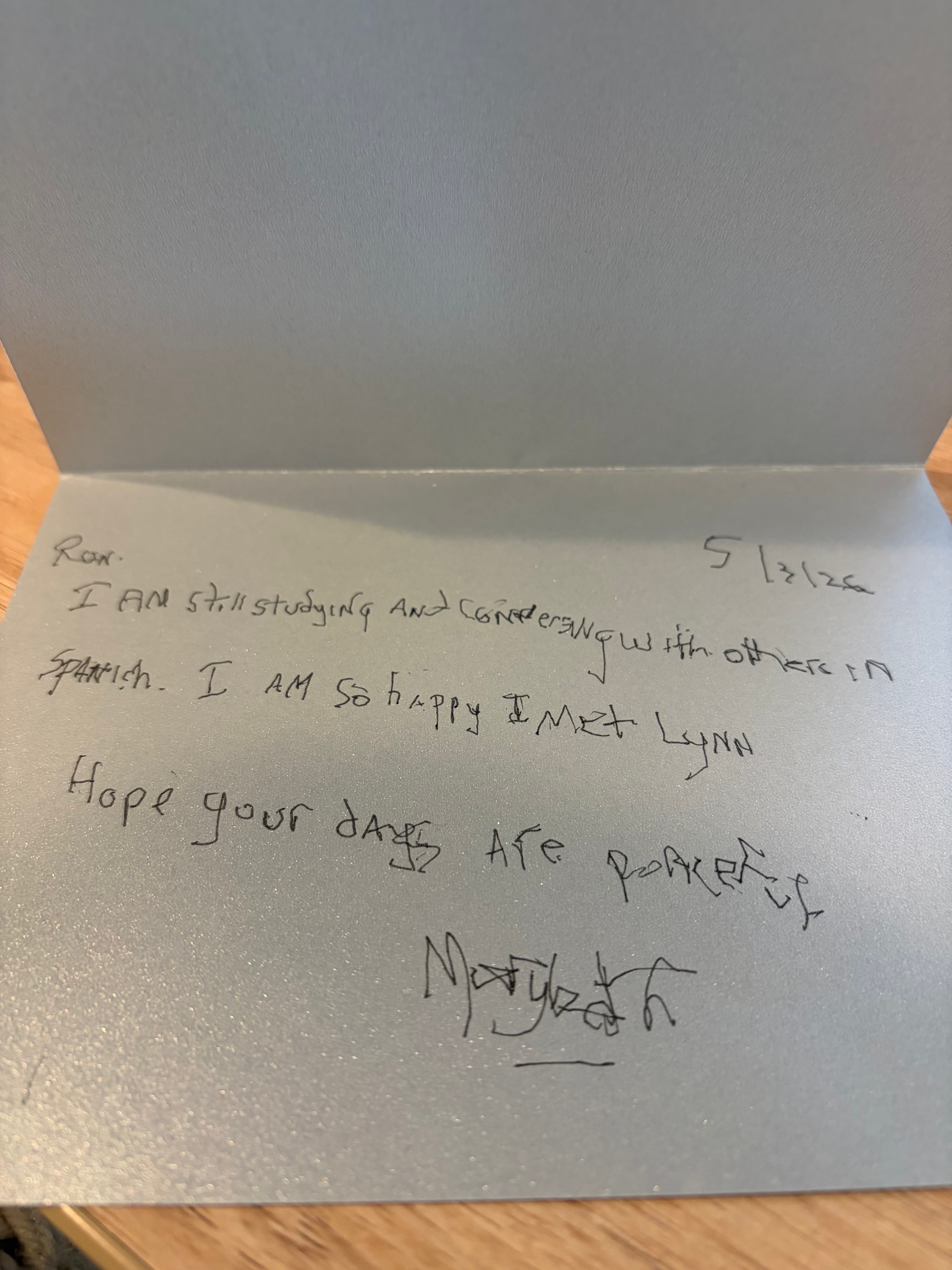
Within that larger context, there have been what we in the Pacific Northwest call “sunbreaks”. Moments in the week, when the clouds separate just enough for warm, healing light to briefly shine through. When Steve calls during one of his Camino training walks to see how I’m doing. When Kevin calls. When MARN calls. When Lou, from high school, reaches out. When Mark invites me to walk. When Kris reaches out and comes over and listens to me ramble like the wonderful counselor she is. When Lil’ Chris sends a heartfelt card and note and invitation to a community event. When the college roommates write to see how we’re doing. When Marybeth sends this card.
Damn, that’s what everyone said, “I’m so happy I met Lynn.” I miss the KChrises, the roommates, Marybeth. Lynn’s people.
More sunshine than a sunbreak, I am not dating anymore because I’ve met someone special. Someone incredibly sensitive to my grieving and the family’s. Someone who watched Lynn’s memorial service on YouTube and said, “I wish I had known her.” Someone who gives me confidence that I will be alright. Especially when my daughters can accept my free falling self and we reconnect.
Sunday, Mother’s Day will be especially hard for A and J. Here’s what I want them to know. I turned on Lynn’s phone recently and there were 99 text messages. One dated 12/16/25, the day after she died, was piercing. Lisa, her boxing coach texted, “I love you Lynn. No more pain. Rest in peace.” Followed by a purple heart and strong arm emoji.
I want them to find solace in their mom’s legacy. So many people loved her. So deeply. We were very fortunate to be among them for as long as we were.
Among the selfless things I do for my beloved readers, paying some attention to Trump’s True Believers has to be near the top of the list.
Think of MAGA like a glacial iceburg. That’s calving. The number of defectors is on the rise, but like in a cult, there’s still a lot of True Believers who literally cannot find it in themselves to criticize the foreign policy of the best President since maybe Lincoln.
After listening to Lindsey Graham and others of them express absolute appreciation for Trump’s Middle East war, I’ve come to this conclusion. Their anxiety is different than yours and mine.
They are not worried about . . .
healthcare access and affordability
rising prices for things like food, insurance, and gas
increasing incidents of gun-related violence
the impact of environmental degradation on their daily lives
polarization in politics and the future of democracy
the rise of Artificial Intelligence and it’s inevitable impact on job security
housing costs, or about the future of Social Security, or about whether they’ll ever be able to retire
their families and their mental health and well-being
the quality and accessibility of education. . .
Nearly as much as they are about the Iran’s nuclear capabilities. When they wake up, they seemingly ask themselves, “Is today the day?”
All of us are anxious. But the roots of the True Believer’s anxiety and most of ours are radically different.
Who often reminds me, as only a loving big sissy can, “It’s not all about you, Ron.” But this post might be. 😜
A subset of humble blog readers, who also happen to be personal friends, have reached out to see how I’m doing post bike accident. Which I’ve greatly appreciated. Here’s more than they, and you, prob wanna know. If my sissy has read this far, she’s rolling her eyes.
Five of us were enjoying a truly beautiful spring day, sunny, 50’s, meaning built-in air conditioning. In a pace-line, we were two hours into a two hour and twenty minute ride, baring down on Tumwater High School at 20-22mph thanks to a slight tailwind.
I was fifth of five. The lead rider, who has been relegated to Witness Protection, did not point out a small, but deep divot in the road. Remember sports fans, whenever you’re on the front, your main responsibility is to the be the eyes for the whole train. Rider number four hit the devilish divit head on, and as a result, slowed quite a bit. I was sitting my customary three feet behind him and didn’t have enough time to avoid riding into his back wheel. At the last fraction of a second, I turned my wheel to avoid his, but all that did was create an angle that launched me dead left into and across the center of the road. Picture a rock skimming across a glassy pond.
My skimming across the pavement happened right in front of a kind and caring woman on the way to work. Had she left for work 20-30 seconds earlier she very well could’ve ran over me. She checked on me and called it in while my friends looped back to provide additional/wonderful support. Soon, a bevy of young male firefighters began asking me questions and poking and prodding me. If I was gay, I would’ve immediately started feeling better. They asked me who the President was, and I said, “Oh man, I feel badly enough already.”
My friends studied my helmet and saw that there were no scratches and so everyone knew my compromised cognition was just my normal state of being. While I was sliding across the road, I was sure I’d broken my collar bone or hip or both. When I came to a stop and was able to sit up and eventually get to the side of the road, I was pleasantly surprised to discover that apart from road rash on my right shoulder, elbow, and knee, all the damage was confined to my right rib cage. Which hurt like a motherfecker.
The fire boys recommended I go to the hospital for a more thorough eval, but they have to say that, right? One also stated with a wink what all my cycling friends and I already know from experience, there’s absolutely nothing they can do for broken ribs.
Meanwhile my friends were putting my chain back on and checking out CanRon, the name of my newish whip, which remarkably, was almost entirely unscathed, maybe because it first bounced off me instead of the road.
Then, I somehow rode it home chapperoned by the team until we got to Deschutes Falls Park and then BC rode with me all the way into the garage atop the Fifth Street Bridge. There’s only two explanations for how I made it home under my own power. Stupidity and adrenaline.
The first night was scary. I had help at dinner, but afterwards, when alone, I was unable to move. I could hear my ribs rattling when breathing, which was even painful. My doc cycling friend who fancies himself a comedian, advised, “Just don’t move or breath.” Eventually, I tried to get into bed, but ended up half on the edge of the mattress and half off. Then, I couldn’t get off the edge of the bed. There may have been a lot of moaning and even tears. Masculinity is overrated.
Eventually, I had a good idea, which like the aurora borealis, happens on occasion. The recliner for the win. Somehow, I slept as well in it as in bed. And that continues to be the case.
I read it takes twelve weeks to recover, but my doc cycling comedian friend texted this yesterday, “You can do activities as tolerated. It should start getting better about 2 weeks after the injury. It will be mostly gone by 6 to 8 weeks.”
The good news is I am way, way better already, six days in. Yesterday, I walked 1.25 miles to the gym, cycled for 30 minutes, and walked home. Just don’t ask me what kind of watts I was pushing. It’s amazing to be able to go from sitting to standing without feeling like someone is jamming a huge butcher knife right into my side. Now, it’s more of a butter knife.
So, my goal is to be back running, cycling, and lastly swimming, closer to six weeks than eight. I mean I need to be ready for the start of the Tour de France in early July. And time is wasting.
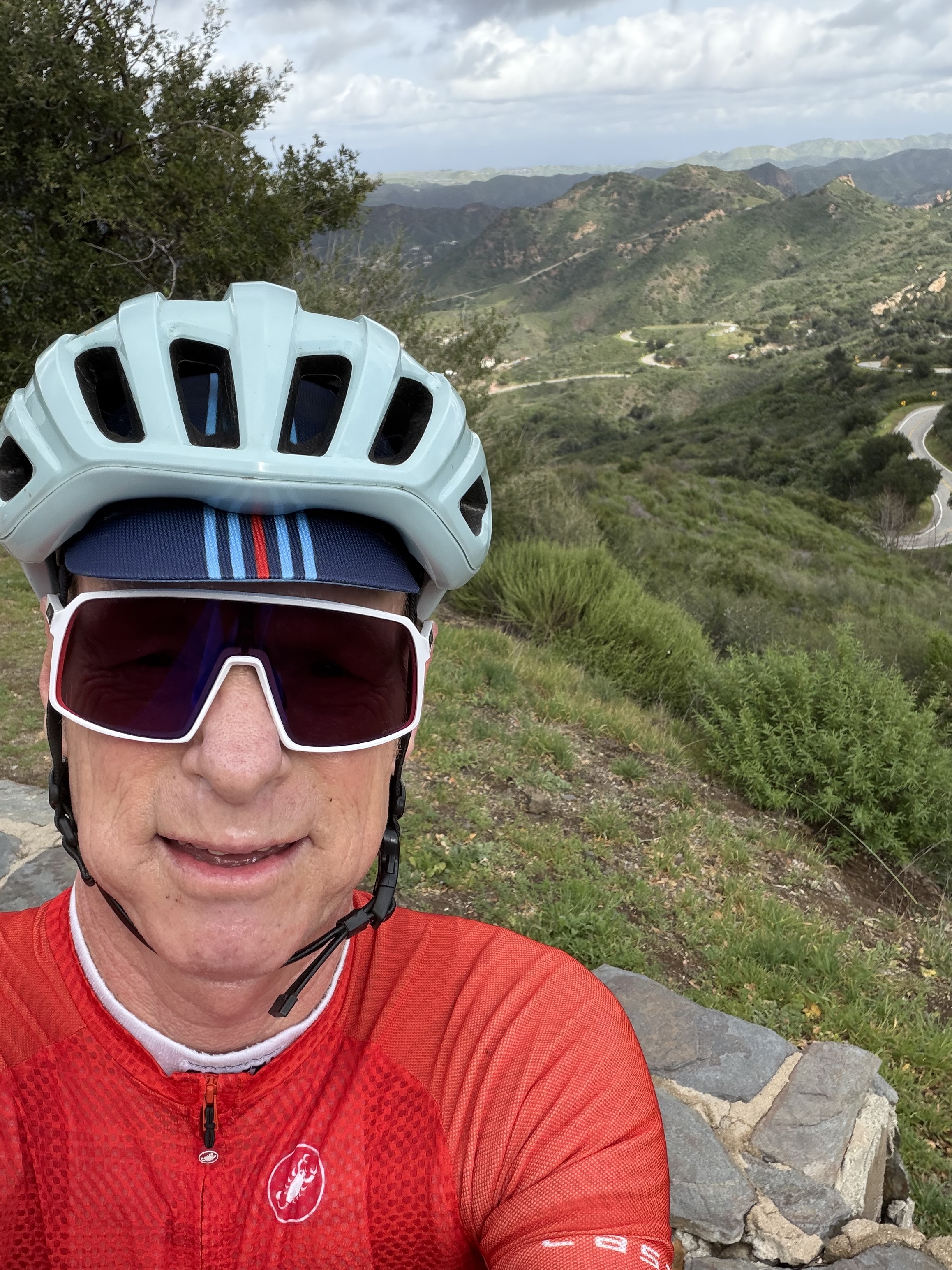
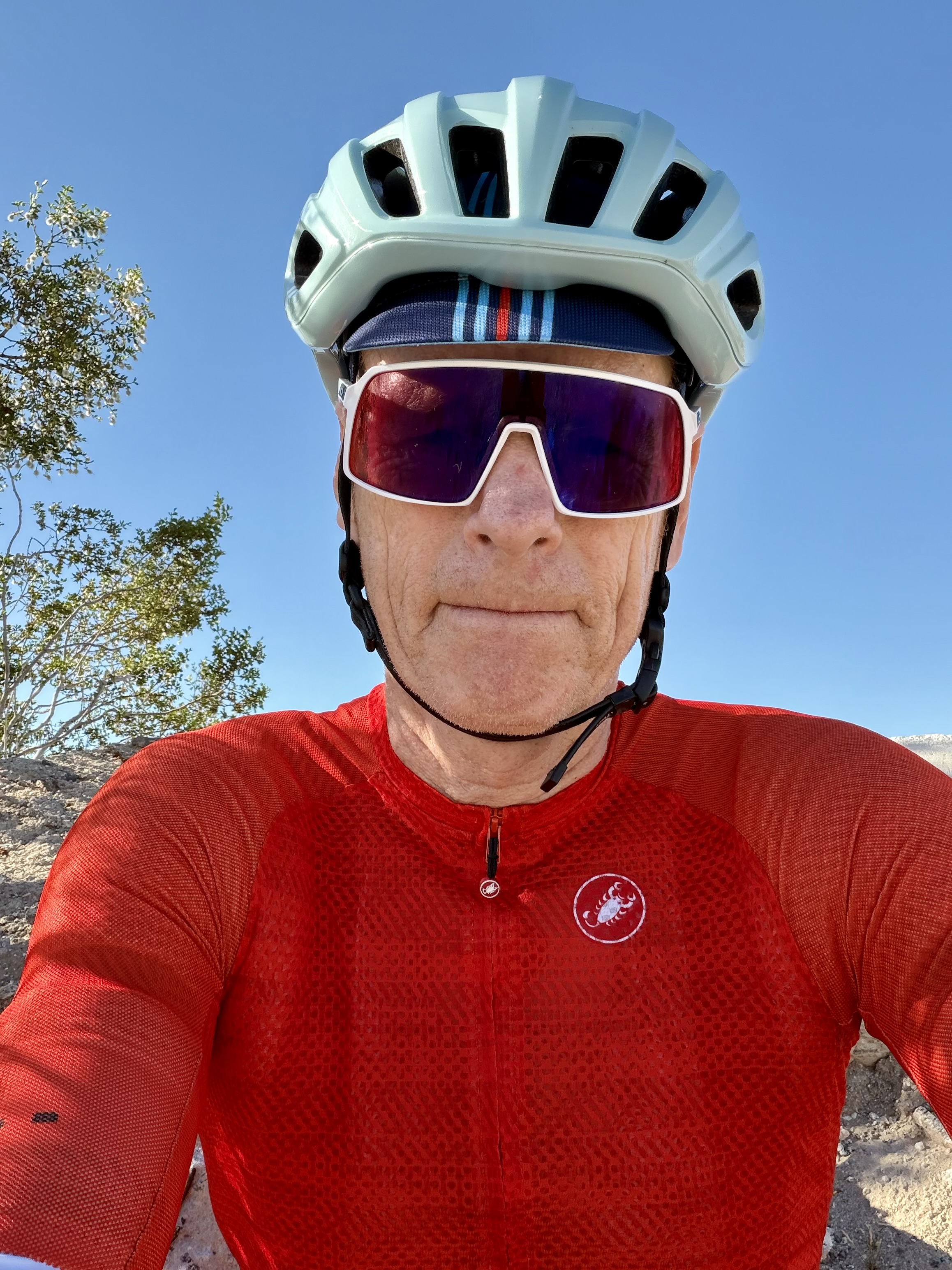
Unlike me, the white Oakley frames did not survive the crash. And for the unusually observant, energy gel in cheek, not chewing tabacco.
Is here. As if emergency rooms aren’t busy enough already.
Related. Yours truly hit the pavement hard Thursday. Right ribs shattered among other owies. Long recovery ahead. In the meantime, I will play write in pain.
“Men will do a lot to avoid going to therapy, including crawling through rivers and digging their own graves. These are just a few activities available from a growing industry of alpha-male camps.”
Today’s ride, 59.6 miles with 4,847′ of climbing was surprisingly easy. I was barely pressing down on the pedal and going uphill faster than ever. Maybe because I switched out my whip.
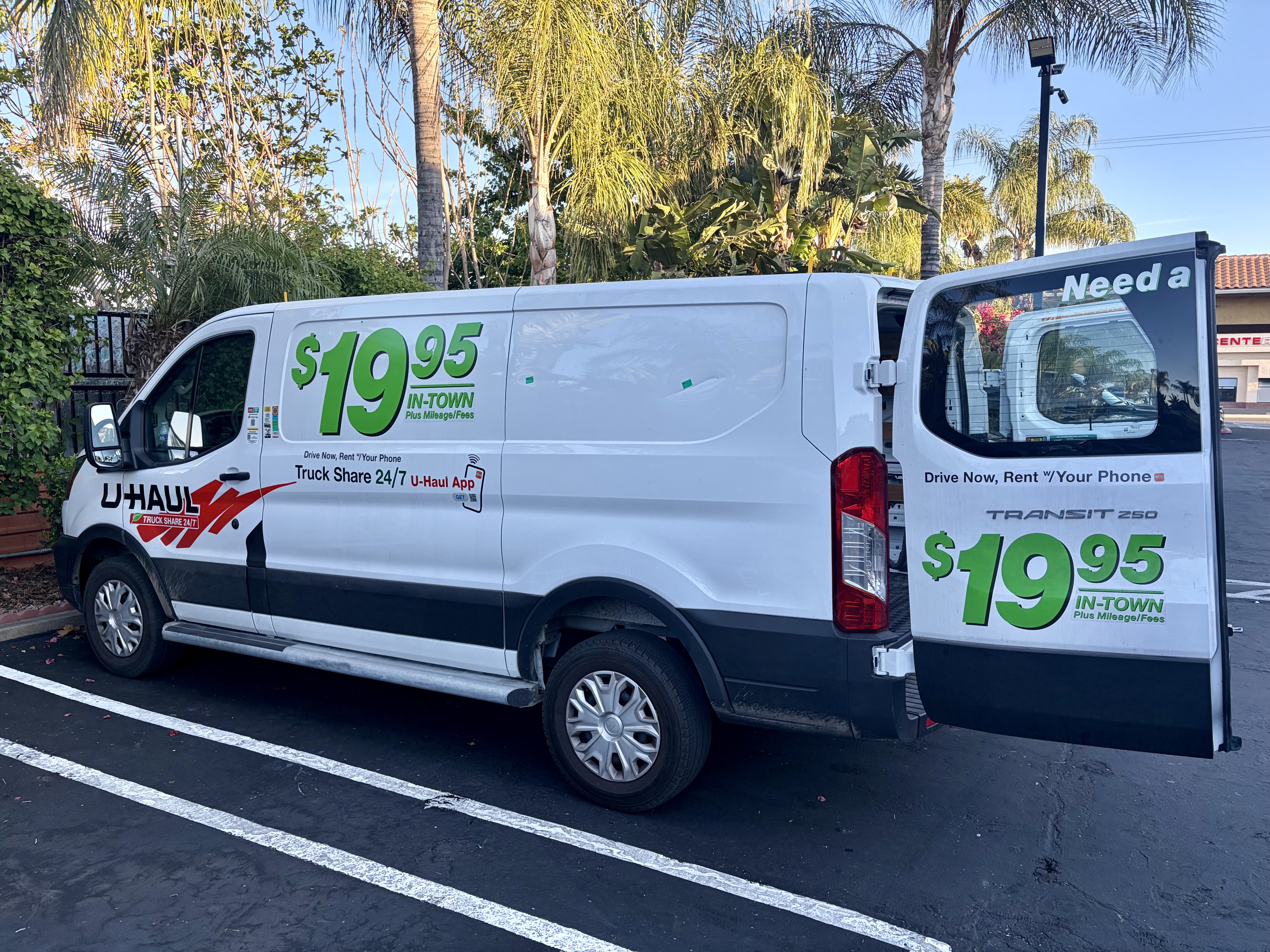
There are 11 of us and so we take turns driving one half of one of the six days. Lucas was the person who got double duty, so me, being my incredibly selfless self, offered to drive both my assigned pre-lunch shift and his post-ride one. Because Lucas is a real athlete, and not an impostor, he gladly accepted.
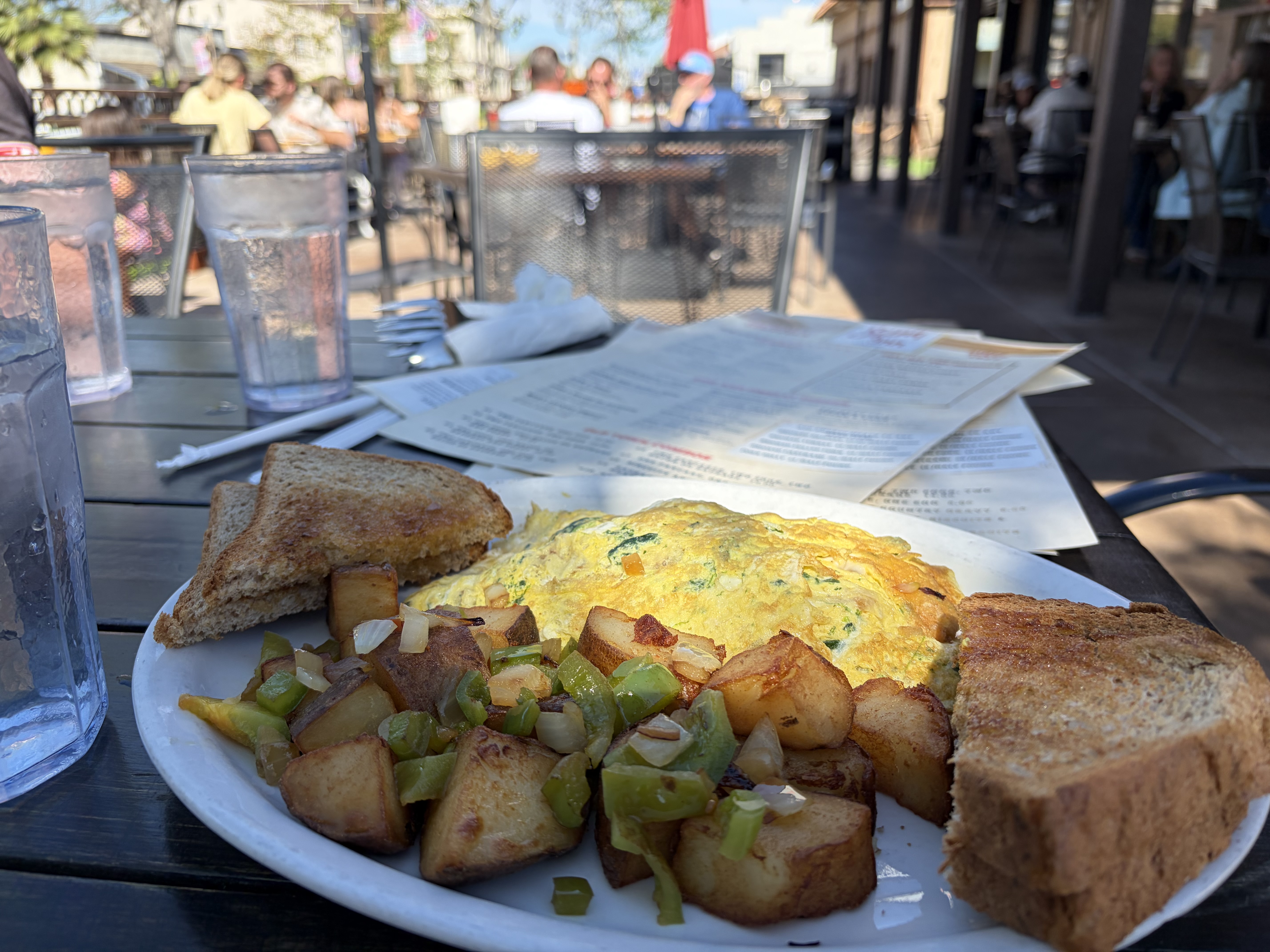
Halfway today, I ate my second breakfast outside at a sun-drenched Temecula cafe.
Eventually, Chucky Chuck, Marky Mark, and Lindy Linda rolled in and I sat with them while they ate. Marky Mark, who didn’t like his heart rate and how he felt during the first half road shotgun with me into Fallbrook. He told a great story about nearly strangling a guy who hit him while he was cycling in China. Who knew MM is a cold blooded almost killer?!
Alternative title of this post. And On The Fifth Day He Rested. Not much of a cyclist and definitely not much of an Old Testament scholar.
For anyone needing Strava inspiration today, my friend, DanDantheTranspoMan, might mow his lawn. He’s a great guy and a hell of a follow.
Tomorrow, lots of Pacific Ocean bike path. The pro triathletes are in town for the biggest race of the early season. I will be so rested you might see me slowly pass Lionel Sanders. Or maybe the pass will be fast.
Hot damn kids, real internet today. Now, the only problem is your intrepid reporter is completely shelled. Not enough strength in my fingers to type much.
Ride report could be titled “Teamwork Makes the Dreamwork”. The first half of today’s ride felt like a ride through the set of Breaking Bad. I was half expecting to see Walter’s and Jesse’s RV around every bend. And I coulda used some cocaine!
Once we hit the highway, the Bay Area Boyz drilled it. All. The. Way. In. They make them tough in NorCal. When Griffin was repairing a flat, Blair told me he once did 300 miles in 20 hours. LOL. If it wasn’t for the BABs, I would’ve ended up as half-melted roadkill. Massive pull after pull that Griffin and I took full advantage of all morning.
It was in the mid-90s at the finish.
Dunno if I can recover in 18 hours. Probs need more like 18 days.
And so it goes.
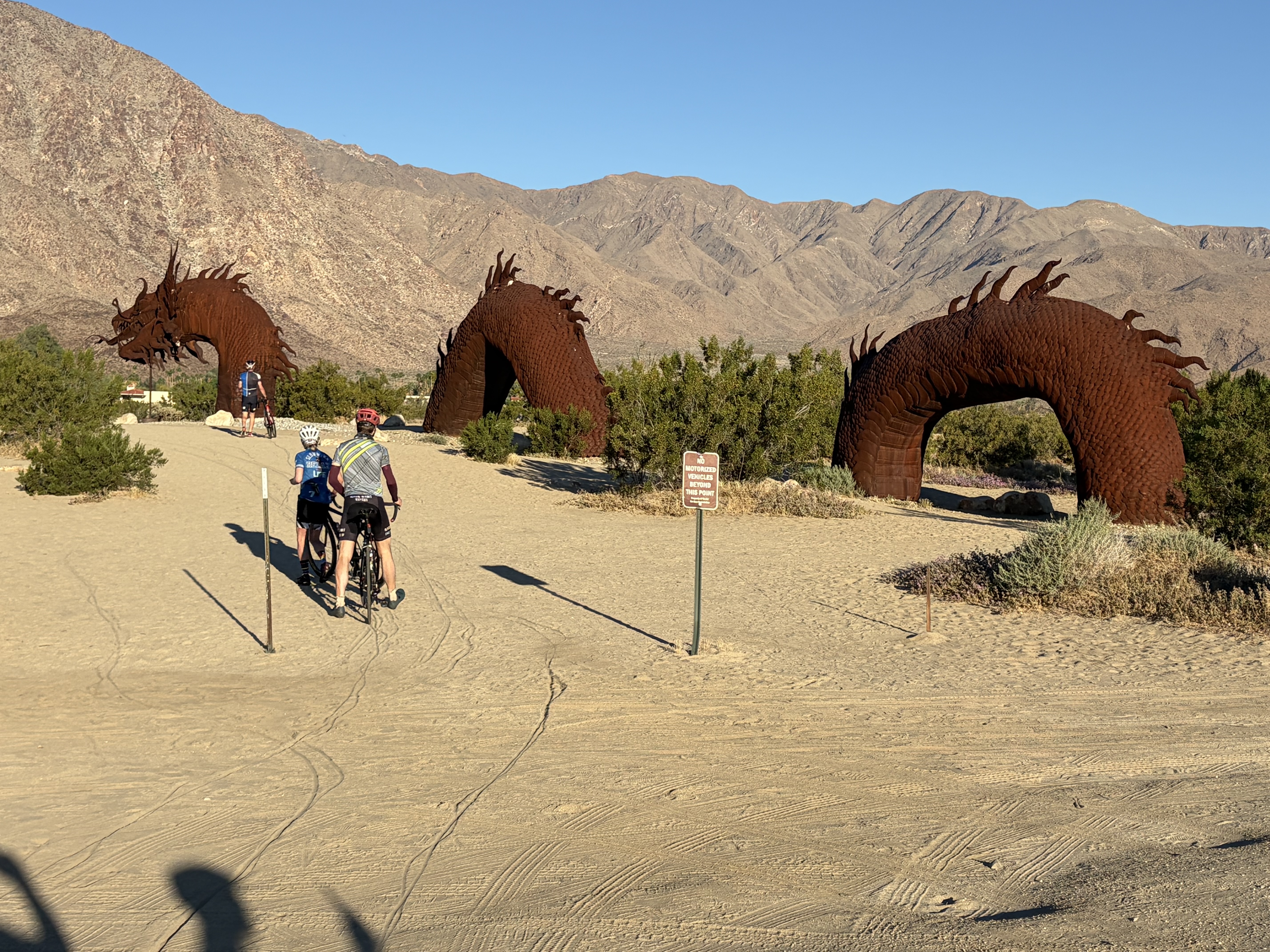
The Michiganders check out a desert dragon. Frickin’ Griffin. The King of Flats.Drug of choice. Shoot that potassium straight into my veins.