Why the Donald Sterling Fiasco Won’t Initiate a Dialogue on Race

The headline read, “Hall of Famers expect league to support Sam”. Of course the league will support Michael Sam, the all All-American defense lineman at Missouri who is the first openly gay active player in the history of the NFL.

But not because NFL locker rooms are especially progressive places. Some players are sensitive to people’s differing sexual orientations, others are decidedly not. As the Donald Sterling illustrates, social media will silence the Decidedly Nots. Sterling went from owner of the Los Angeles Clippers to a pariah in 72 hours. Similarly, any player caught communicating homophobic things about Sam will immediately feel the full weight of instantaneous social media. And any hope for commercial endorsements will be dashed.

One thread of the Sterling coverage has been “If anything positive comes of this, we need to initiate a discussion on race”. There’s little chance of that because social media tends to create a mob mentality with everyone racing to tar and feather the offending homophobe or racist. That creates a chilling effect on what would help initiate a discussion on race—each of us reflecting honestly on how we pre-judge people different than us. Instead of introspection, we pile on the offending person like an unthinking football player ignoring the official’s whistle.

Unlike social media, education depends upon dialogue and dialogue requires that people trust their point of view will be respectfully listened to. The key is to distinguish between racist or homophobic thoughts, words, and actions. Excellent teachers learn to work sensitively with homophobic thoughts and words, but when it comes to hateful actions, of course people should be prosecuted to the fullest extent of the law.

Excellent teachers learn to work with racist or homophobic thoughts and words by exploring their underlying root causes by asking students questions such as “Why do you believe that?” They know that seeing the world from other people’s points of view does not come naturally. They expand students’ worldviews by introducing them to unfamiliar people and places through literature, the arts, and sometimes travel. And by teaching students to substitute curiosity for negative preconceived notions, so that they too learn to ask others, “Why do you believe what you do?”

A Plea to Drivers—Let Us Live

Happy to report that I’m running, cycling, and swimming mostly pain free. Some low level tendonitis, but nothing ice can’t remedy.

I’m hiking from the North Rim of the Grand Canyon to the South, on May 23rd. Twenty-four miles in a leisurely 12 hours, assuming a rattle snake doesn’t get me. Then, to the top of Mount Humphrey, the highest peak in AZ, the next day.

A five day cycling camp in and around Bend, Oregon the first week of June.

In late June/mid July, I’m considering entering a shortish local triathlon and/or a nearby half iron.

And thanks to lottery success this year, on July 31st, the always epic Ride Around Mount Rainier in One Day. Here’s another RAMROD write-up. And here’s more course info.

Runners and cyclists have an obligation to follow the rules of the road and run and cycle defensively. Among other things, that means wearing bright colored clothes; using flashing lights early and late in the day; and following the rules of the road, including stopping for stop signs and red lights whenever anyone is within view; and always running behind any car with tinted windows.

Drivers also have an obligation to follow the rules of the road including stopping at stop signs, looking both ways before pulling onto a roadway, adhering to the speed limit, and respecting bike lanes.

I’ve had a scary number of close calls this spring. I don’t know why, but lots of drivers in my community are in a BIG hurry. That means they routinely brake 10-15 feet beyond white stop sign lines. Which can mean broken bones if not worse. Then, the same hurried drivers glance one way and quickly speed away.

Another common occurrence is what I think the police should write up as an “out of sight, out of mind fuck up.” This is when you, the driver, pass me, the faster than you realize cyclist, and immediately forget I’m right behind you in the bike lane. Then, you suddenly turn right, right in front of me. Recently, I locked my brakes up, swerved, and somehow managed to avoid contact with you.

Even worse, recently, a guy buzzed our bike team by passing closely by us at about 65mph and then immediately swerving into the bike lane. Then yesterday, Mark and I were riding side-by-side in a bike lane when a hulking SUV edged towards the line and gunned it. The message, “I could kill you, if I wanted.” As happens on occasion, we caught the offending SUV at a red light 200 meters later. The driver immediately looked down at her cell phone to avoid eye contact with us. Like driving a drone, she didn’t want to see the individual people on the bicycles.

I imagined her chuckling with her husband about her feat at dinner. If her window was down, and I had a chance to collect myself, I would’ve said to her what I want to say to you:

You’ve got about three tons on us, so if you want, you can easily kill us. But we have wives, children, and sometime soon, grandchildren. They would be sad. So please share the road peacefully and let us live. Thank you.


Keeping Score—What Matters Most?

Last week, a friend, via Facebook, asked me how I was doing. “Excellent,” I wrote. “My family is healthy and happy.” At this stage in my life, everything beyond my family’s health and happiness is like desert, nice, but unnecessary.

Like individuals, organizations can’t evaluate how they’re doing without first clarifying what’s most important. That’s why so many teachers are frustrated today, schools obsess about students’ test scores instead of whether students are curious, kind, and able to accomplish meaningful things in small groups.

On Sundays, I often wonder how do religious leaders keep score? What’s most important in evaluating how a church, synagogue, or mosque is doing? That the budget is balanced, that attendance is increasing, that a lot of mission work is being done?

Our church is in transition. Sometime in the next four or five months, a new pastor will replace our two departing ones. The reduction is partly due to a 20% decrease in membership and a 13% decrease in giving.

Here’s my imperfect understanding of what’s happened. Four or five years ago we hired two progressive pastors who were left-of-center politically; some key church council leaders were lefties; our synod, the Evangelical Lutheran Church of America decided to ordain gay clergymen and women; our state voted in favor of marriage equality; and we rewrote our “Welcoming Statement” to explicitly reach out to GLBT members of our community.

That pace of change overwhelmed some people. Also, as it turns out, people inside religious organizations have dispiriting personality conflicts just like people on the outside. One of our church members told me the members who won the political debates about gay clergy, marriage equality, and the wording of our Welcoming Statement were not gracious winners.

How do religious bodies negotiate political differences and does that factor into how they are doing? Conventional wisdom is that religious leaders and their congregants should leave politics aside. I disagree. Churches, synagogues, and mosques would be much more vital places if they modeled mutual respect for contrasting political viewpoints. Public dialogue about controversial issues is so anemic right now, lots of people on the outside would take notice.

Granted, that’s easy to assert in the abstract, but when talking about abortion, the death penalty, or even marriage equality, it’s much, much harder to implement. In fact, I wonder, are there examples of political diverse religious communities thoughtfully engaged with contemporary issues? Birds of a political feather prefer to flock together, but is that inevitably true inside churches, synagogues, and mosques as well?

I hope not. And I hope our next pastor considers that challenge among the things that matter most.

What People Get Wrong About the NBA and Corona Del Mar High School

Alternative title: Why We Stereotype. Subtitle: Because our pea brains can’t handle complexity.

A sports-minded friend of mine likes soccer; Washington State Cougar football; and this time of year; the Stanley Cup playoffs. But don’t try talking professional basketball with him. He despises The Association because he decided a long time ago that the inmates are running the asylum.

College educated, and a successful professional, he’s like a lot of people who have negative preconceived notions about the league’s players. That because the minority of knuckleheads dominate the news. In fact, there’s greatness in the league, Exhibit A is Kevin Durant’s Most Valuable Player Award speech that you can watch here. Here’s a two-part challenge. Watch the first 4 minutes and then skip to the 22:50 mark and watch the last few. Try not to cry and try not to generalize about NBA players being brash, arrogant, everything that’s supposedly wrong with contemporary culture.

A Los Angeles Times story is titled “‘Prom draft’ reflects Newport Beach Culture, ex-official says“. Here’s the sordid heart of the article:

In 2009, the American Civil Liberties Union sued the school, alleging that the campus fostered a sexist and homophobic atmosphere. The civil rights suit stemmed from an incident in which three male athletes at the school posted a video on Facebook in which they allegedly used homophobic slurs, “outed” a student and threatened to rape and kill a female student.

Nearly a dozen students were expelled this year after it was discovered that a tutor who worked with some of the students accessed school computers and changed their grades.

Newport-Mesa Unified School District officials declined to comment on the prom controversy but in an email to parents, Corona del Mar High Principal Kathy Scott said she’d heard about an ongoing “prom draft” and that it appeared there was a similar draft last year.

“I need your help. I urge you to talk with your student(s) and discuss the seriousness of this type of activity,” Scott wrote. “I do not believe this is intended to be harmful, but this is not behavior that is consistent with our school’s outstanding reputation.”

Jane Garland, head of discipline for Newport Mesa Unified School District until she resigned this year, said some students there live up to stereotypes tied to Newport Beach. “There’s definitely issues at that school with certain students feeling entitled,” Garland told The Times. “The culture in Newport Beach is ridiculous and CDM personifies it.”

Garland should have stopped after saying some students feel entitled. Why? Because some CDM students may not be super wealthy and some who are may actually be mindful of their privilege. When addressing the school’s larger context, she could have said, “Newport Beach’s culture can be ridiculous as illustrated at times by some students at CDM.”

Based on his acceptance speech, Kevin Durant may be a better human being than he is a basketball player. Part of his likability is he doesn’t seek attention for his on or off-court accomplishments. ESPN is much quicker to detail the legal failures of the league’s knuckleheads than it is to describe players’ community service. Similarly, the LA Times is much quicker to detail the moral failings of some Southern California high schoolers than it is to tell the story of appreciative, selfless, ethical young people.

If it bleeds it leads. The end result? We succumb to the media’s knucklehead bias, a phenomenon that hardens our negative preconceived thoughts about people seemingly different than us.

I’ve never been on CDM’s campus, but here’s what I know to be true about it. Its students reflect the good and the bad of their parents. If Garland is right and Newport Beach’s culture can be ridiculous, then no one should be surprised by the aforementioned crises.

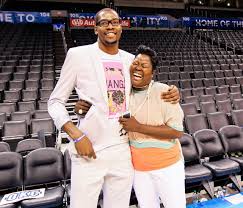
For better or worse, young people follow the lead of their parents. Kevin Durant is worthy of admiration because his mother has been for thirty years. Some CDM parents deserve scorn for a litany of parenting failures. Inevitably though, other CDM parents have more in common with Wanda Pratt, Kevin Durant’s mother, pictured below.

We struggle with nuance, subtleties, and ambiguity. In my alternative version of A Few Good Men, Jack Nicholson shouts at all of us, “You can’t handle complexity!”

imgres

The Most Valuable Person with the leagues best player for 2013-2014


What I’ve Been Reading

Would Jesus Support the Death Penalty? Many Christians strangely believe that Jesus wouldn’t support the death penalty even though they do.”

The Tale of Two Schools. Fieldston and University Heights are in the same New York City borough but worlds apart. How much understanding between their students can a well-told story bring? A lot it turns out.

The Hunt for El Chapo. The story of how the world’s most notorious drug lord was captured. Sure to be a movie.

Louis C.K. Against the Common Core. When a comedian points out the way in which the current priorities don’t add up, it earns even the attention of those who haven’t thought much about school since they graduated. But the brutal math of the New York City school system is no laughing matter.”

We Are All Completely Besides Ourselves by Karen Joy Fowler. Entering students at my uni will read this novel and discuss it during orientation in early September. I don’t think I’ve ever read a book that steadily gets more and more interesting up to the very end. After 50-75 pages, I may have set it aside if it hadn’t been “assigned”. The story of a family of five. The dad is a psychology professor at Indiana University. Recommended. It will resonant strongly with those most sympathetic to the animal rights movement.

Bill Simmon’s Big Score. How a failed newspaper writer built a new kind of media empire at ESPN. I’ve completely tired of Simmon’s act, but still found this an interesting “new journalism” case study. A few factoids. The four major sports are worth a combined $91.2b. ESPN’s worth $50.8b making it the most valuable media brand in the world. Bill Simmons has 2.6 million twitter followers, I’m up to 46. 

On deck—American Crucifixion by Alex Beam. The Murder of Joseph Smith and the Fate of the Mormon Church.

In the hole—Family Life by Akil Sharma.


Stoic Insights on How to Put Up With Put-Downs

One of my running partners manages a hair care sales team. Last week he began a run by telling Dan, Dan, the Transportation Man that he had a new product for him. Some concoction that would make his hair thicker. “What about me?” I asked. “If anyone needs it, it’s me. What am I chopped liver?” “You’re too far gone!”

From my notes from William Irvine’s A Guide to the Good Life:

Understandably, people are sensitive to insults. Rather than deserving our anger, flawed people who criticize us deserve our pity. As people make progress in Stoicism they will become increasingly indifferent to people’s opinions of them. Because they are indifferent to others’ opinions, they feel hardly any sting when insulted. One of the best ways to respond to an insult is with humor, especially self-deprecating humor. Sometimes the best response is no response at all, to calmly and quietly bear what has happened. That robs the person of the pleasure of insulting us.

Self-deprecating humor is like Bill Wither’s music or sunshine in the Pacific Northwest, you can never have too much of it. The trick is to make so much fun of yourself than no one else can compare. In the past, I’ve singled out Tina Fey as a self-deprecating sensei worthy of study. Now, meet her equal, Emily Yoffe or Slate Magazine’s Dear Prudence. Prudence somehow answers impossibly difficult questions about all sorts of interpersonal, romantic, and sexual dysfunction. One of her most recent Q&A’s made me laugh aloud. Do not ruin it for me by suggesting some college students wrote it late at night as a prank on the electronic magazine. It has to be authentic.

Q. I am having a rather silly problem with my otherwise wonderful wife. She gets up early every morning before work to go to the gym, and then takes a shower when she gets back to our small one-bedroom apartment. After her shower, she says she gets overheated easily while we’re both getting ready for work. I can understand that—I’ve already showered while she’s gone, she’s been exercising, and then she’s showered, plus she needs to use a blow dryer to style her hair. But her way of dealing with this is to walk around almost naked (in just her bra and underwear) until she absolutely has to get dressed to leave for work. She eats breakfast like this, puts on her makeup this way—she basically just goes about her morning routine with barely any clothes on and sometimes she skips the bra entirely. Under other circumstances, I would enjoy this. But when I’m trying to get myself ready for the day, this is kind of distracting. I find myself getting aroused, and since we’re both trying to get out the door for work, it’s a bad time for sex. But then I get to work and I’m frustrated all day long. I’ve tried raising this issue with her (delicately) and she gets offended that I can’t control myself after we’ve been married for eight years, which I find offensive. She’s the one walking around half-naked. How can I try to resolve this with her peacefully?

A: Ah, tempus fugit! At this stage in my life, the way I turn off my husband is to walk around naked. This is a sweet dilemma, so it’s too bad you both get so annoyed with each other over the fact that after eight years the sight of your undressed wife bouncing around the apartment is so arousing. I get letters from women wishing that their husbands weren’t lounging around with the family jewels draped over the upholstery (they do not find it a turn-on). But I think yours is the first from a guy who finds his wife’s toilette so distracting he can’t get out the door. But surely, once you’re at the office, you are able to focus on the marketing data and don’t spend the whole day moaning over your morning testicular vasocongestion. If you’re not able to move on and save it for later, you sound very juvenile. Instead of continuing to fight over this, try taking action (not the kind of action that will make you late for work). Buy a pretty, short, sheer robe for your wife and give it to her as a gift. Explain that she’s so damn attractive that if she were a little more covered in the morning it would help you focus on the day ahead. Tell her she of course doesn’t have to wear it, but you know that color looks great on her, and you hope it’s lightweight enough that she can put it on without getting overheated. Let’s hope that she takes your gesture in good spirit and likes the robe. Of course, if it’s silky and sexy, seeing her in it may have the unintended consequence of overheating you.

Prudence’s line about turning off her husband provided the second best laugh of the week. The best goes to my daughters, one of whom posted this picture to her Facebook page.

The two things I'm most proud of in todo el mundo.

The two things I’m most proud of in todo el mundo.

Teach Skepticism

The Tacoma News Tribune has a lengthy, sordid story on a 41 year old con artist named Ryan Rhodes. The story’s utter ordinariness makes it noteworthy. At the center were well-to-do parents who took on faith that Rhodes would build a “high end” competitive baseball league for their 10-14 year old sons. Little did they know that Rhodes ripped $100k off of his grandparents when he was 24 years old and had a history of writing bad checks.

The final sentences of the article:

The list of parents and families dismayed by the Pioneer debacle includes Ed Troyer, Pierce County sheriff’s spokesman, who had a grandson in the Tacoma-based league and coached in his spare time. No stranger to scammers, Troyer said the real cost falls on young people who just wanted to play baseball. “Tacoma really needed a league like that, and now it’s gone,” he said. “It’s pretty sad that all those kids don’t have a league.”

ET, please tell me you’re kidding! That’s the take-away?! The most important take-aways from this case study have nothing to do with baseball. The real cost falls on young people who will never cultivate a healthy skepticism if their parents and grandparents don’t detail for them all of the mistakes they made from the very beginning of the sad saga.

If the boys learn these life lessons all is not lost:

• Learn from your mistakes.

• Never trust anyone automatically. Especially people asking you for money. Know that some people will lie to you, steal your money, and run.

• Be doubly wary of solicitors that are more personable and charismatic than normal.

• If you’ve never done business with a person or group asking you for money, never give it to them in advance of whatever their promising.

• Before giving money to any unfamiliar individual or group, find independent references who can vouch for the veracity of whatever they’re claiming about themselves.


What People Get Wrong About Financial Literacy

Every spring a friend in North Carolina and I have a NCAA college basketball tournament bet. He takes the teams representing the Atlantic Coast Conference and I get those representing the Pacific-12. If his teams win more games, I send him a t-shirt, if mine win more, I anxiously await my cotton trophy. This year, neither conference did well, but I barely won a stylish long sleeve Guilford College tee*.

We met teaching and playing noon basketball at Guilford College in Greensboro, North Carolina, in the 90s. This year, along with the shirt(s—one for the Good Wife too, and a coffee mug, Christmas in April), he included four copies of recent Guilfordians, the liberal, liberal arts school’s student paper.

Reading them made it seem like time had stood still. Faculty salaries were still the lowest among a large comparison group of peers. Enrollment was down. Faculty morale was flagging. Some well-liked faculty were leaving to the disappointment of students. Students were protesting the administration’s salaries, which had increased markedly, and were at least average among the same comparison group. Tucked in one of the articles was a devastating detail that will make the new president’s job especially difficult. The small Quaker school has $16m in deferred maintenance. They budget $1.8m a year for continuing maintenance, meaning they’re eight years behind. Some students complained about mold in the dorms.

Colleges on the financial edge routinely defer maintenance. “Let’s delay the roof on the science lab another year.” Eventually, the quality of life for students and faculty suffers, and as with mounting credit card debt, the financial challenges multiply and trustees fret they’ll never catch up. Public schools, churches, and city council’s everywhere face the exact same challenge. Can we manage our finite revenue—whether bonds or levees, charitable contributions, or taxes—well enough to maintain our existing buildings, roadways, and parks? If you want to assess the health of a school district, church, or city, find out how much maintenance they have deferred.

We’re fortunate that our Washington State home backs up to beautiful woods that we’ve enjoyed for sixteen years. In the woods there are hiking and running trails, deer, owls, and a path to a nice city park. Now the woods are for sale and three different developers are interested. Many in our community who have organized to save the woods from being turned into another housing development attended the City Council meeting last week to implore the Council to follow through on their own five-year plan for creating more park space.

The organizing committee has done great work thinking creatively about grants and related funding that makes the purchase seem feasible. imgres But the city has been deferring maintenance on our existing parks. One includes a nice boardwalk along the Puget Sound, a walkway so neglected, parts of it will be closed to the public this summer. While sympathetic to our arguments, the city manager and council both regretted that the city can’t afford to purchase and preserve the woods because they’ve deferred far too much maintenance.

It’s human nature to put off saving for future expenses. Just like colleges, school districts, and churches, I do it all the time too. I replace my nicked up bicycle tires after flatting a few times. I get my lawn mower tuned up when it won’t start. I go to the doctor when I’m near death.

I talked to the college senior recently about car ownership. Most twenty-one year olds think exclusively about the purchase price, “If I can just save $5k for that $5k car.” I impressed on her the need for a “cushion” for additional costs like insurance, gas, and regular maintenance including oil changes, the battery, and tires. In an ideal world, she’d also factor in replacement costs, but that’s pie in the sky. Once I broadened her thinking about car ownership, she realized it’s not financially feasible yet.**

Most financial literacy talk is seriously flawed. Everyone overemphasizes technical knowledge. Do you know the “rule of 72”? Do you understand the power of compounding interest? Do you understand asset allocation, mutual funds, investing costs, dollar cost averaging, and taxes impact on your returns?

People think if schools just taught that knowledge all would be well, but it’s not that people don’t know enough about personal finance, it’s that they lack the self-discipline to spend less than they earn. Including legions of college educated people who would pass a personal finance multiple-choice test.

Schools can’t teach young people to defer purchases, to set aside money to adequately maintain and eventually replace possessions, to live within one’s means. The only way to teach anyone the limits of consumerism, to delay gratification, the importance of savings, and how to live within one’s means, is to model it for them over time.

Fortunately, my parents, especially my dad, taught me those habits without ever sitting me down for any sort of money talk. For colleges, churches, cities, and families, “deferred maintenance” means “We’re in the habit of spending more than we have.” Like mounting interest charges, it ties the hands of college administrators, church councils, city councils, and families.

We are extremely fortunate to be able to meet our family’s basic needs each month with some money left over. We can do one of three things with our surplus. 1) Succumb to status anxiety and buy unnecessary luxury items; 2) Keep existential questions about life’s larger purposes at bay through mindless consumerism; or 3) Set some of the surplus aside for anticipated future expenses.

* During graduate school, my friend was a UC Santa Cruz hippie. The UC Santa Cruz mascot is the banana slug. Second Born and I had lunch in downtown Santa Cruz in late January. After lunch we found a must have t-shirt that featured a large banana slug with the caption “SLUG LIFE”. The perfect gift for my next loss. So good in fact we decided I had to send it this year win or lose. He was very grateful and assured us he’ll get a lot of grief for it from his Geezer basketball pals. That, of course, was our hope.

** Odd to me that she’s not more motivated to make it financially feasible. At eighteen, I couldn’t wait to own my own car. So I parked golf carts and picked up range balls for a few years and bought a VW Bug for $1,500. Most gratifying purchase of all time. For the time being at least, in keeping with her peers, she’s perfectly content to bicycle, use public transportation, or, and maybe this is the problem, use her parents spare car.

How to Live—Patrick, Jess, Alyssa

• Patrick and Jess married in August, 2012. Eight months later they were watching people finish the Boston Marathon when a bomb exploded next to them. Both lost left legs. Patrick, “We’ll figure this out.” Jess, “As equally overwhelming as the evil that day, was how incredibly good these people were.” A touching story about love and resilience nicely told by Eric Moscowitz. For anyone wanting inspiration on how to live. And listen to Patrick speaking last week. “Sewing the threads of community.”

• Last week, Alyssa Mastromonaco, President Obama’s Deputy Chief of Staff for Operations for the last eight years, gave her first interview. Hagiographic, but lots of excellent insights, especially on the importance of selflessness, teamwork, and kindness. A must watch for my daughters.

http://www.hulu.com/watch/624335


I Just Bought a Drone

Tuesday night, while the Good Wife and I slept, our checking account was ransacked by the Internal Revenue Service. This is where our (personal) record amount of federal taxes will eventually end up.

BF-AH180_12taxr_G_20140411180904

The Internal Revenue Service needs reinventing. Could there be a worse name? It sounds like something from an Eastern Bloc dystopian novel. How about the Public Commons or the Public Commons Service? Now the most dreaded sentence in the English language will be, “Hi, I’m from the Public Commons Service.”

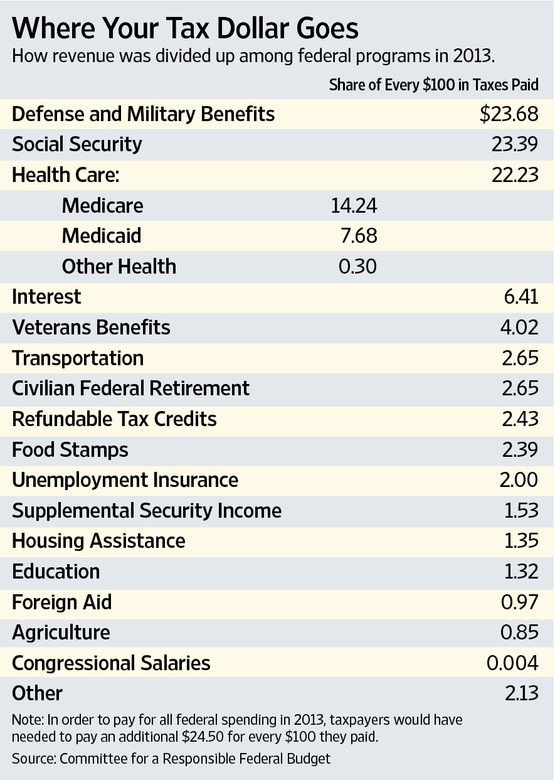
Granted, that’s barely scratching the surface of what’s wrong with the PCS. The main problem with our tax system is once our checking account is raided, we have next to no say over where our federal tax dollars go (apart from voting for two senators and a congressional representative). For example, despite being anti-war educators, 27.7% of our federal taxes go to the military (defense and military benefits + veteran benefits) while 1.32% goes to education. We’re forced to help purchase drones, when we’d much rather help purchase improved teacher salaries.

At the same time, our hawkish neighbors might compensate for our military stinginess by designating far more than their 27.7% for the Pentagon. And of course, our other neighbor, Dan, Dan, The Transportation Man, would significantly increase his 2.65% transportation contribution.

A few significant improvements would result from this experiment in direct financial democracy. 1) Complaining about tax rates would decline. 2A) Government departments and programs would have to explain to the public why they’re deserving of a greater percentage of the total revenue available. And 2B) The more they could demonstrate fiscal responsibility, the more support they’d gain.

Admittedly, these ideas won’t slow the accelerating gap between the Haves and Have Nots. On April 15th, I listened to a panel of tax experts discuss tax reform on the Diane Rehm Show. I was much more intrigued by the tone of the discussion than the details of their ideas. The tone was, “Our tax system is so complex that improving it by simplifying it is impossible, but I’m happy to play along with your national audience anyways.”

As anyone who has tried to improve K-12 schooling, reduce global warming, reduce money’s influence in politics, or eradicate drugs and crime from their community will tell you, those who have a vested interest in the status quo benefit greatly from a sense of overwhelming complexity. Reformers, whether tax or otherwise, can’t wrap their arms around the whole problem, and therefore, don’t know where to begin making changes. Eventually they try piecemeal reforms. Before those reforms take hold, people’s patience runs out. Gradually, everyone and everything reverts back to “normal”. With each passing year or decade, what’s viewed as “normal” becomes more deeply entrenched, making significant change even more difficult.

Tax reformers have lots of good ideas including deductions they’d tweak or eliminate altogether. But they can’t see the forest because of the trees. Their ultimate challenge is to convince the public that simplifying and improving our tax system is possible.