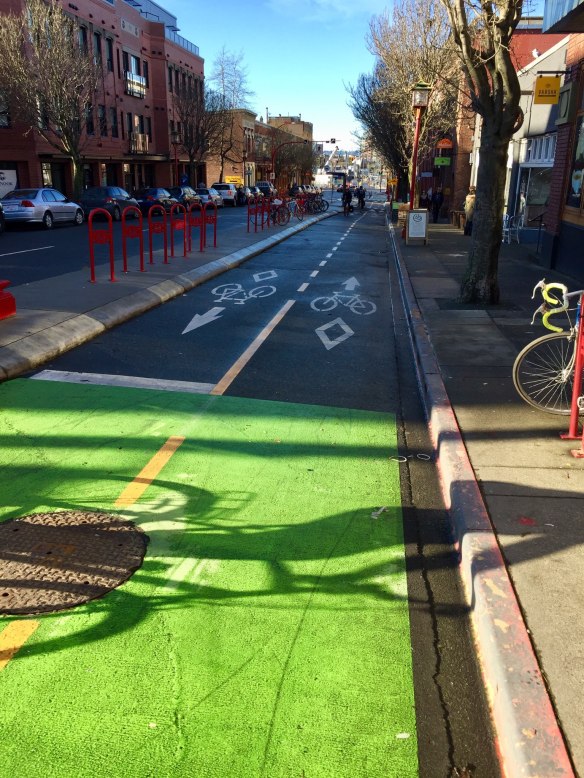
1. Dedicated bike lanes like in Victoria, British Columbia.
2-4.


1. Dedicated bike lanes like in Victoria, British Columbia.
2-4.
During last year’s Super Bowl, the Good Wife and I had friends over for dinner. An enjoyable, television-free evening, one guest peaked at her phone late in the game. Despite learning a historic comeback/collapse was underway, we still weren’t motivated enough to turn on the game. I didn’t see a single play.
It helped that I didn’t care about either team, but like a lot of people apparently, I’m watching far, far less football than in years past. Of course, I’m still weaning myself from UCLA football. That’s been made easier by my team’s apparent decision to quit tackling, which looking at the data, makes sense.
Before you watch this year’s game, read “I’m the Wife of a Former NFL Player. Football Destroyed His Mind,” by Emily Kelly. About her husband, Rob.
“Over time, I had started to notice changes. But this was different. And things became increasingly frightening.
He lost weight. It seemed like one day, out of the blue, he stopped being hungry. And often he would forget to eat. I’d find full bowls of cereal forgotten around the house, on bookshelves or the fireplace mantel. The more friends and family commented on his gaunt frame, the more panicked I became. By 2016, he had shrunk to 157 pounds. That’s right, my 6-foot-2 football-player husband weighed 157 pounds (down from around 200 when he was in the N.F.L.). People were visibly shocked when we told them he had played the game professionally.
Besides damage resulting from football-related concussions, my husband has never had a diagnosed brain injury. He’s never been in a car accident or fallen off a roof. He never did steroids and, after struggling with alcohol abuse for about six years, off and on, after retirement, hasn’t had a drink in eight years. And he’s only 43.”
And:
“He went from being a devoted and loving father and husband to someone who felt like a ghost in our home. For a couple of months one winter he was so depressed and detached, he couldn’t muster up the energy to speak. My questions went unanswered until I simply stopped asking them. The silence was unnerving.”
Lastly:
“After years of little to no sleep, he alternated between sleeping either three hours a night or 20. I’d wake up to find every blind and curtain in the house closed and Rob sitting on the sofa with a blank expression on his face. He no longer felt comfortable driving, refused to leave the house and cut off contact with everyone.
Specific details about how he wanted his funeral to be, and his demand that he be cremated, were brought up with excruciating frequency. One particularly dark time, he went five days without eating anything; he drank only water and a few swigs of chocolate milk. He was suffering deeply and barely surviving. My love and affection seemed to offer no comfort or solace. I felt helpless.”
Winter has taken a toll. This Sunday evening, I think it’s high time to squeegee and sweep the garage floor.
Requirements. Be a tough bastard. Have a sense of humor. Tune out the competition and embrace the process. Swim 1:30/100yds and run 8 minute miles. All day long.
I always appreciate really good writing, but sometimes get frustrated when uniquely talented writers write exclusively about relatively unimportant things. Take Alan Shipnuck, a fellow Bruin, who writes really well about . . . all things golf. Dig his description of TWood’s bottoming out in 2015:
“He developed a palpable stage-fright, the nadir coming on his first hole at the British Open, on the Old Course, site of some of his greatest triumphs. On the tee, wielding a mid-iron, he hit it so fat the gouge that was left behind became a macabre monument to a lost genius.”
Maybe not Pulitzer-worthy, but describing the divot as a “macabre monument to a lost genius” is, if I do say so myself, genius.

From the great electronic encyclopedia in the sky:
“Commodification is the transformation of goods, services, ideas and people into commodities, or objects of trade. A commodity at its most basic, according to Arjun Appadurai, is “any thing intended for exchange,” or any object of economic value. People are commodified—turned into objects—when working, by selling their labour on the market to an employer.”
A year ago, a Seattle runner, training for a marathon, took a self-defense class. In the middle of a long training run, she hopped into a public bathroom on the Burke-Gilman trail, where she was attacked by a violent, deranged person inside her bathroom stall. Thought she was going to die. Then drew on her training, tapped her inner savage, and repelled her attacker.
Made the news. Clearly, a tough, resilient, inspiring woman. A few days ago, I listened to an update. She finished the Chicago Marathon and created a “NTMF” movement, Not Today Mother (something or other), which is intended to inspire women to learn self-defense. A good thing, but then the story took a sharp, predictable, commercial turn. T-shirts and coffee mugs now available for sale. Note too, she’s available for media inquiries and bookings.
A few months ago, pre-Weinstein, my favorite radio sports talk host, who I’ve enjoyed listening to for two decades, stopped by a Bellevue condo complex after a round of golf. Said it was for a massage. Turns out, he paid for sex. His radio station thanked him for his service.
After going dark for awhile, he turned to Twitter to revive his personal brand. He’s not selling t-shirts and coffee mugs, he’s selling himself. The vast majority of people responded positively, quick to forgive, hopeful he’ll get a new gig soon. He replied to darn near each person with a personal “thank you”. I’m sure they think he cares, that they have some sort of personal connection.
They’re all being played. How can he truly care about them, when he’s never met them? All he cares about is increasing his followers on Twitter. The higher that number, the better his odds of a second act.
Everyone is selling something. A friend tells me I’m no different. I’m selling ideas on the Humble Blog. Guilty as charged. But don’t underestimate my commercial chops. At last look, I had 61 Twitter followers.
Dear World Pro Cycling Teams:
I appreciate the opportunity to apply for your position as Performance Enhancing Drugs Wordsmith.
Let’s review where we are. Today’s news that the world’s best cyclist in a routine anti-doping test conducted at the Vuelta a España in September had double the legal limit of 1,000ng/ml of his asthma medication floating around his system, led Chris Froome to say this in his defense:
“My asthma got worse at the Vuelta so I followed the team doctor’s advice to increase my Salbutamol dosage. As always, I took the greatest care to ensure that I did not use more than the permissible dose”.
It’s imperative your riders mount a more credible defense than Froomey when their time in the performance enhancing drug spotlight inevitably comes. That’s where I’m confident you’ll find my services are a bargain at $50,000 per incident.
Every failed test is a little different requiring a true craftsman who can contextualize in a heartbeat. Here’s a little flavor flav of possible talking points for your team’s next PED presser. The first I call the “deflection”, which you’ll find far more subtle than the second, “faux confessional”.
• “Like climate change, these results are more fake science compliments of a vast left-wing conspiracy. Over the millennia, there have always been abnormal tests results like these just as there have always been changing weather patterns. Noam Chomsky and my other accusers are sad (sick) guys. Maybe my critic-crybabies should train harder.”
• “The reports of my failed drug test are true. Regretfully, starting several years ago, I succumbed to the drug-addled culture of the peloton and the pressure of my team’s docs to conform. I am ashamed and embarrassed by the vapidity of my “means justifies the ends” morality. Once I got accustomed to riding in the front of the peloton, I couldn’t help myself. I am not proud of my actions and I am sorry to have perpetuated a hoax on cycling fans the world over. I plan on taking extensive time off the bike to make amends to all of my sponsors, teammates, and fans. [Long pause followed by bursts of laughter.] Kidding of course. Fuck you guys and your fake science. Maybe my critic-crybabies should improve their drug regimens.”
Similarly, I have a bevy of “hidden motor” responses in the quiver too. I look forward to hearing from. You can reach me at PedWordsmith@gmail.com.
This makes me want to fly to Northwest Italy bigly.


Before and after shots. I came out of marathon retirement yesterday and ran around Seattle. Thanks to Pam Johnson, physical therapist extraordinaire; my stalwart training posse; and the home team for the enthusiastic cheers at the finish line.
1. Students’ grades determine where they eat lunch at Florida schools. While trying to process this, I was overcome by a strong desire to excise the peninsula along the Alabama-Georgia borders. Let it drift away I say.
2. Olympic marathon champ Jemima Sumgong banned four years for EPO. This is so common place, why doesn’t the Olympic Organizing Committee wait four years and distribute the awards right before the next game’s Opening Ceremony. And while we’re at it, let’s all agree to wait ten years to give wedding gifts. Make sure the relationship sticks before springing for that state-of-the-art toaster oven.
3. How to Get Entirely Tax-Free Retirement Income. An excellent explanation of why Health Savings Accounts rock.
4. When Your Shitty Health Insurance Doubles in Price.
“Remember, health insurance is not really health insurance. It’s just “large medical bill insurance” – a shaky precaution against having to pay for expensive procedures, so you can keep your investments instead of using them to pay the bills, perhaps eventually becoming poor enough that you are covered by public health insurance (Medicaid). A better name for it might be wealth insurance.”
5. Here’s why you may want to stop judging your emotions.
“. . . research from the University of California, Berkeley found that the pressure to feel upbeat can make you feel downbeat, while embracing your darker moods can actually make you feel better in the long run.
“We found that people who habitually accept their negative emotions experience fewer negative emotions, which adds up to better psychological health,” said senior author Iris Mauss.
At this point, researchers can only speculate on why accepting your joyless emotions can defuse them, like dark clouds passing swiftly in front of the sun and out of sight.
“Maybe if you have an accepting attitude toward negative emotions, you’re not giving them as much attention,” Mauss said. “And perhaps, if you’re constantly judging your emotions, the negativity can pile up.”
1A. Running While Female. Male runners may be shocked to learn how often women must endure on-the-run harassment. Many female runners have come to just expect it.
“43 percent of women at least sometimes experience harassment on the run. . . compared with just 4 percent of men. In the vast majority of cases, it’s not life-threatening. But it is pervasive, and it’s upsetting, and it’s most likely happening to. . . someone you know.
A man will look a woman up and down as she runs past. A driver will shout a come-on, laughing with his friends as they speed away. A person on a bike or in a car will follow a woman, and she might dart down a side street to escape. Even if nothing like this happens most days, knowing that it (or something worse) could happen causes stress. As the recent national dialogue surrounding Donald Trump’s sexist comments and alleged assaults brought to light, almost all women—runners or not—have endured unwanted sexual attention. And no matter how swift a woman’s pace, it’s impossible to outrun harassment.”
1B. Male athletes at Garfield High mentored on how to interact with women.
“‘There was things. . . that I noticed that I’ve done in the past . . . I just realized I should change,’ said Ramari, a football player.”
Imagine that, coaches looking past scoreboards.
2. Why America’s roads are in tatters.
“Brickyard is among the roads that the Muskegon County Road Commission has slated to be turned to gravel, twenty-eight miles in all.”
We are a nation in decline.
“Each American driver pays about $450 per year toward roads, according to the Journal of Infrastructure Systems. Europeans fork over on average 2 to 3.5 times as much — the difference is largely in fuel taxes. Americans have always resisted giving such financial support for infrastructure projects. . . . The federal gas tax, 18.4 cents per gallon, was last raised in 1993 and has since lost more than one third of its purchasing power. Only three states currently index their gas tax to inflation.”
You get what you don’t pay for.
3. How long must Seattle teachers save for house down payment?
“Teachers with five years of experience, and a master’s degree would pay about 28 percent of their annual salary on rent for a one-bedroom in Seattle, according to the NCTQ data.
“Are you giving people enough money to buy a house or even rent a modest apartment? If you aren’t doing that, you’re sort of depriving a profession of what makes it a profession.'”
4. Fuck, I Totally Forgot to Fight for Women’s Rights and Promote Sustainability.
“You know how it is, though.”
 Pressing Pause