Rethinking Policing

Patrick Skinner’s policing philosophy deserves a national audience. Here it is, in short:

“We all matter, or none of us do.”

Related. Unbundle the police. Take two. 

“The roles of warrior cop, traffic patroller, and tax collector are bound up in a way that practically guarantees a large number of violent encounters between armed police and civilians. The United States has about 40 percent more police officers per capita than England or Australia, but adjusted for population, U.S. law enforcement kills 20 to 100 times more people.”

Thursday Assorted Links

1. What happens to Powell’s Books when you can’t browse the aisles? Rethinking the books business.

“Do you have any advice you for someone considering opening an independent bookstore of their own right now? Don’t do it. Um, that’s not good advice. I don’t mean that. It is really a lovely line of work. My only advice is that it will always be challenging. You know, don’t get into the business thinking that if you sort of get a few things right in the beginning that then it will just work and I don’t have to think about it again. The work of book selling is always challenging. There’s always something new, whether it was the big box stores in the ’90s, and then Amazon and now this. There’s always something.”

2. Major landside destroys 8 homes in Northern Norway. Do not miss the embedded vid.

3. Falwell’s blackface tweet brings racial dissent to (anti)Liberty University.

“’It has become obvious to many that your heart is in politics more than Christian academia or ministry, so we would encourage you to leave the position of school president and pursue politics full time,’ said an open letter signed by 36 prominent African-American alumni, including several National Football League players. ‘Your statements hurt the ability of Liberty alumni to obtain jobs and have a voice in the culture. Having the school’s name on a rĂ©sumĂ© can be a liability to many of our graduates.’ The letter was turned into a petition on change.org, signed by nearly 37,000 people as of Monday.”

4. The TikTok house wreaking havoc next door. More counter evidence for American exceptionalism.


Trump Puts Nation on Alert for Terrorists Posing as Peaceful Seventy-Five-Year-Olds

Trump is keeping Andy Borowitz busy:

“Trump listed some ‘telltale signs of Antifa,’ in order to help Americans identify septuagenarian terrorists in their midst.

‘If the person appears to be seventy-five or older, with white hair and a peaceful demeanor, call the authorities immediately,’ Trump said.

He warned that Antifa terrorists are infiltrating American society ‘everywhere,’ even on Zoom.

‘If you are on Zoom with your family and an elderly person suddenly appears with a friendly smile, a string of pearls, and the nickname ‘Grandma,’ you have been attacked by Antifa,’ he said.”


Tuesday Assorted Links

1. Unbundle the police?

“It’s an unacknowledged peculiarity that police are in charge of road safety. Why should the arm of the state that investigates murder, rape and robbery also give out traffic tickets? Traffic stops are the most common reason for contact with the police. . . . Many of the police homicides, such as the killing of Philando Castile happened at ordinary traffic stops. But why do we need armed men (mostly) to issue a traffic citation? Don’t use a hammer if you don’t need to pound a nail. Road safety does not require a hammer.”

2. Kareem Abdul-Jabbar writes as well as he played basketball, and I contend, he may have been the best ever. #UCLA.

“I don’t want to see stores looted or even buildings burn. But African Americans have been living in a burning building for many years, choking on the smoke as the flames burn closer and closer. Racism in America is like dust in the air. It seems invisible — even if you’re choking on it — until you let the sun in. Then you see it’s everywhere. As long as we keep shining that light, we have a chance of cleaning it wherever it lands. But we have to stay vigilant, because it’s always still in the air.”

3. When it comes to Presidential leadership, Mexico just can’t win.

“The numbers were startling: In March, Mexico’s government said, the country’s emergency call centers were flooded with more than 26,000 reports of violence against women, the highest since the hotline was created.

But Mexico’s president brushed aside his own cabinet’s announcement, suggesting, without evidence, that the vast majority of the calls for help were little more than pranks.

‘Ninety percent of those calls that you’re referring to are fake,’ said the president, AndrĂ©s Manuel LĂłpez Obrador, when asked about the surge in calls at a recent news conference. ‘The same thing happens with the calls the metro gets about sabotage or bombs.'”

For shit’s sake. This from a leftist populist, who won the presidency more than a year ago by promising to transform Mexico into a more equal society. Fool me how many times?

Intentional Silence

An interesting tension is building between two profound changes.

The first change is the privileging of marginalized people’s voices in debates about contemporary issues like policing, systemic racism, capitalism, and criminal justice. Increasingly, this means silencing whites, especially wealthy, heterosexual males so that people of color, gender atypical people, heterosexuals, and the poor can be empowered in ways they’ve long been denied. This phenomenon is completely understandable if you know the history of policing, systemic racism, capitalism, and criminal justice in the (dis)United States.

Despite knowing the history and understanding that impulse, some caution is in order, because in its most extreme form, a strict privileging of marginal voices can become a reverse silencing which is antithetical to a vibrant democracy. It’s understandable why people who have been silenced all their lives want to do whatever is necessary to finally “have the floor”, but completely silencing any particular group’s voices is not a viable long-term strategy for strengthening the common good.

The second, more recent change, is the notion that “silence is violence”, an idea that informs this essay by Mark Fraser, a Caribbean-Canadian hockey player. This is the idea that not speaking up about injustice makes one complicit in it. Here Fraser applauds “white peers” for speaking up:

“I cannot recall a time in my life when I have cried for a week straight. I cannot recall a time when I have been on such a roller coaster of emotions. But out of everything I’ve read or heard this week, what has hit me the hardest and has made me shed the most tears is seeing my white peers stand up and say, ‘This isn’t right.’

I cannot express the deep, deep emotion that is stirred up inside me seeing people who have only ever known white privilege stand up and join our cause. This is a moment in history that we should all want to look back on and think we contributed to forward progress in fighting against systemic racism.

. . . . The majority have to speak up and stand up for us.”

Fraser’s perspective contradicts the first trend, and in doing so, illustrates pluralism’s complexity. The take-away is that diverse thinking is even greater within ethnic groups than between them. Expecting people of color, or African-Americans more specifically, to think and act the same way because of similar skin pigmentation is among the most oppressive things of all.

It’s great that Fraser is finding strength in his white friends’ words of support, but many people of color spent the week getting even more angry as high profile whites in entertainment, sports, business, politics, and other industries made ignorant, insensitive comments that they then quickly apologized for in desperate attempts to salvage their personal brands.

If they had only uttered Fraser’s three words, “This isn’t right,” maybe things would’ve been different. But they were not nearly that succinct. And the more they wrote and talked, the worse things got. It was a week-long argument for intentional silence.

Maybe it’s time for people of my complexion, who share aspects of my privileged background, to consciously stop writing and talking. To press pause. Different than a forced silence, I’m advocating for a voluntary one marked by active listening.

And a week, or a month, or a year, after a change in administrations, let our first words form questions. About what it was like to be George Floyd or Breonna Taylor or Ahmaud Arbery. Or what it is like to be Marques Brownlee or Mark Fraser.

Then maybe, we will rise above our differences, find commonalities, and begin building a more just and better future.
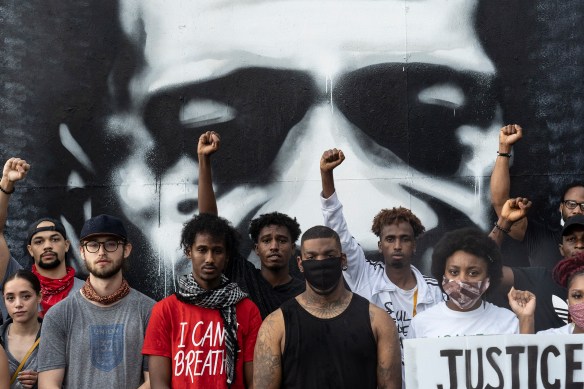
ap_20155577134993_2500Stringer/Sputnik via AP.


Why America Can’t Escape Its Racist Roots

Orlando Patterson, Professor of Sociology, Harvard.

“. . . sociologists have argued that while some whites may have liberal views, a lot of them are not prepared to make the concessions that are important for the improvement of black lives. For example, one of the reasons why people have been crowded in ghettos is the fact that housing is so expensive in the suburbs, and one reason for that is that bylaws restrict the building of multi-occupancy housing. These bylaws have been very effective in keeping out moderate-income housing from the suburbs, and that has kept out working people, among whom blacks are disproportionate, from moving there and having access to good schools. Sociologists have claimed that while we do have genuine improvement in racial attitudes, what we don’t have is the willingness for white liberals to put their money where their mouth is.

One of the fundamental aspects of the American race problem is segregation. The black population is almost as segregated now as it was in the ’60s. That is the foundation of a lot of problems that blacks face, but it also explains and perpetuates the isolation of whites who grow up in neighborhoods where they don’t see blacks or interact with them. That reinforces the idea that blacks are outsiders and don’t belong.”

And Chris Rock says, “Being a cop is a hard job, it’s a hard fucking job. . . . But some jobs can’t have bad apples. Some jobs, everybody gotta be good.”