Swimming Is A Different Animal

To run a faster 10k or half marathon or marathon, a person needs to increase their weekly mileage. Full stop. Interval training can help, along with improved nutrition and sleep, and resistance training; but the most important variable by far is increasing one’s weekly mileage.

Same with cycling. To improve one’s average speed, or to ride a faster 40k or century, improved positioning and aerodynamics help, along with training with faster people (aka intervals), and a lighter bicycle especially if climbing; but the most important variable by far is increasing one’s weekly mileage. “Ass time”.

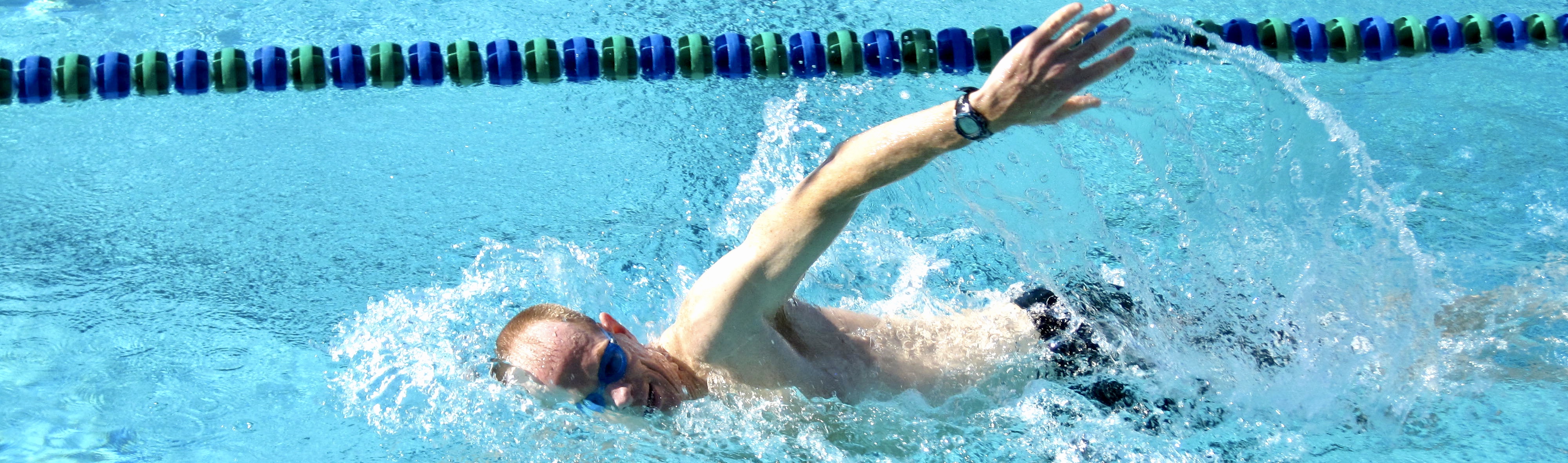
I swim about 6-8 kilometers most weeks. Sometimes, when I can’t run or cycle due to injury or weather, I increase that. For a month or two. And the increase in volume has almost no effect. Instead of swimming 1:32/100 yards, I swim 1:31.

At my age, 59, almost every runner, cyclist, and swimmer is slowing down. The rare exception is the former burner who fell way out of shape and returned to the road or pool in their 40’s or early 50’s. I’m the opposite of that person. I’ve never been a burner, but I compensate for my lack of speed with a very deep cardiovascular base, the result of three decades of consistent training. 

Because of my pedestrian starting point, I’m slowing down more slowly than my active peers. But I digress, back to swimming.

I actually defied the aging process a few years ago and got a touch faster in open water. How? By buying a better wetsuit. Free speed. Well, not exactly free, but you get the point.

Fast forward to my March 2021 Miracle of getting faster in the pool. Some context. I usually do 100 yard intervals in 1:29-1:33 depending on whether I’m doing them alone or with others and when in the workout I’m doing them. It literally takes me about 2,000 yards to “warm up” or the majority of my workout. A month ago, without my fast female friends pushing me in Masters, I was churning out sluggish 1:32 after 1:32 on 1:40 or 1:45.

Right now, I’m limited to 45 minutes at my local YMCA because of some sort of virus. I’ve gotten good at jamming as much as I can into the 45 minutes. Here’s today’s workout:

400y—6:15.  200y x 2—3:05, 3:04.  100y x 4—1:30, 1:30, 1:29, 1:28.

Paddles/bouy. 400y—5:50.  200y x 2—2:50, 2:50.

100y x 4 im, 1:41s on 2m.

Then, in the last 5-6 minutes, I did some easy 50’s and one final 100 concentrating on what I’ve been learning from YouTube stroke analysis tutorials. The easy 50’s were 43 on 1:00 and the easy final 100 was 1:26. Yes please, may I have another. 

Mid or late workout, I can now do 1:28’s (on 1:40) all day long with the same effort I have been swimming 1:32s the last few years. That, in short, is the March Miracle.  

From a running and cycling perspective that sudden improvement makes no sense, but swimming is a different animal. Especially when compared to running and cycling, swimming is super technical, if your stroke is flawed, no amount of volume is going to make much difference. It’s like golf, if your clubface is way open at impact, you’re going to hit a slice no matter how many balls you beat on the range.

Long story short, I’ve been watching a lot of stroke analysis vids on YouTube and finally some of the lessons are taking. Historically, bad muscle memory has blunted coaches’ occasional efforts to improve my stroke.

Somehow, a few stroke improvements have suddenly clicked. Primarily, truly finishing my stroke by gently rubbing my thumbs against my hips, rotating more by lengthening my stroke, and maintaining high elbows through the “catch”. Well, not really the last one. Yet. I’m still a serial elbow dropper. Which is kinda cool because that means there’s still more seconds to be found. And now I have more confidence I can integrate that change too.

In a few years I’ll report back on whether I have higher elbows. Or just tune in to the Olympic Trials in Omaha to see if I’m competing. Your choice.  
fullsizeoutput_7c9


On Obsessiveness

Tyler Cowen’s “My days as a teenage chess teacher” is interesting on a lot of levels. For instance, take lesson learned #6 of 7.

“6. The younger chess prodigy I taught was quite bright and also likable.  But he had no real interest in improving his chess game.  Instead, hanging out with me was more fun for him than either doing homework or watching TV, and I suspect his parents understood that.  In any case, early on I was thinking keenly about talent and the determinants of ultimate success, and obsessiveness seemed quite important.  All of the really good chess players had it, and without it you couldn’t get far above expert level.”

I often envy people who are obsessive about anything even remotely socially redeemable—whether being a grand master in chess, or cycling 12,000 miles/year, or knowing more about Mormon history than anyone except a few dozen Mormon scholars. Why do I envy obsessive people? Because I don’t know if I’ve ever been truly obsessive about anything. It seems like it would be fun to be so immersed in an activity that time stops.

And yet, when I take stock of my life, I can’t help but wonder if my lack of obsessiveness about any one thing may be one of my most positive attributes. If it’s not a positive attribute, splitting the difference between similarly compelling forces, is my essence. It’s who I am.

To the best of my ability, I seek balance. Between work and family life. Between intellectual pursuits and physical ones. Between running, swimming, and cycling more specifically. Between listening and talking. Between teaching and learning. Between friends. Between being silly and serious.   

I wonder, should I stop idealizing obsessiveness?


Challenging Myself In 2021

Are you thinking what I’m thinking? What physical challenges might be motivating to train for and fun to attempt in 2021?

I’m early in the decision-making process, but so far, I’ve narrowed it down to two. The first is a Claire Law inspired 300 mile bike ride with 16,000′ of elevation gain. In under 40 hours, as per her and the Rapha 500k Brevet guidelines. Probs not in the dead of winter though since I’m afraid of the dark. And rain. And cold.

Thanks to my brother for finding the second one, which he instinctively knew, is much more in my wheelhouse.

This is good to know:

“One popular method of doughnut-eating is flattening three or four doughnuts on top of each other to form one pastry. ‘You can trick your mind into thinking that you’re only having three doughnuts when you’re really having more.'”

‘Rona Silver Lining

Americans exercised more in 2020, according to data tracking service, Strava.

“In addition to jumps in running and cycling activity in the U.S., Strava also saw booms in walking, hiking, indoor cross-training activities such as yoga and weight lifting, and water sports like kayaking and stand-up paddleboarding.

‘There was just so much uncertainty surrounding COVID […] it was great to see people deal with that by finding some sort of certainty and an everyday routine,’ Megan Roche, an ultra-runner and epidemiologist, told ESPN.

Women drove the increase in fitness — both in the U.S. and all over the world. Between April and September, women aged 18-29 saw a 45.2% increase in the median number of activities uploaded compared to a 27.3% increase by their male counterparts, the Strava data shows. Women were also biking more, logging a 72% increase in bike trips compared to 2019.”

Case in point, none other than one of my twenty-something daughters. Summer spent lake swimming. Migrated to the pool in the fall. Cycled with friends in the summer. All the while, she turned into a certifiable WALKING machine. 120 miles in November.

Live Wireless Or Die

It’s easy to forget what life was like before global position satellites revolutionized sports technology. I remember rolling my front bike wheel next to a wooden yardstick in my parent’s garage in a desperate attempt to calibrate my sensor that was attached to a couple of spokes. And then using electrical tape to align the wire that ran to the head unit along the fork and head tube. Cumbersome is putting it mildly. And what did I get for all my efforts, a precarious, only mildly accurate set up that constantly needed attention.

Fast forward several decades. Bluetooth, wireless GPS, and (almost always) automatic syncing which results in extremely accurate data recording with a tenth of the effort. Check out what my wrist computer generated during this morning’s run.

IMG_1194

When I first returned to rehab running from my hamstring injury, my average stride length was only 1.16m as opposed to the normal 1.2m. How cool is it that satellites in Outer Space confirm that not only do I feel better, but I am better.

A question for the nerds (used affectionately of course). Why is there a net gain of 35 feet when I started and stopped in my driveway?

The more important question is why do we fret about whether life is improving when we don’t have to wrestle with rulers, electrical tape and wires anymore?

All I Want For Christmas

My poor family, I rarely help them, despite repeated requests, with gift suggestions. But sometimes, old dogs can learn new tricks.

So here’s a suggestion for this Christmas. I just hope none of them read the George Monbiot essay from yesterday. A couple of bottle cages and some pedals would be greatly appreciated too.

Thank you in advance.

How To Get The ‘Rona

Sane people now know the vast majority of cases are the result of people congregating indoors without masks. I’ll continue to be outdoors or inside with a mask on, but if you want to get the ‘rona, some of our Canadian brothers and sisters are here to help.

At least 61 COVID-19 cases tied to ‘very large’ outbreak at Hamilton spin studio, Spinco.

A tutorial.

Step 1. Go to an indoor spin class with LOTS of other people.

Step 2. Conform to what everyone else does—after clipping into your bike, take your mask off.

Step 3. Lean on the pedals hard for an hour.

Step 4. Wait.

Sentence to ponder from the article.

“Hamilton Public Health Services isn’t calling it a ‘super spreader’ event, but Richardson described it as a large outbreak with lots of transmission.”

That’s the funniest thing I’ll read all day.

Be The Rower

Early one morning last week I cycled indoors because Blanca is injured.* Afterwards I plopped into my desk chair to swat back the day’s first wave of emails. All while looking at the Salish Sea.

A rowing scull suddenly materialized. The solo rower probably launched from OAR’s (Olympia Area Rowing) downtown marina dock. With steady strong strokes, they disappeared as quickly as they appeared. Then, five minutes later, after reaching their appointed turn around, they shot by again heading south back to the dock no doubt.

I thought about the probable outline of the rower’s morning—waking early, driving to the marina, lifting the boat from its rack, being on the water at dawn, and rowing a long ways on beautiful glassy water with real purpose. And as required for all Pacific Northwesterners, stopping for the daily latte on the way home.

Then I thought about the rest of the rower’s day and despite everything—the ‘rona, the impending forest fire smoke, the faux electronic schooling, the negative national politics—I bet they had at least a decent, if not good, if not great day. How could they not with that kind of start?

Be the rower. Wake up early. And move. Outside**. Walk, bike, swim, run, paddle, row, skate. With someone or alone. Add some caffeine. Then try to have a bad day. I dare you.

* long sordid story starring a real duffus

**once the fire smoke apocalypse is over

Sports Utility Vehicles

IHS Markit forecasts that SUVs will make up half of all U.S. car sales this year for the first time, strengthening further to 54 percent of sales by 2025.

“SUVs are a monument to a broader American failure that has seen pedestrians and cyclists forsaken for endless miles of road building, with non–car users forced to push what Miller calls “beg buttons” to pause traffic to enter roads that should be egalitarian public spaces.

SUVs . . . not only bring a stew of pollution and an element of fear to those attempting to traverse roads on foot or bike—they are also fundamentally inefficient. ‘You are taking a 200-pound package, a human, and wrapping it in a 6,000-pound shipping container,’ he said. ‘For some reason we think that is a good way to move through a city. If Amazon used that rationale it would be out of business in a week.'”