Pressing Pause On A ‘National Conversation On Race’

Everyday brings more examples. People regularly write, speak, and/or behave in ways a majority of people would deem racially insensitive, if not outright racist. What should we do about that?

It seems like we’ve decided to make the consequences so severe that the racially insensitive have no choice but to suppress their racist tendencies. Dox them, ostracize them, fire them from their jobs.

Conservative Republicans, who not always, but often are racially insensitive, are quick to label this “cancel culture” which only adds to their persecution complex and makes them even more defensive on subjects of race.

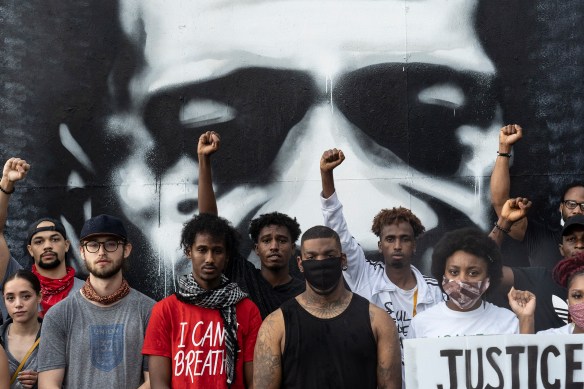
Personally, at this time of heightened racial consciousness, I’m most interested in what militant black men and women are thinking. The more militant, the more I tune in.

Historically, there have been repeated calls by progressives of all colors for a “national conversation on race”. As a life-long educator, that strategy is my preferred one, but I’m not hearing militants make many, if any references to “conversation”.

Maybe that’s because conversation requires slowing down in order to address mutual defensiveness. Instead, activists are accelerating demands for long sought for changes which makes total sense given our collective attention deficit disorder. How long until the media spotlight shifts? In essence, strike now for legislative protections against state-sponsored violence; strike now for the removal of Confederate statues, flags, and related symbols; strike now to destroy white supremacy in whatever form.

As a pro-conversation educator, I’m out of step with the times. Which is okay. Just know I’ll be committed to the conversation long after the spotlight shifts.


Down Goes Bolton!

If this book review of John Bolton’s tell all was a fight, a ref would’ve stopped it in the early paragraphs.

Early in my academic career, I wrote a lot of book reviews. Overtime, I only agreed to review books that I liked since telling people not to read a particular book didn’t feel like a constructive use of time.

Fortunately, Jennifer Szalai of The New York Times does not share my philosophy.

Her take-down of Bolton is exquisite. Her intro tweet to her review is an appetizer of sort:

Screen Shot 2020-06-18 at 9.44.12 AM

The highlights, or if you’re John Bolton, lowlights:

“The book is bloated with self-importance, even though what it mostly recounts is Bolton not being able to accomplish very much. It toggles between two discordant registers: exceedingly tedious and slightly unhinged.”

Szalai on Bolton’s impeachment dodge:

“‘Had I testified,’ Bolton intones, ‘I am convinced, given the environment then existing because of the House’s impeachment malpractice, that it would have made no significant difference in the Senate outcome.’ It’s a self-righteous and self-serving sort of fatalism that sounds remarkably similar to the explanation he gave years ago for preemptively signing up for the National Guard in 1970 and thereby avoiding service in Vietnam. ‘Dying for your country was one thing,’ he wrote in his 2007 book ‘Surrender Is Not an Option’, ‘but dying to gain territory that antiwar forces in Congress would simply return to the enemy seemed ludicrous to me.'”

The finishing touch:

“When it comes to Bolton’s comments on impeachment, the clotted prose, the garbled argument and the sanctimonious defensiveness would seem to indicate some sort of ambivalence on his part — a feeling that he doesn’t seem to have very often. Or maybe it merely reflects an uncomfortable realization that he’s stuck between two incompatible impulses: the desire to appear as courageous as those civil servants who bravely risked their careers to testify before the House; and the desire to appease his fellow Republicans, on whom his own fastidiously managed career most certainly depends. It’s a strange experience reading a book that begins with repeated salvos about ‘the intellectually lazy’ by an author who refuses to think through anything very hard himself.”

Szalai with the technical knock out.

The Lonely Majority

How loneliness could be changing your brain and body.

“A  2018 study. . . found that 54% of 20,000 Americans surveyed reported feeling lonely. In the span of a bit more than a year, the number rose to 61%. Generation Z adults 18-22 years old are supposedly the loneliest generation, outpacing Boomers, Gen X and Millennials, despite being more connected than ever.”

Wowza. The silent, underreported epidemic.

“Loneliness might conjure images of being apart from friends and family, but the feeling runs much deeper than not having plans on a Friday night or than going stag to a wedding. Evolutionarily, being part of a group has meant protection, sharing the workload and increased odds of survival. After all, humans take a long time to mature. We need our tribes.

‘It’s very distressing when we are not a part of a group,’ said Julianne Holt-Lundstad, professor of psychology and neuroscience at Brigham Young University. ‘We have to deal with our environment entirely on our own, without the help of others, which puts our brain in a state of alert, but that also signals the rest of our body to be in a state of alert.’

Staying in that state of alert, that high state of stress, means wear and tear on the body. Stress hormones like cortisol and norepinephrine can contribute to sleeplessness, weight gain and anxiety over extended periods of exposure, according to the Mayo Clinic.”

What to do? Doug Nemecek, chief medical officer at Cigna:

“‘We need to reach out to some friends and make sure we maintain those connections and have meaningful conversations. It’s important for all of us to be comfortable asking other people how they feel.”

And for the lonely majority to risk being vulnerable when asked.

Bolton Rips Trump

Getting reelected was the only thing that mattered.

It continues to be.

Bolton and Trump deserved each other. Mike Quigley on Bolton:

“At the time the country needed him most, and history will reflect, he chose to sell books,” said Rep. Mike Quigley, a member of the House Intelligence Committee. “It wasn’t a question in his mind of whether or not he should talk about it. It’s whether or not he should profit from talking about it. Not exactly ‘Profiles in Courage.'”

Profiles in Cash Money. Boycott the book.

Dave Chappelle—8:46

A friend, whose politics are different than mine, recently asked me to “keep an open mind”.

He can do the same by spending 27 minutes listening to Dave Chappelle’s June 11th YouTube vid.

Raw. X-rated. Because it will definitely offend some, I chose not to embed it. You can easily find it.

An African-American acquaintance of mine tweeted about it this way:

“Feel how you feel about Dave Chapelle. He isn’t above critique. But this…stand up(?) he just released on YouTube is nothing short of genius.”

I wonder, what will my friend think?

Rethinking Policing

Patrick Skinner’s policing philosophy deserves a national audience. Here it is, in short:

“We all matter, or none of us do.”

Related. Unbundle the police. Take two. 

“The roles of warrior cop, traffic patroller, and tax collector are bound up in a way that practically guarantees a large number of violent encounters between armed police and civilians. The United States has about 40 percent more police officers per capita than England or Australia, but adjusted for population, U.S. law enforcement kills 20 to 100 times more people.”

Thursday Assorted Links

1. What happens to Powell’s Books when you can’t browse the aisles? Rethinking the books business.

“Do you have any advice you for someone considering opening an independent bookstore of their own right now? Don’t do it. Um, that’s not good advice. I don’t mean that. It is really a lovely line of work. My only advice is that it will always be challenging. You know, don’t get into the business thinking that if you sort of get a few things right in the beginning that then it will just work and I don’t have to think about it again. The work of book selling is always challenging. There’s always something new, whether it was the big box stores in the ’90s, and then Amazon and now this. There’s always something.”

2. Major landside destroys 8 homes in Northern Norway. Do not miss the embedded vid.

3. Falwell’s blackface tweet brings racial dissent to (anti)Liberty University.

“’It has become obvious to many that your heart is in politics more than Christian academia or ministry, so we would encourage you to leave the position of school president and pursue politics full time,’ said an open letter signed by 36 prominent African-American alumni, including several National Football League players. ‘Your statements hurt the ability of Liberty alumni to obtain jobs and have a voice in the culture. Having the school’s name on a résumé can be a liability to many of our graduates.’ The letter was turned into a petition on change.org, signed by nearly 37,000 people as of Monday.”

4. The TikTok house wreaking havoc next door. More counter evidence for American exceptionalism.


Tuesday Assorted Links

1. Unbundle the police?

“It’s an unacknowledged peculiarity that police are in charge of road safety. Why should the arm of the state that investigates murder, rape and robbery also give out traffic tickets? Traffic stops are the most common reason for contact with the police. . . . Many of the police homicides, such as the killing of Philando Castile happened at ordinary traffic stops. But why do we need armed men (mostly) to issue a traffic citation? Don’t use a hammer if you don’t need to pound a nail. Road safety does not require a hammer.”

2. Kareem Abdul-Jabbar writes as well as he played basketball, and I contend, he may have been the best ever. #UCLA.

“I don’t want to see stores looted or even buildings burn. But African Americans have been living in a burning building for many years, choking on the smoke as the flames burn closer and closer. Racism in America is like dust in the air. It seems invisible — even if you’re choking on it — until you let the sun in. Then you see it’s everywhere. As long as we keep shining that light, we have a chance of cleaning it wherever it lands. But we have to stay vigilant, because it’s always still in the air.”

3. When it comes to Presidential leadership, Mexico just can’t win.

“The numbers were startling: In March, Mexico’s government said, the country’s emergency call centers were flooded with more than 26,000 reports of violence against women, the highest since the hotline was created.

But Mexico’s president brushed aside his own cabinet’s announcement, suggesting, without evidence, that the vast majority of the calls for help were little more than pranks.

‘Ninety percent of those calls that you’re referring to are fake,’ said the president, Andrés Manuel López Obrador, when asked about the surge in calls at a recent news conference. ‘The same thing happens with the calls the metro gets about sabotage or bombs.'”

For shit’s sake. This from a leftist populist, who won the presidency more than a year ago by promising to transform Mexico into a more equal society. Fool me how many times?

Intentional Silence

An interesting tension is building between two profound changes.

The first change is the privileging of marginalized people’s voices in debates about contemporary issues like policing, systemic racism, capitalism, and criminal justice. Increasingly, this means silencing whites, especially wealthy, heterosexual males so that people of color, gender atypical people, heterosexuals, and the poor can be empowered in ways they’ve long been denied. This phenomenon is completely understandable if you know the history of policing, systemic racism, capitalism, and criminal justice in the (dis)United States.

Despite knowing the history and understanding that impulse, some caution is in order, because in its most extreme form, a strict privileging of marginal voices can become a reverse silencing which is antithetical to a vibrant democracy. It’s understandable why people who have been silenced all their lives want to do whatever is necessary to finally “have the floor”, but completely silencing any particular group’s voices is not a viable long-term strategy for strengthening the common good.

The second, more recent change, is the notion that “silence is violence”, an idea that informs this essay by Mark Fraser, a Caribbean-Canadian hockey player. This is the idea that not speaking up about injustice makes one complicit in it. Here Fraser applauds “white peers” for speaking up:

“I cannot recall a time in my life when I have cried for a week straight. I cannot recall a time when I have been on such a roller coaster of emotions. But out of everything I’ve read or heard this week, what has hit me the hardest and has made me shed the most tears is seeing my white peers stand up and say, ‘This isn’t right.’

I cannot express the deep, deep emotion that is stirred up inside me seeing people who have only ever known white privilege stand up and join our cause. This is a moment in history that we should all want to look back on and think we contributed to forward progress in fighting against systemic racism.

. . . . The majority have to speak up and stand up for us.”

Fraser’s perspective contradicts the first trend, and in doing so, illustrates pluralism’s complexity. The take-away is that diverse thinking is even greater within ethnic groups than between them. Expecting people of color, or African-Americans more specifically, to think and act the same way because of similar skin pigmentation is among the most oppressive things of all.

It’s great that Fraser is finding strength in his white friends’ words of support, but many people of color spent the week getting even more angry as high profile whites in entertainment, sports, business, politics, and other industries made ignorant, insensitive comments that they then quickly apologized for in desperate attempts to salvage their personal brands.

If they had only uttered Fraser’s three words, “This isn’t right,” maybe things would’ve been different. But they were not nearly that succinct. And the more they wrote and talked, the worse things got. It was a week-long argument for intentional silence.

Maybe it’s time for people of my complexion, who share aspects of my privileged background, to consciously stop writing and talking. To press pause. Different than a forced silence, I’m advocating for a voluntary one marked by active listening.

And a week, or a month, or a year, after a change in administrations, let our first words form questions. About what it was like to be George Floyd or Breonna Taylor or Ahmaud Arbery. Or what it is like to be Marques Brownlee or Mark Fraser.

Then maybe, we will rise above our differences, find commonalities, and begin building a more just and better future.
ap_20155577134993_2500Stringer/Sputnik via AP.