
Two Worlds

Public and private. All of us behave a little or a lot differently whether we’re in public or not. In extreme cases, people live “double lives”.

The dichotomy between Lynn’s public life, by which I mean when friends and family visit, and private one, where I’m the only person around, is so glaring that it got me thinking.

Specifically, I’ve been pondering why she’s not just okay when friends and family are around, but especially smiley (and today, extremely giggly) and physically better than normal. There’s a wonderful lightness. I guess it makes sense learning what we’re learning about the importance of close interpersonal relationships to our overall health and well-being.

But man, the whiplash that comes when friends and family leave is intense. And disorienting.

When home alone she pops boosters between timed meds and her body is off and on, and when on, she’s bored, and she struggles with any sense of purpose. There’s a heaviness.

Why am I telling you this? Not sure. Maybe to help you mentally prep for this phenomenon if you’re ever a primary care giver. Or maybe I’m letting you in hoping for some sort of connection.

Last night, I had an epiphany. A tough one that I was hesitant to share with Lynn because I expected a negative/defensive reaction.

I told her I had an observation I wanted to share with her. “You have a restless spirit.” There, I said it. Fortunately, I was wrong, because she didn’t argue the point. She listened carefully as I told her I missed her, that it felt like all of her time and attention was taken fighting her Multiple Systems Atrophy. That there was no time or attention left for me.

That I felt more like an employee than best friend.

Most people confined to a wheelchair and unable to do hardly anything independently watch a lot of tv and read. Since Schitt’s Creek ended, Lynn doesn’t watch tv and her reading glasses, despite repeated trips to the optometrist, aren’t working well enough for her to read much.

Thus, when alone, if she’s feeling okay, she’s in constant motion searching for something to do. Anything to do. Or she’s laid out on the couch waiting for her meds to kick in. The only time she’s not on the move is when her body completely quits or she’s asleep.

Our convo, mostly about how dying is scary and spiritual malaise, deepened. She cried and said she didn’t know “I loved her that much”. I took in what I think was her deeper message, “I didn’t know I’m that lovable.” I told her lots and lots of people love her.

I told her I was having a hard time dealing with her restlessness and with her constant MSA fight. That caring for her took all my energy, that there was no leftover energy to just hang. And that it would be really sad to spend our final months or years together not really together.

Case in point. Saturday and Sunday nights I throw dinner together for the fam and then sit at the kitchen island with my own dinner while one or both daughters join their mom at the dining room table. Hell, during the week I do it too, leaving Lynn to eat by herself. Yeah, you’re right, I am a lowlife.

While I am a lowlife, I probably deserve a few points for being vulnerable and risking the convo. Sadly, in part, I risked it because soon we won’t be able to have back-and-forth conversations of that sort.

But not being especially centered myself these days, it’s really tough to take on her anxiety about dying, her exasperation at MSA’s relentless progression, and her general unease and utter restlessness. Especially given the cost that restlessness is taking on our friendship. For now.

Postscript: We ate dinner together. Afterwards, there was more slow dancing in the kitchen. The roller coaster keeps rolling.
A Surprise Swing Dance For The Win

A very good friend of mine has been “unlucky” in marriage. Three divorces. Although the first was so short, and he was so young, he doesn’t count it. A mulligan if you will. So, for all intents and purposes, twice divorced.

Of course, you and I both know luck has nothing to do with whether committed relationships endure.

After his last divorce, about five years ago, he looked in the failed relationship mirror, and really didn’t like what he saw, negative patterns of his own doing.

In no time at all, he fell hard for partner four. So hard, he turned to a therapist to avoid sabotaging it.

No dude in the history of dudes has ever told another dude everything they talk about with their therapist. But my friend has confided in me a bit about his therapeutic journey including his initial question of “Am I an asshole?” I could have saved him a lot of time and money by simply saying “No, you aren’t an asshole. Not even close.” But his initial question was his way of asking, “What’s wrong with me?” Which lead to, “What work do I need to do to avoid fucking up this relationship?”

Relationship Four really warms my heart. I asked him what explains his positivity and joy in this new relationship and without hesitating, he said, “We have fun together.” I herby submit that as a litmus test for any committed relationship.

I don’t know anyone over fifty who has pivoted as much as my friend. The key ingredients as I understand them—introspection, humility, vulnerability, and self-compassion. Inspiring stuff.

Fast forward to a text he sent this morning. And I quote, “And then to top the evening off, I showed M how I had spent the last five weeks secretly learning to swing dance to surprise her for her 50th birthday. Yes, that’s as much as I can manage after five weeks. I can’t dance! And I’m a slow learner.”

The low res video nearly brought me to tears. Just the two of them, swing dancing in front of a big ass swing band in a New York City club. It’s so beautiful. Because it represents so much damn growth. He’s prioritizing her happiness. And so the happiness comes back to him.

On my run this afternoon, I kept returning to the vid in my mind. And all the innumerable podcasts I’ve listened to and “think pieces” I’ve read that lament the problem of boys, and how to raise men, and how to teach masculinity.

My friend’s surprise swing dance is the most manly, most masculine thing imaginable. Because it’s the result of all the intrapersonal work he’s done.

I firmly believe the “boy-man-masculinity” discussion is completely pointless. Instead of asking, “What does it mean to be a man?”, we should ask, “What does it mean to be a decent human being?” Instead of obsessing about getting masculinity just right, we should shift our focus to the personal attributes we want all young people to embody, irrespective of their gender identities.

Especially how to be caring, kind, and selfless. I am incredibly proud of my friend for piecing together an equation that fosters those exact attributes.

Introspection + humility + vulnerability + self-compassion.

How To Stay Together

My amazing playwriting aside, the Jeff Bezos/MacKenzie Scott divorce is an illuminating tale for people committing to one another for the long haul.

The conventional wisdom is that a lack of money and related money fights explain why so many relationships fail. That’s certainly true, but not the whole story. Even people with money can have devastating money disagreements because everyone has a unique money history and no two people will ever think about it the same way.

The bottom line. Couples don’t explore their “money compatibility” nearly carefully enough in the early stages of their relationships. The key is to figure out whether you and your partner are more similar in your thinking about saving, spending, gifting, and investing than not. No, that’s not particularly sexy, but do you want to measure your relationship by decades or not?

One little complication, by which I mean, huge complication. People change over time. Maybe MacKenzie didn’t know Jeff wanted to be the richest person in the world because he may not have wanted to be until his first or one hundredth billion.

What to do about the unknown? Anticipate that your thinking about money will change over time, not radically, but moderately. Similarly, anticipate that your partner’s thinking will change too. Meaning “money compatibility” is always a work-in-progress. Talk about saving, spending, gifting, and investing with some regularity or run the risk of serious differences creating dangerous cracks in the foundation of your relationship.

Of Mountains and Spain 2019

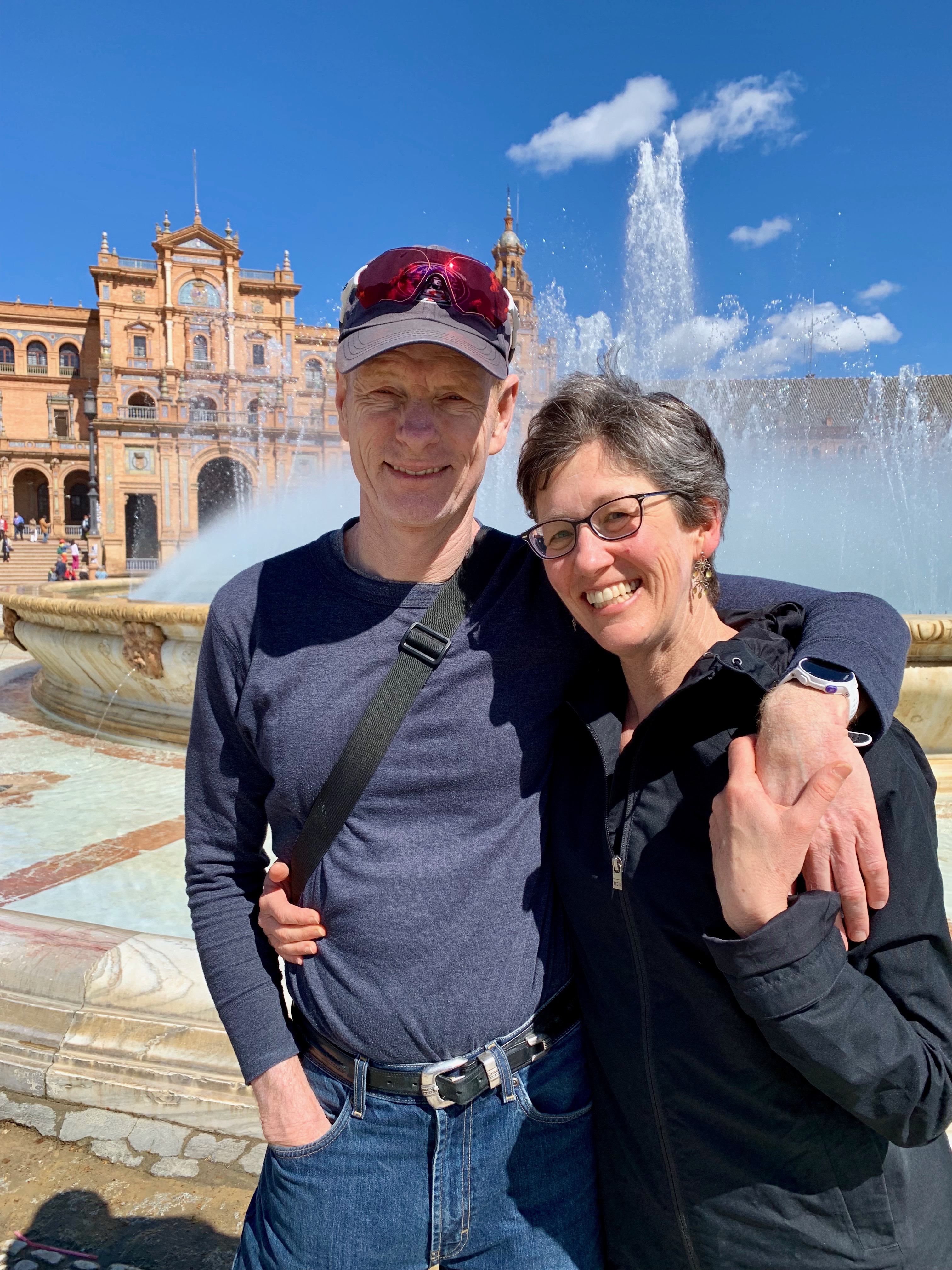
Three years ago, in light of our 30th anniversary, I promised the Good Wife a trip to a “Spanish speaking” country. It only took three years to pull of. The GW has always had a passion for languages, Swedish, Amharic, Spanish in particular. Sad isn’t it, that she married such a language loser, but she has to take responsibility for focusing exclusively on looks.

A week or two before the trip, while loitering in the kitchen, she said to me, “Being in Spain with you is going to be sexy.” Hubba hubba! All of a sudden the long distance flights seemed more manageable. But then I regained my senses and said, “Yeah, except for the fact that you invited our daughters.” Correcting the record, she smiled, “Ah, that was your idea.” What the hell was I thinking? Probably that their schedules would never allow it. They happily proved me wrong. We never should have taken them to live for short stints in China and Norway when they were young.

Here are the sordid details you so desperately want. The four of us shared small apartments in Madrid and Seville for eleven days. I was sick as a perro for about a third of the time. In the end, I’m sorry to report, there was very little hanky and next to no panky.

But all was not lost.

David Brooks in a recent piece, The Moral Peril of Meritocracy, contrasts first and second mountain life. He writes:

“If the first mountain is about building up the ego and defining the self, the second is about shedding the ego and dissolving the self. If the first mountain is about acquisition, the second mountain is about contribution.

On the first mountain, personal freedom is celebrated — keeping your options open, absence of restraint. But the perfectly free life is the unattached and unremembered life. . . . 

So the person on the second mountain is making commitments. People who have made a commitment to a town, a person, an institution or a cause have cast their lot and burned the bridges behind them. They have made a promise without expecting a return. They are all in.”

And:

“Over the past few decades the individual, the self, has been at the center. The second-mountain people are leading us toward a culture that puts relationships at the center. They ask us to measure our lives by the quality of our attachments, to see that life is a qualitative endeavor, not a quantitative one.”

I may finally be approaching the base of the second mountain. Why do I think that? Because when the GW asked me what my favorite moment of the trip was, I wasn’t quite able to tell her. Instead, I told her my second and third favorites.

My absolute favorite was witnessing the wave of emotion that came over her as the trip drew to an end.

The last morning in Seville, I rallied and we went for an aimless walk through our neighborhood’s ancient, narrow streets. Eventually, we ended up at the outdoor window of a tapas bar in a small, beautiful, mostly empty plaza. We ordered dos cafes con leche and waited at an outdoor table. Sipping our drinks, she started to cry. “This is exactly what I wanted to do. I wanted to sit with you at an outdoor cafe and just enjoy the moment.” Later that morning, the tears continued as she declared her abiding love for the whole dam fam. I can’t remember ever seeing her happier.

That made the lengthy planning process, the marathon plane flights, the expenses totally worth it.

IMG_1814.jpg

On Hunger

I took a total looker to the Hippy Theatre last weekend. Thinking I might get some action, we sat in the balcony, but alas, a few other people, too close for comfort, kept me from making much of a move.

We saw All the President’s Men, thinking of it as a prequel to Mueller’s probable findings.

There’s a pivotal scene early on, when two lowly Washington Post reporters, Woodward and Bernstein, begin reporting on the Watergate break in. A senior editor says Woodward and Bernstein are not nearly experienced or skilled enough for what could end up being a national story (understatement). He advises Ben Bradlee to hand off their initial reporting to some established heavyweights. “They’re hungry!” their direct editor argued. Bradlee, conflicted, bet correctly on youthful ambition.

Cyclists routinely let off the gas after cresting hills. Their pedal cadence slows as soon as they begin descending, sometimes to the point of stopping altogether. “I’ve worked hard enough,” legs say to the brain, “I deserve a break.”

Many reporters and people coast, to varying degrees, once accomplished, however they define that. Of course there are outliers, oldsters who continue to grind well past the point of most of their peers.

As evidence of the fact that I’m not nearly as hungry as my younger self, rewind the tape eighteen months. Shortly before moving, I “organized” an underwhelming garage sale. Fewer than normal people showed because of my half-ass marketing. I hollered something sarcastic at my friend across the street like, “Dig the traffic jam!” To which he astutely replied, “You’re not hungry.” Touché. The truth of the matter was, a bit of bacon wasn’t nearly as motivating as saving a few trips to Value Village, which as it turned out, wasn’t much motivation either.

I’m not nearly as Ambitious as in the past, but I’m still ambitious. I care more about personal improvement than professional accomplishment. I want to learn to listen more patiently, to be increasingly selfless, caring, and loving.

That’s a type of hunger. Isn’t it?


How To Find a Boyfriend

In case you’re looking for one. In one word, PowerPoint*. So says Jessica Guzik.

And if you’re looking for one, and are not a serious gamer, you should probably limit your search to college grads. Economist Erik Hurst via economist Tyler Cowen on what young men are doing.

In related news, I’m slowly working my way through The Dance of Anger: A Woman’s Guide to Changing The Patterns Of Intimate Relationships. I think HLerner knew if she pitched it as a “Woman’s Guide” I couldn’t help myself. Savvy. A pgraph to ponder from the early going:

Making a long-term relationship work is a difficult business because it requires the capacity to strike a balance between individualism (the “I”) and togetherness (the “we”). The tugs in both directions are very strong. On the one hand, we want to be separate, independent individuals—self-contained persons in our own right: on the other, we seek a sense of connectedness and intimacy with another person, as well as a sense of belongingness to a family or group. When a couple gets out of balance in either direction, there is a problem.

The Good Wife and I successfully balance that seesaw about a third of the time. Which if we played professional baseball, would make us All Stars.

*nice to know PowerPoint isn’t a complete catastrophe

My Teaching Best—What’s It Look Like?

Last Thursday around noon thirty, teaching the first year writing seminar on the second floor of the Admin Building, I was flat out teaching my arse off. Had you been visiting this is what you would have seen.

Sixteen* first year students and I sit around computer tables arranged in a large rectangle. Eight of them are presenting papers they’ve just written comparing and contrasting ancient Greek notions of love with those most often depicted in Western popular culture. More specifically, they have to explain whether they agree or disagree with Roman Krzarnic when he writes:

“The idea of passionate, romantic love that has emerged in the West over the past millennium is one of our most destructive cultural inheritances. This is because the main aspiration—the discovery of a soulmate—is virtually impossible to achieve in reality. We can spend years searching for that elusive person who will satisfy all our emotional needs and sexual desires, who will provide us with friendship and self-confidence, comfort and laughter, stimulate our minds and share our dreams. We imagine somebody out there in the amorous ether who is our missing other half, and who will make us feel complete if only we can fuse our being with theirs in the sublime union of romantic love. Our hopes are fed by an industry of Hollywood screen romances and an overload of pulp fiction peddling this mythology. The message is replicated by the worldwide army of consultants who advertise their ability to help you ‘find your perfect match’. In a survey of single Americans in their twenties, 94 percent agreed that ‘when you marry you want your spouse to be your soulmate, first and foremost.’ The unfortunate truth is that the myth of romantic love has gradually captured the varieties of love that existed in the past, absorbing them into a monolithic vision.”

After the fourth presentation, I pause to ask if anyone has questions or comments for the first four authors. I wait. Eventually Lauren starts things rolling:

L: So Christie you think God has created one person, a special soulmate for you. So does that mean you wouldn’t commit to anyone that wasn’t a Christian?

C: Yes, I want to be with someone like me, someone with a sincere, foundational faith.

L: But what if you meet someone with similar values? That wouldn’t be sufficient? Isn’t that kind of limiting?

C: No. I think I’m going to end up being a missionary in a developing country so it will be important for my partner to be equally as excited about that. We’ll need that shared foundation.

Sean: Yeah, I feel similarly to Lauren. I want a partner who is not just physically beautiful, but spiritually too. Spiritual beauty means she’ll have an intense love of God as reflected in her words and actions. For me, God should be at the center of our relationship because through God, our marriage will flourish in the purest way possible. While I don’t expect to have everything in common with her, I suspect that there is a girl in the world who is destined to be with me.

Others jumped in. The more secular students respectfully and smartly challenged the committed Christians. I didn’t say anything. Even if I had wanted to, I don’t know if they would’ve let me. I was in the teaching zone because they had forgotten I was there.

Decker Walker nailed it when he wrote, “The educative effect is greater when students do something than when something is done to them.” Teachers are almost always doing things to students. Especially interrupting their thinking by filling every quiet moment with more words. Always more words.

If you were visiting last Thursday you probably wouldn’t have realized I was in the zone because of conventional wisdom about teaching excellence. In fact, you probably would’ve wondered when was I going to assert myself and start earning my salary.

But leading discussions is like flying kites. Sometimes you have to let out the string. I let out the string last Thursday at noon thirty and then a few students grabbed the spool. It was a great discussion because it was theirs. They didn’t need an intermediary. They can read, think, write, and then talk about their ideas all by themselves. That was the day’s most important lesson.

* “Sixteen students,” my public school teaching friends just said to themselves, “shit, anyone could kill it with sixteen students!”

How to Find Your Soulmate

Apparently, the first all important step is to figure out the single most consequential thing you want in a partner. For example, maybe they HAVE to be devotees of Ayn Rand, or farm for a living, or be gluten-free. As detailed in a recent Wall Street Journal article, there are dating websites for each of those interests. Soon there’s bound to be meta-websites where someone could zero in on their dream gluten-free, Ayn Rand loving farmer within 100 miles of Cedar Rapids.

The Journal article was nice because it featured people who weren’t terribly optimistic about finding love, but were finding it thanks to these “niche” websites. They were getting along with their newly found partners, marrying, and starting families. Tough read for a tech skeptic like me.

A noteworthy paragraph:

Relationships often work best when people share similar core values and lifestyle goals. The online dating site eHarmony, for example, matches users by personality traits. Yet if two people are too similar, doesn’t the day-to-day relationship suffer from a lack of fun tension and fresh ideas?

I bet that’s a likely unintended negative consequence of delegating dating to computer algorithms.

Besides the fact that she was fine, a large part of my falling in love with Betrothed was the realization that she brought out the best parts of me. Put differently, I was a better person as a result of our friendship. Specifically, her kindness, her compassion, her social conscience, her generosity, her human decency, superseded my selfish, apathetic self. No computer could quantify that instinct.

I think she’d say I’ve enriched her life too. As a team, our sum is definitely more than our individual parts. But it hasn’t been a walk in the park, in part because we’re so different. Now, twenty-six years in, we’re starting to realize maybe our differences are strengths. Instead of failing miserably at changing one another, we’re learning to appreciate what each person contributes to the relationship, the family, the world.

To find your soulmate chuck the lengthy, hopelessly unrealistic check-list and replace it with one two-part question. Will this person bring out the best of me, and together, will we make a more positive impact on the world than we would apart?

See These Films

1) Mud. 2) Take Shelter. 3) A Place at the Table.

Like most everyone, when I plop down big bucks to see a film, I want to be be transported far from my familiar surroundings. But I most enjoy believable stories, so films set in outer-space, or featuring cataclysmic events, or starring super-heroes don’t really do it for me. Which means I usually seek out independent films that play at our one screen, decrepit, “hippy” theatre.

Friday night, Costco coupons in hand, Ms. PressingPause and I were standing in a longish line at the local cineplex. Knowing Ironman 3, Oblivion, Star Trek into Darkness, and Hip Hop Hemingway were about to start, I said, “None of these people are seeing Mud.” What a shame that I was right.

Worth every bit of our $15. The Jeff Nichols film transports you to rural Arkansas a decade or so ago. Think river life, snakes, boat engines, beans and franks, motorcycles, pick up trucks, Piggly Wigglies, and snakes. So damn authentic it reminded me of Winter’s Bone. It’s a wonderful counterpoint to Hollywood’s steady diet of intelligence insulting romantic comedies. See it for the cross cultural experience and for a greater appreciation for just how hard it is to find and nurture love.

Afterwards, for an incredibly poignant window into mental illness, find and watch another phenomenal Jeff Nichols film. Take Shelter (2007).

A Place at the Table is a powerful documentary that explores hunger in America. It will be available via instant streaming on Netflix sometime in June. See it to meet some hungry families, to better understand hunger’s underlying causes, and to learn about solutions. Given our economically segregated neighborhoods, it’s easy to lose touch with hungry people. I see that disconnect in some of my friends and in myself. The lack of understanding largely explains the associated lack of empathy. The further removed from experiencing hunger you are, the more important it is you see the film.

Lots of new readers last week. Welcome and thanks for the continuing support.