
It’s 1995

Said one technology analyst this week on the heels of artificial intelligence chip maker Nvidia’s red hot quarterly results. Meaning just like when the internet caught fire in 1995, Nvidia is igniting a whole new technology whose trajectory requires educated guesses.

Let’s press pause and ponder whether we’re better off now than in the early 90s. Inevitably my privilege contributes to my belief that we are a lot better off. Partially because of convenience. Specifically, we take for granted the time we save on almost a daily basis from internet-based personal tech. Case in point. A friend recently posted a picture of himself on Facebook at the Westminster, CA Department of Motor Vehicles where I got my license 46 years ago and I thought, “Why the heck did he go in person?” because I can’t remember the last time I went to the DMV.*

Granted, not a substantive example of human progress, but I suspect it is the cumulative effect of relatively simple and smallish such examples that translate into an improved quality of life.

More meaningfully, here’s a far-out social media adventure I went on last week after an extended family member posted this gem to the ‘Byrnes Family’ group text.

That’s my oldest bro teaching me the sweet science in Muhammad Ali’s hometown. As I looked at it, my attention drifted to the background and my best friend’s house. Jimmy D and I were in separable from ages 3-9. Heartbroken over the end of our friendship, when we moved from Louisville to Ohio I sobbed in the back seat halfway there.

Where the heck is Jimmy fifty-five years later I wondered? A quick google search turned up his dad’s obituary from 2020 including his and his sister’s places of residence. A few seconds later, I was on Jim’s Instagram page looking at his island home just off the Maryland shore that he and his husband were selling.** Then I watched a video from inside his home art studio where he talked about his process. Another quick search turned up his new location. After scouring his instagram and admiring his big white fluffy dogs, I visited his sister’s Facebook page and saw a picture of Jim and his elderly mom. And then back to the obituary and some remembrances including an amazing picture of a very young Jimmy with his parents and sisters on the back brick patio of his Cardiff Rd home. . . the one in the picture.

A miracle of modernity.

I listen a lot to people on the forefront of large language models and my take-away from their predictions is that this technology will greatly accelerate economic productivity and further save people time to pursue more non-work interests and activities.

Not all boats will rise to the same degree, because they never have, but artificial intelligence will in all likelihood induce a much higher tide. White collar people in particular will work less while enjoying simple and smallish and quite possibly complex and more substantive improvements to their quality of life.

BUT will any of us be happier? One way to get at that is to reflect on whether we’re happier now than in the early 90s. Despite internet-fueled economic growth, there’s lots of evidence that we are not. In fact, some would argue that a large part of the internet’s legacy, especially among the young, is steadily worsening mental health. And a coarsening of civic life.

Another way to approach the question of whether we’ll be happier in a post AI world is to consider whether it will foster stronger interpersonal connections. Will it, I wonder, enable us to enjoy the company of more close friends? I also wonder whether it will enable us to slow if not reverse the environmental degradation that threatens our well-being. And will we, I wonder, experience more art that moves us more often, and in the end, makes us feel more alive. Alive in ways that renewing car tabs on-line and skimming friends’ Instagram pages never will.

In the same space of time, 29 years from now, in 2053, I suspect we won’t be much if any happier than we are right now. I would like to be wrong and still around so that you can recall this post and roast me for not being nearly optimistic enough.

*needed to do an eye test to renew his license

**someone in my fam asked if I knew Jimmy was gay, “LOL,” I said. “We were six, I don’t think I knew what ‘gay’ was.”
Hurray, META’s Failing

I have good news. META Platforms, Inc., also known as Facebook, has lost 70% of its value in the last year. Zuckerberg’s gamble on creating on-line, virtual reality work places (and entertainment), is off to a terrible start. Zuckerberg, who seems convinced people want to spend more time on-line, is calling for patience and additional investment in the “metaverse”.

Zuckerberg is making a classic mistake, generalizing from his own experience. Because he wants to spend more or most of his time on-line, he thinks others do too. Surrounded by sycophant’s who depend upon him for their livelihoods, he doesn’t have anyone to tell him to snap out of his on-line fantasy world.

No one, two months from now, is going to say their 2023 resolution is “to spend more time on-line”.

Pre-pandemic, there were a lot of snake-oil salespeople promoting distance learning. All will be well, they proclaimed, if we just move school on-line.

Aspects of hybrid learning obviously make sense, but maybe with the exception of Zuckerberg himself, we are an intensely social species. We desire stronger social connections, involving all of our senses, in real life.

That is the lesson of the pandemic and Meta’s swan dive. Couldn’t be happening to a nicer corporation.

Postscript: Marques isn’t rooting for META either, but for a completely different reason (start at 9:00).

Sentence To Ponder

From “How Trump Coins Became an Internet Sensation“.

Some context. Watchdogs have warned that Telegram a Facebook and Twitter-like social media platform exercises far less moderation than its rivals.

“In one post, a fake account for Representative Marjorie Taylor Greene, a Georgia Republican closely aligned with Mr. Trump, shared a fake story on a fake Fox News website about a fake tweet by a fake Elon Musk, falsely claiming that Tesla’s chief executive would soon accept Trump coins as payment.”

Heaven help us.

I Am Happy To Report That I Got In Trouble

IMG_1592 2

In this day and age of unregulated social media algorithms that inflame our most negative instincts, how cool is it that one online community is making a concerted effort to do a hell of a lot better.

It doesn’t even matter that LinkedIn couldn’t detect the self-deprecating nature of my recent “Liberals Are Hypocrites” post. Their algorithm probably stopped at the offensive title and didn’t proceed to the body of the post that read, “Like me.” Or maybe it did scan those two words, but wasn’t able to detect my intended meaning. 

It’s all good LinkedIn, I wholeheartedly applaud your efforts even if I was wrongly caught up in your decency dragnet.

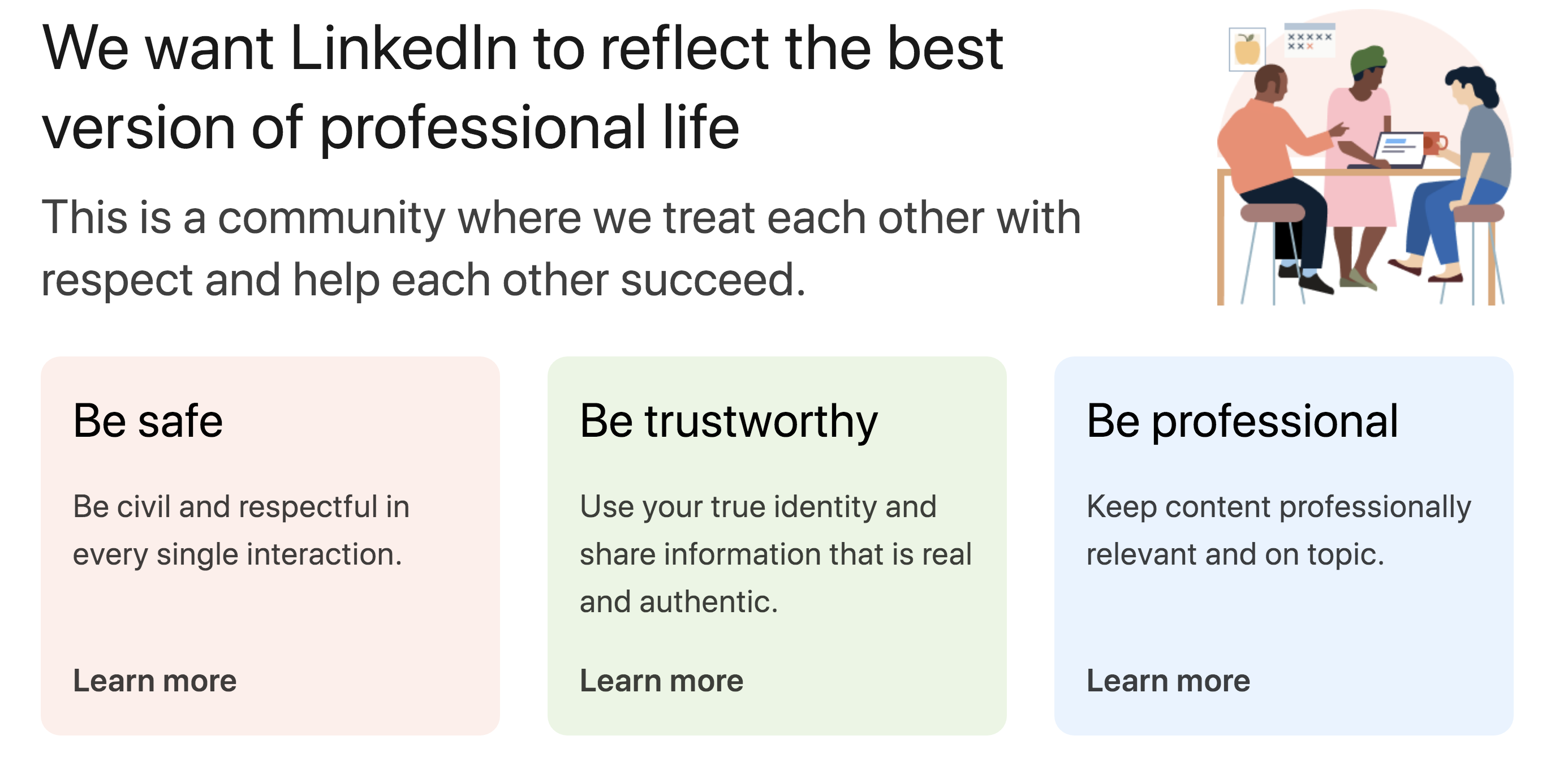
LinkedIn’s Learning Center does a great job explaining their ground rules. Here’s a taste:

Screen Shot 2021-11-12 at 4.53.48 PM

Hey Zuckerberg, Dorsey, et al., here’s a fourth “Be”. Be like LinkedIn.


Help Me Understand

Why do people engage in political debate on Facebook and other social media? Has anyone ever changed their party affiliation or political thinking more generally because someone on social media convinced them to?

It seems utterly ill-suited for meaningful political discussion. Bumper stickers probably are a more effectual means of political persuasion.

Why Do We Social Media?

One of our next-door neighbors doesn’t talk to the GalPal and me. I understand her not talking to me, but the GalPal, come on, she is as friendly as they come.

The couple who sold to us told us that would be the case, which helps not taking it personally. But man, it’s odd. Especially when Ms. NextDoor posts on-line about ordinary, face-to-face stuff. For example, this weekend she broadcasted to the whole neighborhood, plus surrounding ones I think, that her college aged sons were temporarily moving home, as well as other extended family, so she wanted everyone to know more cars will be coming and going. The kind of thing you’d say when bumping into a neighbor on a walk.

But so far, 4.5 years in, I’ve never seen her take a walk. But what do I know, maybe she has a treadmill in her crib and is running 10 miles a day. But I digress.

Alas, I prob have a log in my own eye. I just left a comment on a Facebook Group page called “Saving Guilford College”, the small Quaker liberal arts college in Greensboro, NC where I taught previously. I wrote the following in response to a post from a woman about her deceased husband, my former colleague. She wrote that when he was near death in the hospital he said, “Guilford College killed me.” That got my hackles up. So obviously a delicate sitch. You can decide for yourself how well I balanced respect for her and her family with my frustration at his lack of personal responsibility.

“I was a down-the-hall colleague of Bill’s from 93-98 (Education Studies). He was always super nice and clearly good at what he did. I’m very sorry he didn’t get to enjoy a post-work life with you and the rest of your family. However, respectfully, I don’t understand his contention that Guilford killed him. College professors have lots of autonomy over exactly how hard they work and for how long.”

Was that a wise investment of time? Did I make the world a better place by getting that off my chest? No and no, and yet, I couldn’t help myself. My excuse is I’m supposed to be reading students’ papers today which always gives rise to world class procrastinating. And yes, I’ve already vacuumed. 

Now I’m afraid to open FaceBook to see the probable backlash. What’s keeping me from quitting Facebook? 

Coffee Is For Closers Only

Most writers, like recreational runners hitting the wall, don’t pace themselves. As a result, they shortchange their readers with uninspiring conclusions.

Evan Osnos, in his lengthy New Yorker expose on Facebook provides us writing mortals with a tour de force example on how to close. Dig his last three pgraphs. So good, let’s take them one at a time beginning with the third to last:

“The caricature of Zuckerberg is that of an automaton with little regard for the human dimensions of his work. The truth is something else: he decided long ago that no historical change is painless. Like Augustus, he is at peace with his trade-offs. Between speech and truth, he chose speech. Between speed and perfection, he chose speed. Between scale and safety, he chose scale. His life thus far has convinced him that he can solve “problem after problem after problem,” no matter the howling from the public it may cause.”

He saves a key insight to the very end—conventional wisdom on Zuckerberg is wrong. Then the Augustus reference reminds the reader of Zuckerberg’s fascination with Roman history nicely explained in the body. Then the three brilliant “Between” sentences which beautifully summarize the three tensions that weave throughout the piece. Then Osnos uses a few of Zuckerberg’s own words to thoughtfully wrap the pgraph.

The penultimate one:

“At a certain point, the habits of mind that served Zuckerberg well on his ascent will start to work against him. To avoid further crises, he will have to embrace the fact that he’s now a protector of the peace, not a disrupter of it. Facebook’s colossal power of persuasion has delivered fortune but also peril. Like it or not, Zuckerberg is a gatekeeper. The era when Facebook could learn by doing, and fix the mistakes later, is over. The costs are too high, and idealism is not a defense against negligence.”

Again, a wonderful payoff for sticking with Osnos to the end, another astute insight about “habits of mind” and the difference between growing a new business and leading a mature one. Instead of a mechanical “tell them what you told them”, Osnos leaves the reader thinking even more deeply. Will Zuckerberg be able to make the pivot Osnos so convincingly argues he must? That question gives the piece a stickiness that a typical “let’s just end this” conclusion never does.

And the last:

“In some sense, the “Mark Zuckerberg production”—as he called Facebook in its early years—has only just begun. Zuckerberg is not yet thirty-five, and the ambition with which he built his empire could well be directed toward shoring up his company, his country, and his name. The question is not whether Zuckerberg has the power to fix Facebook but whether he has the will; whether he will kick people out of his office—with the gusto that he once mustered for the pivot to mobile—if they don’t bring him ideas for preventing violence in Myanmar, or protecting privacy, or mitigating the toxicity of social media. He succeeded, long ago, in making Facebook great. The challenge before him now is to make it good.”

Whew, where to start? A vivid reminder that Zuckerberg and Facebook are in their very early years. Anything is possible. And again, respecting his readers’ intellect by leaving things open-ended, a question, does he have the will? There’s no hand holding, every reader will come to their own conclusion. The “pivot to mobile” phrase is a reminder from the body of the time period when Zuckerberg only took meetings with people if their proposals included ways to grow Facebook on mobile devices. Osnos cleverly uses that anecdote to remind the reader one last time of tremendous challenges facing Zuckerberg. And then the final sentence, which again, leaves the reader wondering, can he make it good.

Give the man a cup of coffee.

Postscript: Not a flattering portrait of Zuckerberg and FB. Increasingly, I wonder, why don’t I delete my FB account?

How Does a Racist Become School Superintendent?

I really do not understand.

Given United States history, after the National Football League Houston Texans’ loss Sunday, it’s no surprise at all that a white fan said, “You can’t count on a black quarterback.”

But it’s surprising and sad that the fan is a school superintendent of a Texas school district with 1,020 children. Also, that when criticized, one of his first instincts was to rationalize his racist thought by saying he was referring to the statistical success of black NFL quarterbacks. “Over the history of the NFL,” the superintendent said, “they have had limited success.”

Oh, okay then, you’re just making an objective statement of fact. If there’s no problem though, why did the superintendent add that he hopes none of the district’s students saw the post?

Is it because the brown and black students and their families might view it as further evidence that equal educational opportunity is a mirage when the top educational official, the one responsible for hiring principals, determining curriculum, and setting the overall tone, doesn’t truly trust them or their guardians?

Educational leadership requires school janitors, office staff, teacher aides, teachers, principals, and superintendents to understand that. . .

  • the history of the United States has resulted in a still lingering institutional racism which makes it more difficult for students/people of color to succeed
  • people routinely succumb to negative assumptions about people of color, including students, based upon woefully, inadequate firsthand experience in diverse communities
  • educators have to be extra conscious of holding historically marginalized students in unconditional positive regard trusting they are en route to becoming young adults that will powerfully defy people’s negative, and too often, racist assumptions
  • students are equals in every way, including intellectually, some just require more support than others to achieve their particular academic and personal objectives

How the hell does a person who doesn’t think you can trust quarterbacks with particular skin pigmentation ever succeed in becoming a teacher, let alone a school building leader and then superintendent? Time after time he was vetted and deemed the best candidate for the job. What does that say about the quality of public schooling in Texas?

Also important to note, the superintendent said that he has not faced any repercussions from the post as of Monday afternoon. No public rebuke. No suspension. No diversity training.

What are the odds the School Board provides the necessary leadership to right this wrong? My guess. About the same as The Texans tapping the superintendent to take over at quarterback.

Yes he’s old, pudgy, and slower than molasses, but very trustworthy.

Update.

Wednesday Assorted Links

1. Jordan Spieth laughs off “very British” haircut. Dude seems totally unaffected by his fame. Personable and grounded. Now if he can just get the flat stick heated up again.

2. Don’t ban scooters. Redesign streets. Related, I want one of these (the Plus to be specific).

3. No more free food for Facebook employees. Hope they are alright.

4. They don’t own homes. They don’t have kids. Why Millennials are plant addicts.

“Everyone made fun of me because I was sleeping on an air mattress and buying plants. But having living things to care for soothed me.”

“They don’t come in and buy $300 pots unless they are actors. They buy a lot of succulents, hanging plants and airplants.”

What the hell is an airplant?

5. 1 Hen, 76 Ducklings. Call me old fashioned, but I think if you’re going to have a baby, you should take care of it yourself.

In Praise of Digital Minimalism

I just spent five days* cycling on some of Central Oregon’s most beautiful roadways and I don’t have a single picture to show for it. Mount Bachelor and the surrounding mountain lakes were spectacular, as was the Prineville Resevoir, Paulina Lake, and McKenzie Pass.

I wish I had taken a few, but three things conspired against my picture taking—limited jersey pocket space, riding most of it at a very brisk pace, and a reaction against camera happy people who fail to live in the moment because they’re preoccupied with capturing “the moment” for other people and future reference.

I always marveled at the phalanx of parent poparazzi** at my children’s athletic competitions, artistic performances, and graduations. I wanted to ask what’s it like trying to organize all of those images? And even more perplexing, I wondered when exactly they planned on breaking out the 7th grade piano recital video? At halftime of the Superbowl when all of their friends are huddled in front of their television? “Hey, want to watch something even better than Beyonce?!”

In the interest of quality over quantity, computer sanity, and realistically accessing images with some regularity, I’m considering a limit on my digital images. No more than 500. That would make at least one of my daughter’s nauseous. Yes, I’ve heard of the cloud, but what good does it do to have tens of thousands of images or hours upon hours of video if you hardly ever make the time to access more than a tiny fraction of your digital library?

On Saturday, I’m looking forward to attending my eldest’s college graduation in Minnesota. I’ll probably be the only guy not taking pictures or filming for future reference. Why? Because I want to be fully present and I’ll be surrounded by family and friend fotogs***. I will ride their digital coattails just like you can view the ride I took Sunday up and over McKenzie Pass if you click the link in the opening paragraph. The YouTube video shows you some of the fantastic video looping in my head tonight.

* actually four days—I swam, ate, napped, and ate one day while the rest of the gang rode another 100 miles

** damn, that may be my best use of alliteration ever, thank you very much

*** I know how to spell photog, it’s just that sometimes my genius for alliteration gets the best of me