Weekend Assorted Links

1. The Quick Therapy That Actually Works. Referred to as “microtherapy”.

“Effective solutions are crucial because Americans—stressed out, lonely, and ghosted by Tinder dates—are in desperate need of someone to talk to. The data suggest that most of the Americans who have a mental illness aren’t receiving treatment. About 30 percent of psychotherapists don’t take insurance. Quick interventions offer ‘something, when the alternative is nothing.'”

Research findings are hopeful, but skepticism is understandable.

“Lynn Bufka, a psychologist with the American Psychological Association, says that these types of brief interventions could be just a first step toward the treatment of various mental-health woes. They might be enough for some people, while others go on to get more intensive therapy. But. . . for more severe issues, such as bipolar disorder and major depression, a quick dose of therapy is unlikely to be enough. ‘These kinds of interventions are probably more likely to be beneficial before full-blown symptoms or disorders have developed.'”

2. An Echo Dot in Every Dorm Room.

“If students can’t or don’t want to spend money on their own smart speaker, Saint Louis University’s Echo Dots offer a way to bring voice assistants into the dorm without any added cost to the student, since the project went through the capital funding process and wasn’t funded by tuition increases.”

I’m calling bullshit on this. There is an opportunity cost. Money that is being directed to Echo Dots is money not being spent on something else like physical plant maintenance and that money for physical plant maintenance will come from students. I’m also very wary of the wholesale adoption of any technology. Maybe my thinking will change, but right now, if I were an SLU student, I would not want an Echo Dot.

3. The worrying future of Greece’s most Instagrammable island.

A Greek-American who has lived in Santorini for 12 years laments:

“‘People treat churches like selfie studios. There’s one in front of my house and people used to ring the bell every three minutes or climb up on the roof for their fake wedding shoots. I’d get woken up at 6am by people traipsing across my terrace.” His frustration at the crowds has led him to start hanging ‘respect’ signs around Oia that state ‘it’s your holiday… but it’s our home’.”

As if that’s not enough.

“The constant building and flood of tourists create tons of rubbish, which is all dumped illegally. Santorini still has no proper waste-management facilities, so all the empty water bottles, coffee cups and restaurant leftovers go into a huge dump which doesn’t meet EUregulations. Leakage is free to infect the surrounding earth, water and air.”

Alexa, find me someplace free of deranged photographers.

4. The Mistrust of Opposite-Sex Friendships.

The headline is misleading since the focus is on opposite-sex best friends.

This makes sense to me:

“Alexandra Solomon, an assistant psychology professor at Northwestern University and the instructor of the university’s Marriage 101 course. . . wonders whether the correlation between negative attitudes toward opposite-sex friendships and negative or violent expressions of jealousy could be due to participants’ personal beliefs about gender roles.

It speaks to a bit of a rigid, dichotomous way of thinking—I suspect there’s a layer in there about how much [the subjects] endorse traditional gender roles. . . . A woman with more traditional ideas about gender might feel threatened by her boyfriend’s female best friend because. . . ‘she may have this idea that I ought to be your one and only, and I ought to be able to meet all your needs. If you love me, then you’ll only turn to me.‘ A man with similarly rigid or traditional ideas about gender roles, she added, might feel territorial or possessive, as though his female partner belongs to him and only him.”

The more important, relevant question is about the potential for opposite-sex friendship more generally. I’ve long been intrigued by the tendency of friends to congregate in same sex circles at social gatherings. Even opposite-sex friendships of multiple decades seem relatively superficial. Opposite-sex friends seem to bump up against an invisible wall as if friendship is a zero-sum game. It’s that wall that intrigues me the most. More specifically, why the wall?

5. Waze Hijacked L.A. in the Name of Convenience. Can Anyone Put the Genie Back in the Bottle?

This was a hard read. Seemingly, my favorite app has no regard for the common good.

6. Elizabeth Warren Is Attracting More Supporters and More Media Attention.

An easy read. :)

Over Parenting

Parents, grandparents, and guardians of infants and young children cannot dedicate themselves enough to children’s well-being. Especially during the first ten years of life, every hour spent conversing with children; playing with them; helping them learn to enjoy sports, arts, and school tends to pay positive dividends later when they blossom into respectful, thoughtful, kind, independent, self-confident young adults.

But I’m not sure how to square that hypothesis with the fact that an increasing number of adolescents are suffering in silence with not just anxiety disorders and depression, but suicide, because many loving parents, grandparents, and guardians invest time and energy in those same silent sufferers.

As many are quick to point out, one thing that’s different these days is the pervasive influence of social media. The most shocking related statistic I learned lately is that 40 percent of teens say they use a device within five minutes of going to sleep, 36 percent admit to waking up to check a device, and 32 percent say they use a device within five minutes of waking up.

For parents the numbers are 26, 23, and 23.

If tonight Steve Kerr tweets that I’m needed in Golden State’s backcourt, or the Royal Swedish Academy of Sciences tweets that I’ve won the Nobel Peace Prize, I’m sorry, I’m not waking up. I know, sleeping straight through the night, how old fashion can I get?

To point to social media as the single most important variable is too simplistic. When it comes to something as complex as parenting and adolescent development, differences over time have to be multi-causal. So what else might explain what’s different today? Or to ask the same question differently, when it comes to raising relatively happy and mentally healthy young adults, what did my parents’ generation tend to get more correct?

I think the answer lies in one thing I notice about parenting today. Many super involved parents of young children seem wholly unable to disengage from their children’s lives as they move through adolescence into adulthood. More simply, compared to their parents, they stay way too involved, way too long. Having dedicated themselves so much early on, it’s as if they can’t help themselves. But somewhere between ages ten and twenty, parent involvement reaches a point of diminishing returns.

Many modern parents don’t realize that too much involvement can convey a lack of trust in young people’s abilities to learn from their mistakes and gradually become independent. Just yesterday, after some unsolicited advice, Youngest, who is building a photography business said to me, “And dad, I’m going to make mistakes because I’m new at this.”

I believe over parenting is contributing to an unhealthy, prolonged, co-dependence between parents and children. I have no idea how to restore some semblance of balance.

How about you?

Weekend Assorted Links

1. Tour du Rwanda? Click on the “continue reading” link to be transported to Central Africa.

2. My mom, who died four years ago today, liked to say, “Variety is the spice of life.” Apparently, not everyone agrees. Related, dad was a serious PB&J guy.

3. As Students Struggle With Stress and Depression, Colleges Act as Counselors. One reason tuition continues to rise much faster than inflation.

4. Is this the answer to my terrible, no good, awful commute?

5. I know some Specific Northwest Pressing Pausers who make regular trips to the Swamp. Instead of exacerbating climate change, maybe they should consider this.

6. Why some parents pay bribes to get their kids into more selective colleges.

I Was Wrong

No, not about how to properly load the dishwasher, I’m very right about that.

I was wrong about the merits of Positive Psychology, a newish subfield of psychology dedicated to the study of happiness or “subjective well-being”. When I read the literature, I believed it was based upon solid social science. Ruth Whippman taught me otherwise.

As referenced in Michael Schien’s subtly titled Forbes piece, “Positive Psychology is Garbage”, Barbara Ehrenreich does the same in her book Bright-Sided: How Positive Thinking Is Undermining America.

Writing in Forbes, Schien explains Seligman’s success, the pseudo-intellectual founder of the movement:

“When describing his concepts, Seligman uses big words about statistics, mathematical equations, and empirical data. For most of us, this serves as the equivalent of a doctor’s white coat—it seems authoritative, so we don’t question it.”

Guilty as charged. Later, he adds:

“It’s a lesson you would do well to follow. When trying to get people to pay you for your ideas, present them in terms that have the whiff of science whenever possible. Equations. Data. Statistical analysis. Remember, it’s not that the science itself actually matters, it’s the appearance of science that counts.”

I’m left believing happiness is partly the result of being born to happy parents. Other things that tip the balance from despair to joy include a good night’s sleep, a few close friends, healthy food, sunshine, art, physical activity, and socially redeeming work.

But without equations, data, and statistical analysis, I don’t expect anyone to pay my list any attention.

One Surefire Way to Improve Mental Health

Jean M. Twenge, a San Diego State University psychology professor, argues that smart phones are contributing to Millennial’s worsening mental health. The data is concerning.

Here’s her Atlantic essay (hyperbolically) titled “Have Smartphones Ruined a Generation” and here’s an interview with her from yesterday’s PBS NewsHour.

In summary, the less tethered young people are to their phones, the better their mental health.

What Distinguishes Our Species

This NY Times opinion piece is going to be very widely read and much discussed. Of the many interesting points:

While most people tend to be optimistic, those suffering from depression and anxiety have a bleak view of the future — and that in fact seems to be the chief cause of their problems, not their past traumas nor their view of the present. While traumas do have a lasting impact, most people actually emerge stronger afterward. Others continue struggling because they over-predict failure and rejection. Studies have shown depressed people are distinguished from the norm by their tendency to imagine fewer positive scenarios while overestimating future risks.


Maybe Our Most Perfect Drug

Lots of people are seeing therapists and taking meds to combat anxiety disorders and depression. Stacy Horn suggests a much less expensive alternative, join a choir. She explains:

. . . as science works to explain what every singer already knows, no matter where you fall on the voice suckage scale—sing. I know of no other activity that gives so much and is this eminently affordable and accessible: Just show up for choir practice. Singing might be our most perfect drug; the ultimate mood regulator, lowering rates of anxiety, depression and loneliness, while at the same time amplifying happiness and joy, with no discernible, unpleasant side effects. The nerds and the church people had it right.

In high school, following the lead of some close friends, I sang in a large Lutheran youth choir. We toured for two weeks each summer, wowing Lutheran congregations all over the fruited plains. One summer at Indiana University in Bloomington, we even won a large national competition. But, as any Lord’s Joyful alum will tell you, no thanks to me. When you look up “voice suckage” in the urban dictionary, you see my larynx. Little known fact. Kool Herc, Kurtis Blow, and The Sugarhill Gang started rapping in the late 70s so that I’d have an alternative to singing.

Horn earns my enduring affection with this confession:

One of my main goals in our weekly rehearsals is not being heard. Over the years I’ve become a master in the art of voice camouflage, perfecting a cunning combination of seat choice, head tilt, and volume.

As they liked to say on The Wire, I feel you!

My alternative drugs of choice, by which I mean social activities that help me maintain some semblance of mental health, are swimming, cycling, and running with friends.

The GalPal and I recently enjoyed catching up with old friends from the state that just decided to stop paying teachers extra for Masters degrees. One whom struggled with depression recently. Her most perfect drug? Caring for and riding a horse. Almost daily. At first glance, this activity isn’t as social as the others, but in fact, our friend always looks forward to seeing the same few horse owners at the medium-sized, community-based barn. A couple of times a week, after grooming and riding their horses, they cross the street to a golf course restaurant where they eat and visit. Her mental health in tact for another day.

Reduce anxiety and depression without therapy or meds. Follow Horn’s advice and join a community choir. Or follow my lead and swim, cycle, run, hike, or walk with another person. Or if you can afford it, horse around with friends. You feel me?

imgres

Me at my last concert performance

A Panacea for Improved Health

I have a neighbor who makes money off of his car. He carefully shops for an underpriced used one, then takes immaculate care of it, and then gets reimbursed by his employer at 50+ cents per mile.

I admire his fiscal discipline, but who wants to spend their weekend washing their car the way he does? One time he yelled at another neighbor who was washing the bottom 90% of her van. “You gotta start with the roof and work down!” Best comeback ever, “No one’s gonna see the top!” Blood pressure spike. And he routinely rips me for using the last bit of dirty water in the bucket to wash my wheels, but I tell him my goal is for my car to be 90% as clean as his in 10% of the time. And normally it is.

We’re all obsessive about something. One could argue I substitute exercise for car washing. Last week was pretty typical for April. Four runs for 28.7 total miles. Two swims for 6,000 meters and two bike rides for 90 miles. And an hour lifting weights. Total time, 11-12 hours. People like me tend to have a lot of fitness activity-based friendships and we often find the swimming, cycling, and running enjoyable in and of itself. We’d still go out and run, swim, and cycle even if there weren’t empirical health benefits tied to those activities. We’re lucky that our hobbies come with health benefits.

Some people no doubt think about my commitment to fitness the same way I think about people who obsess about the stock market’s every move and spend their days thinking, talking, and writing about money. There’s an opportunity cost to finance tunnel vision. Life passes by. Investing wisely is a means towards other more meaningful ends—like learning about other people’s interests and engaging with them.

Like extreme car washing, there’s a tipping point where a person’s fitness routine can detract from their physical, emotional, and spiritual health. That’s where “Doc Mike Evans” comes in. He asks a great question near the end of this high-speed informative whiteboard lecture—Can you limit your sleeping and sitting to just 23.5 hours a day? 

Like my quicker, more casual approach to car washing, Doc Evans explains how you can achieve most of my health benefits in much less time. Walk 20-30 minutes a day. Even better if you integrate walking as a means of transportation by living within a mile of your work, a grocery store, and other stores. And of course driving less is good for your pocketbook and the environment too.

Forget my approach of driving to the pool and overdoing it in the form of occasional marathons and triathlons*. Instead, as Doc Evans advises, walk 20-30 minutes a day and enjoy markedly improved mental and physical health.

Maybe you’re already a walker, but wish there were even more tangible health benefits. Evans explains how you can reap additional benefits by extending the time and distance of your daily walks. But since time is most people’s greatest obstacle, I suggest picking up the intensity by choosing more hilly routes. My running teammates probably get tired of me saying, “The hills are our friends.” When I don’t feel like exerting myself much, which is a lot of the time, I sometimes commit to a hilly route because hills force me to increase the intensity. As an added benefit, when I’m running up hill, my conservative Republican Nutter friends don’t have enough oxygen to complain about the current political scene. If you’re a Florida or Texas flatlander, move.

We expect complexity today, but this isn’t. If you want to enjoy an improved quality (and quantity) of life, take a ten minute walk sometime today. And then repeat tomorrow. And the next day. Extend it to twenty minutes next week. And repeat. Every day.

* This summer I’m going to be more family focused than last year. We’re looking forward to a fair number of visitors from afar, and at the end of the summer, launching Seventeen at a still-to-be-decided college. I’m #34 on the RAMROD waitlist which means I’ll definitely get in and Danny and I plan on running the Wonderland Trail in mid-August. I may throw in a few short/medium distance triathlons on unscheduled weekends. Or maybe I’ll just take a walk.

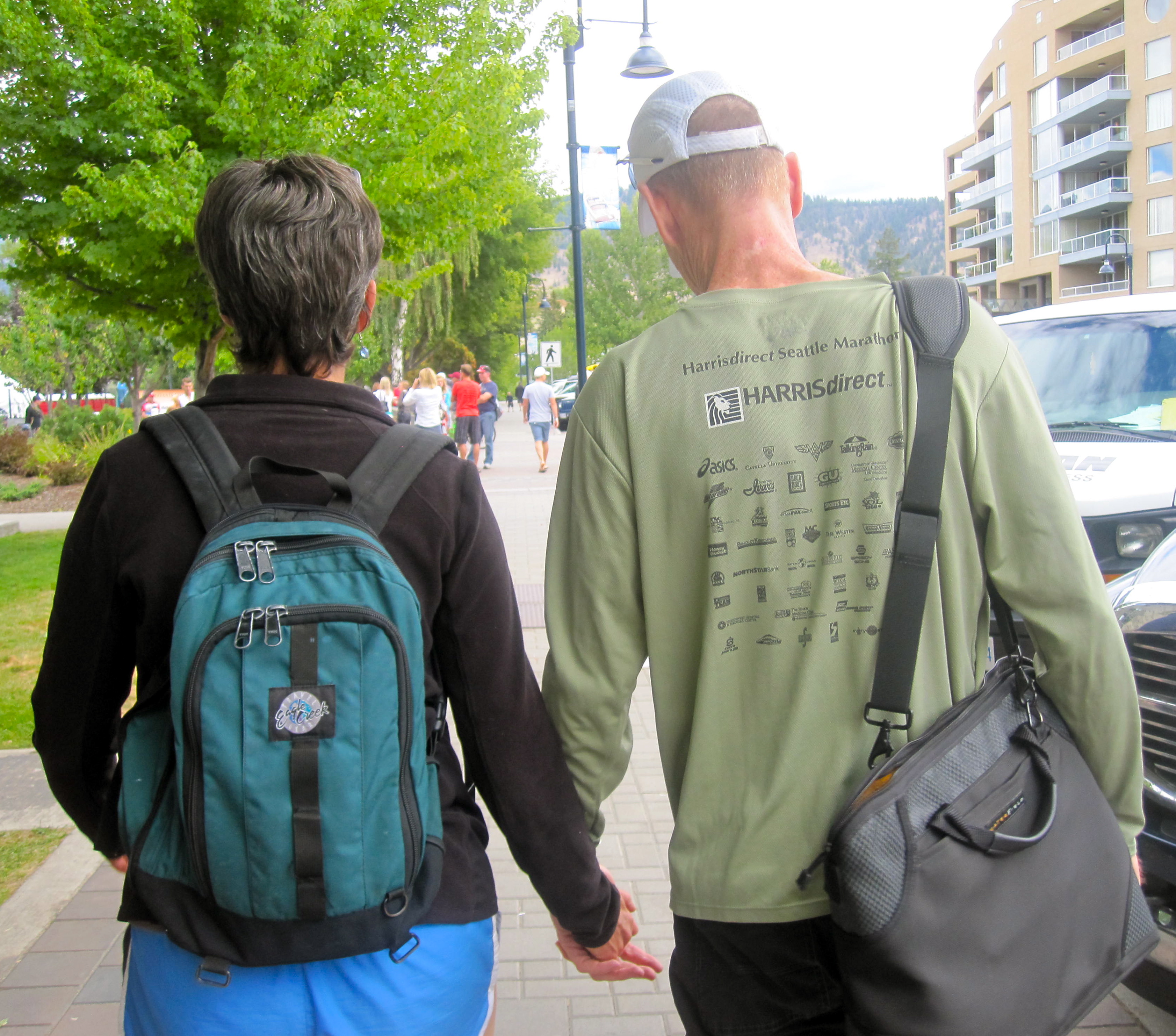
Betrothed and I walking

Amazing she’ll still hold hands with me after all these years

The Great National Happiness Rat Race

Just one of many money phrases, sentences, and paragraphs from a recent NYTimes blog post by Ruth Whippman, a Brit living in California. Whippman beautifully articulates what I’ve long thought. She leads with an Eric Hoffer quote, “The search for happiness is one of the chief sources of unhappiness.”

Notable nuggets:

Despite being the richest nation on earth, the United States is, according to the World Health Organization, by a wide margin, also the most anxious, with nearly a third of Americans likely to suffer from an anxiety problem in their lifetime. America’s precocious levels of anxiety are not just happening in spite of the great national happiness rat race, but also perhaps, because of it.

Thomas Jefferson knew what he was doing when he wrote that “pursuit of happiness” line, a perfectly delivered slap in the face to his joy-shunning oppressors across the pond. The British are generally uncomfortable around the subject, and as a rule, don’t subscribe to the happy-ever-after. It’s not that we don’t want to be happy, it just seems somehow embarrassing to discuss it, and demeaning to chase it, like calling someone moments after a first date to ask them if they like you.

Evidence of this distinction is everywhere. Blindfold me and read out the Facebook statuses of my friends, without their names, and I will tell you which are American and which are British. Americans post links to inspirational stories, and parenting blogs packed with life lessons. (British parenting blogs tend to be packed with despair and feces.) My American friends post heartwarming messages of support to one another, and often themselves, while my British cohort’s updates are usually some variation on “This is rubbish.”

Even the recent grand spectacle of the London 2012 Olympic Games told this tale. The opening ceremony, traditionally a sparklefest of perkiness, was, with its suffragist and trade unionists, mainly a celebration of dissent, or put less grandly, complaint. Still, this back door approach to national pride propelled the English into a brief and unprecedented stint of joyous positivity — lasting for the exact duration of the Games. For three weeks I was unable to distinguish my British friends’ Facebook statuses from those of my American ones.

The transformation wasn’t absolute of course. . . . Our queen, despite the repeated presence of a stadium full of her subjects urging in song that she be both happy and glorious, could barely muster a smile, staring grimly through her eyeglasses and clutching her purse on her lap as if she might be mugged.

Cynicism is the British shtick. . . . By contrast, in America, happiness is work. Intense, nail-biting work, slogged out in motivational seminars and therapy sessions, meditation retreats and airport bookstores. For the left there’s yoga, for the right, there’s Jesus. For no one is there respite.

While the British way can be drainingly negative, the American approach to happiness can spur a debilitating anxiety. The initial sense of promise and hope is seductive, but it soon gives way to a nagging slow-burn feeling of inadequacy. Am I happy? Happy enough? As happy as everyone else? Could I be doing more about it? Even basic contentment feels like failure when pitched against capital-H Happiness. The goal is so elusive and hard to define, it’s impossible to pinpoint when it’s even been achieved — a recipe for neurosis.

Happiness should be serendipitous, a by-product of a life well lived, and pursuing it in a vacuum doesn’t really work. This is borne out by a series of slightly depressing statistics. The most likely customer of a self-help book is a person who has bought another self-help book in the last 18 months. . . . Every year, with remarkable consistency, around 33 percent of Americans report that they are “very happy.” It’s a fair chunk, but a figure that remains surprisingly constant, untouched by the uptick in Eastern meditation or evangelical Christianity, by Tony Robbins or Gretchen Rubin or attachment parenting. For all the effort Americans are putting into happiness, they are not getting any happier. It is not surprising, then, that the search itself has become a source of anxiety.

So here’s a bumper sticker: despite the glorious weather and spectacular landscape, the people of California are probably less happy and more anxious than the people of Grimsby. So they may as well stop trying so hard.