The Winter Of Grief II

My mom was 64 years 10 months old when my dad died from a heart attack while driving to work in Tampa, FL.

I’m 63 years 10 months old.

I wish I could go back in time and interact with my mom with the wisdom gained from what I am experiencing. It’s not that I wasn’t compassionate, it’s just that my compassion would be on a whole different level.

One painful insight that I’d bring to our relationship is the knowledge of how the person’s life lingers and how the trail they left offers constant memories which both deepen and lengthen the grief.

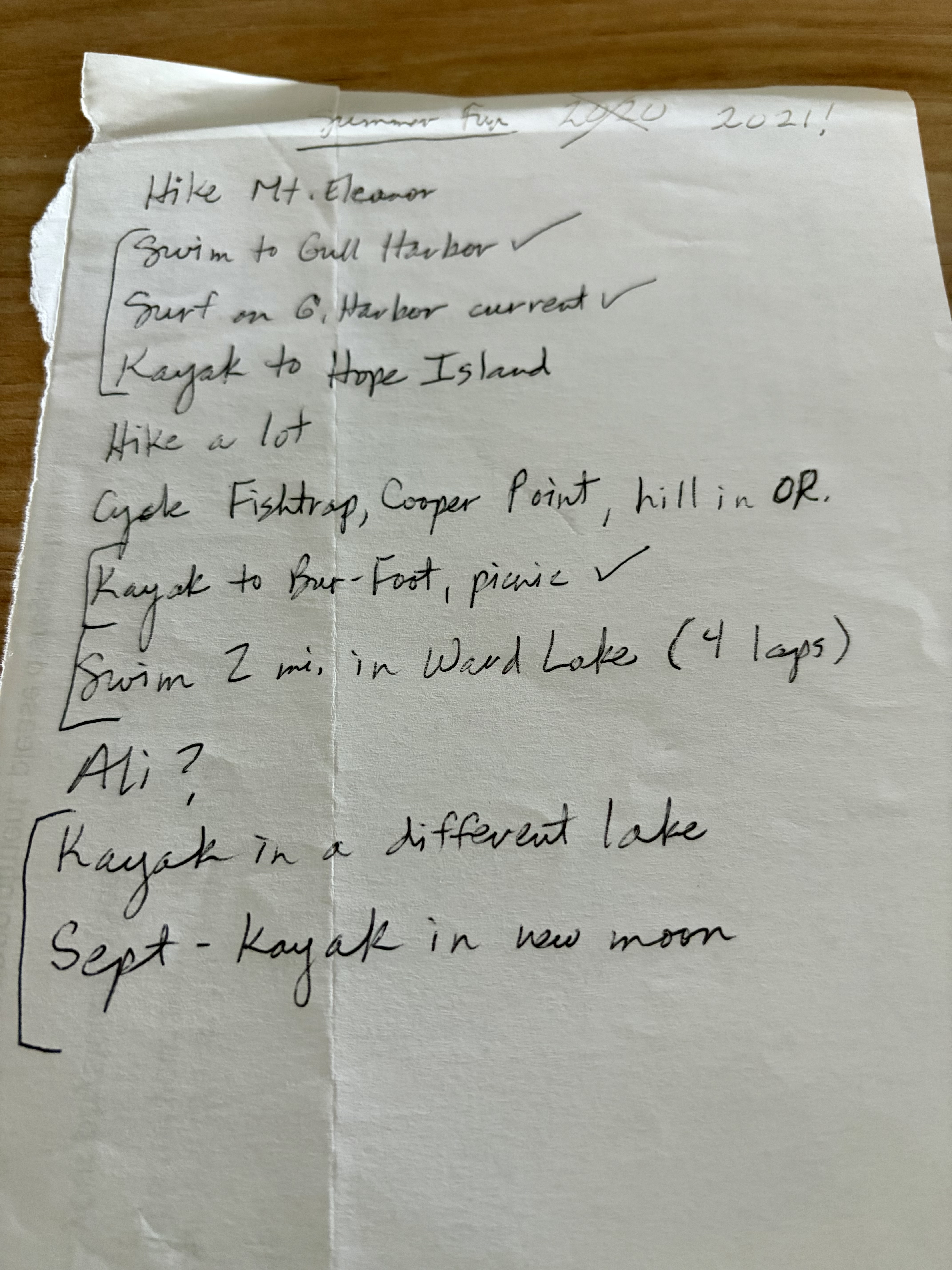
For example, today, after visiting Lynn I went through her collection of papers and books from the last few years. A literary tower balancing precariously on the piano bench.

And I stumbled across the attached picture. The crossed out “2020” speaks to some procrastinating, but I love how dang aspirational her list was. Ward Lake laps, haha. The “Oregon hill” is McKenzie Pass which I raved to her about after each of my ascents.

“Surf in Gull Harbor current” meant kayaking to the mouth of the harbor then riding the current into the harbor. Sometimes in the boat, sometimes not.

“Hike a lot” unchecked. “Hike Mt. Eleanor” unchecked. Fuck, why didn’t we go on more hikes?

The wisest thing anyone has said to me during this ordeal was a hospice chaplain who said don’t focus so much on Lynn’s mortality that you ignore your own. That was piercing. And stuck.

I wonder, what if things were reversed and Lynn had to interact with my material wake. Would she take the seven iron out of my golf bag and hold the grip seeking some sort of cosmic connection? Yeah, I think she prob would.

Here’s what I think about my own mortality. Lynn had just over four years left when she cobbled together her “Summer Fun” list. I’m guessing she assumed she had more than four summers left. I know I did.

I do not want to save up for the future, to put things off, to assume a long, healthy future.

One of the simplest ways I’m doing that may seem silly. These days, my uniform is t-shirts and jeans. I have about 10 t-shirts, some that I like to wear more than others. And I have one fave, that I used to reach for and then stop and say to myself, “I should save that for next time.” Now, I look for it and wear it whenever it’s clean. Because of Lynn.

Without being morbid, take your mortality seriously. Don’t wait. Hike. Cycle. Be on or in the water. In your favorite t-shirt.

Two Worlds

Public and private. All of us behave a little or a lot differently whether we’re in public or not. In extreme cases, people live “double lives”.

The dichotomy between Lynn’s public life, by which I mean when friends and family visit, and private one, where I’m the only person around, is so glaring that it got me thinking.

Specifically, I’ve been pondering why she’s not just okay when friends and family are around, but especially smiley (and today, extremely giggly) and physically better than normal. There’s a wonderful lightness. I guess it makes sense learning what we’re learning about the importance of close interpersonal relationships to our overall health and well-being.

But man, the whiplash that comes when friends and family leave is intense. And disorienting.

When home alone she pops boosters between timed meds and her body is off and on, and when on, she’s bored, and she struggles with any sense of purpose. There’s a heaviness.

Why am I telling you this? Not sure. Maybe to help you mentally prep for this phenomenon if you’re ever a primary care giver. Or maybe I’m letting you in hoping for some sort of connection.

Last night, I had an epiphany. A tough one that I was hesitant to share with Lynn because I expected a negative/defensive reaction.

I told her I had an observation I wanted to share with her. “You have a restless spirit.” There, I said it. Fortunately, I was wrong, because she didn’t argue the point. She listened carefully as I told her I missed her, that it felt like all of her time and attention was taken fighting her Multiple Systems Atrophy. That there was no time or attention left for me.

That I felt more like an employee than best friend.

Most people confined to a wheelchair and unable to do hardly anything independently watch a lot of tv and read. Since Schitt’s Creek ended, Lynn doesn’t watch tv and her reading glasses, despite repeated trips to the optometrist, aren’t working well enough for her to read much.

Thus, when alone, if she’s feeling okay, she’s in constant motion searching for something to do. Anything to do. Or she’s laid out on the couch waiting for her meds to kick in. The only time she’s not on the move is when her body completely quits or she’s asleep.

Our convo, mostly about how dying is scary and spiritual malaise, deepened. She cried and said she didn’t know “I loved her that much”. I took in what I think was her deeper message, “I didn’t know I’m that lovable.” I told her lots and lots of people love her.

I told her I was having a hard time dealing with her restlessness and with her constant MSA fight. That caring for her took all my energy, that there was no leftover energy to just hang. And that it would be really sad to spend our final months or years together not really together.

Case in point. Saturday and Sunday nights I throw dinner together for the fam and then sit at the kitchen island with my own dinner while one or both daughters join their mom at the dining room table. Hell, during the week I do it too, leaving Lynn to eat by herself. Yeah, you’re right, I am a lowlife.

While I am a lowlife, I probably deserve a few points for being vulnerable and risking the convo. Sadly, in part, I risked it because soon we won’t be able to have back-and-forth conversations of that sort.

But not being especially centered myself these days, it’s really tough to take on her anxiety about dying, her exasperation at MSA’s relentless progression, and her general unease and utter restlessness. Especially given the cost that restlessness is taking on our friendship. For now.

Postscript: We ate dinner together. Afterwards, there was more slow dancing in the kitchen. The roller coaster keeps rolling.

Paragraph to Ponder

Via LOliver by way of JByrnes:

“There is so much to tend to, hold, be with, feel. May you find so much gentleness for your own process. May you let your humanity unfurl, over and over again. May the grief and hurt wrapped up in facing the world be held by your own willingness to look. May love soften the hard edges. May light soothe the dark places. May you return to your own heart’s knowing and trust what it whispers to you. May you let yourself do all of this so imperfectly, that imperfection a reminder that you are a human being, figuring it all out for the first time. I’m with you.”

Early evenings, like a lot of the time that I care for Lynn, I’m on the move. Making dinner, getting her fed, eating myself, doing dishes, cleaning the counters, taking out the trash, vacuuming the hardwood floor.

Activity blunts the grief. But I pressed pause Monday evening and it rushed in.

I stopped cleaning to dance. In the reflection of the oven, I saw the real dancer watching me. When I try dancing, she just smiles.

And now, the dancer pushes her wheelchair away from the table so that she can move toward the pretend dancer.

“You want to dance, don’t you?” Bigger smile. I expedite things by wheeling her into the kitchen. Where I help her up and embrace her. We slow dance like first-time junior highers slowly swaying back and forth.

But dammit, it’s The National singing “I Need My Girl”.

The refrain rips through. “I need my girl. I need my girl. I need my girl.”

My girl has no clue I’m crying.

May love soften the hard edges. May light soothe the dark places.

How Long Will We Slight The Social-Emotional Costs Of On-Line Learning?

Thursday, First Year Writing, The Morken Building 131, the first in-person class of the academic year. Students take turns summarizing their first papers about whether one needs, as a Stoic philosopher we read argues, a coherent philosophy of life and a “grand goal of living” to avoid squandering one’s life. They’re smart, so they push back at the suggestion one can neatly plan their life. They talk about some things being outside of our control, like viruses.

If not a coherent philosophy of life, what about guiding principles I wonder. And if so, which ones? They’re not quite ready for subtly, nuance, ambiguity, complexity. That’s why college is four years long. For now at least, I keep those thoughts to myself and just listen.

One student says her mother died in February. Not expecting that, I loose track of what follows, wondering how she died and what would it be like to lose your mom at 17 or 18. She says doing well in school doesn’t matter as much as it did previously.

The students, many who say they struggle with anxiety, have never enjoyed going to class more. Not because of the doofus facilitating things, because they’re famished for friendship. Flat out famished. They linger afterwards, partly to disinfect the tables, but mostly to extend our shared sense of normalcy as long as possible.

The student whose mother died walks up to the front to talk to me. Through my mask I thank her for having the courage to share that news and gently inquire about her mother’s passing. She tells me her mother chose “Death With Dignity” after a lifetime of being severely disabled. And she wanted me to know the paper was really challenging to write, but my sense was, not in a bad way, in an important way. I think it caused her to grieve her mother in a way she hadn’t. She ended up writing her mother a letter and using parts of it to begin her paper.

For those few moments, as her classmates slowly filed out of the room in small groups, she and I shared a human connection that superseded our teacher-student identities. I saw her and heard her in a way that’s utterly impossible on-line.

I am all in on the scientific consensus regarding masks, social distancing, maximizing time outdoors, and washing hands. I am comfortable enough returning to the classroom because my university has done an excellent job preparing for as safe as possible a return to in-person classes. I will not help politicize this public health crisis.

What follows is a non-partisan question, my reference point is the social-emotional health of young people.

If we don’t begin implementing “blended” or “hybrid” teaching methods soon, with at least some in-person instruction, what are the social and emotional costs to friendless students who are not being seen or heard in any kind of meaningful way?

Pivoting Towards Gratitude

Seventeen years ago I got an unexpected call at work. My 69 year old dad had died from a massive heart attack, in his car, at a red light, on his way to his office. Today, Mother Dear’s health is precarious.

My story isn’t unique because the cycle of life doesn’t discriminate. Baby boomers’ parents are dying every day. How do we avoid being overcome by grief?

My dad’s sudden, unforeseen death taught me important lessons. A few weeks afterwards I realized I had a stark choice to make. Should I continue being upset at the fact that he’d never get to know our daughters, that our friendship wouldn’t continue deepening, that my mom wouldn’t enjoy his company anymore, that a taken for granted future was cut short? Or should I be grateful that he was a great grandfather for a few years, that he was my father for 34 years, and that my mom and him spent fifty plus years together.

I chose to be grateful for the time we enjoyed together. “And,” as Robert Frost once wrote, “that has made all the difference.” In the short-term, this intentional pivoting towards gratitude doesn’t inoculate anyone from tremendous sadness. But it’s indispensable in avoiding longer term paralyzing grief.

On a Thanksgiving Day car trip, the conversation with Betrothed turned to our parents’ declining health. I shared this perspective with her and my related opinion that since our parents are in their early 80’s everything from here on in is “extra credit”. We’ve been blessed beyond belief to have them as parents. We won the lottery of life without having to buy tickets. We’re blessed to have a treasure trove of positive memories with them. We need to consciously choose gratitude by celebrating the quality and quantity of time we’ve enjoyed with them.

As a cyclist, I reminded the Good Wife that I run a real risk of getting hit and possibly killed by a drunk or distracted driver. I told her if I die at 52 or 62, I wanted something from her. I said, “Grieve with gusto. Be as sad as you want for a few weeks or months. But then consciously choose to be thankful for the three or four decades we spent together. For the fact that we met. For the specialness of our friendship. For the team we made. Our daughters (who may be younger or the same age I was when my dad suddenly died) will need that modeled for them. Show them how to choose gratitude.”

The Essential Dilemma of Human Intimacy

Oliver Burkeman’s The Antidote: Happiness for People Who Can’t Stand Positive Thinking, with its discussion of Stoicism, has me thinking about the Newtown parents. Burkeman and the heartbreaking portraits of the dead first graders. With their beautiful, innocent smiles, and future promise.

It’s difficult to imagine anything more difficult to overcome than a parent having to bury their six or seven year old child. Friends of ours watched helplessly for a year as their eight year old son died from leukemia. I tried to empathize, but probably failed to scratch the surface of their heartbreak.

The Newtown parents didn’t have any reason to take a little extra time the fateful morning of the shooting to be especially present and loving. One wonders, how will they survive the shooting? Right now, their sadness is bound to overwhelm ancient Greek wisdom and everyone’s best intentions. The best way to support them is to respect their privacy and make sure our representatives enact meaningful gun control.

But what if we shift things a bit to think about Stoicism and our lives, and the people we’re closest too, and their eventual deaths. And the essential dilemma of human intimacy—the closer and more meaningful the friendship, the greater one’s vulnerability, the greater one’s vulnerability, the more intense the pain upon death.

There is a way to minimize the probability of intense grief, keep friendships superficial. But who wants to compromise the quality of their life that way? So what are we to do? Being intimate and dependent upon others doesn’t mean we’re doomed to debilitating sadness upon each of our close friends’ or family members’ deaths.

The ancient Greeks wrote about the impermanence of everything and encouraged people to reflect on the worst things that could happen to them. The result being greater appreciation for their material well-being, their health, their work, and their family and friends. Taking time to think about worse case scenarios, or negative visualization, also mentally prepares one for inevitable changes in life, including especially sad ones such as the death of a loved one.

The ancient Greeks also emphasized living in the present, an “easier said than done” cliche if not developed more fully. Think about how different birthday celebrations might be if everyone committed to living more in the present. Instead of giving the birthday person gifts (kind of an odd practice if you think about it, “Hey congrats on being born!”), and asking him or her to make a wish for the upcoming year, the party would be a celebration of the previous year. The message being that life is fragile and isn’t it wonderful that we had another year to enjoy the birthday boy’s or girl’s friendship. Each person could reflect on the birthday person’s previous year and share what has been most memorable and what they most appreciate about them. And yes, of course we can keep the cake and ice cream.

My dad died suddenly at age 69. I was 33. I was devastated in part because it wasn’t until my mid 20’s that we started to understand and appreciate one another. I thought we had the luxury of time for our friendship to flourish. But shortly afterwards, I started to think like a Stoic before knowing anything about Stoicism. I realized I could be upset that our friendship didn’t get to mature or I could be thankful that we enjoyed a positive and more personal 5-10 years. I’ve chosen the later. And that decision informs the way I try to live. I want to love boldly, fully appreciate my friends and family, and celebrate each passing year as an undeserved gift.

My hope is that with the passing of time the Newtown parents can make a similar switch from understandable anger at the time they won’t get to spend with their sons and daughters to appreciating the six or seven years they did get with them.

That math and psychology will be tough. Godspeed Newtown parents.

imgres